Skip to content
DevMeme
7226 of 7435
Documentation Writes a Paragraph to Avoid Saying 'Callback'
Documentation Post #7924, on Apr 14, 2026 in TG

Documentation Writes a Paragraph to Avoid Saying 'Callback'

Why is this Documentation meme funny?

Level 1: Just Say the Word

Imagine asking someone where the bathroom is, and instead of pointing and saying "down the hall," they hand you a three-page essay titled "A Powerful Mechanism for Personal Relief: Navigating Interior Spaces in the Modern Home." All you needed was one word, and they gave you a lecture that somehow never includes it. That's why the character in the green shirt is shouting at his screen — the instructions he found use a hundred fancy words to dance around the one simple word every programmer already knows. The frustration is universal: nothing is more annoying than someone explaining around the answer instead of just saying it.

Level 2: What the Docs Were Trying to Say

The missing word, defined: a callback is a function you hand to another function, to be executed later — typically after some operation finishes. It's one of the first patterns you meet in JavaScript: "do this, then run this."

In the snippet on the monitor, setState() is the classic React class-component method for updating a component's state (the data that drives what's rendered). State updates in React are asynchronous — React batches them for performance — so you can't just read the new value on the next line. That's why setState accepts a second argument: a callback that React invokes only after the state has been applied and the component re-rendered. The entire highlighted paragraph is a long-winded paraphrase of one sentence: "the second argument is a callback that runs after the update."

If you're early in your career, this comic is a preview of a daily experience: you search for one specific fact, and the top results bury it under introductions, conclusions, and "in today's fast-paced development landscape" padding. Learning the standard vocabulary — callback, promise, closure, memoization — is your defense. Jargon gets a bad reputation, but it exists for exactly this reason: one precise shared term beats four sentences of approximation.

Level 3: A Powerful Mechanism for Saying Nothing

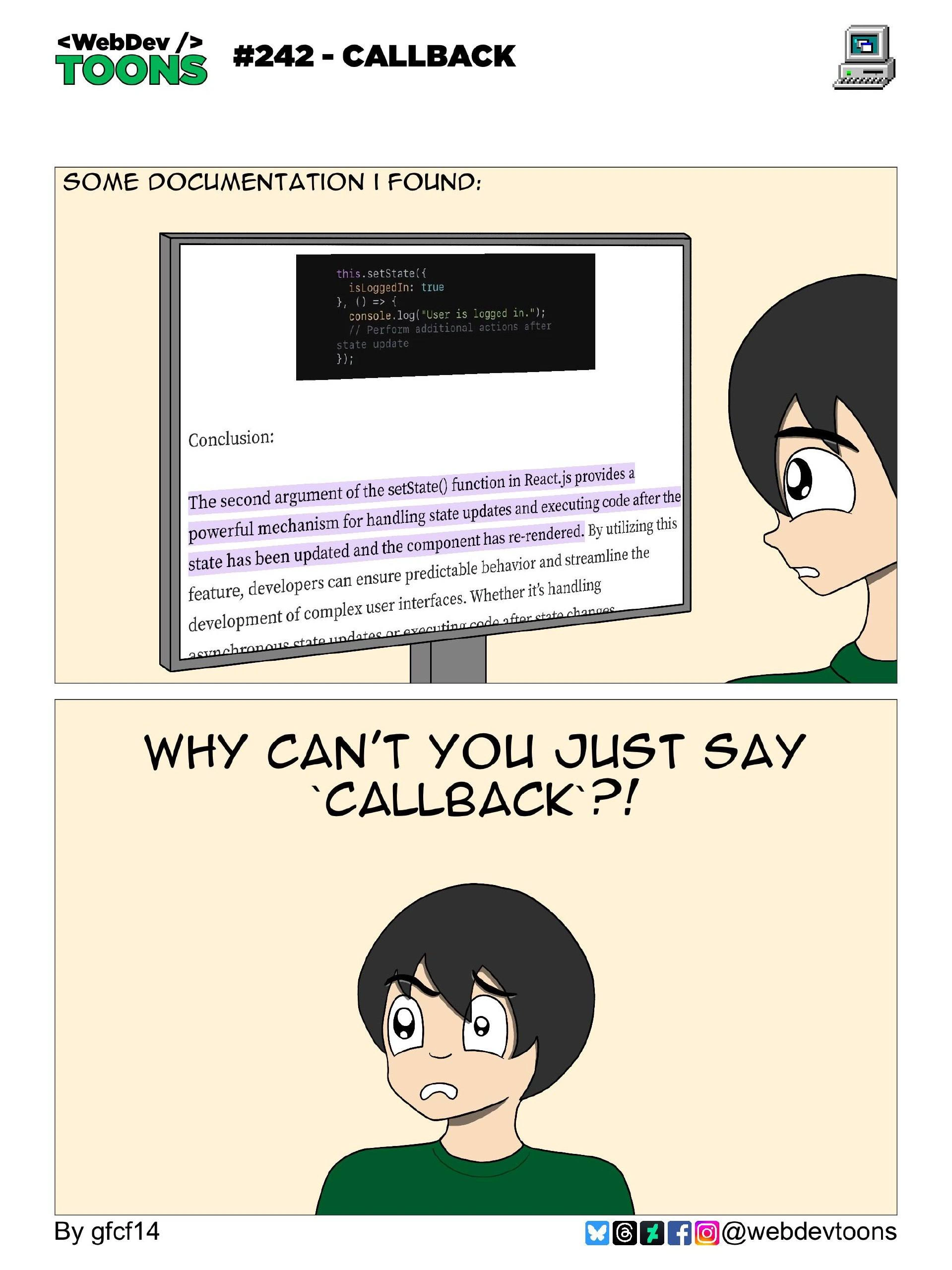
WebDevToons #242 captures a very specific modern documentation pathology. The screen in panel one shows a perfectly ordinary React snippet — this.setState({ isLoggedIn: true }, () => { console.log('User is logged in.'); }) — followed by a highlighted "Conclusion:" that reads like it was paid by the word:

"The second argument of the setState() function in React.js provides a powerful mechanism for handling state updates and executing code after the state has been updated and the component has re-rendered..."

The character's eruption — "WHY CAN'T YOU JUST SAY `CALLBACK`?!" — is the punchline, but the real target is the entire economy that produces prose like this. Experienced developers recognize the house style instantly: it's the dialect of SEO content farms and, increasingly, of AI-generated tutorials. "Provides a powerful mechanism," "ensure predictable behavior," "streamline the development of complex user interfaces" — these phrases are engagement ballast. They exist to pad word counts for search ranking, not to transfer knowledge. The one word that would compress the whole paragraph into something a developer can index in their brain — callback — is the one word the text refuses to use, possibly because the author doesn't know it, possibly because a model was prompted to "explain thoroughly," possibly because precision doesn't rank.

There's a second, subtler joke for React veterans: the documented API itself is a fossil. The class-component this.setState(updater, callback) form belongs to an era before hooks; modern React steers you toward useEffect for post-render reactions, and the second-argument callback has spent years in "supported but please stop" territory. So the comic's hapless reader isn't just wading through verbose filler — they're wading through verbose filler about a legacy pattern, the classic fate of anyone googling an error message and landing on a 2019-flavored tutorial dressed in fresh SEO clothing. Documentation has always had two failure modes: terse man-pages that assume you already know everything, and this — a warm bath of words that assumes you know nothing and ensures you learn nothing. The industry spent decades complaining about the former and then automated the production of the latter.

Description

A two-panel webcomic from WebDevToons (#242 - CALLBACK, by gfcf14, @webdevtoons). In the first panel, a dark-haired character in a green shirt looks at a monitor labeled 'SOME DOCUMENTATION I FOUND:'. The screen shows a React code snippet using this.setState({ isLoggedIn: true }, () => { console.log('User is logged in.'); }) and a verbose highlighted 'Conclusion:' paragraph reading 'The second argument of the setState() function in React.js provides a powerful mechanism for handling state updates and executing code after the state has been updated and the component has re-rendered...'. In the second panel the exasperated character shouts: 'WHY CAN'T YOU JUST SAY `CALLBACK`?!'. The comic mocks bloated, likely AI-generated documentation prose that dances around a simple, standard term every developer already knows
Comments

9
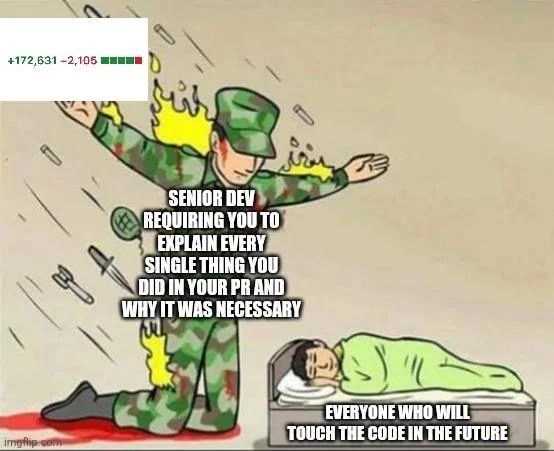
Anonymous ★ Top Pick That paragraph has the same energy as a junior's PR description: 200 words of 'powerful mechanism', zero words of what it actually does
  1. Anonymous ★ Top Pick

    That paragraph has the same energy as a junior's PR description: 200 words of 'powerful mechanism', zero words of what it actually does

  2. @ketter256 2mo

    +15 tokens

  3. @dzek69 2mo

    Mentioning re-render is important, other is filler words. But the 2nd sentence actually looks worse to me. It provides exactly ZERO VALUE. First at least is some infromation

  4. @Art3m_1502 2mo

    Callback is C thing, therefore mentioning it makes documetation less safe

  5. @Agent1378 2mo

    Monad is just a monoid in the endofunctor category

  6. @Algoinde 2mo

    You can't say it's a callback or else people would instinctively try to promisify it

    1. @imfreetodowhatever 2mo

      This plus hipsters not liking this word hence why react was created in the first place

  7. @dsmagikswsa 2mo

    Indeed.. replace powerful with callback.

  8. @nwordtech 2mo

    Your comprehension is not the goal. It's avoiding liability

Use J and K for navigation