The Hidden Complexity of Server Actions Explained with Minecraft
Why is this Frameworks meme funny?
Level 1: Mixing Toys with Tools
Imagine you have a very serious job to do and someone suggests using a toy to do it – that’s the joke here. It’s like trying to fix a real car using LEGO pieces, or plugging a Nintendo Minecraft contraption into a office computer and expecting it to make the computer work better. In this meme, the person is joking that a piece of a video game (Minecraft’s redstone, which is like a toy wiring kit) could be used to power a real website feature. That’s obviously a crazy idea! The two things don’t fit together, just like puzzle pieces from different sets. It’s funny because it’s a big mix-up: we don’t normally combine a fun game world with professional web coding, just like you wouldn’t use cartoon tools to repair a real house. The caption “what could go wrong?” makes us laugh because we know everything would go wrong – using Minecraft stuff in real code would break the website, just like using toy blocks in a real engine would make the car fall apart. So the meme is basically tickling the part of us that loves both games and coding by pretending they’re one and the same. It’s a playful way of saying, “developers sometimes come up with wild fixes – imagine if they took it this far!” Even if you don’t get all the technical details, the picture of a game’s glowing redstone wires hooked up to a serious-looking button in code is like seeing someone attach rocket boosters from a video game to their bike. It’s silly and that’s why it’s amusing!
Level 2: React Meets Redstone
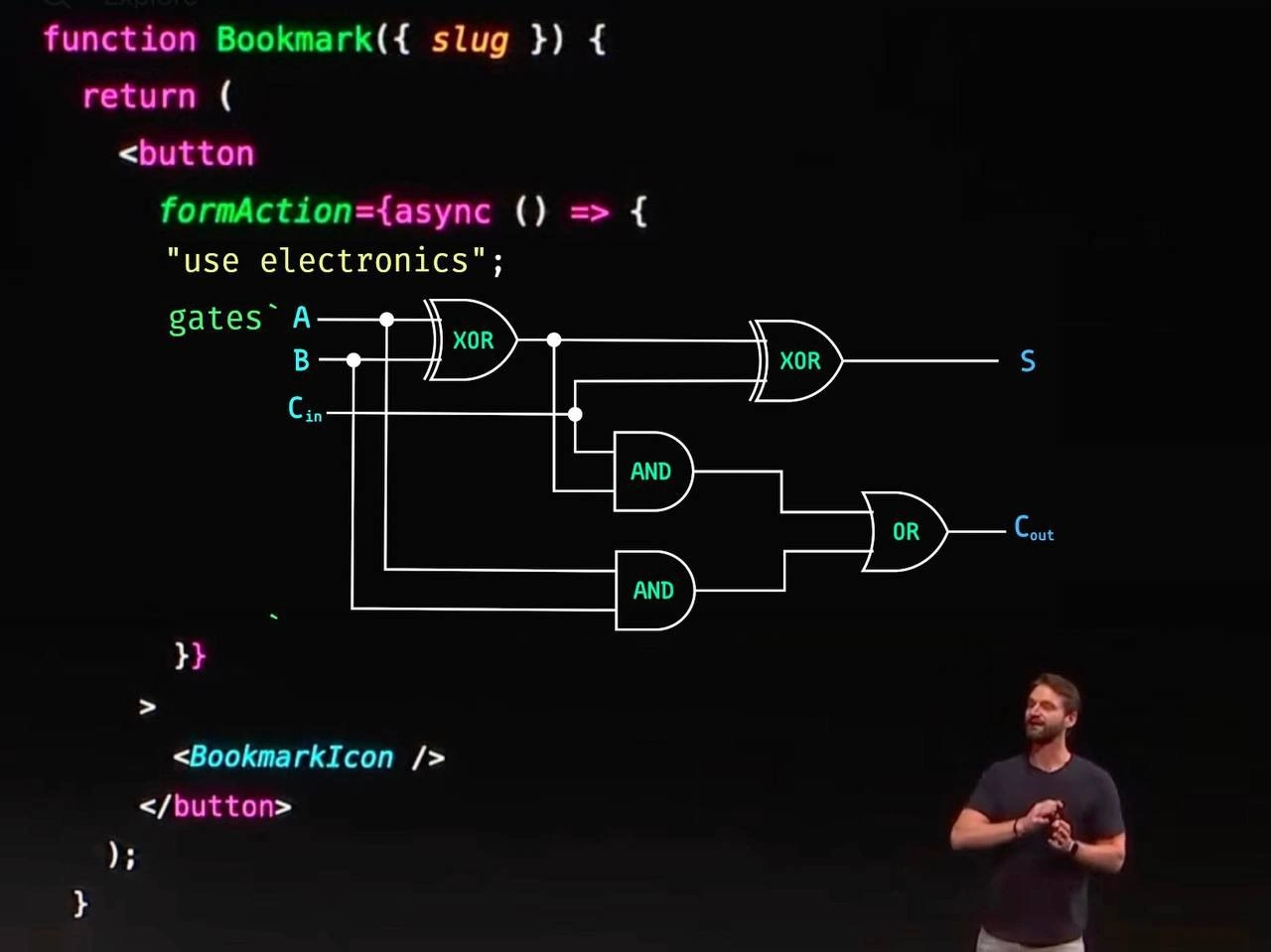
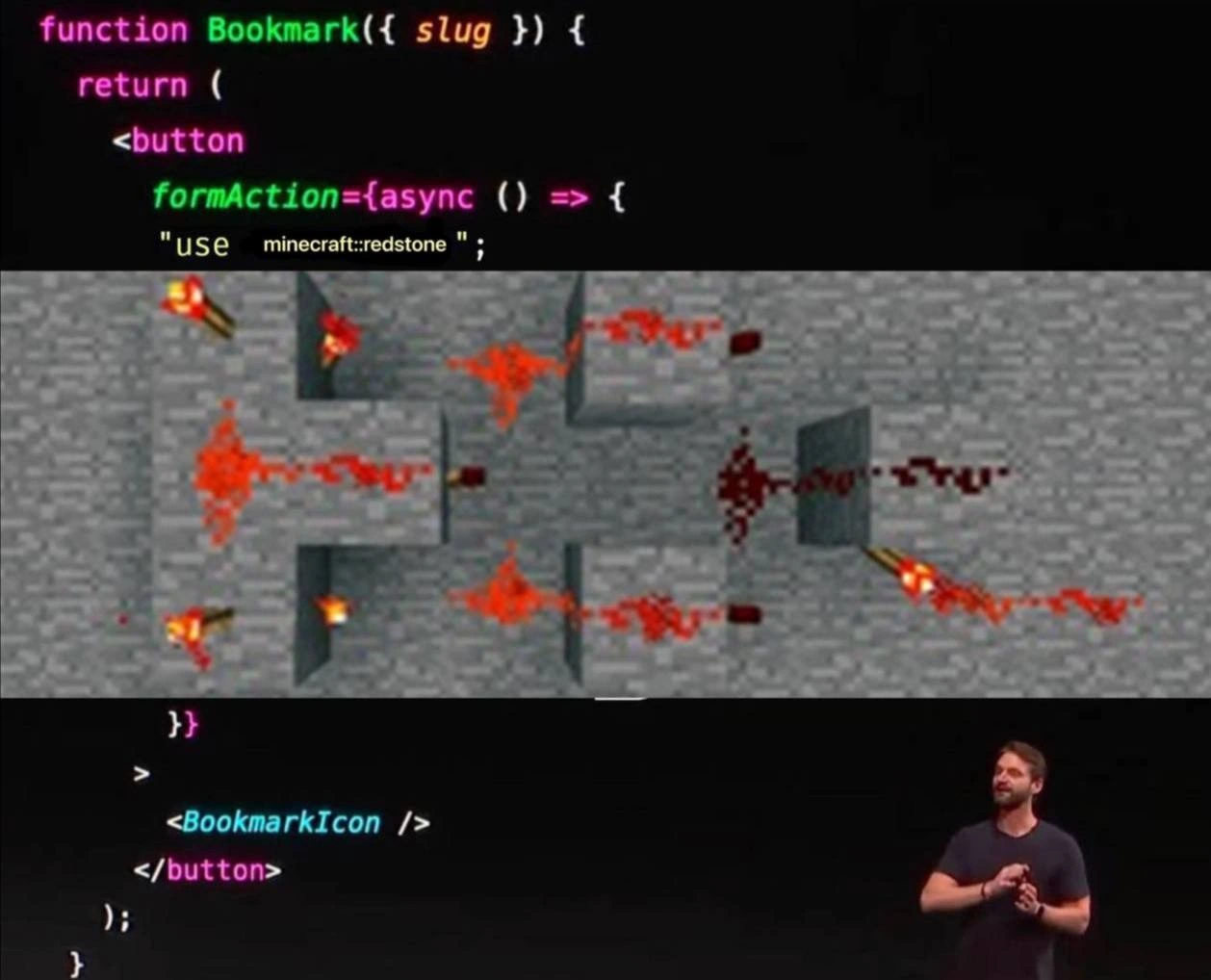
Let’s break down the joke in a straightforward way. In the top and bottom panels, we see what looks like React code (JavaScript XML, JSX, with syntax highlighting). There’s a React component function defined as function Bookmark({ slug }) { ... } which returns a <button> element. That part is normal for a React component – a component is like a reusable UI piece, and here it likely renders a bookmark icon button for a given article or item (represented by a slug prop). The interesting bit is the attribute on the button: formAction={async () => { "use minecraft::redstone"; }}. This is where the humor lies. In modern React (specifically Next.js’s App Router in late 2023), formAction is a special prop that allows you to attach a server action to a form button. Essentially, when that button is clicked, it can run an asynchronous function on the server. Normally, to enable this, you’d include a special directive inside the function: "use server";. That string tells Next.js, “this code should run on the server, not in the browser.” It’s not a regular string for the function to process; it’s more like a label that the framework looks for during build time.
Now, instead of the expected "use server", the code shows "use minecraft::redstone";. This is not a real directive – it’s something the meme author made up. The double colon :: syntax isn’t even valid in plain JavaScript strings for anything special (it just becomes part of the string text). It resembles the way one might import modules in other languages (for example, Rust uses use something::submodule;). So basically, the code is intentionally wrong/funny: it’s as if the developer is trying to import or use Minecraft’s redstone within a React function. In reality, if you run this code, the "use minecraft::redstone"; line would just be a no-operation string. The function doesn’t actually do anything (there’s no real server logic after that string) – so clicking the button would either do nothing or throw an error because the form action isn’t properly handled. It’s like putting a fake road sign on a highway; drivers (or in this case, the program) won’t know what to do with it. This is why the meme caption jokes, “what could go wrong?” implying that everything would go wrong if you tried this in a real app.
The middle panel of the meme is a screenshot from Minecraft, specifically showing a redstone circuit. Minecraft is a popular sandbox game where, among many other things, players can create electrical circuits using a material called redstone. Redstone acts like wiring – you lay down redstone dust to connect components, and you can power it with switches, torches, or other power sources. In the image, the red glowing lines are redstone dust carrying a power signal, and the little red-tipped sticks are redstone torches, which act like power sources or logic gates. The arrangement we see is actually a redstone NOT-gate (also known as an inverter). In Minecraft, a redstone torch will output power unless the block it’s attached to is powered, in which case it turns off – this creates an inversion of the input signal. So, if the input is on, the output turns off, and vice versa. Players use setups like this to build all sorts of logical devices – you can combine multiple gates to make AND gates, OR gates, even memory circuits. People have famously built calculators and simple computers in Minecraft using redstone logic! It’s a game, but it can simulate real-world digital logic in a fun way.
Now, why is that in the middle of a React code meme? The joke is visually blending two worlds: the world of web development (React, JavaScript, frameworks) with the world of Minecraft (games, building blocks, redstone engineering). The code joke “use minecraft::redstone” is suggesting that the button’s action is somehow wired up to this Minecraft redstone contraption. Of course, in reality, you can’t literally connect a Minecraft circuit to a web application’s button. They’re completely unrelated systems. But the humor comes from pretending that by writing a magical line in your code, you’ve suddenly tapped into Minecraft’s logic. It’s like saying, “I’ve tried everything to make this feature work… might as well use Minecraft redstone!” It exaggerates the complexity or novelty of modern frameworks by comparing it to something utterly out-of-place.
We should also talk about the person in the bottom-right corner of the meme. That looks like a tech conference speaker on stage. It gives the vibe that this crazy feature (“use minecraft::redstone” in React) is being announced as the latest big thing. This is poking fun at how tech frameworks are often introduced with great enthusiasm at conferences. React and Next.js regularly have big announcements (like introducing Server Components, new routing systems, etc.). The meme imagines a scenario where a presenter proudly announces a Minecraft integration for React – which is obviously a joke. This plays on the developer experience hype: sometimes the new features in our tools feel almost as weird or unexpected as mixing a video game with a web framework. As a newcomer, you might not have experienced it yet, but in the developer community, we often have a bit of good-natured skepticism (and humor) around new buzzwords and features. Today it’s “Server Actions with use server directives”; who knows, tomorrow it might be something wild like “use AI” or... “use Minecraft redstone”! The meme is basically saying: “Frameworks keep adding crazy stuff – imagine if they went this far.”
So in summary, React Server Actions are a real cutting-edge feature where you mark functions with "use server" to run them on the server. Minecraft redstone is a game mechanic for building logic circuits. The meme merges these by replacing the real directive with a fake one, and showing a Minecraft circuit as if that’s the underlying logic. It’s highlighting the absurdity in a playful way. The underlying message is a funny commentary on how complicated or fanciful front-end development can get. If you’re new to web dev, don’t worry: you won’t actually have to learn Minecraft to use React! This is just dev humor. It takes something real (server actions) and exaggerates it with something nerdy and unrelated (Minecraft circuits) to get a laugh out of those who understand both. And even if you didn’t know all the details, the absurd combination itself – like mixing a serious coding framework with a pixelated game element – is enough to clue you in that it’s meant to be silly.
Level 3: NOT Your Typical Action
For experienced devs, this meme hits on multiple fronts of humor. First off, it lampoons the new React Server Actions feature by taking its syntax and giving it an absurd twist. In a real Next.js app, you might see something like:
<button formAction={async () => {
"use server";
// perform server-side logic, e.g., save a bookmark
}}>
<BookmarkIcon />
</button>
Here, the formAction prop on a <button> is using an async arrow function marked with "use server" to indicate it should run on the server. This is a cutting-edge approach in React/Next.js to handle form submissions – instead of writing an API endpoint and calling it, you just annotate a function and the framework handles the wiring (no pun intended) between client and server. It’s fancy frontend DX (Developer Experience) magic: click the button, and the annotated function executes on the server, updating the database or performing some action, then refreshing the UI. Now, along comes the meme: it shows a component Bookmark doing:
<button formAction={async () => {
"use minecraft::redstone";
}}>
<BookmarkIcon />
</button>
This is immediately recognizable to a seasoned dev as wrong-but-funny. The "use server" directive has been replaced with "use minecraft::redstone". That’s not a thing any framework expects! It’s the equivalent of yelling nonsense into a walkie-talkie – no one on the other end knows how to respond. A senior engineer chuckles because they know the framework’s internals will likely ignore this unrecognized directive. It’s a perfect example of use_directive_abuse for comic effect. The code as written would not trigger the server action pipeline at all. In other words, the formAction would no longer actually call back to the server. It’s “wired” to a fake power source. The meme visually underscores this with a Minecraft redstone circuit acting as the supposed logic. The middle image of a redstone NOT-gate is symbolic: the not gate implies “this is not really going to do what you think.” It’s also a clever nod – a NOT gate inverts a signal, just as this meme inverts the meaning of the "use server" directive into something nonsensical. For those of us who have dabbled in Minecraft, seeing that little layout of gray blocks, red dust, and torches elicits a knowing grin. In Minecraft, you’d build a NOT gate by powering a redstone torch (which inverts the input signal). In a web app, you definitely don’t expect to be debugging your button by checking if a virtual torch is lit!
The presence of the keynote presenter in the bottom-right ties it all together with a satire of tech announcements. It looks like a scene from a React or Next.js conference where a feature is being introduced to great fanfare. We can easily imagine a excited presenter saying: “And now, powered by our new integration... you can use Minecraft Redstone in your React server actions!” — followed by applause. Of course, this is never actually announced, but the meme mimics the style of framework hype. Seasoned devs have witnessed countless framework and library announcements, each promising to revolutionize development. By exaggerating to the point of “blending Minecraft into React,” the meme pokes fun at the framework churn we experience. One month it’s a new state management library; the next, a new build tool; then React introduces Server Components and Actions. It can feel like we’re constantly rewiring our apps with the latest and strangest ideas. So when we see "use minecraft::redstone", it’s a hyperbolic joke: What’s next, plugging actual game mechanics into our code? This speaks to an underlying truth in dev culture: we often joke that front-end development is so crazy these days, you might as well need a pickaxe and some redstone dust to get things working.
Another layer of humor here is the cross-domain mashup. Developers love both coding and video games (Minecraft has a huge overlap with the tech crowd). By referencing a beloved game inside a code snippet, the meme rewards those with multi-nerd expertise. If you know React and you know how redstone works in Minecraft, you’re in the elite club that gets the full joke. A senior developer likely has seen Minecraft’s elaborate contraptions – people build calculators, elevators, even rudimentary CPUs using redstone logic in the game. The idea of literally using one of those contraptions to power a web app is absurd and delightful. It’s mixing a modern tech stack with a sandbox toy. For veterans, it also has a whiff of historical irony: once upon a time, computing was about wiring up physical logic gates (okay, maybe not with glowing red dust and torches, but with actual wires and transistors). Nowadays, we write high-level code and let silicon do the rest. Seeing a redstone NOT-gate slapped in the middle of a React UI flow reminds us, with a laugh, how many layers of abstraction we usually have in between. It’s a comical teardown of those layers – as if a frustrated engineer said “Screw it, I’ll handle the logic with my own two hands… in Minecraft!”
And of course, the caption “what could go wrong?” is classic ironic understatement. Any senior dev knows that when someone says that, everything is about to go wrong. Using a game engine’s logic bricks in a production web app? Yeah, that’s a one-way ticket to a late-night debugging session. The meme resonates especially with those who have been on-call for production issues caused by much more trivial mistakes. Compared to a real outage caused by a misused config or a missing "use client" directive, this scenario is blissfully unreal – which makes it safe to laugh at. In summary, the meme is a cocktail of frontend humor: riffing on new React conventions, lampooning the continuous evolution (or revolution) in frameworks, and delighting in a ridiculous cross-over of a programming concept with a gaming one. It’s satire that says: “Developers are so creative (or desperate) that they’ll even wire up Minecraft redstone if it helps… or even if it doesn’t!”
Level 4: Redstone Directive Alchemy
At the deepest level, this meme mashes up metaprogramming pragmas with digital logic gates – two extremes of computing. In modern React (especially Next.js App Router), a special string literal like "use server" is a compile-time directive. It’s akin to a "use strict" directive or a pragma that flags to the framework’s bundler: “hey, treat this function as a server-side action.” Under the hood, the build system likely parses the AST (Abstract Syntax Tree) of your code, looking for that exact "use server" string at the top of an async function. If it’s present, the function’s body is isolated, serialized, and shipped to run on the server environment instead of the client. Omit it (or change it), and the function won’t get the special treatment – it might end up running on the wrong side (or not at all). By writing "use minecraft::redstone" instead, the developer is subverting the expected directive. Technically, this string is just an expression statement with no effect. The JavaScript engine sees an unused string and moves on, but the React runtime or compiler doesn’t recognize it as a valid directive. Essentially, the code is no longer marked as a server action. The result? The formAction probably falls back to default behavior or errors out – the UI is wired to nothing. It’s a bit like sneaking a bogus command into a program: the compiler quietly ignores it or misinterprets it, leading to undefined behavior. Here, the undefined behavior is visualized as a chaotic Minecraft redstone circuit – a tongue-in-cheek representation of the app’s logic going electrically haywire.
Delving even deeper, there’s an ironic full-circle in play. Minecraft redstone dust and torches essentially form a sandbox model of real-world circuits and boolean logic. The middle panel’s redstone NOT-gate (the arrangement of glowing dust lines and torches) is a direct analog of the fundamental logical NOT operation – in electronics, this is built from transistors; in Minecraft, from torches and powered dust. Redstone is even Turing-complete, meaning given enough space and time, you can construct a functioning (albeit slow) computer inside Minecraft using these basic gates. By jokingly putting "use minecraft::redstone" in a React codebase, the meme collapses the highest abstraction of web development down to the lowest-level computational primitives. It’s abstraction inversion to a ridiculous degree. In a theoretical sense, all our web apps ultimately run on logic gates and machine code – but we never explicitly think about transistors when writing a React component. Here the meme forces that meeting of worlds, as if saying: “Fine, if we’re adding all these magical directives to our Frontend, why not go all the way down to the metal (or rather, the digital stone)?” The humor emerges from this absurd cross-domain abstraction: an ultra-high-level framework feature (server actions in React) being configured with what looks like a hardware wiring instruction. It’s a nerdy nod to the notion that every fancy Modern Tech Stack feature is, in the end, powered by binary states of electricity – or in this case, the binary states of glowing red dust in a video game.
Historically, programming languages and frameworks have had these special 'use XYZ' directives or annotations to influence compilation and runtime (think of 'use strict' in ES5, or #pragma in C/C++). They’re meta-instructions, not regular code – a form of frontend meta-programming where code is manipulating the behavior of the compiler. The React team’s introduction of React Server Actions (an experimental feature around late 2023) added one more of these meta switches ("use server") to our lexicon. The meme wittily extends that trend: why stop at 'use server'? Let’s import a completely unrelated universe – 'use minecraft::redstone' – as a pretend compile-target. It satirizes the idea of frameworks constantly churning out new keywords and directives (framework churn irony). This hyperbolic “directive abuse” highlights how bewildering it can feel when every other month there’s a new magic string or convention to learn. To a seasoned engineer, there’s also a subtext of having fun with type systems and namespaces: the format "minecraft::redstone" mimics a Rust/C++ namespace (minecraft::redstone) as if Minecraft were a module providing low-level operations. It’s a playful jab at how far we might go in mixing paradigms – from strongly-typed systems to dynamic JSX, and from game logic to web apps. In essence, React Server Actions and Minecraft redstone logic live at opposite ends of the computing spectrum. By colliding them, the meme creates a kind of comedic alchemy – blending elements that absolutely shouldn’t mix, and reveling in the wonderfully nerdy explosion that results.
Description
A three-part meme that humorously explains the underlying complexity of modern web development features. The top and bottom parts show a React code snippet for a 'Bookmark' component, presented as if on a slide at a tech conference, with an image of React core team member Dan Abramov in the bottom right. The code contains a button with a `formAction` that includes the parody directive '"use minecraft::redstone";'. The middle section, visually interrupting the code, is a screenshot from the game Minecraft, showing an intricate and complex circuit built with redstone dust, repeaters, and torches. The meme brilliantly parodies the '"use server";' directive from React Server Components (popularized by Next.js), suggesting that behind this simple line of code lies a system as complex and difficult to reason about as a Minecraft redstone contraption. It's a layered joke for senior developers who understand React, the new server components architecture, and the surprisingly deep engineering parallels found in Minecraft
Comments
7Comment deleted
My new server action works great, but now our AWS bill includes a line item for 'virtual pickaxe durability loss' and the p99 latency is dependent on avoiding Creepers
Finally, a deployment target that unifies React’s compile-time directives with 20-tick redstone latency - because who hasn’t wished their CI pipeline required a pickaxe?
Finally, a React directive that accurately represents the complexity of debugging server components - you need an engineering degree, perfect timing, and the whole thing breaks if someone looks at it wrong
Ah yes, the classic 'use minecraft:redstone' directive - because when your PM asks for a simple bookmark feature, why not architect it with the same complexity as a 64-bit ALU in Minecraft? At least when this form action breaks in production, you can debug it by following the redstone dust trail. Bonus points if your error handling includes checking for insufficient torch power and accounting for chunk loading delays
Server actions are just RPC with a nicer name - wiring a button to "use minecraft::redstone" finally documents the consistency model: works great until the chunk unloads, i.e., your serverless cold start
Server Actions are the redstone of the modern web: wire a mutation to a button, sprinkle a magic pragma, and hope the propagation delay doesn’t race your CDN - flawless in the demo, spectacular in prod
Async actions in JS: one line. In redstone: one chunk of pure timing hell