React Developers Architecting a Simple Form Submission
Why is this Frameworks meme funny?
Level 1: A Rocket for Pizza
This meme is funny because it’s like using a giant rocket ship to do a simple chore. Imagine you want to deliver a pizza to your friend next door. Instead of just walking it over, you build a huge rocket, put on a space suit, and launch the pizza into orbit and back down to their house. 🚀🍕 That would be a crazy, over-the-top way to solve a simple problem! In the same way, the picture shows people with a huge machine trying to send just five little pieces of information. It’s silly because they don’t need all that stuff for something so basic. We laugh because we can see it’s way too much effort for such a small task, and the people in the joke don’t seem to realize it. It’s a fun reminder: sometimes we make things harder than they need to be, and that makes everyone go “Wow, that’s overkill!”
Level 2: Form Handling Overkill
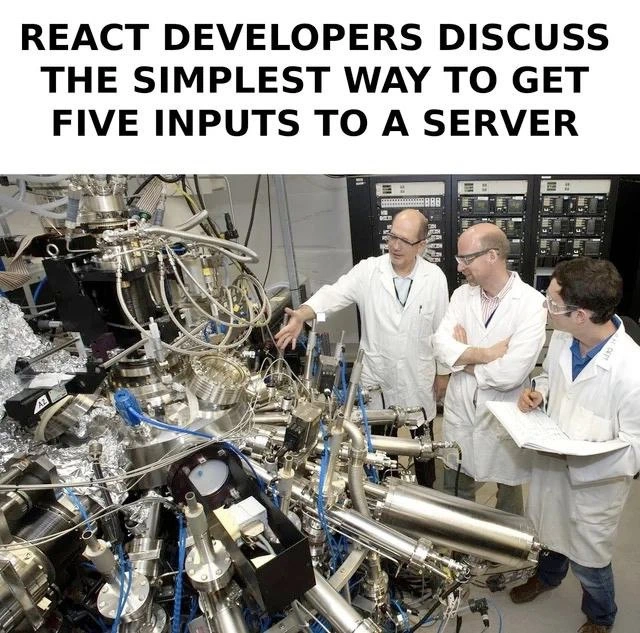
Let’s unpack the joke in simpler terms. We have a basic job: send five input values from a form to a server – something like a contact form with name, email, etc. In the old days (or with just plain HTML), you’d fill in those inputs and hit “Submit,” and the browser would send the data straight to the server. Done. But here, our React developers are treating this humble task as if they were launching a rocket or running a high-energy physics experiment! The image of scientists surrounded by a crazy tangle of equipment perfectly represents that over-engineering vibe.
React is a popular JavaScript library for building user interfaces. Instead of working with simple HTML forms directly, React developers build everything as components (little reusable pieces of UI). To manage what users type (the form state), they often use hooks like useState (to keep track of values) and useEffect (to do something when values change). There’s also React Context, which lets you share data easily between components without passing props down every level. Context is useful, but here it’s like using a megaphone to talk to someone next to you – probably unnecessary for a small form. The meme jokes that these devs add state management tools like Context or even external libraries (for example, Redux or MobX) just to handle five little pieces of text. That’s the “form_handling_overkill” the tags mention – using far more infrastructure than needed.
Now, what about sending the data to the server? A simple approach would be an HTTP POST request with those five inputs. But modern teams might use GraphQL, a powerful query language for APIs. GraphQL is cool because it lets clients ask for exactly the data they need and get it in one go. But setting up GraphQL means defining a schema, writing a resolver on the server, and using a client library on the frontend. For just five inputs, that’s like installing an entire subway system to cross the street. The context tag graphql_for_simple_post highlights this specific overkill: using GraphQL when a straightforward REST endpoint or form submit would do. It’s not that GraphQL or Redux or context are bad – they’re great in the right situations – just funny when they’re clearly more than what’s necessary.
The three “scientists” in the picture are like the devs debugging or discussing their creation. One is gesturing at the maze of pipes and wires: that could be the lead engineer explaining how data flows through their form system (“First, the input state goes into our Context, which triggers our reducers, which updates the store, which invokes the mutation…”). Another is taking notes on a clipboard – maybe documenting this elaborate process. This visual gag compares a simple web form to a CERN experiment. CERN is the famous European physics lab with the Large Hadron Collider, a massive, complex machine built to smash particles and discover fundamental physics. It’s extreme and complicated – just like our hypothetical form architecture. Lab_grade_frontend as a tag nails this image: the front-end (usually just code in your browser) has become as complicated as lab equipment.
For a junior developer or someone new to web dev, here’s why it’s amusing: you usually learn to make forms in a straightforward way – a bit of HTML, maybe some minor validation, then send it off. As you get into frameworks like React, you discover there are many ways to handle the same task, often involving new concepts: “Should we use a context? What about a reducer? How do we manage all these pieces of state?” If taken too far, you end up tying yourself in knots. The meme is a lighthearted warning: beware of hook hell (getting tangled in too many useEffect and useState hooks) and reducer sprawl (creating a reducer for every little thing, until your code looks like a flowchart factory). It’s relatable because many of us have followed a tutorial or a team convention that suddenly felt like using a sledgehammer to crack a nut.
In summary, the meme shows an overcomplicated solution to a simple problem. It teaches an implicit lesson: always consider if a simpler approach exists. As a developer, it’s easy to get excited about new tools (who doesn’t want to try the latest state library or API tech?). But when you catch yourself building a mini-CERN to handle a form, maybe step back and laugh – then refactor before you actually need a lab coat to debug your code.
Level 3: Large Hadron Form Collider
In this meme, three React developers in lab coats are figuratively standing before a complexity collider of their own making. The caption jokes about them discussing “the simplest way to get five inputs to a server,” while the photo shows a maze of pipes, cables, and valves worthy of CERN’s particle physics labs. The humor targets over-engineering in modern web development – specifically how a simple React form can become absurdly elaborate. Seasoned engineers recognize the scenario: a trivial feature (just five input fields!) ballooning into a full-blown lab-grade frontend architecture.
Why is this funny to an experienced dev? Because it’s too real. We’ve seen teams turn a basic form submission into a Rube Goldberg project of contexts, state managers, and microservices. Instead of one straightforward HTTP POST request, the solution involves:
- State management libraries (Redux or endless
useStatehooks for each field) - Multiple context providers wrapping components to pass data around
- A forest of custom hooks (
useEffect,useReducer, etc.) orchestrating updates - Perhaps a GraphQL layer (
useMutationwith Apollo) to send the data, complete with schema, types, and resolvers - A form validation library, routing logic, and maybe a new micro-frontend module for good measure
Each of these tools is powerful, but using all of them together for a five-field form is like using a particle accelerator to toast a slice of bread. The image literally depicts an overcomplicated apparatus, which mirrors the code complexity. Senior devs chuckle (and cringe) seeing the fancy contraption: they’ve battled “hook hell” and reducer sprawl before. The meme exaggerates, but not by much – sometimes developers apply enterprise-grade patterns to the simplest problems, creating a front-end pain point that is painfully familiar.
Let’s break down the satire. The text says “React developers discuss the simplest way…” – obviously ironic, because nothing in that picture is simple. It riffs on how discussions in a team can spiral: “Maybe we should use Context.” – “Let’s add a custom hook.” – “How about GraphQL for flexibility?” – “Throw in a state machine library!” Every added idea is like another pipe or valve in that machine. The end result is a wildly over-architected solution. The Developer Experience (DX) suffers: deploying or debugging such a system is as daunting as calibrating a collider. Seasoned devs have learned the hard way that more moving parts = more ways to break. Yet, many have been swept up in meetings or design reviews where a simple feature gets the “CERN treatment” because everyone brings their own favorite tool or fear of not being “scalable” enough.
There’s also an element of tech culture satire: modern frontend development sometimes encourages using the latest libraries and patterns for clout or future-proofing. It’s a tongue-in-cheek jab at how a team might justify complexity: “We might need offline caching, internationalization, and real-time subscriptions for this contact form.” Sure, those are real concerns at scale, but applying all at once here is comically premature. This is essentially the “YAGNI” principle (You Aren’t Gonna Need It) being blatantly ignored. Instead of the KISS approach (Keep It Simple, Stupid), the team built a mini Space Shuttle. Relatable Developer Experience: most of us have looked at a codebase and thought, “Why on Earth did they do that just for this?”
The meme resonates because the contrast is universal: trivial problem, astronomical solution. It highlights that gap between textbook simplicity and real-world “architecture astronaut” discussions. And although it’s satire, it gently reminds us: maybe, just maybe, a simple HTML form or a single fetch() could have done the job. Instead, we’ve got something that needs a PhD (or a hardhat and goggles) to operate. The experienced laugh is a mix of amusement and “I’ve been there, please no” anxiety. We laugh so we don’t cry, acknowledging how easy it is to over-think a problem until the simple solution disappears in a tangle of pipelines pipelines and code.
// Over-engineered React form snippet (satire)
const [firstName, setFirstName] = useState("");
const [lastName, setLastName] = useState("");
// ... imagine similarly for five fields ...
// Using Context to store form data globally (overkill for just 5 inputs):
const formData = useContext(FormDataContext);
const dispatch = useContext(FormDispatchContext);
// Sync each field to a global state with useEffect (why are we doing this? 🙃)
useEffect(() => {
dispatch({ type: "UPDATE_FIELD", name: "firstName", value: firstName });
}, [firstName]);
useEffect(() => {
dispatch({ type: "UPDATE_FIELD", name: "lastName", value: lastName });
}, [lastName]);
// GraphQL mutation for submission (instead of a simple POST)
const SUBMIT_FORM = gql`
mutation SubmitForm($data: FormInput!) {
submitForm(data: $data) { success }
}
`;
const [submitForm] = useMutation(SUBMIT_FORM);
function handleSubmit() {
// Submitting the entire form data through Apollo GraphQL client
submitForm({ variables: { data: formData } });
}
Above: We jokingly illustrate the "simple" five-field form turned into a mini enterprise. We’ve got multiple useState hooks, a global Context with dispatch, syncing state on every change, and even a GraphQL mutation via Apollo. It’s all perfectly modern, and totally overkill. A seasoned dev can’t help but smile (or facepalm) at how familiar this looks. The meme exaggerates for comedic effect, but it rings true whenever a team piles on every frontend framework and technique for a basic task. It’s a cautionary laugh: just because you can build an engine of interlocking parts doesn’t mean you should for something this small.
Description
A meme that satirizes the perceived complexity of the React ecosystem. The image has a caption in bold, white text: 'REACT DEVELOPERS DISCUSS THE SIMPLEST WAY TO GET FIVE INPUTS TO A SERVER'. Below the text is a photograph of three scientists in white lab coats, intently gathered around a massive, extraordinarily complex piece of scientific machinery that resembles a particle accelerator or fusion reactor. The machine is a dense tangle of wires, pipes, and metal components. The humor lies in the juxtaposition of a fundamentally simple task (sending five form inputs to a server) with the image of an incredibly over-engineered, complex solution. This resonates with experienced developers who have encountered situations where React's patterns, state management, and ecosystem of libraries can turn a straightforward problem into a major architectural undertaking
Comments
7Comment deleted
The discussion concluded they need a globally syndicated state machine, a custom hook factory, and a GraphQL mutation. They're now A/B testing if the 'submit' button's border-radius impacts conversion
Sure, we could use a plain <form>, but then where would we mount the 37 context providers and brag about our immaculate GraphQL mutation pipeline?
"We need Redux for state management, React Hook Form for validation, Zod for schema, React Query for the POST request, and a custom abstraction layer... or we could just use FormData like it's 2005 and ship it before lunch."
After three sprints, five architecture review meetings, and implementing Redux Toolkit with RTK Query, custom middleware, normalized state with entity adapters, Formik with Yup validation schemas, React Hook Form as a backup, Axios interceptors with retry logic, and a comprehensive error boundary hierarchy - the team finally shipped a contact form that could have been `<form onSubmit={e => fetch('/api/contact', {method: 'POST', body: new FormData(e.target)})}>`
Asked for five inputs, the React guild proposes a micro-frontend using controlled components, Formik + Zod, a Redux slice, a GraphQL mutation with optimistic updates, offline cache, feature flags, and telemetry - because nothing says 'POST /submit' like a 12-person platform initiative
Five inputs to server? Just hoist state to the app root, wrap in five useCallbacks, and dispatch via saga - simpler than a monolith refactor
Only React could turn five text inputs into a pipeline of controlled components, three custom hooks, a context provider feeding a reducer, Zod/Formik validation, Redux-Saga side effects, and an Apollo mutation with optimistic cache - when the senior quietly suggests, or we could just use an HTML form POST