The 'Serverless' Promise vs. Reality in Next.js
Why is this Frameworks meme funny?
Level 1: The Hidden Helper
Imagine your friend’s mom promises to host a “kitchen-less” bake sale – she says nobody needs to bake or use a kitchen, and you’ll still get yummy cookies. You get really excited thinking cookies will just appear like magic without anyone cooking. But when you show up, you see someone quietly working with an oven in the back room. Those cookies didn’t appear out of thin air – a hidden chef baked them, you just didn’t know about it at first. You feel a bit surprised and maybe a tiny bit fooled: they said “no kitchen,” but there was a kitchen behind a curtain all along. It’s kind of funny, right? They used a play on words to make you imagine magic, but in reality someone still did the work, just out of sight.
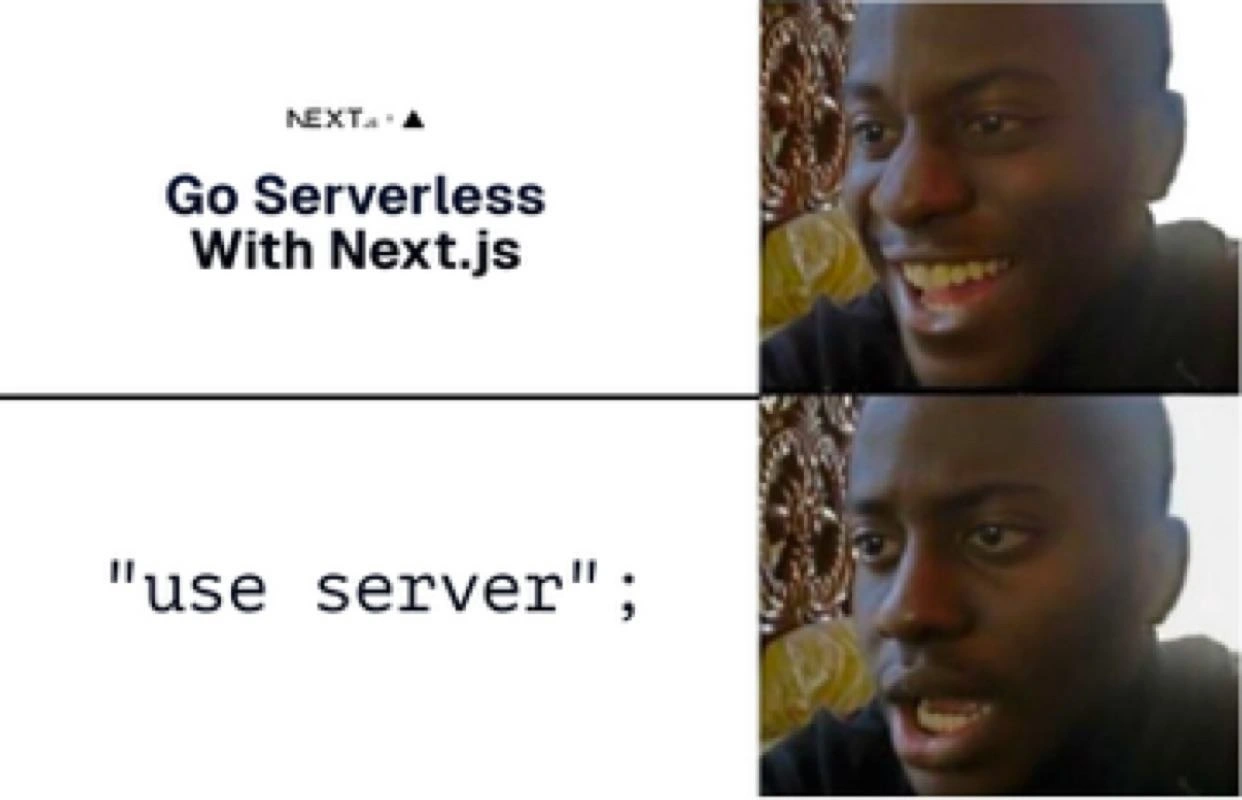
That’s exactly what’s happening in the meme. Next.js (a tool developers use) said “Go Serverless,” which sounds like “no servers needed – it’s automatic!” Developers got excited hearing that, just like you did with the kitchen-less cookies. But then in the actual recipe (the code), it says "use server";. Oops – there is a server involved after all, it’s just hidden in the back (run by the Next.js service). The first picture shows the happy anticipation, and the second picture shows the face of realizing the truth. It’s funny because the promise felt like magic (“no servers!”) but the reality is simply that the server is someone else’s responsibility. In the end, just like cookies still need a baker, code still needs a computer server to run on – even if you don’t see it. The meme makes us laugh about how we sometimes believe we can have nice things with no effort, only to discover the “secret helper” making it happen behind the scenes.
Level 2: Servers in Disguise
Let’s break down what’s happening here in simpler terms. Next.js is a popular web development framework built on React. It helps developers build websites and applications by handling a lot of setup automatically. When Next.js says “Go Serverless,” it’s using a big buzzword in web development: serverless means you deploy your code without managing a dedicated server yourself. In a traditional setup, you might rent or set up a server (a computer in the cloud) to run your website’s backend code. With ServerlessArchitecture, you just give your code to a cloud service (like Vercel, the company behind Next.js), and they run that code on-demand, scaling it automatically. It’s like not having to own or maintain a restaurant kitchen because you can hire a service that cooks each dish as people order — you only pay per dish instead of running a whole kitchen all day. This approach is great for Deployment because it can be easier and more cost-effective for many cases. When you hear “serverless” in marketing, the idea is you don’t see the servers; you’re not logging into a machine or worrying about OS updates. But here’s the catch: behind the scenes, there are still servers (computers in data centers) doing the work. It’s just that those are managed by someone else (e.g., Vercel or AWS). A common joke is “serverless is just someone else’s computer” — meaning the code doesn’t run by magic, it runs on a server, just not one you set up yourself.
Now, Next.js recently introduced something called Server Actions. This is part of their new “App Router” system and is related to how you write server-side logic in a Next.js app. Normally in Next.js, you have React components. By default, many of these can run on the server to render HTML (we call them server components) or on the client (the user’s browser, as client components). To avoid confusion and bugs, Next.js uses special file directives: for example, if you want a file’s React component to run in the browser, you put "use client" at the top of the file. This tells Next.js, “hey, this component needs to be sent to the browser.” Conversely, with the new nextjs_server_actions feature, if you have a function that you want to run on the server (for example, a function that saves a form to a database or sends an email – things you cannot do from the browser for security or practicality), you mark it with "use server" at the top. That use_server_directive is literally the text "use server"; (including quotes and the semicolon) as the first line of the file or function module. It’s kind of similar to JavaScript’s "use strict"; directive or Next’s own "use client" – it’s not doing a runtime action like a normal line of code; it’s more like a label or switch for the build system. It tells Next.js: “this code runs on the server side.”
So, what does the meme convey? The first panel shows the bold claim “Go Serverless With Next.js” with the Next.js logo – this is the marketing promise that you, as a developer, won’t have to worry about servers if you use Next.js on something like Vercel. The guy is super happy about it, as many developers get when they hear they might not need to worry about deploying or managing backend servers. It sounds like all the hard parts of running web apps (scaling, servers, etc.) are solved. Frameworks and cloud platforms love to advertise this simplicity.
Then the second panel drops the joke: it just shows the text "use server"; and the guy now looks shocked or disappointed. Why? Because the very code for using one of Next’s shiny new features (Server Actions) requires writing “use server.” It’s as if the framework is quietly admitting, “Psst, this part runs on a server we manage.” To a newcomer, that might be confusing – didn’t they just say serverless? But to someone who knows the lingo, it’s a bit funny: of course there’s a server involved! The MarketingVsReality contrast is literally spelled out in text. It’s the fine print that wasn’t in the advertising banner: you still have to think about what runs on the server versus the client.
In clearer terms, Next.js saying “serverless” means you don’t personally maintain a server machine; however, your code is still split into server and client parts. The "use server" directive is telling Next.js, “Keep this function on the server side (in a cloud function), don’t send it to the user’s browser.” For example, if you write a function to handle a form submission (say, saving a new blog post to the database), you’d mark it with "use server" so that when you deploy your app, Next.js knows to run that function on their server infrastructure. The user’s browser will call that function kind of like it’s calling an API. This is what they mean by nextjs_server_actions – you can directly call server functions from your React components without manually setting up an API route; Next does the wiring for you. It’s cool tech, but the joke here is that calling it “serverless” is a bit misleading, since the very mechanism uses the word “server”.
Think about Edge Functions as well: these are like mini-servers that run code at data centers geographically closer to users (the “edge” of the network). Vercel uses edge functions to make some Next.js server-side work faster for global users. But again, edge function is a fancy term for “code running on a server, just one that’s near the user.” The meme hints at this broader point: all these modern WebDev conveniences (serverless functions, edge computing) still involve actual servers doing the heavy lifting. As a developer early in your career, it’s important to understand that “serverless” doesn’t mean you avoid learning about servers entirely – it means the server is abstracted away. You should still know why you might use "use server" or how a cloud function works, even if you’re not configuring the Linux server yourself.
So in summary, this meme is funny to developers because it highlights a truth in a cheeky way: Next.js’s marketing suggests you won’t deal with servers, but one of its key features literally requires you to type the word “server”. It’s a tongue-in-cheek reminder that in ModernWebDevelopment, even the most advanced frameworks can’t completely hide the existence of servers or backend logic. The guy’s disappointed face is basically saying, “Ha, I knew it – there is a server after all!” It resonates with anyone who has felt tricked by a tech buzzword before. We laugh because we’ve all been the excited person in the first panel at some point, and then we’ve all had that moment of realization in the second panel. The meme distills that experience into two frames and two words: use server.
Level 3: Schrödinger's Server
At first glance, Next.js’s marketing proudly shouts “Go Serverless!”, promising a modern ServerlessArchitecture where backend complexity vanishes into the cloud. In the meme’s top panel, our developer is grinning at that slogan, thrilled by the idea of deploying code without ever touching a server. But then reality hits: the bottom panel reveals a snippet of actual Next.js code with an explicit "use server"; directive – and our developer’s face falls. This punchline lands because seasoned engineers know the truth: serverless doesn’t literally mean no server, it means “not your server, not your problem (until it breaks)”. The meme humorously exposes the MarketingVsReality gap: Next.js/Vercel hype up edge_functions_expectations and no-ops simplicity, but the code literally whispers, “oh by the way, we still use server.” It’s a classic gotcha in ModernWebDevelopment – the framework promises magic, yet under the hood you find a plain old Node.js process waiting to do the work.
This relates to Next.js’s new Server Actions API. In Next 13+ (App Router), you can write functions that run on the server by labeling them with a special directive. At the top of a file you might see code like:
"use server";
export async function submitOrder(orderData) {
// This code runs on the server (not in the user's browser)
// e.g., securely save orderData to a database:
await db.orders.insert(orderData);
return "order_saved";
}
That use_server_directive is not a comment – it’s a pragma that Next.js uses (similar to the "use client" directive) to know this file’s exports must execute on the server side. It’s essentially telling Next’s compiler and bundler: “Don’t even think about sending this function to the browser; keep it on the server.” The irony is rich: the framework’s MarketingVsReality slogan says Serverless, yet their code literally contains the word “server.” It’s like Next.js forgot to hide the evidence of the actual server from the developer’s view. The meme nails this contrast by putting "use server"; in plain text as the big reveal – an API that quietly acknowledges the presence of a server runtime even while the sales pitch downplays it.
Why is this so funny (and painful) to experienced devs? Because we’ve seen this pattern before. In the 2000s, everything was on a single big server (monoliths). Then came microservices, then containers, and now ServerlessArchitecture and Edge Functions where you deploy snippets of code to run on-demand globally. Each step, marketing trumpeted “no more servers to manage!” – yet each step still had servers, just more abstracted. With Next.js (backed by Vercel’s cloud), “serverless” means they operate the servers for you, spinning up Node.js instances or V8 isolates on demand. Someone still ends up running a Node process somewhere (and someone will be paged at 3 AM when it crashes – hint: it’s just not you directly, it’s Vercel’s SRE on call). Seasoned engineers recognize that serverless_promise_vs_runtime tension: you get convenience at the cost of ceding control to a “black box” server in the cloud. When something goes wrong, you’re often stuck reading obscure logs from “cold starts” or timeouts in a Lambda. In other words, Frameworks like Next.js abstract away deployment details, but they can’t cheat physics – your code doesn’t run on air; it runs on “someone else’s computer” (another server) every time. The meme cleverly highlights this reality in one glance.
To put it bluntly, Next.js’s Go Serverless slogan has a silent addendum: “…on our servers.” The developer’s excited face turning to dismay reflects every engineer who’s been burned by hype. We chuckle because we’ve been there: reading glossy docs about magical deployments, then finding config files or directives ("use server", of all things!) that reveal the underlying Deployment is just as real – and as messy – as ever. It’s a form of DeveloperHumor catharsis. We aren’t really upset that Next.js uses servers (of course it must); we’re poking fun at the marketing spin. After all, “serverless” is a lie-to-children – a simplification that glosses over the actual machinery. The meme laughs at how quickly the nextjs_server_actions code cuts through the buzzwords: one blunt string, "use server", drops the act and reminds us there’s no free lunch in computing.
Let’s break down the promises vs reality for clarity (with a dash of cynicism):
Marketing Promise: “Deploy your app without servers, it’s all handled for you!”
Reality in Code: You literally write"use server";to tag logic for the backend. There is a server — you’re just outsourcing its management.Hype: “Run at the edge, super fast, globally, no ops needed.”
Under the Hood: Your function executes on a Node.js runtime or V8 isolate in some data center near the user. It’s quicker, sure, but you’ve basically got mini-servers (lambdas) popping up world-wide. They can still suffer cold-start delays or memory limits, just like any server process.Buzzwords: “Full-stack React with no backend to worry about!”
Truth: Your React code in Next.js can seamlessly call server action functions, but those functions are running on a backend (Node) environment. If that environment fails or your database is down, no amount of frontend sugar will save you. You’ve simply moved the backend into a managed service.
Notice a pattern? Each time, the vercel_marketing glosses over operational details, but the implementation can’t avoid them. The meme’s joke lands because it’s FrameworkChurn in action: fancy new WebDev feature, same old computing reality. The senior engineers reading “use server” in a supposedly serverless paradigm smirk and think, “Cute, Next.js, very cute. You almost had us there.” It’s a gentle roast of both the hype and ourselves for ever getting excited about the hype. After years of chasing the next best thing, we’ve learned to read the fine print in code. The man’s disappointed expression? That’s every tech lead who’s been through a dozen “revolutionary” frameworks, finally unsurprised that going serverless still involves… well, a server.
Description
A two-panel meme using the 'Disappointed Black Guy' format to comment on Next.js development. The top panel shows a young Black man smiling with excitement, placed next to the text 'Go Serverless With Next.js' and the Next.js logo. The bottom panel shows the same man with a look of disappointment and confusion, next to a line of code: '"use server";'. The meme humorously captures the cognitive dissonance developers experience with modern web frameworks. The promise of 'serverless' suggests an abstraction where developers don't need to manage or think about servers, but the introduction of React Server Components in Next.js requires the explicit '"use server";' directive, which feels contradictory and brings the server concept right back into the code
Comments
7Comment deleted
Next.js marketing: 'Go serverless!' The Next.js codebase: 'Just kidding, here's a server. Please use it. Explicitly.'
Serverless used to mean “no servers”; in 2024 it apparently means “no ops budget until you add ‘use server’ and wake the same Fargate container anyway.”
Nothing says "serverless" quite like manually annotating every function with server directives, just like nothing says "simplified" quite like explaining to your team why half the codebase runs on the client and half doesn't, depending on which quotation marks you used
Ah yes, Next.js: where 'going serverless' means you'll spend half your time deciding which components need 'use server' and the other half debugging why your serverless functions are timing out because someone imported a 50MB library on the server side. Nothing says 'serverless' quite like meticulously managing server/client boundaries and wrestling with hydration mismatches. At least with traditional servers, we knew where the pain was coming from
Nothing says "serverless" like adding "use server" and then debugging why your pooled DB connections keep dying on Lambda between cold starts
Next.js serverless: where 'use server'; ensures your code stays humbly server-bound amid the hype
Serverless with Next.js: the moment you add 'use server' for a DB write and VPC access, the edge becomes Node with cold starts and starved connection pools - congrats, you’ve built a distributed monolith you can’t ssh into