Skip to content
DevMeme
5135 of 7435
React Server Actions: Now Powered by Fundamental Electronics
Frameworks Post #5619, on Nov 1, 2023 in TG

React Server Actions: Now Powered by Fundamental Electronics

Why is this Frameworks meme funny?

Level 1: Wires in My Webpage

Imagine you’re just trying to click a button on a webpage, and suddenly someone shows you the wires and circuitry that make the computer work. 😄 That’s the joke here. It’s funny because it’s mixing two worlds that normally stay separate. It’s like if you’re reading a comic book and in the middle of a fun story, there’s a page from an electrician’s textbook showing how to wire a lamp! In simple terms: React is usually all about making interactive things on a screen (like a “Bookmark” button you can click), not about what’s happening inside the computer’s chips. But this meme pretends that by adding a magic phrase (“use electronics”), the code for that button suddenly turns into a circuit diagram. It’s as if a teacher was showing off a new phone app and then started explaining the electric circuit board inside the phone to the class. The surprise of seeing XOR gates (little logic machines) next to web code is what makes it silly. It’s basically saying, “Whoa, we went so deep into making our web app efficient that we ended up building the actual hardware for it!” Even if you don’t know what XOR or full adders are, you know they’re not typically part of making a website. That out-of-place mash-up creates a goofy, “this is overkill!” moment. It’s like using a microscope to hammer a nail – two tools from different worlds thrown together. And that’s why developers chuckle: it’s a playful exaggeration of how complicated things have become, showing something super simple (a button) alongside something super technical (the circuits inside a computer), all on one stage for comedic effect.

Level 2: Code Meets Circuit

Now let’s break down what’s happening in simpler terms. The image shows a piece of React code and a hardware circuit diagram combined on one slide – which is very unusual! React is a JavaScript library for building user interfaces on the web (buttons, forms, interactive components on a webpage). In React’s newest patterns (used in frameworks like Next.js 13+), there are special markers like "use client" or "use server". These are instructions you put at the top of a file or inside certain functions to tell the framework where to run that code. For example, "use client" means this component should run in the browser (the client), as opposed to running on the server. It’s a bit like labeling a box “deliver to front-end” or “deliver to back-end” so that React knows what to do with it. This was introduced to optimize apps by splitting work between the server and client. Developers are getting used to sprinkling these directives in their code to get the behavior they want.

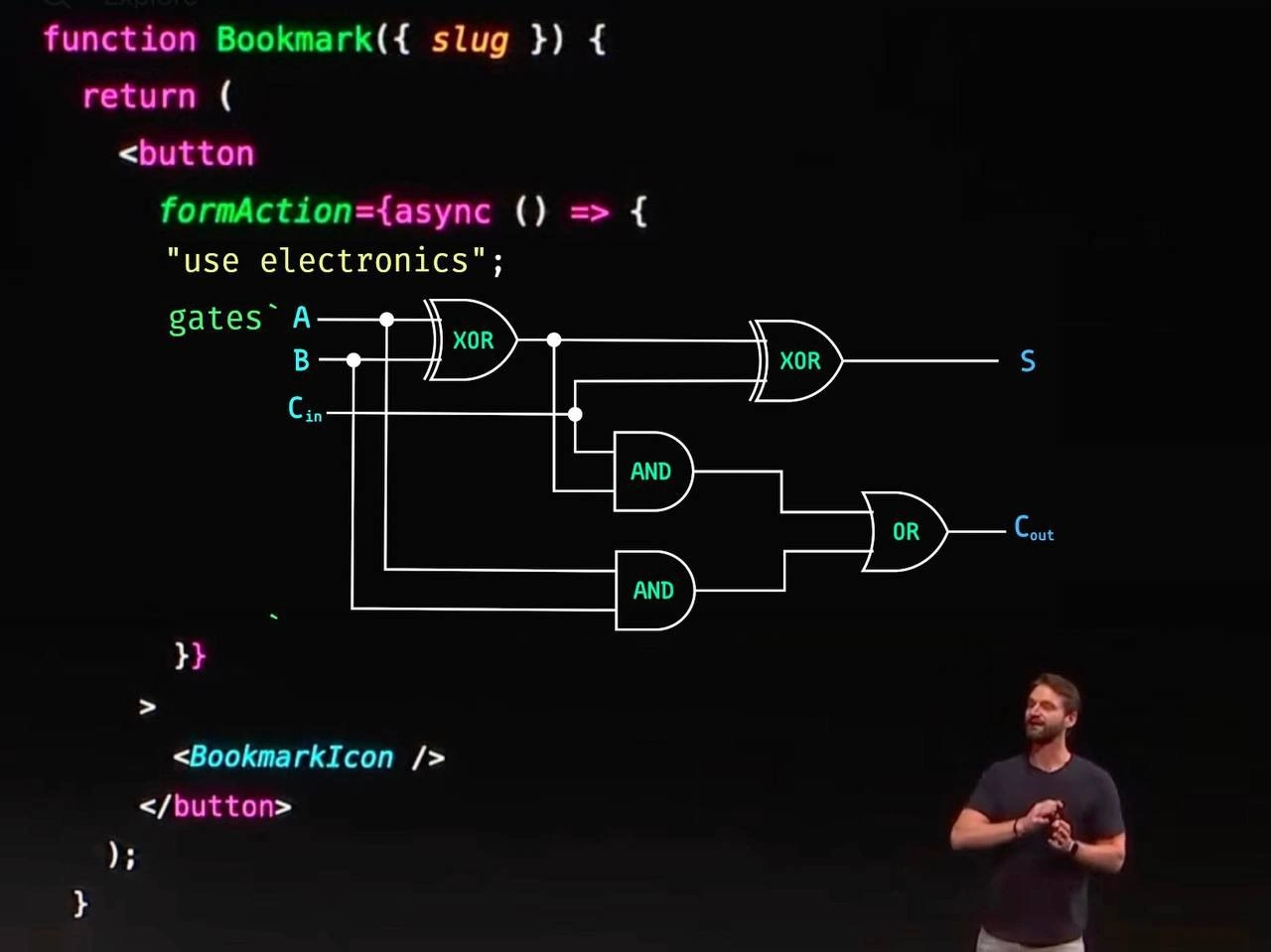
In the code on the slide, we have a React component defined as function Bookmark({ slug }) { … }. It returns a <button> element that presumably will bookmark something identified by a slug (a slug is usually a unique part of a URL, like an ID for an article or item – e.g., slug might be "post-123" to identify which post to bookmark). The interesting part is the attribute formAction={async () => { ... }} on the button. In plain HTML, a <button> inside a <form> can have a formaction attribute to specify where to send the form data. But here in React/Next.js, formAction is being used in a more magical way: they allow an async function to be attached directly to the form submission. That means when the user clicks this button, instead of just doing a normal browser form submit, it will trigger that async JavaScript function (often executing on the server). This is a new feature – essentially it lets React developers handle form submissions with actual code (even server-side code) without leaving the comfort of the component. It’s pretty cool! Normally, you might label that function with "use server" if you wanted it to run on the server.

But look what the meme’s code does: inside the async function, it has a line "use electronics";. This is not a real thing in React! 😂 It’s a joke, obviously. It’s written in the style of a directive (notice the quotes around it, similar to how one might write "use strict"; or "use client"; in code). By saying "use electronics", the code pretend-claims: “hey React, treat this function in a special way… maybe so special it runs on actual electronic hardware!” It’s poking fun at the idea of having to specify everything. As if now we have to tell our framework, “Please, use actual electrons and logic gates to execute this part.” The moment this fake directive appears, the slide shows a bunch of logic gates right next to the code. Those gates – labeled XOR, AND, OR – are basic components of circuits.

The diagram in white lines with letters A, B, C_in and outputs S, C_out is a classic full adder circuit from digital electronics. Here’s what that means: imagine you have two single-bit numbers (A and B, which can each be 0 or 1, like two binary digits) and maybe there’s a carry-in bit (C_in, which is like “did we have an overflow from adding the previous bits?”). A full adder will calculate the sum of these bits. It outputs S (the sum bit result of A + B + C_in) and C_out (the carry-out, which is 1 if the addition resulted in an overflow that needs to carry to the next higher bit). If you’ve ever added binary numbers, you know you add bit by bit, and if two 1s sum to 0 with a carry, that carry goes to the next addition – that’s what this circuit handles. The XOR gate (Exclusive OR) outputs true (1) if an odd number of its inputs are true. In this context, an XOR essentially adds two bits but ignores any carry (since 1 XOR 1 = 0 with a carry, XOR alone would give 0 for 1+1). So one XOR gate here is combining A and B for a preliminary sum, and the next XOR combines that with C_in to produce the final sum S. The AND gates output true only if both inputs are true – they are used to detect where a carry should occur. For instance, if A and B are both 1, then definitely a carry-out should be 1 (because 1 + 1 = binary 0 with a carry). Also if either A or B is 1 and C_in was 1, that produces a carry too. The outputs of those AND gates feed into an OR gate because if either condition for carry is true, the carry-out C_out becomes 1. Essentially: C_out = (A AND B) OR (C_in AND (A XOR B)). You can see the wires in the diagram following that logic. The bright teal labels XOR, AND, OR highlight which gate is which.

So, why is this circuit slapped on a React code snippet? This is where the humor kicks in. In a normal React presentation, you’d never expect to discuss actual circuits on a chip! React devs talk about things like state, props, maybe performance optimizations – but not about building an adder from logic gates. The meme creates a scenario where the two worlds – high-level web coding and low-level hardware design – are mashed together. The speaker in the corner (with face blurred, likely to anonymize them) is shown on stage, as if presenting this monstrosity at a conference, grinning and gesturing like “Look what we did!” It’s an absurd visual: a proud dev showing off that their React component now literally contains electronics. The phrase in the title “morphs into literal XOR gates onstage” captures that absurd transformation. It suggests that by simply using one more special directive ("use electronics"), the React code turned into a hardware diagram.

For a junior developer or someone new to these concepts, here’s the context: Frontend web development (with libraries like React) usually stays far, far away from worrying about transistors or logic gates – those are Hardware concerns. The reason this meme is funny is because it breaks that rule. It’s like someone took a basic web app function and said, “Actually, let’s implement part of it with physical circuits.” It’s an extreme joke about going “full stack.” You might’ve heard of full-stack developers — people who do both front-end (what the user sees) and back-end (the server, database, etc.). This meme jokingly extends the idea of full-stack to include the actual hardware stack too! 😄 In reality, no framework expects front-end devs to design circuits. But sometimes it feels like we’re asked to know everything. Modern web frameworks (Next.js, for example) are introducing concepts that require understanding a bit about how servers work, how bundlers work, and so on. To someone overwhelmed by all that, the meme says, “Well, at this rate, next you’ll have to know how a CPU adds numbers using XOR gates!”

The tags like javascript_compilation_memes and hardware_software_boundary describe exactly this scenario: it’s a meme about the idea of JavaScript (a high-level language) being compiled into something crazy low-level, and about the boundary between software and hardware disappearing. React itself normally runs in a browser or on a server as software. But if it were to “use electronics,” you’d be running things directly on chips. Of course, that’s not actually happening here – it’s a joke. The visual of the full adder is basically a nerdy punchline. It’s saying: “Look, our little bookmark button code is so optimized, it’s down to the raw bits and gates now.” The reason developers find this funny is because it’s a wild exaggeration of real trends. Every year, frameworks add new features to squeeze more performance or better developer experience, sometimes blurring boundaries (like mixing server and client logic). This meme takes it to an extreme for laughs: mixing frontend_meets_gate_level in one snippet. Even if you don’t get all the specifics of the circuit, the contrast itself is humorous. It’s as if a slide from an Electrical Engineering 101 class accidentally got overlaid on a JavaScript talk. The takeaway: It’s highlighting the absurdity of combining two very different layers of technology and how, sometimes, working in tech can make you feel like you have to know everything from React components to resistor circuits.

Level 3: From Hooks to Hardware

At a more approachable level, this meme lands as satire about modern web frameworks and their ever-increasing complexity – a joke experienced developers can really smirk at. React’s "use client" directive (recently introduced in frameworks like Next.js to distinguish client-side components from server-rendered ones) is already a new twist that developers must learn. The meme cranks it up to eleven by imagining the next absurd step: "use electronics", implying “run this code on actual hardware circuits.” The speaker on stage is gesturing proudly at a slide that merges a React/JSX snippet with a logic_gate_overlay – something you’d never see in a normal presentation. This juxtaposition pokes fun at how our industry loves collapsing layers for performance or capability. Today it’s client vs server components; tomorrow, will we be writing UI components that compile into FPGA logic blocks? It feels like a parody of a tech conference reveal: “One more thing... our components now compile straight to silicon for ultimate speed!” It’s absurd, but that’s the humor. Seasoned devs have a saying that a sufficiently ambitious framework eventually recreates the entire stack. Here, React (a Frontend library) seemingly absorbed Hardware design, turning a UI button into an adder circuit. It’s riffing on the trope that engineers keep reinventing solutions at different layers – e.g., high-level frameworks inadvertently reintroducing low-level problems. There’s irony and DeveloperIrony indeed: we abstract away details to make development easier, yet frameworks become so powerful or magical that we joke they’ll handle everything down to chip design.

The code on screen is a real-looking component: function Bookmark({ slug }) { ... } returning a <button> with a formAction. In Next.js’s App Router, formAction allows you to attach an async action to run on the server when the button is clicked (a fancy new feature to simplify data mutations without writing separate API routes). It usually involves writing an async function that the framework serializes and calls on the server – pretty high-level magic! The meme replaces the guts of that action with a pseudo hardware directive: inside the async arrow we see "use electronics"; instead of something like "use server";. This is a tongue-in-cheek reference to React’s conventions (like 'use strict' or 'use client' at the top of files) now being taken to ridiculous lengths. The moment we see "use electronics", the slide slaps a full_adder_circuit diagram on top, as if that string literally switched the mode from software to hardware. It’s a playful exaggeration of how a single keyword can change a lot in these frameworks – e.g., forgetting to put "use client" can break your component since it might default to server-side. Now imagine if forgetting "use electronics" meant your code wouldn’t auto-generate the needed logic gates – completely ludicrous, and that’s why it’s funny to devs. We often joke that with each new release, frameworks demand we learn something at a lower level: RealWorldTradeoffs like “oh, you want faster load times? You might need to think about bundler output, or even WebAssembly, or heck, maybe writing C++.” This meme takes that sentiment to the extreme: “You want even more optimization? How about designing circuits directly!”

For veteran engineers, there’s also a nostalgic chuckle here. Many of us learned about adders and truth tables in school (that OR gate and XOR gate combo is burned into our brains from basic CS courses). We never expected to think about them during a React UI talk! It’s the ultimate cross-domain surprise. It hints at the absurdity of being a “full-stack” developer today: not only do you need to know your FrontendHumor (React, hooks, state management) and backend APIs, now you also have to know LowLevelProgramming details like gate logic. Of course, in reality you don’t – but it can feel like that when frameworks get incredibly convoluted. The meme captures that engineering irony: the stack of technologies has grown so tall and complex that sometimes it collapses on itself. Engineers often say “all abstractions are leaky.” Here’s a leaky abstraction indeed – the details of binary addition are literally leaking into a UI component slide. The presence of a confident speaker on stage completes the joke: we’ve all seen enthusiastic tech leads or library authors unveil mind-bending features at conferences. This image imagines a presenter proudly treating a full adder diagram as the next shiny feature in a front-end framework. It’s a bit of self-deprecating industry humor. We push boundaries so much that one day a talk like “frontend_meets_gate_level optimization for React” might almost sound plausible. It’s a way of laughing at ourselves: we create higher-level tools to simplify development, yet we also celebrate doing incredibly low-level optimizations when needed. The meme says: Software folks, behold – we are now so full stack that we’re literally meddling with silicon. And if you listen closely, you can almost hear an old-timer grumbling, “Back in my day, we coded UI in plain JS. Now these kids are out here generating schematics on stage!”

Level 4: JSX to ASIC

At the deepest technical layer, this meme is highlighting a collision between high-level UI code and low-level digital logic. In the slide, we see a React component written in JSX (JavaScript XML) suddenly intertwined with a schematic of a full adder circuit. A full adder is a fundamental building block of computer arithmetic: it adds two single bits plus an incoming carry bit, producing a sum bit and a carry-out. The diagram superimposed on the code shows inputs A, B, C_in feeding into logic gates (two XOR gates, two AND gates, and an OR gate) to produce outputs S (sum) and C_out (carry). In formal Boolean algebra:

$$ S = A \oplus B \oplus C_{\text{in}} $$ $$ C_{\text{out}} = (A \wedge B) \vee (C_{\text{in}} \wedge (A \oplus B)) $$

These equations correspond exactly to the drawn gates: XOR (⊕) gates compute the sum bit, while AND (∧) and OR (∨) gates combine to compute the carry-out. In hardware terms, those teal XOR symbols are performing bitwise addition (excluding carries), and the AND/OR combination is gathering the carry conditions. This tiny circuit is what a CPU uses internally to add binary digits – it’s CS_Fundamentals 101 and lives deep in the realm of Hardware design. Normally, as front-end developers, we think about high-level abstractions (components, state, hooks), far removed from transistors. But here the meme collapses the abstraction stack: it visually inlines the ultimate low-level implementation (logic gates on silicon) right into a React code snippet. It’s as if the React code is being directly compiled to hardware. In theoretical terms, this evokes the idea of hardware-software co-design – usually the domain of embedded systems or FPGA programming, not web interfaces. There’s even a cheeky pseudo-directive "use electronics"; in the code, mimicking React’s special directives. This alludes to how frameworks might one day allow code to target not just server or client, but actual hardware circuits (a tongue-in-cheek nod to LowLevelProgramming). The humor is rooted in seeing the hardware/software boundary obliterated: a frontend UI component seemingly contains a full_adder_circuit. It’s a reminder that under the hood of any high-level app, down at the clock-cycle level, those familiar logic gates XOR, AND, and OR are churning away. The meme exaggerates this truth by literally showing a frontend_meets_gate_level scenario. For a seasoned engineer, this is deliciously absurd: we spend our careers working above layers of compilers and operating systems precisely so we don’t have to think about individual bits and logic gates – yet here they are, exposed on a conference slide as if React itself came with a hardware description language built-in. It’s a playful jab at the ever-increasing scope of modern tools, hinting that maybe the next frontier after “full stack” development is truly full stack, from UI down to silicon. The code’s structure even hints at a domain-specific language: notice gates` ... as if a template literal could describe hardware. This is not real JavaScript syntax anyone uses, but it parodies how one might embed an HDL (Hardware Description Language) snippet in JS. In an academic sense, the meme tickles the idea of JavaScript compilation to silicon – a wild concept, but not entirely impossible given projects that compile high-level languages to FPGAs or ASICs. It’s combining the world of Frontend development with the raw truth of computing: at the bottom, it’s all ones and zeros flowing through logic gates. By morphing a React "use client" directive into "use electronics" controlling actual gates, the meme paints a ridiculous yet conceptually intriguing picture of a framework that doesn’t stop at the usual abstraction layers. It’s a reminder of the computer science axiom that any software abstraction, no matter how lofty, ultimately boils down to physical signals — albeit we never expect to see that literal XOR gates depiction in a React code demo! The contrast is both technically profound and hilariously unexpected for those who appreciate how each abstraction layer works. This is the meme winking at us: “Look, we went from a React component straight to an ASIC design – how’s that for optimizing your render pipeline?”.

Description

A multi-layered meme parodying the complexity of modern web frameworks, presented as a tech conference slide. The top and bottom portions show a React code snippet for a 'Bookmark' component, featuring a `formAction` with the satirical directive '"use electronics";'. In the bottom-right corner, React core team member Dan Abramov is shown on stage. The center of the image, breaking up the code, displays a digital logic circuit diagram of a full adder, complete with inputs (A, B, Cin), outputs (S, Cout), and interconnected XOR, AND, and OR gates. This meme humorously exaggerates the hidden complexity behind the '"use server";' directive in React Server Components. It suggests that this seemingly simple line of code abstracts away a system as fundamental and intricate as the basic electronic circuits that form the foundation of computing

Comments

7
Anonymous ★ Top Pick I tried to use the 'use electronics' directive, but my component failed to render because I forgot to terminate the high-impedance state on the data bus
  1. Anonymous ★ Top Pick

    I tried to use the 'use electronics' directive, but my component failed to render because I forgot to terminate the high-impedance state on the data bus

  2. Anonymous

    Next-JS 14: Ship your server actions straight to the ALU - because why stop at edge functions when you can target literal edges on the die

  3. Anonymous

    When React's abstraction layers get so thick that you need a full adder circuit just to increment a counter, but at least now your state updates are deterministic at the transistor level

  4. Anonymous

    Ah yes, the classic React Server Components confusion: when the framework docs say 'use server' but you implement a full adder circuit instead. This is what happens when you take 'closer to the metal' literally in your frontend code. At least now your bookmark button can perform binary arithmetic at the gate level - because nothing says 'modern web development' quite like implementing a 1-bit adder in JSX. The real question is: does this count as server-side rendering or just really aggressive hardware acceleration?

  5. Anonymous

    React’s new “use electronics”: your formAction now has carry‑propagation latency - finally a UI where debounce meets metastability

  6. Anonymous

    'use electronics'; - the directive that fixes JS's floating-point woes with silicon-precision sums, no bitwise hacks required

  7. Anonymous

    Proof that every abstraction leaks: click a React button and somewhere an XOR flips; if design wants 64-bit, call it a ripple-carry UI and ask for two quarters of capacity planning

Use J and K for navigation