A FAANG Manager's Controversial Take on Open Source Contributions
Why is this Career HR meme funny?
Level 1: All Work, No Play
Imagine you love playing soccer so much that after team practice is over, you still kick the ball around in your backyard for fun. Now picture your coach finds out and gets angry. He says, “If you have the energy to play soccer at home for free, you must not be working hard enough during our official practice!” Then he benches you from the team as punishment. Sounds pretty silly, right? He’s treating your extra practice – which actually makes you a better player – as if it were a bad thing.
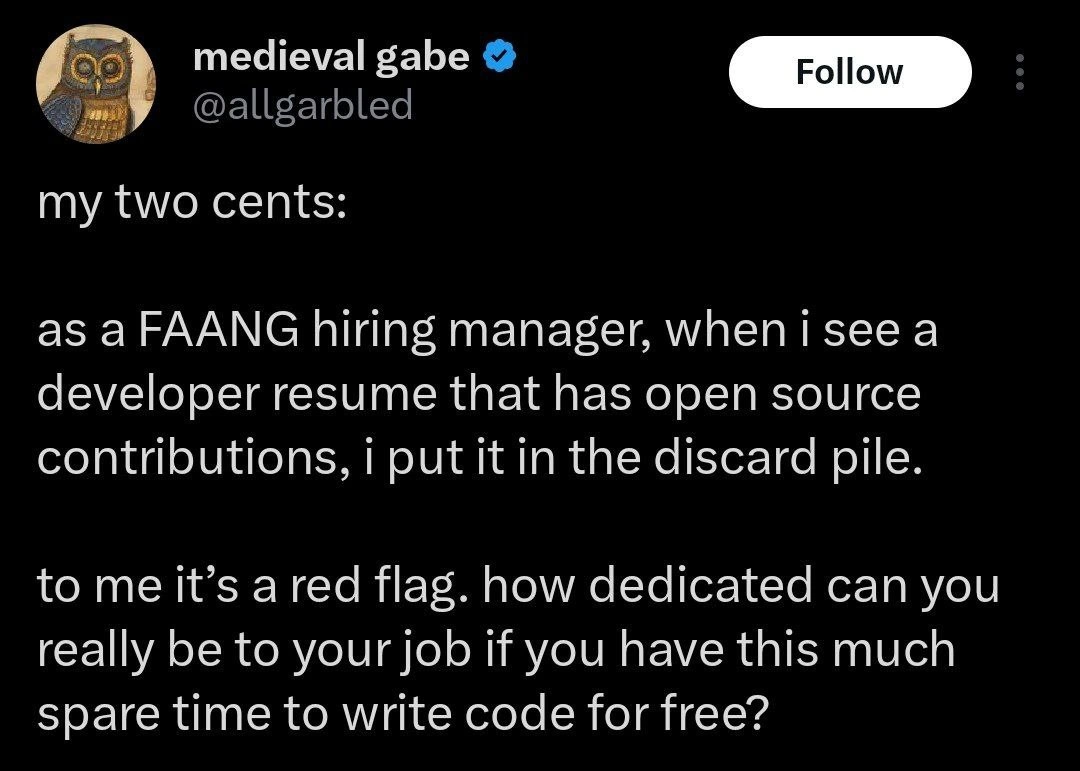
That’s exactly what this joke is about. In the picture, a big company boss claims that when a programmer writes code in their free time (just for fun or to help others), it’s a “red flag,” meaning he thinks it’s bad. It’s like saying, “No hobbies allowed, you should only ever do homework for me!” It’s funny because it’s so backwards: doing extra work on your own is usually a sign of passion and love for what you do. Most people would be happy to see someone so interested that they practice on their own. But this goofy manager acts like it means you’re not loyal enough to the company. In simple terms, the meme is laughing at the idea that caring and sharing (writing free code for everyone) could ever be seen as a negative. It’s pointing out how ridiculous it would be if someone in charge only wanted you to work and never play – all work, no play, which we all know isn’t fair or fun.
Level 2: FAANG vs FOSS
For those newer to the industry, let’s break down the clash in this meme. FAANG is an acronym for five big tech giants – Facebook (now Meta), Amazon, Apple, Netflix, and Google (now under Alphabet). These firms are famous for tough HiringPractices and prestigious jobs. A lot of developers dream of working there, and having cool projects on your resume (like an app you built or code you shared) is usually a plus. OpenSourceContribution refers to code you write and share with the world for free, usually as part of community projects. Think of posting a useful code library on GitHub or fixing a bug in Linux on your own time. It’s like volunteering in the coding world – you’re improving software for everyone, not just for your company or yourself. This is core to OpenSourceCulture, where knowledge and tools are freely available and built collaboratively.
Now, a resume red flag is a term recruiters use for anything on a candidate’s resume that suggests a potential problem. Common red flags might be things like unexplained long gaps in work history, very short stints at many jobs (job-hopping), or lack of any teamwork experience. Open source contributions, however, are almost never seen as red flags – quite the opposite! Typically, if a recruiter or hiring manager sees you’ve contributed to a well-known open source project or maintained your own successful project, they’re impressed. It shows initiative, passion for coding, and real-world experience working with code. Many junior devs are encouraged to do side projects or contribute to open source precisely because it can strengthen their resume and skills. In interviews, you might get asked, “What’s a cool project you’ve worked on?” and an open-source side-project is a great answer.
That’s why the tweet in the meme is so shocking (and funny) to developers. The person claims to be a FAANG hiring manager who discards any resume listing open source work. He literally says those contributions are a “red flag” – meaning a warning sign that the candidate isn’t good. The reasoning given is, “how dedicated can you really be to your job if you have this much spare time to write code for free?” In plain terms, he’s suggesting that if you have time outside your 9-to-5 job to code as a hobby, then you must not be working hard enough at your paid job. It’s an extreme take on ManagerExpectations: basically expecting employees to spend almost all their energy on the company’s work alone.
This goes against what most of us believe in the tech community. OpenSourceCulture frames coding for free as a generous, passion-driven activity. Many of the libraries and tools that FAANG companies use internally (and even open-source themselves) come from engineers who tinkered in their free time. For example, Google’s servers run on Linux, which is open-source, and Facebook created React and then gave it to the community as open-source. The idea that a big-tech manager would not want people who do the same kind of community work is ridiculously backwards. It hints at a kind of outdated corporate mindset: one that values “company men/women” who appear to devote every breath to their employer, and suspects those who have “spare time” projects as not sufficiently loyal or hardworking.
Let’s clarify a bit why someone might think this way. In some very intense work environments, there’s a belief that a top performer should be fully engaged at work – maybe even working overtime regularly. If you’re contributing to open source on the side, a boss like this might wonder, “Why aren’t you using that energy for our problems?” It’s a warped view of dedication. Instead of seeing open source work as you sharpening your skills or showing enthusiasm, they see it as you possibly holding back effort from the job. There’s also a hint of confusion about “writing code for free.” A manager with a purely business mindset might literally not understand why someone would code without pay – as if every bit of coding should be monetized or owned by a company. In reality, developers contribute to open source for many reasons: learning new technologies, gaining experience, giving back to the community, or simply because it’s fun.
For a junior developer or someone outside the tech bubble, the meme is saying: Believe it or not, there are bosses who think having programming hobbies means you’re a bad candidate. It’s a satire of HiringPractices gone wrong. The community finds it funny because it’s so out-of-touch – it’s basically an anti-pattern in hiring. If you saw this for real, you’d probably be relieved you dodged a bullet not working under such a manager. The meme highlights the tension between OpenSourceCulture (which values generosity and passion) and a certain toxic strain of CorporateCulture (which here values blind devotion to the company above all). Most modern tech companies do appreciate open source, so this tweet is likely a joke or troll, but it resonates as a cautionary tale: watch out for any job environment that doesn’t want you to grow or contribute beyond your day job.
Level 3: Open Source, Closed Mind
The meme calls out a CorporateCulture paradox that senior devs know all too well: companies feast on open-source software but frown when you contribute to it. A self-proclaimed FAANG hiring manager proudly declares that seeing OpenSource contributions on a resume is a “red flag” – an absurd bit of managerial_gatekeeping. The humor (and horror) here comes from the stark hypocrisy. Big-tech firms (Facebook, Amazon, Apple, Netflix, Google) run on open-source foundations – from Linux servers to libraries like React – yet this manager treats supporting that ecosystem as disloyalty. It’s like a chef whose restaurant uses free farm produce, then blacklists farmers who give away veggies.
In real life, experienced devs share a collective eye-roll at this hiring_hot_take. We’ve seen bizarre hiring practices, but tossing a resume for too much passion? That’s a new level of anti_open_source_bias. The tweet reads:
“how dedicated can you really be to your job if you have this much spare time to write code for free?”
Seasoned engineers recognize this toxic mindset. It idolizes all-consuming day jobs and suspects any side project as resume_red_flags of insufficient fealty. In some cutthroat teams, there’s an unwritten expectation that real devs eat, sleep, and breathe the company’s code – nights and weekends be damned. By that twisted logic, writing code for fun (or for the community) is practically treason. OpenSourceCulture values sharing and learning, but here it’s portrayed as a lack of loyalty. It’s a classic case of oss_vs_corporate_loyalty: the manager values a narrow notion of dedication (“Only code for us!”) over innovation or broader impact.
This is darkly funny because it’s a FOSS (Free and Open Source Software) red flag turned upside-down. Usually, having public code on GitHub or contributing to popular projects is a green flag – proof you love coding enough to do it off the clock. Many FAANG interviews even encourage talking about side projects. Here, though, an alleged big-tech manager claims the opposite, as if being a well-rounded developer is a deal-breaker. It satirizes a fear many devs have: that some old-school boss equates “spare time” with “slacking at work.” ManagerExpectations in such places can be medieval indeed – note the tweet author’s handle “medieval gabe”, winking at the archaic mindset.
Behind the sarcasm lies a real industry pattern: some organizations quietly discourage outside activities. A cynical veteran might recall clauses where any code you write – even at home – belongs to the company, or bosses who ask “Why aren’t you focusing 110% on our projects?” The meme nails this absurd priority. It’s also CareerHumor with a bite: if a FAANG manager truly thinks like this, they’d filter out many passionate developers – probably the very people who keep technology moving forward. It’s gallows humor for devs: “Sure, toss out the candidates who actually love coding. Good luck hiring your perfectly docile 9-to-9 coder drone!”
In short, the meme highlights the absurdity of managerial_gatekeeping that prizes blind corporate loyalty over community-driven improvement. It’s a jab at any manager who would rather have obedient grinders than creative engineers. The shared laughter (and groans) come from how backwards that is. After all, these companies owe much of their success to open source – rejecting contributors is not just ironic, it’s CorporateCulture self-parody. This resonates with senior devs who’ve seen laughable “red flags” come and go. Today it’s coding in your free time; tomorrow, who knows – maybe having a life outside of work at all? Nothing says dedication like making sure you have no personal passions, right?
def is_candidate_qualified(resume):
if resume.has_open_source_contributions():
# Red flag detected: candidate enjoys coding outside company control
return False # Disqualify for having a life
return True # Proceed with corporate loyalist
Above: A tongue-in-cheek snippet of how this FAANG manager might filter resumes. This spoofed logic captures the meme’s satire: valuing ManagerExpectations of total devotion over actual coding skill. The experienced engineers laughing at this know that if such filtering were real, it’s the company shooting itself in the foot. In practice, it’s more of an exaggerated cautionary tale – a reminder that any company treating passion and initiative as “red flags” has its priorities utterly upside down.
Description
A screenshot of a tweet from the user 'medieval gabe' (@allgarbled) with a profile picture of a stylized owl. The tweet, set against a black background, has the text: 'my two cents: as a FAANG hiring manager, when i see a developer resume that has open source contributions, i put it in the discard pile. to me it's a red flag. how dedicated can you really be to your job if you have this much spare time to write code for free?'. The post is a satirical take on corporate hiring culture, specifically within large tech companies (FAANG). It humorously presents an absurdly toxic perspective where a developer's passion for coding, demonstrated through unpaid open-source work, is viewed as a lack of dedication to their job. This resonates with experienced developers who are familiar with the often-unrealistic expectations and debates around work-life balance, 'hustle culture,' and how personal projects are valued in the industry
Comments
19Comment deleted
That manager probably thinks a pull request is a new gym exercise and that 'free software' just means the company saves on licensing fees
Sure, why trust someone who fixes your favorite dependency upstream when you could hire the engineer whose GitHub history looks like a pristine, decade-old SourceSafe repo?
Plot twist: This hiring manager's entire tech stack runs on open source projects maintained by developers with 'too much spare time' - from Linux servers to React frontends, all while their proprietary codebase depends on npm packages written by people who clearly aren't dedicated enough to deserve a FAANG job
Ah yes, the classic FAANG hiring paradox: 'We want passionate developers who live and breathe code... but only during business hours and exclusively for us. If you contribute to the very open source libraries our entire infrastructure depends on, clearly you're not committed enough to help us build yet another A/B testing framework.' Nothing says 'we value innovation' quite like penalizing developers for doing exactly what made the tech industry successful in the first place
Calling OSS on a resume a red flag is Goodhart's-law recruiting: optimize for engineers with no public PR scars, then wonder why your on-call runbooks read like NDAs
Hiring managers love OSS contribs - on their own GitHub profiles, where it pads the resume without the red flag
Open source contributions are a red flag - because anyone who can navigate maintainers, CLAs, and semantic versioning will notice our trunk-based monolith still on SVN behind a VPN
And what's wrong with his position? God damm genius Comment deleted
The guys don't only write code for money - they spend their free time increasing skills to be even better! It's true dedication. Comment deleted
While I respect the self improvement grind, stop working for free. Go outside and develop other skills. Spend your free time doing non-work related things. Comment deleted
Usually when customers ask for a discount I tell them on one condition that I release some part of code as open source. Open source may not be profitable but will give you lots of connections Comment deleted
What if this is our Passion? Also will you suggest to learn on something others funding or plan to keep funding effective? Or in a more simplified example, is it better to learn letters in a four line book at KinderGarden, or better to write in Paid magazine to learn letters? I prefer the first one! 🫣 Comment deleted
I mean you do you man. Keep working for free if you want. I will keep working when I'm paid to and enjoying my time away from codebases when I'm not. Comment deleted
It's a sound work-life balance and likely comes with a decent salary. However, it lacks true dedication. This mindset confines you to repetitive, mundane tasks. It risks diminishing your enthusiasm, assuming it hasn't already, and could lead to stagnation, which in development equates to degradation. Comment deleted
I dedicate myself to living outside of the office. I come here to work and make money and then I go home and do what I actually enjoy. Your first sentence was correct. Good work life balance with good pay. Comment deleted
code enjoyer vs. free time enthusiast Comment deleted
better for us, tho Comment deleted
Lol, good luck, I'm being paid to write the open-source in my company 😅 Comment deleted
What are those colored badges under usernames? Comment deleted