Sarcastic Random Error Message from an Uncaring System
Why is this Bugs meme funny?
Level 1: Error for No Reason
Imagine you’re in class and you’ve been doing everything right for a while – all your homework is correct and the teacher hasn’t scolded you at all. Then one day, out of nowhere, the teacher marks a perfectly correct answer of yours as wrong and says, “You haven’t made any mistakes recently, so I’m giving you this error just because I felt like it. Don’t think I actually care about being fair.” Sounds crazy and unfair, right?
That’s exactly the silly feeling this picture is joking about, but with a computer. The computer pops up a message that’s basically, “Hey, you haven’t seen an error in a bit, so here’s a random error for no real reason. We still don’t care about helping you, by the way!” It’s like a prank. In real life, computers normally show errors only when something is actually wrong. But this old-school style joke is funny because the computer is acting like that mean teacher – giving you trouble even when you did nothing wrong. It’s a surprise error for no reason at all, and the fact that it admits “we haven’t started caring” is just the cheeky cherry on top. Even if you’re not a computer expert, you can laugh at the idea of a machine being that randomly rude and uncaring. It’s basically a goofy way to say: sometimes computers (especially old ones) seemed to mess with us just because they could!
Level 2: Old-School Error Pop-up
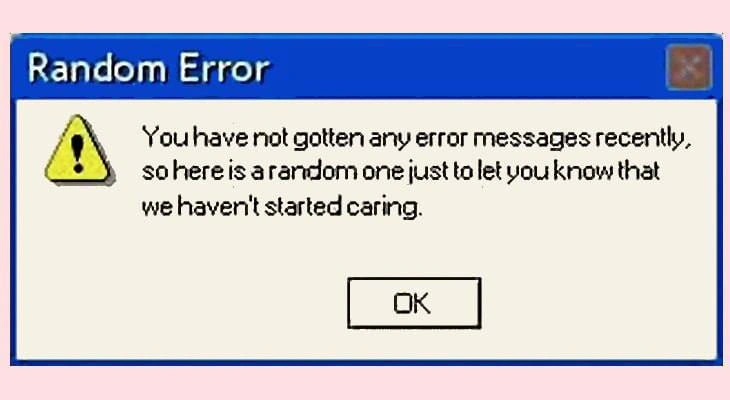
Let’s break down what’s happening in this meme. We see a retro Windows 95-style error dialog box. It has the classic blue title bar saying "Random Error" and that little [X] close button on the top-right. Inside the box is a yellow triangle with an exclamation mark – that icon means a warning or error message is being shown. The text of the message humorously says you haven't gotten any errors recently, so here's a random one to remind you that "we haven't started caring." There's an "OK" button at the bottom for you to acknowledge the message (as if saying "gee, thanks" to the computer).
Why is this funny to developers? It’s highlighting how older Operating Systems and programs (especially from the 90s) often gave really unhelpful ErrorMessages. In the early days (like with Windows 95 and other LegacySoftware), if something went wrong, you'd get a pop-up like this that might as well have said, "Something bad happened. Oh well." There usually wasn’t much explanation or guidance. You’d click "OK" and just be left wondering what the heck that was about. The meme exaggerates this by making the error message deliberately pointless – it literally says the system is giving you an error for no real reason and that it doesn't care. Of course, no real software would admit that, but it captures how we felt about those cryptic pop-ups: it was like the computer didn’t care about our time or sanity.
Now, the title mentions error budgets being wishful thinking. An error budget is a modern idea from Google's Site Reliability Engineering (SRE) practice. It’s basically a tolerance for errors – for example, if you aim for 99.9% uptime for a service, that 0.1% downtime is your “budget” for things to go wrong. If you don't use up that budget (i.e., if you have fewer errors than expected), great! But this meme jokes that in a system like Windows 95, even if you had a plan for how many errors are “allowed,” the system might randomly throw extra errors anyway. In other words, planning for reliability is hard when the software is unpredictable. The phrase "just wishful thinking" means that any hope of controlling or budgeting errors in such an environment is probably naive. The old system will do what it wants, budget be damned.
Also mentioned is structured logging. Logging means recording what a program is doing (especially when errors happen) to some file or system so developers can read it later. Structured logging means those logs are in a consistent format (like as JSON, or with specific fields for error codes, messages, etc.) that makes them easier to search and analyze. Today, developers love structured logs and detailed error reports – they help in debugging issues quickly. But back in the Windows 95 era, logs were often just plain text (if they existed at all) and error messages were mostly these pop-up dialogues. There wasn’t a convenient centralized place to see everything that went wrong. For example, Windows had an Event Viewer, but many home users didn’t even know it existed. So "pre-structured-logging era" refers to those days when we didn’t have fancy logging setups. If a program crashed, sometimes all you got was a small dialog saying something like "Error: Something went wrong [OK]." Not very helpful!
In simpler terms: this meme is calling back to the Bugs and quirky behavior of older systems. It shows a fake Windows 95 error message that basically says, "You haven't seen an error in a while, so here's a random error because we still don't care." It’s a form of TechHumor making fun of how capricious (and frustrating) older computers could be. Developers who’ve been around a bit laugh at this because they remember those days. And even newer folks can understand the joke: imagine software purposely complaining for no reason – it’s absurd, right? Yet, when a program gives you an unhelpful system message, it feels like that: you’re left thinking, "Great, the computer is throwing errors just to troll me now."
Level 3: The OS That Cried Error
"You have not gotten any error messages recently, so here is a random one just to let you know that we haven't started caring."
This tongue-in-cheek Windows 95-style dialog is a nostalgic jab at LegacySystems and their unapologetically unpredictable error handling. It parodies an era of OperatingSystems when getting a bizarre error popup was normal, often with no helpful info. The meme text explicitly admits the indifference we seasoned engineers always suspected: the system throws an error just because, implicitly saying "we still don't care about your sanity."
In modern reliability terms, this is like the system wantonly burning through your error budget for no reason. An error budget (a concept from Site Reliability Engineering) is supposed to be the allowed amount of failure (e.g., downtime or errors) your system can have before it breaches its Service Level Objective. But here the OS is basically saying, "Oh, you had 0 errors so far? Let me introduce a random one to keep things exciting." It's a cynical twist on Murphy's Law: if everything’s quiet, something will break. The result? Any careful planning of failure rates becomes wishful thinking when a legacy application can cough up a phantom error out of nowhere. In other words, an old-school system doesn't care about your fancy SRE metrics or uptime guarantees – it'll toss out a needless ErrorMessage like this and laugh in packets.
Technically, the meme highlights how LegacySoftware (like the Windows 95 family) lacked the robust error handling and logging we expect today. There's a yellow warning triangle icon (the classic ⚠️ used for non-critical errors) and a generic "Random Error" title, mimicking the exact UI of a Windows 9x dialog box. Back in the pre-structured-logging era, when something went wrong, you might get a modal dialog or a cryptic message box. No JSON logs, no centralized tracing — just a pop-up interrupting your workflow with a vague one-liner. The message here is obviously satirical (no real OS would confess "we haven't started caring"), but it feels true because so many old error messages were effectively just as unhelpful. How many times did we see "An unknown error occurred" or "Error 0x8000FFFF" and think, great, what am I supposed to do with that? It often felt like the system was mocking us. This meme captures that exact exasperation and exaggerates it for effect.
For seasoned devs, it triggers war stories: late nights rebooting a Windows 95 PC because some random BugsInSoftware threw an error box that wouldn't go away, or editing AUTOEXEC.BAT in safe mode without any guidance beyond a terse error line. Structured logging and graceful error handling were not priorities in consumer OS design back then. The meme essentially nods to the fact that robustness and caring about errors weren't in vogue yet. It's poking fun at the gap between modern software practices and the wild-west of 90s computing. We have to chuckle (perhaps a bit bitterly) because at times it really did feel like the system was intentionally messing with us.
And yes, it's hilarious in hindsight. The dialog’s phrasing is so blunt and cynical that it reads like the OS patch notes from an alternate universe. TechHumor like this lands well with developers who have been around long enough to remember when OperatingSystems would slap you with a message that basically shrugged. Today, we talk about five-nines reliability and crafting user-friendly error guidance. Back then? Getting a message box at all meant something went wrong, and beyond that the computer usually didn't give a binary dime about details. As the meme deftly illustrates, error budgets or not, an uncaring legacy system will do whatever it wants — even fabricate errors — leaving us engineers rolling our eyes and mumbling "Classic...".
// Pseudo-code of a legacy system throwing an error for no good reason
if (noErrorRecently()) {
// The OS decides to remind you it's still unreliable
MessageBox(NULL,
"Here is a random error, because why not?",
"Random Error",
MB_OK | MB_ICONEXCLAMATION);
// No helpful logs, just this obnoxious popup...
}
Description
The image displays a classic Windows XP-style error dialog box. The window has a blue title bar with the text 'Random Error' and a red 'X' close button in the corner. Inside the dialog, there is a yellow triangular warning sign with an exclamation mark. The main text of the error message reads, 'You have not gotten any error messages recently, so here is a random one just to let you know that we haven't started caring.' Below this message is a single 'OK' button. The humor is derived from the anthropomorphic and sarcastic nature of the error message. It parodies the often unhelpful and impersonal nature of system errors by presenting a fictional one that is explicitly hostile and indifferent to the user's experience. This resonates with developers who have spent countless hours debugging cryptic or useless error messages, imagining a system that is actively working against them
Comments
11Comment deleted
This is what happens when you set the logging level to 'passive-aggressive'
SREs call it an error budget; Windows 95 just used a random number generator and called it a feature
This is what happens when you finally achieve five nines uptime - the monitoring system gets so bored it starts generating synthetic incidents just to validate that the PagerDuty integration still works and your on-call rotation hasn't atrophied from disuse
This perfectly captures the evolution of enterprise error handling: from 'something went wrong' to 'nothing went wrong, but we're contractually obligated to interrupt your workflow anyway.' It's the logical endpoint when your observability platform's SLA requires a minimum number of alerts per quarter, regardless of actual system health. Peak product management: turning the absence of problems into a problem
Our pager does this too - when the error rate is quiet, it fires a “health check” alert to prove the system can still annoy humans at scale
This is what happens when you mistake the error budget for an error quota - someone ships a daemon that pops random dialogs to prove the logging pipeline still works
The one error message with perfect reliability: it fires exactly when your SLOs start looking too good
Why does a random error has a warning icon? 🤓 Comment deleted
What icon would you expect it to have? 🤔 Comment deleted
MB_ICONHAND Comment deleted
MB_ICONERROR Comment deleted