Resident Evil 4 Inventory Management as an Analogy for Code Optimization
Why is this Games meme funny?
Level 1: Puzzle-Packing Your Bag
Think about packing your toy box or backpack like a puzzle. You have a bunch of different things: a big teddy bear, some books, a pair of shoes, and even a toy fish. One way is to just toss everything in – but then you might run out of space or the lid won’t close. Now imagine your friend insists on arranging every item carefully: the shoes go in the corners, the books lay flat at the bottom, the teddy bear is squeezed just right, and that toy fish is turned sideways to fill a gap. Your friend is smiling proudly because everything fits perfectly, like pieces in a jigsaw puzzle. They even announce, "See? It's more efficient!" as if packing is a game they just won. It's funny because, in a normal situation, most people wouldn't care that much about a tiny bit of space in the bag. But we all know someone (or maybe we are that someone) who loves things to be super neat and optimized. Watching a person treat a simple task like a serious puzzle – and get excited about saving space – makes us laugh. It's that mix of admiration (for the clever packing) and amusement (because it's a bit over-the-top) that makes the scene so relatable and silly.
Level 2: Suitcase Tetris
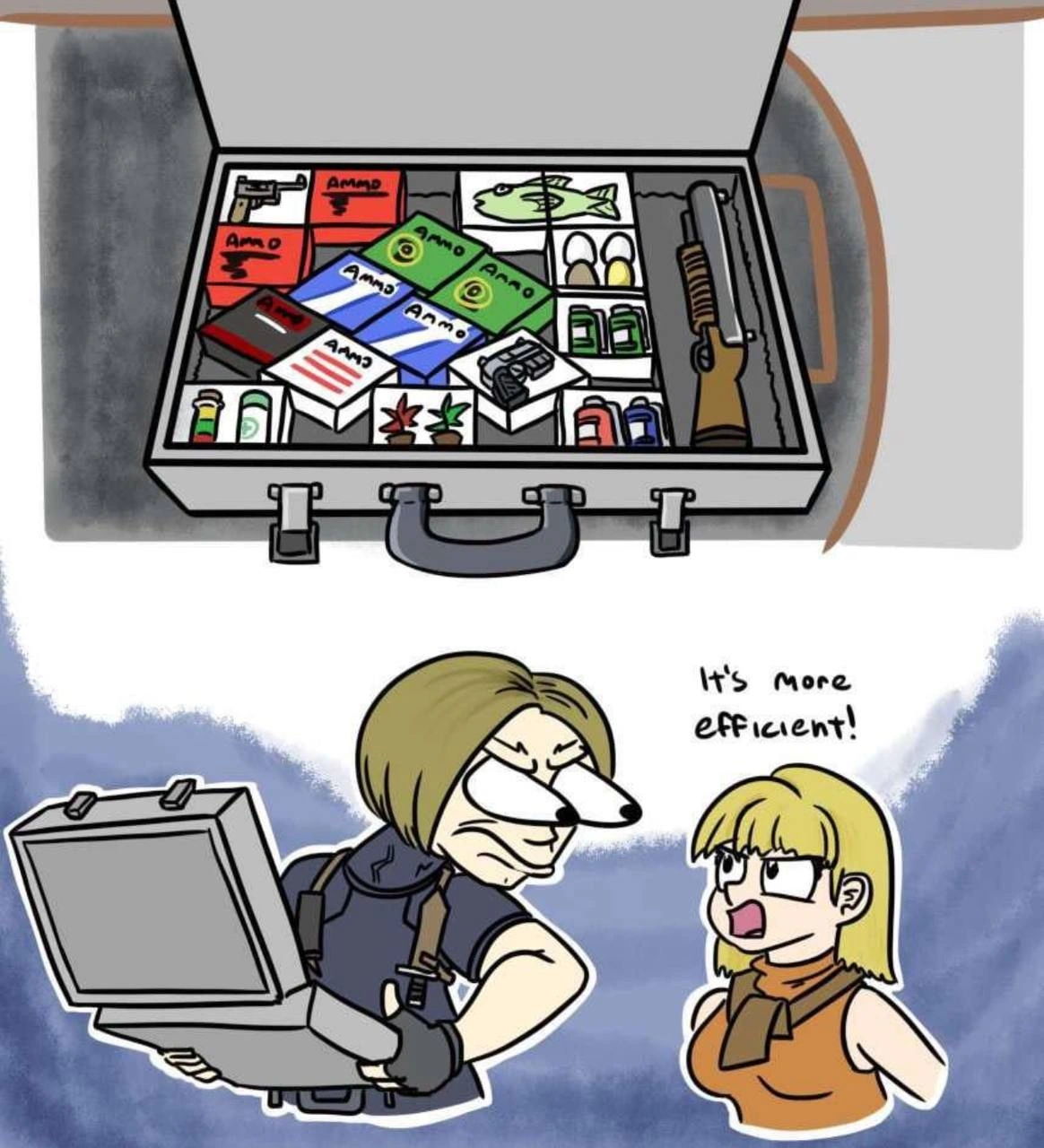
This meme is basically comparing a backpack (or suitcase) packing puzzle to what programmers do with code for efficiency. In the top image, which is styled like an inventory from Resident Evil 4, we see a briefcase with a neat grid. Every item – the red and green ammo boxes, the herbs (healing plants), the first-aid sprays, a big fish, and even a shotgun – is placed without wasting a single square. In that game, each item occupies a few grid squares, and you can rotate or move them. It’s literally like playing Tetris: you try to fit different shaped pieces together so there's no empty space. People jokingly call it "inventory Tetris" because you spend time arranging items just to make everything fit nicely.
Now, a bin-packing algorithm is a computer method of solving a similar problem: given a bunch of stuff of different sizes, how do you pack it into a limited space (or into as few containers as possible) without overflow? Imagine you have 10 different books and only a small box – you want to pack those books without leaving gaps, or without needing a second box. The algorithm’s job is to figure out a good way to do that. It's actually known to be a tricky problem for computers (there's no quick formula that guarantees the absolute best packing every time once you have lots of pieces; they'd have to try many combinations). But humans do a decent job intuitively for smaller sets – like when you instinctively know how to arrange your suitcase or car trunk. In programming contests or classes, you might encounter simplified versions of these problems to learn about algorithm design and how we analyze an algorithm’s efficiency (called algorithm complexity analysis). The bottom line: the meme’s hero turning his backpack into "a real-time bin-packing algorithm" means he's treating packing his bag like a serious computer puzzle to solve optimally on the spot.
For developers, this relates to how we manage memory in programs. Think of computer memory as a big storage room where our data lives. If we put data in randomly with gaps in between, we might waste space or cause the computer to work harder to find things. One concept in programming is memory management, which includes making decisions about where and how to store data. A senior programmer might say, "Hey, if we store these pieces of data next to each other and in the right order, we can save a lot of space and make the program run faster!" This is like arranging the items in the briefcase carefully. In fact, there’s something called structure padding: if you have a data structure (like an object with multiple fields), the computer might insert little empty bytes to align things for speed. By rearranging fields, you can sometimes remove those bytes so the structure uses less memory (no empty gaps). It's a very real "packing" problem programmers deal with, especially in systems programming.
Then there's the idea of cache. Computers have different levels of memory, and the CPU (the brain of the computer) operates fastest with data stored in a special fast memory called cache. But that cache is tiny, so it grabs data from the main memory in chunks (those 64-byte pieces called cache lines). If your data is all in one chunk, the CPU can get it in one move, which is super fast. If it's scattered, the CPU has to fetch multiple chunks. Think of it like picking apples: it's quickest if all the apples you need are in the same basket (one trip), rather than having to go to multiple baskets one by one. So programmers sometimes reorganize data so that things that are used together are physically stored close together. That way, when one piece is needed, the others likely come along for the ride in the same cache line, speeding things up. This is one of those efficiency-in-coding tricks that you learn as you dig deeper into performance.
The fun part of this meme is the attitude. Leon is treating his inventory arrangement as if it's the most important mission, proclaiming efficiency gains like a proud engineer. Many new developers eventually chuckle at this because they've seen (or done) something similar in coding: like spending hours to optimize a function that maybe didn't need it, just for the challenge or satisfaction. It’s an inside joke about optimization trade-offs. Yes, you can invest a lot of time to make something very efficient, but you should ask: is the benefit worth the effort? In the game context, reorganizing the briefcase perfectly might only give a tiny advantage (maybe you fit one extra grenade). In coding, tweaking an algorithm might only save a few milliseconds. The joke is that sometimes we do it anyway, because it's cool to see everything line up perfectly. And when someone asks why you're bothering, well, you answer just like in the meme: "Because it's more efficient!".
Level 3: Min-Maxing Inventory
This meme nails a certain developer archetype: the engineer who can't resist micro-optimizing everything. It's funny because it exaggerates that habit to an absurd scenario. Here we have a video game hero — Leon from Resident Evil 4 — who should probably be worried about zombies, but instead he's fixated on perfectly arranging his inventory. As he thrusts the closed briefcase at his confused companion and scowls "It's more efficient!", every seasoned developer can imagine a colleague (or themselves) with that same obsessive conviction about a piece of code or system design. The combination of elements is spot-on: a survival game inventory (usually a frantic mess) transformed into a flawless Tetris grid, and a badass character acting like a persnickety sysadmin about it. It's the juxtaposition of high-stakes action with nitpicky optimization that makes us laugh.
In real software teams, this pattern plays out when someone optimizes beyond the point of practical return. Perhaps you've seen it: a senior dev spends half a day refactoring some low-level routine, aligning data structures just right or shaving off minor CPU cycles, and then proudly declares, "Now it runs 5% faster!" Meanwhile the junior dev or project manager is like the bewildered companion in the meme, blinking and thinking, "Was that really necessary? We have bigger things to do." The humor here is that we recognize both sides: the deep satisfaction in making something maximally efficient, and the outsider perspective that maybe it's overkill. The meme captures that shared experience with the visual of a perfectly packed case that arguably didn't need to be that perfect.
This speaks to optimization trade-offs and the culture around them. On one hand, performance tuning is important – in some domains like game development, embedded systems, or high-frequency trading, packing data tightly or optimizing algorithms can be the difference between success and failure. A senior engineer who's been through tough performance bugs knows that sometimes seemingly trivial inefficiencies (like wasted memory or extra computation) can balloon into issues at scale. So there's a bit of respect in the joke too: Leon’s fastidious packing is the kind of thing that saves you when resources are limited (he can carry that extra first-aid spray because he made space, just like an old-school dev fits a feature into 64KB of RAM by clever packing). This is performance optimization in spirit. On the other hand, there's a reason we joke about "premature optimization." Time is a resource too, and spending hours to optimize something that isn't a bottleneck hurts developer productivity. The meme illustrates this trade-off by showing how ridiculous it looks when focus on efficiency eclipses common sense (fighting monsters vs. sorting your briefcase).
There's also a bit of affectionate ribbing of senior engineers here. The protagonist's intense expression is basically saying, "Trust me, this matters!" – a face we've seen on developers who dive deep into assembly code or algorithmic fine-tuning while others shrug. The line "It's more efficient!" becomes a mantra that justifies any amount of fussing. It's the same energy as insisting on using a complex bitwise hack in C because it saves a few bytes, or writing a custom memory pool allocator for a program that probably doesn't need it – actions driven by a kind of pride in mastery of fundamentals. The blond companion's confusion mirrors the team members who might not immediately grok why such low-level detail is worth the trouble. It's a dynamic many devs recognize: the seasoned performance guru versus the pragmatist.
Historically, this mindset comes from a place of necessity. Back in the day, computing resources were scant – older games and software had to fit in tiny memory spaces and run on slow CPUs. The folks who wrote those had no choice but to become memory Tetris champions. So today's senior engineers, especially those who learned in that environment (or in systems programming), carry that torch of efficiency. They have a bit of the "Leon attitude" ingrained: never waste an opportunity to optimize. The irony is that modern environments, with gigabytes of memory and fast processors, often don't require that level of micro-tuning for everyday apps. That’s why seeing Leon do it in a modern meme format is comedic: it's a bit old-school, a bit over-the-top, but undeniably impressive too. It's like seeing someone solve a Rubik's cube blindfolded – you think "wow, that's skill", and also "was that really needed right now?"
In summary, the meme is hilarious because it blends a CS_Fundamentals problem (packing efficiently) with a developer personality trope. It reminds us of those times we've gone on an optimization bender for the pure satisfaction of it. And it lightly chides us that maybe, just maybe, stopping mid-crisis to perfectly organize your pack (or your code) might be missing the forest for the trees. Yet, we admire it because when the going gets tough, that obsessive optimizer might just save the day – or at least fit one more crucial item in the bag.
Level 4: NP-hard Inventory Tetris
Deep down, this meme highlights a classic combinatorial optimization challenge hidden in plain sight: the bin-packing problem. Here, the "bins" are the grid spaces in a game inventory and the "items" are guns, ammo, and even a fish. In theoretical terms, bin packing (and its cousin, the knapsack problem) is known to be NP-hard – meaning as the number of items grows, finding the perfect packing arrangement becomes exponentially difficult. It's the same type of intractable problem that makes optimizing things like cutting stock or scheduling tasks so computationally tough. Fun fact: even the game Tetris relates to this – filling a rectangular space with shapes optimally is, mathematically, an NP-complete problem! So when our hero’s briefcase looks impeccably organized, it’s because he (probably unknowingly) solved a small instance of a very hard problem. The humor is that he's doing this complex packing dance in real time, something that would flummox an algorithm if the case were much larger. Yet, gamers manage it with quick heuristics – a testament to human spatial reasoning playing the role of a greedy algorithm.
In practice, neither games nor computers try to perfectly solve NP-hard packing every time – they use clever shortcuts. Leon (the character here) is effectively using a heuristic: maybe he's grouping items by size, rotating them to fill gaps, like a human approximation of a first-fit decreasing algorithm (a common strategy for bin packing where you sort items by size and then try to fit them sequentially). The attaché case in Resident Evil 4 gives a constrained playground where a player can manually brute-force the best layout since the inventory isn't huge. But the phrase "real-time bin-packing algorithm" in the meme title jokes that Leon has basically become a living algorithm, optimizing his inventory on the fly as if solving a live computing problem.
This obsessive packing has a perfect parallel in computer engineering: memory layout optimizations. Just as Leon arranges ammo boxes and herbs with no empty cells, a low-level programmer might arrange data in memory to avoid any wasted space. For instance, in languages like C/C++, struct fields can be reordered to eliminate padding bytes (empty gaps the compiler might insert to align data). By carefully packing a struct or using bit-fields, you solve a one-dimensional bin-packing problem: fitting data into the smallest memory footprint. The benefit? Better use of the CPU cache and memory. A cache line (usually 64 bytes long in modern CPUs) is like a row in that briefcase – if you can fit all needed info into one cache line, the processor can grab it in one go with no leftovers. Cache locality is the term for keeping related data close together, and it's a big deal for performance. An optimization nerd will sometimes redesign data structures so that, say, an array of objects stores frequently-used fields contiguously, ensuring sequential memory access (much like contiguous ammo boxes) and avoiding the dreaded cache misses that happen when data is scattered (like items tossed randomly in a bag).
Even at the operating system level, there's an analogous issue called memory fragmentation. Over time, as a program allocates and frees memory (imagine picking up and discarding items), the memory can end up with gaps – free spaces that are too small to use effectively. It's akin to an inventory with weird single-cell holes that no item can fill. Memory allocators use strategies with names like buddy allocation or compaction to mitigate fragmentation – conceptually, they shuffle or split memory blocks to group free space together, not unlike reorganizing an inventory to consolidate empty slots. This is essentially a bin-packing problem in the wild: the OS must decide how to place various-sized allocation requests into the memory space efficiently. And as with our hero’s case, finding the optimal placement each time is impractical, so the OS relies on heuristics and occasional tidy-ups (garbage collection or memory compaction) to keep things reasonably efficient.
The brilliance of the meme is tying this pedantic efficiency to a relatable visual. It winks at those of us who know that behind simple organization lies serious computational theory. There's an ironic truth: a senior engineer optimizing a program's memory layout is doing the same kind of thing as Leon meticulously fitting a green herb next to a hand grenade – both are solving a packing puzzle for performance reasons. However, in computing, we often caution against spending too long on these puzzles unless necessary (because NP-hard problems can eat up a lot of time for little gain). That’s why seeing it in an over-the-top context (a zombie game hero glaring and saying "It's more efficient!") is funny. It merges a CS fundamental (efficient packing) with a tongue-in-cheek portrayal of how extreme an efficiency nerd can get. Essentially, the meme operates on the contrast between the arcane complexity of what's happening (solving an NP-hard problem, optimizing cache usage) and the absurd simplicity of the situation to an onlooker (just packing a bunch of items in a case). It's a love letter to optimization geeks wrapped in a joke.
Description
The image is a two-panel cartoon meme referencing the video game 'Resident Evil 4'. The top panel shows the game's iconic inventory attaché case, meticulously organized with weapons, ammo boxes, herbs, and even a fish and eggs, arranged in a grid-like fashion similar to the game's inventory system. The bottom panel depicts the game's protagonist, Leon S. Kennedy, with a comically intense and stressed expression, holding the open case and yelling, 'It's more efficient!' at the character Ashley Graham, who looks on with a concerned expression. The humor comes from applying the obsessive, grid-based inventory optimization from the game to a real-world scenario, where such meticulous packing would seem absurd. For developers, this is a relatable metaphor for the endless pursuit of optimization in their code or systems. They can spend hours arranging data structures, refactoring algorithms, or configuring build tools for marginal gains in efficiency, a process that can seem nonsensical to outsiders but is a core part of the engineering mindset
Comments
10Comment deleted
This is me after spending a day reducing the CI/CD pipeline runtime by 15 seconds. The product manager doesn't get it, but my soul is at peace
Sure, the QA team calls it “overkill,” but anyone who’s wrestled with malloc fragmentation knows Leon’s briefcase is basically a visual malloc with zero heap churn
After 15 years of watching junior devs optimize database queries that run once at 3am while ignoring the N+1 query in the main user flow, I've learned that 'It's more efficient!' is developer-speak for 'I spent the weekend reimplementing a standard library function to save 3 nanoseconds on a background job that runs monthly.'
This is the architectural equivalent of implementing a microservices mesh with service discovery, circuit breakers, and distributed tracing for a CRUD app with three users. Sure, the briefcase *could* hold ammunition, currency in four denominations, emergency rations, and tactical equipment - but when you're just carrying air, maybe a Ziploc bag would've sufficed. Classic case of solving tomorrow's scale problems today while the actual requirement is 'store nothing efficiently.' The real kicker? That empty briefcase probably took three sprint planning sessions and a architecture review board to approve
Classic 2D bin-packing - we'll Tetris the inventory for 'cache locality' while the N+1 query still throttles prod
'It's more efficient' is senior-speak for: we applied first-fit decreasing to the inventory; optimal packing is NP-hard, but those aligned rectangles make the cache feel faster
DevOps justifying a 4GB Docker image stuffed with vi, gcc, and redis: 'It's more efficient!'
This triggers my OCD sooo bad Comment deleted
https://kingbird.myphotos.cc/packing/squares_in_squares.html Comment deleted
wtf am i looking at 💀 Comment deleted