The definitive O'Reilly guide to vibe-driven development
Why is this Juniors meme funny?
Level 1: Playing Dress-Up
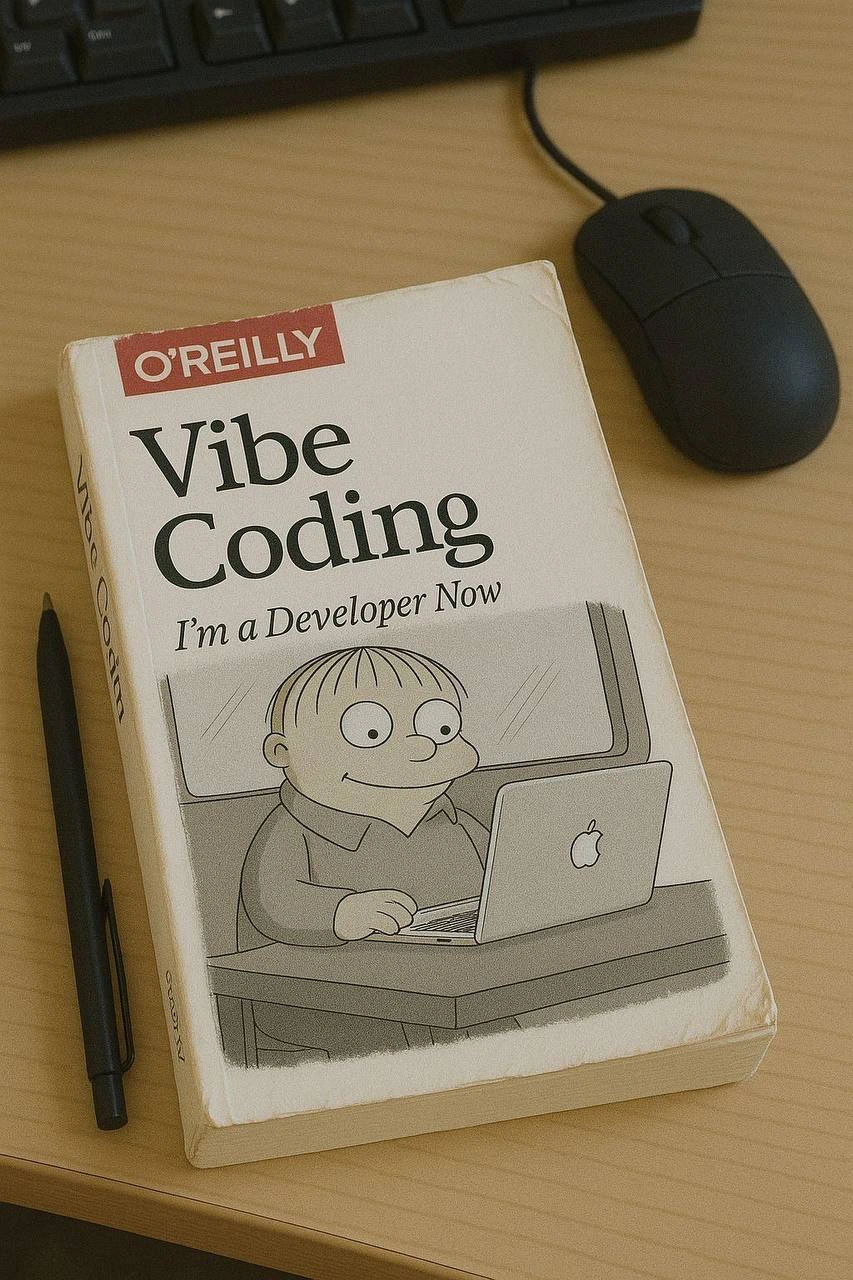
This meme is funny in a very simple way: it’s like a child playing pretend and thinking they’re a grown-up after doing something small. Imagine a little kid putting on a toy astronaut helmet after reading a space story and proudly announcing, “I’m an astronaut now!” We know it’s adorable because the kid has so much more to learn before they can actually fly a rocket. In the same way, the meme shows a “Vibe Coding” book that makes a beginner feel like, “I’m a real developer now!” just because they followed their feelings and got something working. It’s cute and silly because becoming really good at coding, like any skill, takes a lot of practice and knowledge – more than just one book or a few quick tricks. The humor comes from that innocent confidence. We laugh not to mock, but because it reminds us of a kid dressing up in a lab coat and saying, “Look, I’m a doctor!” It’s that heartwarming, relatable kind of funny, where you see someone’s excitement to be something great, even if they’re only at the very beginning of their journey.
Level 2: Hello World Vibes
Let’s break down the meme in simpler terms. It shows what looks like an official programming book, with the famous O’Reilly label at the top. O’Reilly Media is a real publisher known for its high-quality programming books – if you’ve ever seen tech books with a white cover and a detailed sketch of some animal (like a camel or an owl) on it, that’s probably O’Reilly. They’re like the encyclopedias of coding: people trust them for solid fundamentals and deep dives into programming topics. If a developer has an O’Reilly book on their desk, it usually means “I’m serious about learning this.”
Now, on this particular book cover, instead of an animal, there’s a cartoon laptop cover illustration of a googly-eyed child happily typing on a laptop. That’s already a clue that something is off – O’Reilly typically doesn’t do cartoon covers! The title of the book is “Vibe Coding”, which isn’t a real term you’ll find in any curriculum. It’s jokey shorthand for a style of coding where you sort of wing it. Think of vibe coding as coding by feeling or guessing: you’re not following a structured approach or well-known best practices; you’re just trying things out, copying bits of code from here or there, and hoping it works. The italic subtitle “I’m a Developer Now” is like the punchline on the cover. It reads as if the book is declaring on behalf of the reader, “I’ve got this book, I did some coding, so hey, I’m officially a programmer!” It’s poking fun at the enthusiasm of someone who’s just started learning and is super excited to claim the title of “Developer,” perhaps a bit prematurely.
This humor resonates a lot in dev communities because we’ve all seen or experienced the early learning stage where confidence can exceed competence. For instance, imagine a person who just finished an online coding bootcamp. A bootcamp is an intensive, short-term training program that teaches people programming basics and maybe a specific tech stack (like web development) within a few months. Bootcamps are great for getting you up to speed quickly, but of course a few months of learning is just scratching the surface of the vast software development field. Still, it’s common for graduates to feel pumped up – right after graduation, they might feel like, “Yes! I can build anything now.” It’s that LearningToCodeJourney stage where one might underestimate how much there is still to learn. This book cover parody nails that feeling by literally spelling it out: “I’m a Developer Now.” It’s as if the person is announcing their new identity with pride, book in hand like a diploma.
The term “vibe coding” isn’t something you’ll find in a glossary, but the meme uses it to capture behavior often seen in junior devs (or anyone teaching themselves to code). Instead of carefully planning, following design principles, or deeply understanding the documentation, a newbie might:
- Google error messages and paste solutions without fully understanding them.
- Try a bit of code here, a bit there – basically trial-and-error until the program runs.
- Rely on Stack Overflow answers for every bug: Stack Overflow is a popular Q&A site where developers copy snippets of code others have shared. A novice might string together code from these answers purely on vibes, hoping it will solve their problem.
When someone codes by vibe, they might say things like, “It felt like adding this check would fix it, and hey, the error went away!” It’s less science, more just trying whatever comes to mind or whatever a quick search suggests. We’ve all done this starting out – for example, adding random console.log statements to “see what happens,” or tweaking CSS by guessing until the page looks right. This approach sometimes works for small tasks, but it can backfire or lead to messy code because the person doesn’t fully grasp why the fix worked (or if it’s the correct fix at all). That’s why it’s funny: the child on the cover represents that innocent, naive approach to programming – as if coding is as simple as following your gut feelings.
Now, let’s talk about the visual details, because they reinforce the joke. The book is placed on a typical programmer’s desk – you can see a keyboard at the top, a black wired mouse to the side, and a pen lying next to the book. This desk_setup_scene makes it look like a real workspace. It’s easy to imagine this could be a junior developer’s actual desk on their first day at work or a student’s desk at home. The book itself is a bit worn and crinkled at the edges, like it’s been read or carried around. Maybe our enthusiastic newbie has been thumbing through their “ultimate guide” day and night! Right away, a developer might recall their own desk when they started out: perhaps they had “JavaScript: The Good Parts” or “Learning Python” lying there. But instead of those real titles, here we have “Vibe Coding” which sounds more like a fun mockery of those real guides.
Notice the apple logo on the cartoon laptop in the cover image. That detail is gold for context: many developers (especially those coming out of bootcamps or starting out) strongly associate having a MacBook with being a “real developer.” It’s almost a meme in itself – walk into a tech meetup or a coding class and you’ll see glowing Apple logos everywhere. The meme artist included that to emphasize, “Look, this kid is using a Mac, he’s got all the gear to feel like a true dev.” It’s part of the developer culture reference layered into the meme.
The reason this is all so relatable is that the learning process in programming often involves a phase where you don’t know what you don’t know. Beginners might feel very confident after accomplishing small projects. Developer communities lovingly tease this mindset because nearly everyone goes through it. There’s even a common joke graph about the “Mount Stupid” from the Dunning-Kruger effect – basically, when you learn a little and your confidence shoots up high, only to drop later when you realize the complexity of what you’re dealing with. “Vibe Coding” is pointing right at that peak of overconfidence. It’s a self_taught_dev_joke as well – self-taught programmers often recount how they initially just cobbled things together (maybe following vibes or guessing) before they learned proper practices.
In more straightforward terms: the meme is a playful nod to learning. It’s saying, “Hey, remember when you started programming and kind of just tried things without fully understanding them? And you felt super proud when it sorta worked?” It’s not meant to insult beginners – rather, it’s a gentle, knowing smile from the community. We’ve all been that kid at the keyboard, thrilled that our code runs, proudly calling ourselves developers, even if our code was held together by duct tape and vibes. Learning to code is a journey, and this fake O’Reilly book cover captures one funny step on that journey. It’s popular in DeveloperHumor circles because it combines an inside joke about O’Reilly books with a universally understood newbie experience.
Level 3: Fake It ’Til You Compile
At first glance, you see the familiar O’Reilly logo on the book cover and expect a serious programming tome – the kind seniors cut their teeth on. But the title “Vibe Coding” and that cartoon kid grinning at a MacBook shatter the illusion in the funniest way. This contrast is the core of the joke: a developer culture reference mixing an authoritative format with a totally non-authoritative idea. O’Reilly books are legendary tech manuals (often sporting an obscure animal on the cover) that imply “this is the real deal.” Here, instead of a stoic animal, there’s a wide-eyed child typing away – signaling junior dev energy at maximum. It’s a classic oreilly_book_parody: we’ve replaced the wise owl of knowledge with Ralph Wiggum at a laptop, essentially saying “I have a book, so I know what I’m doing!”
This meme pokes fun at the exuberant confidence many junior developers have after completing a bootcamp or a few tutorials. They dive into coding projects guided less by deep understanding and more by gut feeling – hence the term vibe coding. Imagine a fresh hire who just learned to print "Hello, World!" and now thinks they can build the next Facebook purely on “good vibes” and copy-pasting from Stack Overflow. Seasoned engineers recognize this as a form of “cargo cult coding”, where a newbie might imitate code patterns or rituals (like adding random npm packages, or using every new framework in sight) without grasping why. The result often works by coincidence rather than design. In senior circles, we jokingly call this approach Vibe-Driven Development (VDD) – a play on real methodologies like Test-Driven Development. It’s coding by intuition, trial-and-error, and perhaps a dash of hope. We’ve all seen code that technically works but has that shaky “stitched together by Googling at 2 AM” quality. This meme’s relatable humor comes from that shared experience: we DevCommunities have collectively witnessed (or lived) the moment a newbie proudly proclaims, “It compiles, ship it! I’m a developer now.”
The subtitle “I’m a Developer Now” is the cherry on top. It’s written in italics, just like a real O’Reilly subtitle, but it reads like something a proud beginner would announce after fixing their first bug or finishing an online course.
“I’m a Developer Now” – every new coder’s triumphant (if premature) declaration.
For the senior folks, this line drips with both nostalgia and a bit of “oh kid, if only it were that easy.” We remember that intoxicating feeling of getting a program to work for the first time – the LearningCurve moment when you feel like you’ve conquered the machine. But we also know that real software development involves a lot more: debugging race conditions, writing tests, understanding algorithms, dealing with merge conflicts collaboration issues, and countless lessons learned the hard way. The meme humorously encapsulates that Dunning-Kruger stage of the LearningToCodeJourney, where one’s confidence is high, and actual experience is low. In dev circles, we often laugh about how bootcamp graduates (and yes, many of us were there) might stroll into a new job armed with the “ultimate guide” vibes and a belief that if they just follow the vibe or a checklist from a course, everything will click. Meanwhile, their senior teammates are bracing for the inevitable avalanche of questions and quirky code.
This parody cover also winks at how newcomers sometimes treat big-name books or certifications as magic totems. In reality, you can’t become a coding wizard just by osmosis – placing an O’Reilly book on your desk (as seen in the desk_setup_scene) doesn’t automatically transfer knowledge to your brain. The slightly worn look of the book and its placement next to a pen, mouse, and keyboard adds to the authenticity of the joke. It’s staged like a real dev’s workspace, down to the wired black mouse (no fancy wireless setup, keeping it old-school). The apple_logo_laptop on the cartoon cover is another inside joke: many aspiring devs insist on getting a MacBook, thinking it’s the official gear of coding. Seeing that Apple logo in a whimsical cartoon context exaggerates the “I’m so pro!” posturing. Developer communities eat this stuff up because it’s a gentle roast of our younger selves. We all remember when we thought knowing a bit of HTML or copying a snippet of jQuery felt like wizardry. The meme says, “It’s okay, we’ve all been Ralph Wiggum at the keyboard, thinking we run the place with our newfound powers.”
In summary, this image blends DeveloperHumor with a teaching moment: it highlights the gap between perceived knowledge and real experience, wrapped in a format that screams “official tech reference” but delivers a punchline instead. It’s an affectionate parody of the junior dev mindset – after all, every expert was a beginner once who might have relied on pure enthusiasm (and a healthy dose of Googling) to get by. The joke lands so well because it’s relatable humor born from true scenarios: seniors have untangled code that clearly was written by “just vibing it out,” and juniors laugh (perhaps a bit nervously) because they recognize a piece of themselves on that book cover. This junior_dev_meme resonates across the spectrum – whether you’re the battle-hardened coder remembering your naïve days, or the newbie currently riding that high of early confidence, the truth is clear: coding by vibes alone is adorably optimistic, and that’s exactly why we find it so funny.
# Pseudocode for Vibe-Driven Development (VDD)
def build_feature(feature):
attempt = 0
code = None
while not works(code):
attempt += 1
code = google_solution(feature) # copy-paste potential fix from the internet
code = tweak_until_compiles(code) # adjust randomly until syntax errors go away
if attempt > 5:
add_todo_comment("Not sure why this works, but it does.")
break
return code
app = build_feature("login flow")
print("I'm a Developer Now!" if works(app) else "Time to blame the framework")
(The code above jokingly illustrates “vibe coding”: keep throwing code at the wall until something sticks, then confidently declare success.)
Description
The image displays a fake O'Reilly book cover, perfectly mimicking the publisher's iconic style. The book is titled "Vibe Coding" with the subtitle "I'm a Developer Now." The cover features a black-and-white illustration of Ralph Wiggum from The Simpsons, sitting cluelessly happy at a desk with a laptop that has an Apple logo. The book is placed on a wooden desk next to a keyboard, mouse, and pen, giving it a realistic setting. The humor stems from the subversion of the O'Reilly brand, which is known for authoritative, in-depth technical manuals. "Vibe coding" is a satirical term for writing code based on intuition and superficial understanding rather than solid engineering principles. Using the naive and simple-minded character Ralph Wiggum as the mascot perfectly captures the essence of this clueless-yet-confident approach, making it a sharp commentary on the Dunning-Kruger effect sometimes seen in novice programmers
Comments
8Comment deleted
The index for 'Vibe Coding' is just one entry: 'Stack Overflow, see page 1. For all other topics, see page 1.'
Quarterly architecture review: I cited Brewer’s theorem, ops showed 99th-percentile latencies, and the new hire just waved his dog-eared copy of “O’Reilly’s Vibe Coding” and said, “Relax, I’m optimizing for vibes over Big-O.”
This is what happens when you promote someone to architect because they successfully centered a div once and their PR got merged without conflicts - suddenly they're writing the definitive guide to 'vibe-based programming' where unit tests are replaced with 'it feels right' and code reviews consist of 'I'm helping!'
This O'Reilly parody perfectly captures the Dunning-Kruger peak of software engineering: that magical moment after your first 'Hello World' when you're convinced you could architect a distributed microservices platform. The 'Vibe Coding' methodology - where confidence inversely correlates with competence - is surprisingly prevalent in production environments, usually identifiable by comments like 'I don't know why this works, but don't touch it' and pull requests that somehow pass CI despite violating every SOLID principle simultaneously
Vibe-driven development: the spec is vibes, the compiler is confidence, the tests are dashboards, and the design doc arrives as the postmortem
VDD (Vibe Driven Development): architecture is a feeling, ADRs are emojis, and compiled once on my teammate's Mac counts as the test suite
The book that turns PMs into 'developers' faster than a JS framework release - now hiring vibe architects!
je suis vibe coders Comment deleted