A quiz for when your imposter syndrome has imposter syndrome
Why is this MentalHealth meme funny?
Level 1: Feeling Not Good Enough
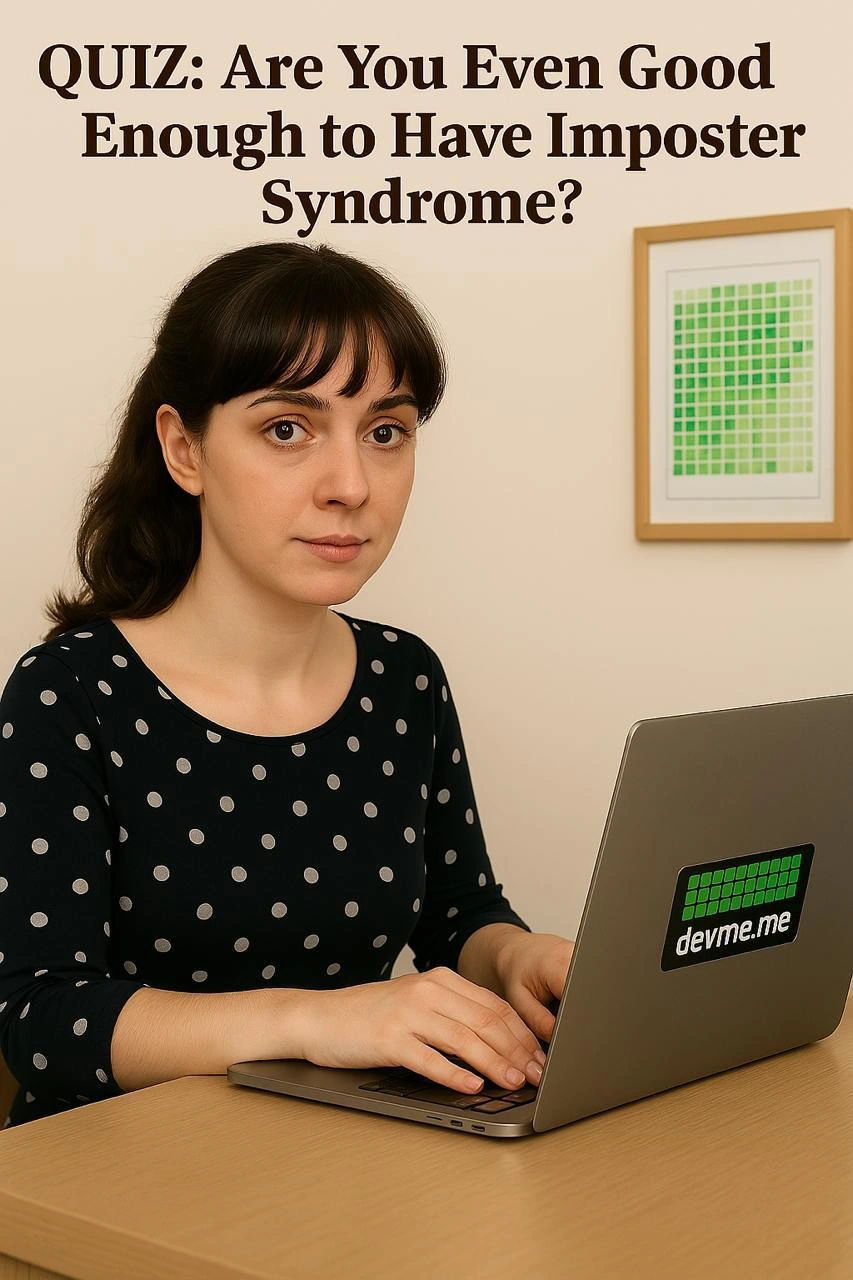
Imagine you’re a kid at a new playground and all the other kids seem really good at the games they’re playing. You start to feel like you’re not as good as they are, like maybe you don’t belong in their game – that’s a simple way to describe feeling like an imposter. Now, this funny poster in the picture is asking, “Are you even good enough to feel that way?” It’s a joke! It’s as if someone is teasing, “Hmm, have you played well enough to even worry about playing badly?” Silly, right? It’s poking fun at how we sometimes doubt ourselves so much that we get mixed up.
Think of it like this: You join a soccer team, but you’re the newest player. You feel insecure and think, “Everyone is going to find out I’m bad at soccer.” That’s feeling like an imposter – like you’re wearing a team uniform you don’t deserve. Now imagine a friend jokingly asks you, “Hey, are you sure you’re even good enough to worry about that?” It sounds confusing, but it’s meant to make you smile. It’s saying you’re not alone in feeling not good enough. In fact, feeling that way means you care and you want to do well. All the other players you thought were so confident? They’ve felt nervous and out of place at some point too.
So the big question on the wall, “Are You Even Good Enough to Have Imposter Syndrome?”, is a playful way to laugh at that double doubt we sometimes have. It reminds us not to be so hard on ourselves. Just like every kid on the team gets nervous, every programmer (even the super smart ones) sometimes feels unsure. And if you ever worry “maybe I’m not good enough to be here,” guess what – most of us have felt exactly the same, and we’re all in this together. It’s okay to feel that way, and you definitely belong in the game!
Level 2: Welcome to the Club
Let’s break down why this meme hits home for so many in the developer community, especially juniors. First, what exactly is Imposter Syndrome? In simple tech terms, it’s when a developer (or any professional) feels like they don’t really know what they’re doing, and fears that eventually they’ll be “exposed” as a fraud – even if, in reality, they are competent. It’s that sinking feeling after a coding interview or during your first week on a new job where you think, “Did HR make a mistake hiring me? Everyone else seems to have it together except me.” If you’ve ever apologized for asking a basic question in a team chat, or felt nervous that your pull request will reveal you as an amateur, you’ve tasted imposter syndrome. It’s a developer insecurity that’s surprisingly common from newbies to experienced devs. In fact, in many DevCommunities (from subreddits to Stack Overflow to local meetups), people share this feeling to reassure each other. You’ll often hear, “Don’t worry, everyone starts somewhere,” because literally everyone has felt out of their depth at some point in tech.
Now, the meme takes this familiar concept and gives it a twist of self-deprecating humor. The headline on the wall says: “QUIZ: Are You Even Good Enough to Have Imposter Syndrome?”. It’s styled like a playful magazine quiz or clickbait article, but it’s really a sarcastic question. It implies “maybe you’re not even qualified to feel like a fraud.” That sounds mean or nonsensical at first, but it’s poking fun at how we sometimes doubt ourselves so much that we even doubt whether our self-doubt is justified! It’s like a loop of insecurity. Juniors often go through this: you might think “Only real programmers have imposter syndrome because they’ve achieved something. I’m just genuinely bad.” The meme is shining a light on that exact thought. By framing it as a quiz, it’s exaggerating the idea — of course there’s no real quiz or threshold for feeling insecure, but it jokes, “Hey, maybe you need to reach a certain skill level to earn the right to angst like the rest of us!” Don’t worry, that’s not true; the humor is in the absurd gatekeeping of an experience that is actually super common and open to all. In other words, welcome to the club, we’ve got jackets… and lots of self-doubt.
Look at the woman in the image: she’s sitting at a desk with her laptop, giving a kind of neutral, almost concerned look. Developers spend a lot of time in that exact posture — typing away, occasionally pausing and staring at the screen with that “am I doing this right?” face. Her navy shirt with light-grey polka dots isn’t particularly “programmer-y,” but that actually reinforces that she could be any dev. (Not everyone wears hoodies with binary code on them – devs come in all styles!). Her face is intentionally blurred, which in the meme context suggests this could be you. It’s inviting you to project yourself into that seat. The laptop has a sticker that reads “devme.me” on a grid of green squares. Devs love laptop stickers as a way to show off their favorite tech or communities (think GitHub, Docker whale logos, or conference swag). Here, devme.me hints at the source (a developer meme site) and those bright green blocks might remind you of the GitHub contribution chart. You know, that calendar of green squares on your GitHub profile that shows how many contributions (commits) you’ve made each day. Many coders take pride in filling those squares (green means you coded that day). Having that chart as a decorative sticker or wall art, as seen by the framed print on the wall (with a nice green gradient pattern), is a subtle joke in itself — it’s like saying “coding is not just my job, it’s my art.” For a newcomer, if you haven’t made many contributions yet, seeing others’ walls literally decorated with evidence of coding productivity can be intimidating! The meme environment quietly nods to that: everywhere you look, there are hints of “real developer” vibes (stickers, commit charts), so a newbie might feel, “Wow, I don’t measure up.”
The categories and tags tell us this meme is about Mental Health in tech and developer communities, with a focus on Juniors. That means it’s widely understood as a supportive inside joke – not meant to bully newbies, but to comfort them by showing the ridiculous side of our shared anxieties. When you’re new to programming, it’s easy to assume you’re the only one who feels lost. But the tag RelatableDevExperience is there because this exact feeling is something almost every developer relates to. Junior devs often experience panic the first time they debug a big codebase or when they deploy to production (deployment anxiety is real!). You might think, “Surely a real developer wouldn’t be this nervous, maybe I’m not cut out for this.” This meme basically replies with a wink: “If you’re worried about not being a real dev, that kinda proves you are one of us, paradoxically! Even doubting yourself is a rite of passage.”
Let’s demystify some terms: ImposterSyndrome (the feeling of being a fraud) isn’t officially a medical syndrome but a commonly used term. DeveloperAnxiety and DeveloperInsecurity refer to the stress and self-doubt that come with programming – like when you’re afraid to push your code because “what if it breaks everything?” The meme format itself – a big caption on an image – is typical in DeveloperHumor circles. And note, this is a form of SelfDeprecatingHumor: we’re laughing at our own tendency to be too hard on ourselves. By phrasing it as “Are you even good enough to have this problem?”, the meme creates an exaggerated scenario that makes you chuckle and think, “Alright, that’s just silly — of course I’m allowed to feel unsure.” It’s almost reverse psychology to get you to realize you’re not alone and you shouldn’t invalidate your own feelings.
In many developer forums, seeing a meme like this might prompt folks to share their own stories: “I remember thinking I wasn’t qualified to call it imposter syndrome, I literally thought I was just bad at my job. Turns out even seniors feel that way sometimes!” And a senior dev might chime in, “Honestly, I’ve been coding for 10 years and I still have days where I feel like an impostor. It never fully goes away, but you learn to trust your track record more.” These kinds of community conversations are gold for a junior — they reveal that what you’re feeling is normal and not a sign that you actually suck. It’s important to define these experiences in plain terms so you realize: imposter syndrome = feeling like you’re not good enough, even when you are. And crucially, everyone in tech feels this at some point. Yes, even that genius coder who seems to know everything has her moments of doubt. So if you’re a newcomer and you find yourself thinking thoughts like “I don’t belong here”, remember this meme and know it’s practically a shared running joke in the industry. Welcome to the club!
Level 3: The Imposter Paradox
At first glance, the meme sets up a paradox of self-doubt that only a developer could concoct. The bold wall text “QUIZ: Are You Even Good Enough to Have Imposter Syndrome?” mocks the very notion of imposter syndrome by adding an extra layer of insecurity on top of it. In tech circles, imposter syndrome refers to that creeping feeling that you’re a fraud — that despite your accomplishments (shipping code, solving tickets, even a promotion), you believe it’s just a matter of time before everyone realizes you have no idea what you’re doing. The humor here is that the meme jokingly gatekeeps self-doubt: “Are you even qualified to feel unqualified?” It’s a tongue-in-cheek jab at how developer anxiety can become almost absurdly self-referential.
This resonates with seasoned engineers because many have lived this irony. In a typical dev’s career, there’s a phase where you learn about the Dunning-Kruger effect – the cognitive bias where beginners are overconfident (they “don’t know what they don’t know”), but as soon as you gain some real skill, your confidence plummets because you become painfully aware of all the gaps in your knowledge. Imposter syndrome kicks in right there. The meme’s quiz title is like a snarky senior engineer teasing: “Come back when you’ve leveled up enough to doubt yourself properly.” It satirizes the idea that one must achieve something first in order to feel like a fraud about it.
In real developer communities, this kind of self-deprecating humor is a coping mechanism. Teams might joke, “I have imposter syndrome about not having imposter syndrome!” which is essentially what this meme says. The absurd quiz format hints at all those online questionnaires that try to quantify subjective experiences. It’s poking fun: imagine a checklist in a dev magazine asking, “Do you Google basic syntax more than 5× a day? Have you copy-pasted from Stack Overflow this week? Congratulations, you qualify for imposter syndrome!” The imposter_syndrome_quiz framing exaggerates how common this feeling is — so common that it’s almost a rite of passage in tech. After all, if you don’t occasionally feel like the weakest coder in the room, are you even in the right room? (Old joke: the only developers with zero imposter syndrome are either actual impostors or blissfully ignorant.)
The image details reinforce the dev atmosphere behind the joke. The person at the laptop has a deliberately blurred face — this could symbolize that anyone (perhaps everyone) in the field can be “that developer” feeling insecure. It’s not about a specific individual; the anonymity makes it universal. The laptop’s green-grid devme.me sticker alludes to a developer meme site (and devs sure love decorating their MacBooks with stickers from conferences, frameworks, and in-jokes). Even the wall art – a framed print of green gradient squares – looks like a nod to the GitHub contributions graph, those little green squares developers obsess over to track daily code commits. It’s a subtle easter egg: a wall of green squares is basically a productivity trophy in dev culture. Hanging that on the wall is peak programmer aesthetic, and also a sly reminder of one cause of imposter syndrome – comparing your commit streak to others’. The experienced eye chuckles at these touches, recognizing the setting as a slice of dev life: a quiet workspace, a captioned_wall_text that reads like a sarcastic motivational poster, and a programmer swimming in self-doubt.
Under the hood, this meme is highlighting a serious MentalHealthInTech issue in a wry way. Veteran engineers know that constant learning and the fast pace of tech can feed insecurity. You fix one bug, but ten new frameworks have popped up. You finally understand one system, then hear a junior excitedly explaining a tool you’ve never heard of. It’s hard not to feel like a fraud sometimes. The meme’s question “Are you even good enough to have imposter syndrome?” reflects an intrusive thought many won’t admit: “Maybe I feel like a fraud because I actually am one.” It’s dark humor – essentially the imposter syndrome itself calling you an imposter for claiming imposter syndrome! This absurdity makes seasoned devs laugh and wince at the same time. They’ve been in those late-night deploys or intimidating code review meetings thinking, “I’m faking this… and wait, do I even deserve to call myself a faker, or am I just genuinely lost?”
In technical teams, openly discussing these feelings has become more common (post-mortems sometimes include personal reflections, and DevCommunities at meetups or on Slack have #mental-health channels now). But often it’s easier to share a meme like this — everyone reacts with a 😅 because it’s too real. Senior devs will recall times they felt this as juniors, and perhaps still do before big presentations or when debugging hairy legacy code. They know imposter syndrome doesn’t magically vanish with years of experience; if anything, moving into bigger roles can amplify it. That’s why the RelatableDevExperience is so strong here: the joke acknowledges a universal developer phobia and then one-ups it. It’s like the meme is an inside joke between battle-scarred engineers: “We’ve all rolled our eyes at ourselves for feeling undeserving, haven’t we?”
To put it in code for the truly hardcore, the meme’s logic might look like this:
# Pseudocode for the imposter syndrome paradox:
if developer.feels_like_fraud and developer.experience < 1:
print("Double Imposter Syndrome: You're not even experienced enough to feel inexperienced!")
else:
print("Standard Imposter Syndrome: Welcome to the club, we all feel like frauds sometimes.")
The if condition above captures the meme’s punchline: you feel like a fraud but worry you have no right to feel that way because you’re too “green” — that’s imposter syndrome in its most ironic form. In any case, the output of this mental code is the same communal truth: imposter syndrome is extremely common among developers of all levels, and laughing at the absurdity helps us cope. The senior perspective here recognizes both the humor and the underlying empathy: as contradictory as it sounds, questioning your right to feel like a phony is almost a sign that you’re on the right path in your career (it means you care about your craft!). This meme elegantly satirizes that Imposter Paradox, eliciting a knowing laugh from veteran coders who’ve been down this rabbit hole of self-doubt.
Description
The image features a woman with dark hair and a polka-dot shirt sitting at a desk with a laptop, looking directly at the camera with a serious, slightly concerned expression. Overlaying the top of the image is large, bold text that reads, "QUIZ: Are You Even Good Enough to Have Imposter Syndrome?". The laptop has a sticker on its lid resembling a green GitHub contribution graph, with "devme.me" written below it. A framed picture with a similar green grid pattern hangs on the wall in the background. The humor is a meta-commentary on imposter syndrome, a phenomenon where high-achieving individuals feel like frauds. The joke gatekeeps the very feeling of inadequacy, creating a paradoxical loop of self-doubt that is deeply relatable to many in the tech industry. It humorously questions whether one has achieved enough to even 'qualify' for feeling like an imposter, a sentiment that resonates with senior developers who recognize the absurdity of their own persistent self-doubt
Comments
11Comment deleted
My imposter syndrome is so advanced it's telling me I'm not a good enough imposter. I probably faked my way into feeling like a fraud
If your architecture diagram needs two zoom-outs in Miro just to fit on the screen, congrats - you’re senior enough for imposter syndrome; everyone else is stuck in the Dunning-Kuber cluster
After 20 years in tech, I've finally achieved enlightenment: I'm now experiencing imposter syndrome about my imposter syndrome, while simultaneously debugging a race condition in my self-confidence that only manifests in production (aka client meetings)
This is the ultimate recursive paradox for senior engineers: questioning whether you're competent enough to even qualify for imposter syndrome is itself the most advanced form of imposter syndrome. It's like a stack overflow of self-doubt - you've achieved such meta-awareness of your inadequacy that you've inadvertently proven you belong, but that realization immediately invalidates the proof. Meanwhile, your GitHub contribution graph mocks you from both your laptop and your wall art, a constant reminder that green squares don't correlate with confidence, just with remembering to push your commits before midnight
Imposter syndrome is the senior engineer’s garbage collector - only runs when you’re idle, then pauses the world during performance reviews
After 20 YoE architecting fault-tolerant distributed systems, imposter syndrome whispers: 'That zero-downtime deploy? Total fluke - you're one merge conflict from fraud exposure.'
Eligibility test for imposter syndrome: if you designed the platform but still copy-paste the kubectl incantation from the runbook you wrote
I'm good enough to tell apart a generative network picture Comment deleted
Yes. Comment deleted
No Comment deleted
So uncanny God I hate AI Comment deleted