That One Regrettable Production Acronym
Why is this Production meme funny?
Level 1: Late Night Regrets
Imagine you wrote a word or a label that you thought was just a shortcut, but it turned out to be a bad word or something really embarrassing without you realizing it. Let’s say, in a school project, you tried to shorten the title “Banana Analysis” into an acronym, and you ended up writing “BANAL” or just “BAN” on the cover. You didn’t see anything wrong with it at the time and turned it in. But later that night, when you’re in bed about to fall asleep, your brain suddenly goes, “Hey… remember that silly thing you did today?” It then reminds you in detail: you picture yourself handing in the project with that goofy abbreviation on it. You feel your face get hot with embarrassment in the dark. You think, “Oh no, did the teacher or my friends notice? I must have looked so dumb!” Suddenly, you’re wide awake, replaying that moment and wishing you could go back in time and fix it. In our meme’s story, a programmer had a similar feeling. They used a short name in their work that accidentally spelled something awkward. Now it’s bedtime, which is when our minds often bring up old oopsies. The person’s brain is shown as a little character coming in with a big file of that memory, saying “Ah, a classic!” and laughing, “What an idiot!” It’s like your own mind is teasing you for the mistake. So the poor developer ends up staring at the ceiling, unable to sleep, just like you would if you kept thinking about that school project slip-up. The funny part of the meme is that we can all relate to this—having an embarrassing memory pop up just when we want to relax. And for developers (people who write code), even something as tiny as a bad name in their code can become that embarrassing memory that keeps them up at night. In simple terms, it’s showing how anyone can lose sleep over a goofy mistake, and sometimes all you can do is chuckle at how silly it all is (after you’ve groaned, of course!).
Level 2: Naming Gone Wrong
Let’s break down what’s happening here in simpler terms. In this cartoon, a developer is about to sleep when their brain (shown as a walking, talking character) pops up with a reminder of a past coding mistake. The specific mistake is using a bad acronym – “ANAL” – as a short form for something related to analytics in code. This is an example of naming conventions gone wrong. A naming convention in programming is basically a agreed way to name things (like variables, functions, or services) clearly and consistently. Good naming conventions make code easier to understand. For instance, you might name a variable total_users so anyone can guess it holds a count of users. A bad naming choice, on the other hand, can confuse people or even accidentally spell out something embarrassing, as it did here! In the developer’s code, they probably wanted to abbreviate “analytics” and chose the first four letters A-N-A-L. They didn’t intend anything bad – they just took a shortcut. But in English, “anal” is a real (and kind of crude) word unrelated to analytics. So it’s a classic oops moment in VariableNaming or acronym creation.
Now, why is the developer haunted by this at night? Because that code with the unfortunate name made it all the way to production. “Production” means the code isn’t just sitting on your laptop or a test server; it’s running in the real world, being used by real users or systems. In a newbie’s terms: it’s like the difference between a draft in your notebook and a message posted on a giant billboard. Once it’s on the billboard (production), any mistake or embarrassing thing is out in the open. If our developer has a piece of code in production labeled with ANAL, that means coworkers, system admins, or even customers might see it in logs, interfaces, or documentation. It’s no longer a private little bug you can quietly fix; it’s part of the official system now. Changing things in production is possible, but it’s often a slow and careful process – especially if other parts of the system depend on that name. For example, if one program is sending data labeled “ANAL” and another program expects that exact label to know it’s analytics data, renaming it to “Analytics” would break their communication until both sides agree on the change. This interconnectedness is why we treat production changes so seriously.
The meme also touches on the concept of technical debt in a very human way. Technical debt is a term developers use to describe the consequences of quick-and-dirty decisions in code. Think of it like taking a shortcut in a school project: you get things working faster, but maybe you used glue and tape where you should have used proper building blocks. It “debts” you time in the future because at some point you’ll need to fix or improve that part. Using a sloppy name like ANAL is a form of technical debt – it didn’t break anything, so it passed testing, but it’s “messy” in a social and maintainability sense. The interest on this debt is paid in embarrassment and confusion. Every time someone new reads the code, they might chuckle or question it, and someone (maybe our poor developer) has to explain, “Uh, yeah, that stands for our analytics module… we uh, didn’t think that one through.” It’s a pretty relatable form of DeveloperHumor to joke about these things, because almost every programmer has done something like it. Maybe you named a variable temp everywhere and later had no clue which temp was which, or you left a comment like “// FIXME: remove this hack” that never got removed. Those are all smaller-scale technical debts that can nag at you later.
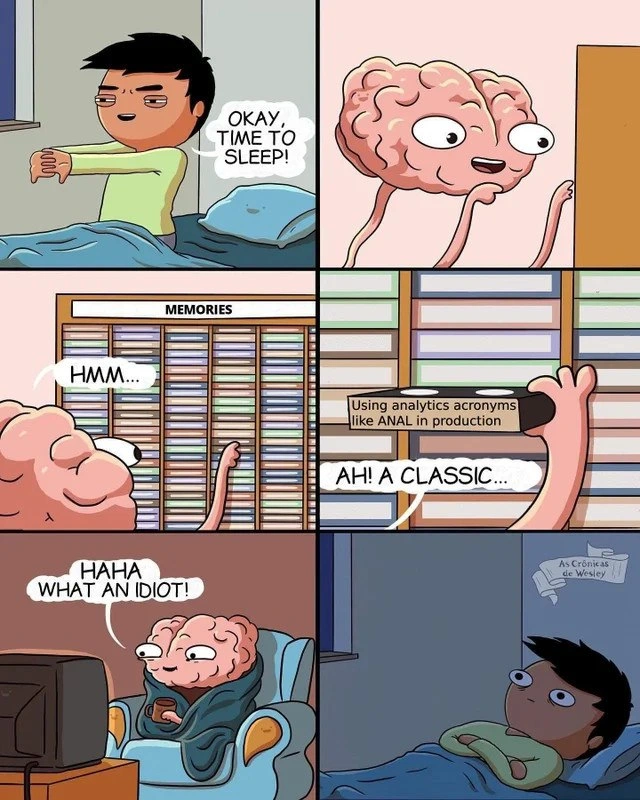
What’s unique (and funny) here is how the brain reminds him. The brain character is shown browsing a huge wall of memories filed away, as if our minds have an archive of all our past experiences. It singles out the memory titled “Using analytics acronyms like ANAL in production”. That title alone reads like a file from the NamingFailures hall of fame! The brain then sits down cozy as if watching a favorite old movie, laughing “What an idiot!” This is a playful way to depict self-criticism – the developer’s own mind is ridiculing him with his past error. A lot of us have experienced something like this when we try to sleep: you suddenly remember that dumb thing you said or did years ago and feel a flush of shame or facepalm. In developer life, those memories often involve code we wrote. Maybe you remember the time you took down a server with a single command mistake, or pushed a bug to production on Friday afternoon. Here it’s an embarrassing naming mistake that the protagonist is cringing about. And it’s late at night, of course, the classic time for brains to overthink. This format – where the brain sabotages your sleep with anxiety or random thoughts – is a common meme theme (sometimes called late night brain memes). It’s exaggerated in a funny way, but it rings true, which is why it makes developers nod and laugh.
For someone newer to coding, the big lesson is: naming matters more than you think. It’s not just pedantic fussing. The names we choose in code are how we communicate to other developers (and our future selves) what the code is about. Using clear and non-awkward names is part of good CodeQuality and professionalism. If you make up acronyms, double-check that they don’t spell out something weird! Many teams have a practice of reviewing acronyms or product names to avoid exactly this kind of situation. (You wouldn’t want to propose a new software called “Supervisory Unified Data Diagnostics” only to realize too late it abbreviates to “SUDD” or something silly.) This meme is a humorous cautionary tale. The dev probably didn’t have bad intentions – they just followed a habit of shortening words – but it shows why being thoughtful with names saves you grief. And if you do slip up, well, you’ll join the club of developers who have a developer meme story to tell. At least we can all laugh about it later (even if at 3 AM we’re laughing through tears).
Level 3: Naming and Shaming
Naming things in code is notoriously hard. There’s an old joke: “There are only two hard problems in Computer Science: cache invalidation, naming things, and off-by-one errors.” In this meme, the developer’s brain is capitalizing on that truth. The scene is painfully familiar to seasoned engineers: you crawl into bed after a long day, say “OK, time to sleep!”, but suddenly your mind (personified as a mischievous pink brain) decides it's code review time. And not a kind review either – it’s pulling out the most cringe-worthy commit from your memory archives. Here, the brain literally walks up to a giant wall of file drawers labeled “MEMORIES” (like some internal database of all your past coding decisions) and goes “Hmm…” searching for a juicy one. Of course, it finds the infamous instance of poor naming conventions: the time our dev used an analytics acronym that unfortunately spells “ANAL” in production. The brain gleefully slides out that memory file, cackling “Ah! A classic…” – as if this mistake is a legendary blooper in the dev’s personal history. By production standards, deploying something named ANAL is a facepalm-level CodeQuality lapse, and the brain knows it. Now, with the developer’s conscious self as captive audience, the brain replays this memory like a late-night sitcom, wrapping itself in a cozy blanket and laughing “HAHA WHAT AN IDIOT!” at its own host. This is the ultimate DeveloperHumor self-burn: the rational part of you mocks the mistakes you made under pressure or ignorance. Meanwhile, the hapless developer lies wide awake in the dark, eyes bulging in horror and embarrassment, as that one naming fail from years ago dances in their head. This panel hits home for every programmer who’s ever had a “Did I really push that to production?” moment. It captures the TechnicalDebt we carry in our heads – not just the TODOs in the codebase, but the psychic debt of knowing we created something silly or ugly that we can’t easily fix now.
On a technical level, this meme spotlights how naming conventions and abbreviations can backfire spectacularly. “ANAL” was presumably meant to be a short for analytics or analysis. It’s common for developers to create acronyms or short identifiers for systems and features – for convenience, for brevity, or due to legacy constraints. But unlike acronyms like NASA or JSON that become harmless jargon, some combinations turn into real words with very unfortunate meanings. Here the chosen four-letter acronym forms a word that, in English, is synonymous with, well, “anal” (as in the anatomical or R-rated sense). This is a classic naming failure: it passes all the compiler or runtime checks (the computer doesn’t care if your variable name is embarrassingly hilarious), but it fails the human readability test. Any developer or stakeholder seeing AnalReport or ANAL_Data in the code, logs, or database is going to do a double-take. In a professional environment, that’s a cringe moment – it undermines the code’s seriousness and by extension the author’s professionalism. Seasoned devs reading this likely recall similar incidents, either from their own mishaps or tales around the office. Perhaps a colleague hastily named a function getAnalResults() instead of getAnalyticsResults() and no one caught it in code review. Next thing you know, that name is part of an API contract or widely logged, and it’s too late to easily change. The result? You get to be the butt of jokes (pun intended) in every code walkthrough, and years later your brain will still rib you for it at 2 AM.
Why not just rename it, you ask? Ah, here comes the dirty truth of Production code and TechnicalDebt. Once a name is out in the wild – part of a released API, a database field, or even just something other services and scripts rely on – changing it is a non-trivial affair. Renaming a poorly chosen identifier in a large system can be like trying to recall an email sent to thousands of people: the damage (or in this case, the dependency) is already done. If “ANAL” was, say, a key in production logs (ANAL: User logged in 😳) or an acronym in a public-facing API (/api/v1/anal/report), then other systems, config files, or clients might be expecting that exact string. Changing it might break dashboards, scripts, or third-party integrations that have already adapted to the quirky name. That’s how a silly naming decision turns into long-lived technical debt – a small shortcut or oversight that accrues “interest” over time in the form of maintenance headaches and endless embarrassment. In practice, teams often just live with it (often tacking on a comment in the code like // TODO: rename this idiocy someday which rarely happens). The meme nails that feeling: you “live with it” publicly, but privately (late at night) you’re kicking yourself endlessly. In the final panel, the developer’s bug-eyed stare at the ceiling says it all: this is never going away. Everyone who’s been in software for a while has a war story or two about a naming blunder that haunts them. This could be something as benign as a variable named cow that should have been columnWidth (causing confusion to everyone) or as mortifying as deploying a service with an acronym that reads like a curse word.
This comic also riffs on the classic late_night_brain_memes format, with the brain acting as an impish antagonist. The humor is amplified for devs because the “memory” chosen isn’t a generic awkward moment, but a Developer Meme deep cut: a naming failure in a production system – truly the kind of thing only we would lose sleep over. It’s a form of imposter syndrome and perfectionism that many in tech share. We might have survived on-call rotations and ProductionIncidents involving crashing servers or bug fiascos, but nothing triggers 3 AM self-loathing like remembering “I am the person who named that core module AnalyticService as AnalService.” The brain’s line “What an idiot!” is exactly how our inner critic sounds, ruthlessly unforgiving of a past self who thought committing that code was a fine idea. This layer of relatable psychodrama is what makes the meme so effective in DeveloperHumor circles: it’s funny because it’s true, and it’s a bit painful because we’ve all been that idiot at least once.
On a more positive note, experienced devs take these memories as lessons burned into our psyche. That one embarrassing incident likely made the meme’s protagonist (and all of us laughing at it) far more careful about naming conventions. It’s the reason you’ll now see them meticulously expanding acronyms, double-checking that new service name, or running that seemingly innocent abbreviation past a colleague (“hey, does ‘SimpleUtil for X’ acronym to anything weird?”) to avoid another ANAL-class disaster. In code reviews, senior engineers often stress clarity and even do a quick sanity check on acronyms and variable names for exactly this reason. It’s part of building a culture of good CodeQuality – preventing unintentionally hilarious or confusing names is as important as preventing logic bugs, because code is read by humans. The meme’s hyperbolic scenario (brain laughing at you in the night) underlines the emotional cost of technical debt: it’s not just about harder refactors later, it’s also about pride and peace of mind. And every time we see a joke like this, it collectively reminds the community: be careful with your naming; your future self (and brain) will thank you!
# Imagine a logging scenario in code:
analytics_tag = "ANAL" # short for "analytics", but oops...
log_message = f"{analytics_tag}: User logged in"
print(log_message)
# Console output: "ANAL: User logged in"
# In hindsight, maybe use a less 'anal' prefix like "ANLT" or just "Analytics" for clarity!
In the code above, you can see how an innocent abbreviation can produce naming_failures in output. A developer aiming to keep things short ends up prepending every log with a word that elicits giggles (or groans). Once such code ships, those log lines become part of the system’s vernacular. Imagine the Production monitoring dashboard filling up with “ANAL:something” entries – not exactly the legacy one dreams of leaving behind! Refactoring that after deployment might be more work (and risk) than teams are willing to take on, especially if it would require syncing changes across multiple services or analytics_acronyms used by other teams. So, the awkward acronym stays. And as time passes, it graduates from a current concern to a memory – a memory that your brain might gleefully resurface when you’re trying to get some shut-eye. The meme captures this transition from an active coding mistake to a ghost of TechDebt that haunts the developer long after the code ran in production.
Description
A six-panel comic strip illustrating the familiar experience of being kept awake by an embarrassing memory. In the first panel, a man with black hair is in bed, stretching and saying, 'OKAY, TIME TO SLEEP!'. The second panel shows his personified pink brain, awake and mischievous. The third and fourth panels depict the brain searching through a vast library of 'MEMORIES' on shelves, pulling out a VHS-like tape labeled 'Using analytics acronyms like ANAL in production' and exclaiming, 'AH! A CLASSIC...'. The fifth panel shows the brain comfortably settled in an armchair with a blanket and a mug, laughing hysterically at the memory playing on a screen, saying 'HAHA WHAT AN IDIOT!'. The final panel returns to the man, now wide-eyed and sleepless in bed, haunted by the memory. A watermark in the bottom right reads 'As Crônicas de Wesley'. The humor stems from the relatable cringe of a past professional mistake, specifically an unfortunate choice of acronym that made it into a production environment. For senior developers, it's a funny reminder of the lessons learned about the critical importance of thoughtful naming conventions and the long-lasting embarrassment that can result from a seemingly minor oversight
Comments
8Comment deleted
Your brain's nightly code review of your life's repo always manages to find that one commit you forgot to squash: 'feat: Implement Advanced Networking & Analytics Layer'
Amazing how the acronym that sailed through two architecture reviews, three sprint demos, and CI linting only surfaces at 02:00 as java.lang.ANALyticsFailureException
The real production incident isn't when the system goes down at 3am - it's when your brain's memory garbage collector decides to surface that one time you named your Analytics Library 'ANAL' and it made it through three code reviews before someone noticed during the all-hands demo
Every senior engineer has that one production variable name that haunts them at 3 AM - usually discovered during a client demo when you're screen-sharing and suddenly 'ANAL_METRICS_ENDPOINT' is projected on the conference room wall. The real tragedy isn't the acronym itself, but knowing it's now immortalized in three years of commit history, documentation, and that one Stack Overflow answer with 500 upvotes
Who needs PagerDuty when your hippocampus enforces 24/7 alerting on that prod analytics dumpster fire?
2 a.m. brain: remember when we shipped the analytics flag ANAL_ENABLED? Turns out the hardest problems in CS are naming things - and explaining to HR why it’s all over Grafana
Pro tip: if your metric prefix survives a grep -R without HR escalation, it’s production-ready
😂 Comment deleted