Skip to content
DevMeme
6132 of 7435
The Quadratic Formula Refactored by a Clean Code Zealot
CodeQuality Post #6725, on Apr 30, 2025 in TG

The Quadratic Formula Refactored by a Clean Code Zealot

Why is this CodeQuality meme funny?

Level 1: When Simple Gets Complicated

Imagine you have a really simple instruction, like a teacher telling you: “Take 2 apples from the basket.” That’s pretty clear, right? Now picture a very strict friend saying, “Hmm, ‘2’ is not clear enough, and ‘apples’ is too short. Let’s rewrite that.” The friend insists you write: “action_take = REMOVE_ITEMS_FROM_CONTAINER; item_type = APPLES; item_quantity = TWO_CONSTANT.” Suddenly, your simple instruction has turned into a mouthful of words and even a made-up constant for the number 2! Now it sounds confusing even though it was originally easy to understand.

That’s exactly the joke in this meme. A straightforward math formula was like the simple instruction – it was clear to people who know math. But a picky reviewer treated it like it was bad just because it didn’t spell everything out. So the formula had to be rewritten in a super long, “over-explained” way to make the reviewer happy. It’s funny because the new version is actually harder to read, just like the apple instruction became silly and complicated. The meme is joking about how sometimes trying too hard to make something “perfectly clear” can end up making it confusing. It’s like using a hundred words to explain what 10 words could have said – it just makes everyone laugh and think, “Was all that really necessary?”

Level 2: From Formula to Code

Let’s break this down in simpler terms. We have a famous math formula here – the quadratic formula – and it’s being treated like a piece of code that went through a strict code review. The quadratic formula is used to find the solutions of a quadratic equation (something like ax² + bx + c = 0). In math class or CS_Fundamentals, you usually see it with those single-letter variables a, b, c, and x. In that context, everyone knows:

  • a, b, c are the coefficients of the equation (they’re just standard names in algebra, each letter represents a number).
  • x is the unknown you’re solving for.
  • The numbers 2 and 4 in the formula come from the derivation of the formula (they’re not random; 4 comes from $2^2$, and 2 is in the denominator as part of solving the equation).

Now, in programming and CleanCodePrinciples, we have some rules of thumb to make code more readable:

  • Use descriptive variable names: Don’t just call everything x or y. Instead of n, say count or totalItems – something that hints at the purpose. This helps other developers understand the code without needing extra comments. It’s a big part of NamingConventions in coding. In a typical CodeReview, if someone sees a variable a outside of a well-known math context, they’ll likely comment: “Please use a more meaningful name.” They ask, “what does a stand for? Is it area? Is it age? Apples?” The idea is that code is read more often than it’s written, so names should be clear.
  • Avoid magic numbers: A magic_number is any numeric literal in code whose significance isn’t obvious. For example, seeing if (speed > 88) { timeTravel(); } in code might confuse readers – why 88? (Back to the Future reference aside...) If 88 has meaning (say, 88 mph is the threshold for the DeLorean to time travel), good practice is to do something like:
    const int TIME_TRAVEL_SPEED_MPH = 88;
    if (speed > TIME_TRAVEL_SPEED_MPH) { timeTravel(); }
    
    This way, the code is self-explanatory. CodeQuality improves because another dev immediately knows 88 is a special number (not just an arbitrary choice).
    In our formula, 2 and 4 are kind of obvious if you remember the math, but a strict reviewer or an automated tool might still label them “magic numbers” since there’s no immediate explanation like “why 4?” in the code. Normally, one wouldn’t replace well-known constants like 2 with a named constant – 2 is 2. But something like 4 could be named if it had a special role (here it’s part of the discriminant calculation b^2 - 4ac). In a very literal translation, someone might define:
    const int FOUR_CONSTANT = 4;
    
    just to say “we didn’t hardcode 4; we declared it.” This is usually considered overkill unless the number 4 carries meaning (like FOUR_SUITES in a deck of cards context). The meme exaggerates this by using TWO_CONSTANT and FOUR_CONSTANT – which, while eliminating raw literals, give no extra info. It’s just following the rule for the rule’s sake.
  • Code review culture: In software teams, before code gets merged, teammates review it – this is the code_reviews process. They might catch bugs, suggest better approaches, or often, point out style issues. The meme’s scenario is a bit like a code reviewer who’s very stringent on style pointing out all the “issues” with the straightforward mathematical code. Comments like “Single-letter variable names (bad)” or “Makes no sense” are exaggerated versions of real code review comments. Usually, a reviewer would be more polite (“Can we rename these variables to be more descriptive?”), but the meme is for DeveloperHumor, so it amplifies the voice of a picky reviewer for comic effect. It reflects a common newbie experience too: the first time you put a piece of code up for review and get a bunch of nitpicks about things that seemed fine (like using i as a variable or having a 42 in there). It can be frustrating but it’s part of learning CodeQuality standards.
  • Mathematics vs Programming notation: In math (and by extension in many algorithms taught in school), single letters are the norm. They’re quick to write and universally understood in context (like E = mc², nobody complains that E is a single letter because we all know it means energy in that formula). In programming, however, we often favor clarity over brevity. This meme falls under mathematics_vs_programming humor because it shows what happens when you apply programming clarity rules to a math formula that was already clear in its own domain. The result is technically “clearer” to a computer or a rigid reviewer, but arguably less clear to a human who knew the math. It’s like translating between two languages: Math has a terse language of symbols; Code has a more verbose language of words. A direct translation can sound awkward, just like a word-for-word translation of an idiom between languages can be funny or nonsensical.

In summary, what’s happening in the meme is a satire_on_code_reviews. It imagines a scenario where a simple math formula is treated as if it were poorly written code. To pass the review, the author rewrites it in a comically verbose way: longer variable names (coefficientA instead of a), no raw numbers (FOUR_CONSTANT instead of 4), and an overly descriptive output name (solutionOutput instead of x). The top version is “correct math but ‘bad code’” (from a style perspective), and the bottom version is “comically verbose code that satisfies the style guide.” It’s making fun of the idea that following CleanCodePrinciples blindly can sometimes produce code that’s technically clean but humorously clunky. For a junior developer, it’s a reminder that context is key: good naming and avoiding magic numbers are important, but you should also use judgment. If something is well-known or obvious (like a famous formula), sometimes a brief notation is okay. Conversely, if you saw (-b + sqrt(b*b - 4*a*c))/(2*a) in a random codebase with no comment, you might not recognize it immediately as the quadratic formula – so a compromise could be to add a comment or use slightly more descriptive names. The meme just pushes everything to the extreme for laughs.

Level 3: Quadratic Code Smells

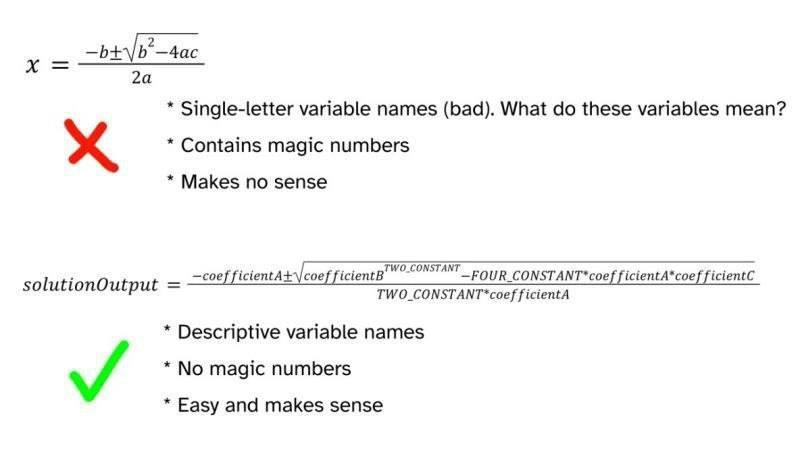
At first glance, this meme pits a classic math formula against strict Clean Code principles. The top code snippet is the elegant quadratic formula:

$$x = \frac{-b \pm \sqrt{b^2 - 4ac}}{2a}$$

In a code review setting, this concise expression gets slammed with a big red X. Why? The reviewer’s comments read like a linter’s complaint list:

  • Single-letter variable names“bad, what do these variables mean?” In programming, naming everything a, b, c is a cardinal sin of NamingConventions and CodeQuality. But here a, b, c are standard coefficients from the quadratic equation (a staple of CS_Fundamentals and algebra). The humor is that a code reviewer who lives by descriptive naming sees a and freaks out: “This tells me nothing!” Meanwhile, any mathematician (or any developer who remembers high school algebra) instantly knows what a, b, and c represent in this context. The meme exaggerates a common code review refrain: "I need more context in the name," even when the context is obvious to the intended audience.
  • Contains magic numbers – The formula has literal 2 and 4 in it. In coding, unexplained literals are called magic numbers (a well-known CodeSmell). A code reviewer would insist we replace these with named constants. Of course, 2 and 4 in the quadratic formula aren’t arbitrary; they’re mathematically derived constants (the formula discriminant uses 4, and the division is by 2a). But the meme shows the reviewer treating them like some mysterious hard-coded values. It’s poking fun at how blindly applying the “no magic numbers” rule can be absurd. It’s as if the reviewer thinks 4 is some project-specific tweak that should be labeled FOUR_CONSTANT for clarity.
  • “Makes no sense” – The reviewer’s final gripe is that the formula “makes no sense.” This is dripping with irony. The quadratic formula is a perfectly sensible, well-known solution for a second-degree polynomial. But from a certain pedantic code-only viewpoint, the compact notation might look cryptic. The meme exaggerates that perspective: a frustrated reviewer who doesn’t recognize the formula might literally think it’s gibberish or overly terse code.

Now enter the bottom block of the meme: the refactored code with a triumphant green check mark. The formula has been rewritten to appease every code review nitpick:

const int TWO_CONSTANT = 2;
const int FOUR_CONSTANT = 4;

double solutionOutput = (-coefficientB + Math.sqrt(Math.pow(coefficientB, TWO_CONSTANT) 
                      - FOUR_CONSTANT * coefficientA * coefficientC))
                      / (TWO_CONSTANT * coefficientA);

Here, every single-letter name and number has been ceremoniously banished:

  • x became solutionOutput – a verbose name that screams “I am the result of solving something!” Sure, it’s descriptive, but it’s also ridiculously cumbersome compared to a simple x. In a real codebase, a name like root1 or solution might suffice. The meme cranks the verbosity to 11 for comedic effect, implying some code style guru demanded maximum explicitness.
  • a, b, c turned into coefficientA, coefficientB, coefficientC – now no one can accuse these of being unclear... except now they’re so explicit it hurts. The code reads almost like legal documentation. It’s poking fun at the idea that more characters = more clarity. In reality, there’s a balance: a is bad if it’s a loop counter with no meaning, but in a well-known formula, a is arguably clearer (or at least standard) than a contrived name like coefficientA. The humor lands because we recognize the pattern of overzealous naming conventions: “Don’t use abbreviations! Spell everything out!” even when the abbreviation was universally understood.
  • 2 and 4 became TWO_CONSTANT and FOUR_CONSTANT – this is the meme’s most absurd twist. The code reviewer eliminated magic_numbers by introducing constants, but gave them hilariously tautological names. Instead of, say, DISCRIMINANT_FACTOR = 4 (which might convey purpose), they literally called it FOUR_CONSTANT. This is a tongue-in-cheek jab at cargo-cult clean coding. It follows the letter of the rule (“no naked literals”) but utterly misses the point (the name should convey meaning!). In real clean code, a constant should explain why that number is there. Here we just get the number shouted in all caps with “_CONSTANT” slapped on. It’s a perfect satire of those pull request comments that nitpick trivial things: “Looks good, just make 5 a constant.” Technically it’s “fixed,” but nobody is better off for it.

The result of all these changes? The bullet points now praise the code for having descriptive variable names, no magic numbers, and being “Easy and makes sense.” The joke is that, to anyone who knows math, the new code is actually harder to read and more confusing than the original formula! The original was a clear algebraic equation; the new one is a forest of words, constants, and symbols. This is a classic developer humor scenario: following CleanCodePrinciples to the letter can sometimes break the spirit of clarity. It’s highlighting the tension between mathematics_vs_programming notation. In math, brevity and symbolic elegance reign; in production code, verbosity and explicitness often win in code review. Neither approach is “wrong” universally – each has its context – but the meme has fun with what happens when you apply one context’s rules to the other’s code.

Seasoned developers chuckle at this because they’ve seen analogous situations in real life. Perhaps you’ve had a pull request where a well-meaning reviewer demands longer names for obviously short-lived variables, or wants every 3.14 turned into PI_CONSTANT even in trivial contexts. It’s a satire on code_reviews that obsess over style guides even when it’s counterproductive. We’ve all encountered that one team or linter that would indeed reject the quadratic formula for not meeting the naming standard! The meme is effectively saying: “Look how silly things get when you take clean code rules to an extreme.” It’s a loving jab at our profession’s tendency to occasionally prioritize form over substance. After all, code is for humans to read – but if humans already understand the short form (like a famous formula), making it longer can actually reduce CodeQuality. The experienced reader appreciates this irony and might even recall a specific code review memory, smirking at how satire_on_code_reviews often contains a grain of truth.

Description

This image is a two-part meme satirizing the dogmatic application of 'clean code' principles to mathematics. The top section displays the standard quadratic formula, labeled with a large red 'X'. An accompanying list criticizes it for using 'Single-letter variable names (bad),' containing 'magic numbers,' and making 'no sense.' The bottom section presents a 'fixed' version of the formula, marked with a green checkmark. This version replaces the concise mathematical notation with verbose, programmatic names like 'solutionOutput,' 'coefficientA,' and 'TWO_CONSTANT.' The bullet points praise this version for having 'Descriptive variable names,' 'No magic numbers,' and being 'Easy and makes sense.' The humor stems from the absurdity of applying software development's readability rules to a universally understood and highly efficient mathematical formula. It mocks the idea that verbosity always equals clarity, highlighting how context is crucial when applying coding standards. For developers, it’s a relatable jab at over-engineering and the misinterpretations of coding best practices, often seen in less-experienced programmers


Comments

29
Anonymous ★ Top Pick This is the version of the quadratic formula you get when the PR reviewer's only comment is 'please add more descriptive variable names'
  1. Anonymous ★ Top Pick

    This is the version of the quadratic formula you get when the PR reviewer's only comment is 'please add more descriptive variable names'

  2. Anonymous

    Quadratic formula PR after review: now lives in QuadraticRootResolverImpl, TWO_CONSTANT and FOUR_CONSTANT are Spring-injected, latency doubled - but hey, SonarQube is green so it’s “clean code.”

  3. Anonymous

    Nothing says 'senior engineer' quite like turning a universally understood mathematical formula into an enterprise-grade abstraction layer where TWO_CONSTANT needs its own named constant - because what if the value of 2 changes in the next sprint?

  4. Anonymous

    When your junior dev takes 'no magic numbers' literally and extracts `TWO_CONSTANT` and `FOUR_CONSTANT` in the quadratic formula - because apparently mathematical constants aren't self-documenting enough. Next PR: renaming π to `CIRCLE_CIRCUMFERENCE_TO_DIAMETER_RATIO_CONSTANT`. At least the code review will be... descriptive

  5. Anonymous

    Code review on the quadratic formula: replaced a, b, and c with coefficientA/coefficientB/coefficientC and extracted TWO_CONSTANT and FOUR_CONSTANT to appease “no magic numbers”. Build passes; roots don’t - turns out ± isn’t an operator and we’re still doing integer division

  6. Anonymous

    Refactoring the quadratic formula into enterprise vars: because 'a, b, c' is just Y2K for mathematicians

  7. Anonymous

    When your linter bans magic numbers so hard that 2 becomes TWO_CONSTANT, you’ve turned O(1) algebra into an RFC - next bikeshed: naming the ± operator

  8. @Grebenkin_Il 1y

    He can't even rewrite the formula normally...

  9. @gongchanM1 1y

    Now its time to figure out what is a coefficient A B and C

  10. @summitbc 1y

    unironically i would've done so much better with math in school if formulae were expressed as code. but more clearly than this image

  11. @azizhakberdiev 1y

    can't wait "played for absolute fools" meme about algebra

  12. @Bjastkuliar 1y

    Java monent

  13. @deadgnom32 1y

    I had this situation, when I needed to make an alternate loop execution with if(i%2){}else{} colleagues wanted me to get rid of the magic number and put it into a constant. when I suggested to call the constant two, they weren't satisfied.

    1. @mrYakov 1y

      Make even_element iterator lol, clear and descriptive

      1. @deadgnom32 1y

        there were another 2 numbers it was a loop producing comfortable tick step for graphs. like 1 5 10 50 100 500 1000 5000 10000... and they wanted *2 and *5 to be constants too

        1. @mrYakov 1y

          Actually, it should be stored into cloud, so each time you need it, you should auth to your server, then fetch it. Why you dont know how to design modern apps ?

          1. @deadgnom32 1y

            you are aware, that you reach INT_MAX in 14 iterations which are so fast, that its nearly noop?

          2. アレックス 1y

            prompt(“Could you please find the quadratic formula of…”)

        2. _ 1y

          In that case making [2, 5] a constant may be overkill but at least it's not entierly stupid. Suppose you then want 1 2 5 10 20 50 …, you could just change it to [2, 2.5, 2]

          1. @deadgnom32 1y

            while request to a server takes billions time longer

          2. @deadgnom32 1y

            well. for such a small function consisting of 3 lines loop, they can write it anew

      2. @deadgnom32 1y

        now figure out how to call them too. half_decade_numeral_system times_two_half_numeral_system

  14. Manuel 1y

    Once in a project in which I was working management added sonar lint, which required us to not use magic numbers even when it didn't make any sense. So we created a file in the root of the project that exported all the numbers we needed as constants with their numeric values as names

  15. @Eugene1319 1y

    How -b became -coefficientA Who did review it

    1. @blackjacksante 1y

      Nailed it

  16. @patsany_horosh_mne_v_dm_pisat 1y

    fr this should be like this at school

  17. @mrYakov 1y

    To be honest. Best way to do graphs is allow user to input target intervals. By list of points or math formula.

  18. @feralape 1y

    The quadratic formula is legacy code now, power series formula is my new best friend

  19. @alexe_sh 1y

    Then needs to be rewritten into code/LaTeX

Use J and K for navigation