The Absurdity of Acronyms and Technical Jargon
Why is this Communication meme funny?
Level 1: Secret Code Silliness
Imagine you have a friend who starts using a secret code made of just letters when they talk to you. One day they ask you, “DYKTMM?” – just a bunch of letters – and you have no idea what they mean. You scratch your head and think, “Hmmm, those letters... maybe they’re asking ‘Do You Know The Muffin Man?’” You start laughing because that’s a line from a funny old nursery rhyme, and it’s the only thing that fits! 😄 It turns out your friend was just abbreviating a normal question so much that it looked like complete gibberish. This meme is joking about that exact situation, but among computer programmers. It’s poking fun at how some developers use so many short forms and acronyms that their messages end up looking like a secret code. The result? Everyone else feels confused and ends up guessing wildly – just like thinking a serious question was about a Muffin Man! The big lesson is simple: if you shorten your words too much, no one understands you, and that’s both funny and a little frustrating. It’s usually better to just say the whole thing so your friends (or teammates) don’t have to play detective to figure out what you mean.
Level 2: Lost in Abbreviation
For a junior developer or someone new to tech, this meme is all about miscommunication caused by over-the-top acronyms. In programming and IT, an acronym is when we take a phrase and shorten it by using just the first letters of each word (for example, HTTP stands for HyperText Transfer Protocol, and IDE stands for Integrated Development Environment). Developers also use a ton of chat slang and shorthand. Dev communities on Twitter, Slack, and forums have their own lingo full of abbreviations. Usually, these help save time when typing – but when excessive acronyms get tossed around, it can leave people totally confused. That’s exactly the scenario this meme jokes about.
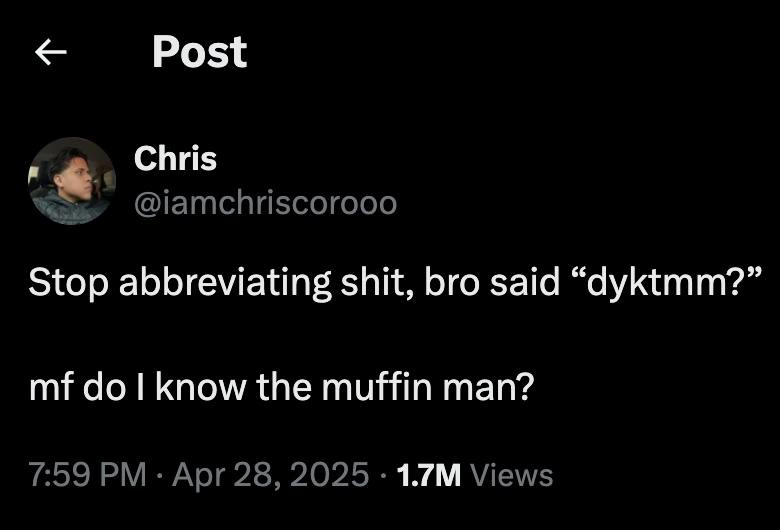
In the screenshot, someone complains: “bro said ‘dyktmm?’” – meaning a guy actually typed dyktmm as a message. The original poster is so frustrated they exclaim, “Stop abbreviating stuff!” because they have no clue what dyktmm is supposed to mean. In their confusion, they blurt out, “mf do I know the muffin man?” (In a very informal, joking tone, “mf” here is a crass shorthand like “dude/buddy, seriously?”). Why “muffin man”? Well, if you spell out dyktmm, it could match the phrase “do you know the muffin man?” – which is a famous line from a children’s nursery rhyme. In other words, the abbreviation was so cryptic that their brain jumped to a completely unrelated phrase that just happens to fit those letters. It’s a comedic way of saying, “I have no idea what you just asked – those letters are gibberish to me, so I’m going to joke that you’re asking about a nursery rhyme.”
This highlights a real issue in developer communication: abbreviation overload can backfire. When a team member uses too many unknown acronyms, everyone else has to stop and decode the message instead of just understanding it. This is especially challenging for newcomers or outsiders who aren’t familiar with the team’s inside jokes or shorthand. For example, if you’re new and someone texts you, “Hey, PR #805 LGTM. Just fix the env var in config ASAP,” you might be thinking “English, please?” Here’s the translation:
- PR #805 – Pull Request number 805 (a code change proposal)
- LGTM – “Looks Good To Me” (their approval of the change)
- env var – environment variable (a configuration setting)
- ASAP – as soon as possible (quickly!)
Without context, that message is a wall of acronyms and abbreviations. A junior dev might have to ask a senior or Google each term. It’s easy to feel lost or even a bit embarrassed not knowing the lingo. The meme exaggerates this feeling by using a completely off-the-wall interpretation (“muffin man?”) to show just how silly it feels when faced with such an opaque abbreviation. It’s funny and relatable because most of us have had a moment where a colleague’s message looked like random characters. You stare at it thinking, “Is this even English? Did I miss a memo or are they speaking in code?”
Let’s break down a few terms and tags related to this meme:
- Communication – In a dev team, this means how people share information (through chat, emails, code comments, etc.). Good communication is clear and easy to understand.
- DeveloperExperience (DX) – This refers to what it’s like being a developer in a given environment or project. Things that affect DX include documentation quality, tooling, and yes, communication practices. If everything is written in cryptic acronyms, that’s bad DX for newcomers.
- Developer Culture – The shared habits, language, and values among developers. Using acronyms like these is part of tech culture (think of terms like “RTFM” or “TL;DR”). The meme is poking fun at this culture quirk.
- Inside Jokes – References or jokes that only people within a certain group understand. Often, acronyms can become inside jokes. For example, seasoned devs might say “PEBKAC” and smirk, knowing it means “Problem Exists Between Keyboard And Chair” (jokingly blaming a user for an error). If you don’t know that one, you’d be baffled or take it literally.
In the context of this meme, dyktmm isn’t even a standard acronym in tech – that’s why it’s so confusing and funny. It reads like some obscure Twitter or Discord slang. The poster’s dramatic response (“Do I know the muffin man?!”) is basically them throwing their hands up and saying “I have absolutely no idea what you’re trying to say.” It emphasizes how over-abbreviation can completely fail at communication. After all, the whole point of using an acronym or abbreviation is to communicate faster – but if no one understands it, you’re not communicating at all. You’re just causing miscommunication.
The meme’s popularity (note the 1.7M views on the post) suggests it struck a chord with a lot of developers. It’s a form of relatable humor – plenty of folks tagging their friends or teammates like, “Haha, remember when you used that weird abbreviation and confused everyone?” It gently encourages techies to be more mindful: sometimes it’s better to type out “do you know...?” than to assume everyone will decode dyktmm. In short, clear communication > clever shorthand. Spell it out, and you won’t have colleagues jokingly singing about the Muffin Man in frustration.
Level 3: From TL;DR to WTF
In the upper echelons of dev culture, acronyms breed like rabbits in spring. This meme captures a communication breakdown so extreme it’s hilarious. A developer complains, “Stop abbreviating s**t,” after a colleague drops the cryptic dyktmm in chat. The only “sensible” expansion they can imagine is the nursery rhyme line “do you know the muffin man?”. It’s absurd – and that absurdity is the joke. We’re seeing a mash-up of hyper-compressed dev lingo with a muffin man reference that has no business in a serious context. The humor lands because every seasoned coder has been there: staring at an acronym stew, wondering if they need a decoder ring or a nursery rhyme book to figure it out. It’s a classic DevCommunity inside joke about our own worst habits.
This touches on a real problem in DeveloperExperience (DX): when team communication becomes an alphabet soup. In theory, abbreviations save time – in practice, overusing them is an anti-pattern that sabotages clarity. There’s an old saying in software engineering: “There are only two hard things in Computer Science: cache invalidation and naming things.” (Some wit later added “off-by-one errors” as a third, making it ironically three hard things.) Abbreviations like these are a symptom of that naming problem. We struggle to name or phrase things clearly, so we invent snappy shorthand. But without a shared context, that shorthand becomes write-only jargon – only the author knows what it means. It’s like we applied a lossy compression algorithm to English: it encodes the info into fewer characters, but anyone without the key is left going “WTF?” (which, fittingly, is another acronym we resort to when utterly confused).
Dev communities on platforms like Tech Twitter love their acronyms and slang. It signals you’re “in the know,” part of the culture – until it backfires. The post’s author Chris is basically calling out an abbreviation overload. In dev Slack channels, issue trackers, and commit messages, we see this daily. Someone might comment on a PR (Pull Request), “LGTM, just fix the NPE in the CI pipeline ASAP.” To an uninitiated junior, that could read like gibberish: LGTM (Looks Good To Me), NPE (NullPointerException error), CI (Continuous Integration system), ASAP (as soon as possible) – a bowl of random letters. By the time you decipher it, the day’s over. No wonder a newcomer might reply with something sassy like, “mf, do I know the muffin man?” – essentially “What on earth are you asking me?!” with a sprinkle of snark. It’s relatable humor because even veteran engineers have gone cross-eyed reading a colleague’s message stuffed with team-specific acronyms. We’ve all felt that mix of miscommunication frustration and here we go again resignation.
The meme’s punchline also has a delicious irony: The frustrated complainer themselves uses an abbreviation – “mf” – while ranting about acronyms. (In casual slang, mf is a not-so-polite “dude/buddy” intensified – a shorthand born from the very culture being mocked.) This meta-joke isn’t lost on experienced devs. It underscores just how ingrained shorthand is in our daily chatter: we can’t even curse someone out for over-abbreviating without abbreviating a bit ourselves. The senior engineers reading this are nodding (and probably chuckling) because they’ve weathered decades of TLA hell. FYI, TLA stands for “Three-Letter Acronym” – and yes, we have an acronym to complain about acronyms. The industry is that far gone.
It’s worth noting that once upon a time, brevity had a purpose. Old-school systems and early tech communication (think SMS texts limited to 160 chars, or when IRC and email had bandwidth constraints) forced us to be concise. Byte by byte, abbreviations saved money and time. Even in code, early languages had short identifier limits, so devs named variables tmp and ctr out of necessity. But in 2025, writing a Slack message or GitHub comment isn’t a 1970s punch card – we have the luxury of space. The continued overuse of acronyms is more cultural inertia than technical need. It persists because typing out full phrases feels slow, and because insider lingo can make one feel like part of the in-crowd. That’s why the practice is self-perpetuating: new devs see “TL;DR” and “ICYMI” flying around and quickly adopt the lingo to blend in. Over time, an entire team or open-source project can evolve a mini-language of cryptic shorthand.
Let’s look at a few typical examples of this inside joke alphabet soup devs swim in:
- LGTM – “Looks Good To Me.” Common approval in code reviews.
- RTFM – “Read The ___ Manual.” A salty way to tell someone to check the docs (implying they should have done so already).
- PEBKAC – “Problem Exists Between Keyboard And Chair.” A snarky tech support term blaming the user, not the system.
- K8s – Shorthand for Kubernetes (because there are 8 letters between “K” and “s”). Even our abbreviations get abbreviated with numbers!
- i18n – Stands for internationalization (18 letters squished between i and n). Related: l10n for localization, a11y for accessibility.
Each of these started as a convenient shortcut or an in-joke. And each can bewilder the uninitiated. The term “naming things” isn’t just about function names or variables – it extends to how we label concepts in conversation. When we name a process “CI/CD” (Continuous Integration/Continuous Deployment) or refer to our database as “RDS” (Relational Database Service) without explanation, we’re creating a potential knowledge barrier. Sure, these acronyms save a few seconds of typing or breath, but they often shift the effort to the reader or listener, who must decipher them. In other words, we save ourselves time upfront and force others to spend time decoding – not exactly a net gain for team productivity or clarity.
So when someone in the meme said dyktmm with a straight face, it epitomizes the “too far, didn’t read” of acronym culture. The recipient’s brain probably bluescreened for a second, then jokingly reinterpreted it as a nursery rhyme because, well, what else could those letters possibly mean? It’s a perfect comedic exaggeration: turning a baffling work question into “Do you know the Muffin Man?” – a question so out-of-place and childlike in a professional setting that it highlights the ridiculousness at play. It’s the developer equivalent of a record scratch moment. The muffin_man joke works as a contrast: high-tech chat meets low-tech nursery rhyme. It reminds us that if your shorthand is so opaque that it might as well be referencing fairy tales, you’ve got a problem.
Ultimately, this meme resonates with seasoned devs because it lampoons a part of our daily life we love to hate. It’s a gentle roast of how we often communicate. We chuckle because it’s true: we’ve seen commit messages like “Fix fx bug in cmpnt svc” or comments like “FYI, OG dev used old JWT lib ASAP upd8 plz” and thought, “my god, do I know the muffin man?” – meaning “I have no clue what you’re asking, this might as well be nonsense.” It’s a shared exasperation. And the next time we find ourselves typing a novel acronym nobody’s seen before, maybe we’ll remember this joke and spell it out – at least so our coworkers don’t start singing nursery rhymes in response.
Description
This image is a screenshot of a tweet from a user named Chris (@iamchriscorooo). The tweet, set against a black background, reads: 'Stop abbreviating shit, bro said “dyktmm?”' followed by a new line, 'mf do I know the muffin man?'. Below the text, the tweet's metadata shows '7:59 PM · Apr 28, 2025 · 1.7M Views'. The humor comes from the exasperation with overly cryptic online abbreviations, where the user comically misinterprets the nonsensical 'dyktmm?' as the opening line of a nursery rhyme from the movie 'Shrek'. This resonates deeply with the tech community, where the overuse of acronyms (e.g., IaaS, PaaS, SaaS, EKS, IAM, VPC) can create a high barrier to entry and lead to similar, albeit less funny, communication breakdowns. The original post caption, 'Please, it's muffin time We like trains too btw!', further leans into the surreal, meme-heavy internet culture, referencing both 'Shrek' and the 'asdfmovie' series
Comments
22Comment deleted
Our team's abbreviation dictionary is longer than our actual codebase. 'DYKTMM' is now an official acronym for 'Did You Keep The Mainframe Manual?'
When a Slack thread hits me with “DYKTMM?” I’m torn between “Distributed YAML-Kustomize Templating Microservice Manager” and “Do You Know the Muffin Man?” - either way, our acronym debt just went sev-1
When your team's Slack has devolved so far into acronym soup that 'DYKTMM' could equally mean 'Did You Kill The Memory Manager' or 'Do You Know The Muffin Man' - and honestly, after debugging that memory leak for 12 hours, both questions feel equally relevant to your mental state
After years of optimizing variable names to single letters and creating acronyms for everything from SOLID to YAGNI, we've finally achieved peak efficiency: communication so compressed that 'dyktmm' could mean anything from 'do you know the muffin man' to 'deploy your Kubernetes to my machine.' At this rate, we'll soon be debugging conversations like we debug minified JavaScript - desperately searching for a source map to understand what anyone actually meant
dyktmmm? The variable name that turns code reviews into 'expand or explode' therapy sessions
Acronyms are lossy compression for intent - push the ratio too far and 'dyktmm' round-trips to 'do you know the muffin man'; same reason public APIs shouldn’t ship identifiers named ctx, svc, and mgr
Slack acronyms are so dense that “DYKTMM?” could be “Do You Know The Muffin Man” or “Did You Kick The Message Broker Manually” - either way it ends in a SEV‑1
Literally, my first translation was Do you know the muffin man without reading further :D Comment deleted
https://www.youtube.com/watch?v=LACbVhgtx9I Comment deleted
THE MUFFIN MAN?? Comment deleted
Who lives on Drury Lane? Comment deleted
Well, I heard it from the Muffin Man Comment deleted
_the_ ultimate song ^^ Comment deleted
"stop abbreviating" uses abbreviation in very next sentence Comment deleted
That's for consealing a swear word, rather than a pure abbreviation. Comment deleted
Wait, it doesn’t mean “my friend”?! Comment deleted
jk Comment deleted
And I'm totally a real man Comment deleted
icl ts pmo sm r u fr rn Comment deleted
🙄 Comment deleted
Did you look this up yourself? Comment deleted
nvm Comment deleted