Python's C-based Secret Revealed
Why is this Languages meme funny?
Level 1: Behind the Curtain
Imagine you’re watching a fantastic puppet show. The puppet (let’s call it “Python”) is dancing and talking, and you might think the puppet is doing everything by itself. But actually, behind the curtain, there’s a puppeteer in black clothes (that’s “C”) moving the puppet’s strings and making the magic happen. In this meme, the first astronaut is like someone who just realized the puppet has a puppeteer: “Wait, Python is being controlled by C this whole time!” And the second astronaut is like the friend who knew the secret all along, saying “Always has been,” meaning “yes, it was C behind the scenes from the very start.” It’s funny because the first person is super surprised that something he thought was working on its own (Python) actually has an older, hidden helper (C). The second person isn’t surprised at all – he knew the trick the whole time! The meme is basically joking about that “Aha!” moment when you find out a big secret: Python, the friendly programming language, is actually powered by C behind the curtain, and it’s been that way all along.
Level 2: Powered by C
For those newer to software, let’s break down the core idea: Python is a programming language, and it’s often called a “high-level” language because its syntax is easy to read and it handles a lot of complex details for you (like memory management). C, on the other hand, is a lower-level, compiled language – it’s closer to the computer’s hardware and requires the programmer to manage more details manually. Now, the meme is highlighting a perhaps surprising fact: the main program that runs Python code (the Python interpreter) is actually written in the C language. In other words, when you install “Python” on your computer, under the hood you’ve installed a program (commonly known as CPython) that is largely composed of C code. That C program’s job is to take your .py files and execute them. So when you write something like:
print("Hello, World!")
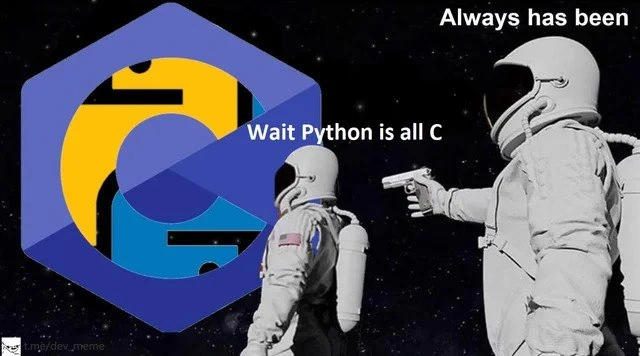
and run it, the CPython interpreter (a C program) is what reads your Python text, interprets it, and ultimately uses C functions to display text on your screen. The front astronaut saying “Wait, Python is all C” represents a person realizing this relationship: that the friendly Python language depends on an engine built with C. The second astronaut replying “Always has been” is the seasoned developer essentially saying, “Yes, that’s always been true, even if you just found out!” – with the astronaut meme’s trademark dark humor twist of him holding a gun as if this truth is inescapable.
Let’s unpack a few terms and tags here. CPython is the name of the most common implementation of the Python language (the one you likely download from python.org). It’s called CPython because it’s the C implementation of Python. There are other implementations of Python (like Jython in Java, or IronPython in C#), but CPython is by far the most widely used, and it’s basically “what people mean by Python” in general. When we say the Python interpreter is written in C, we’re talking about CPython. An interpreter is a program that reads instructions written in a programming language and executes them. Python is often referred to as an interpreted language because of this setup (though internally it does a compile step to bytecode, it doesn’t compile all the way down to machine code ahead of time like C does).
The meme’s image itself is a popular template: two astronauts in space looking at a startling scene. In the image, the thing they’re looking at is a giant C language logo (that blue hexagon with a bold letter C) with Python’s snake logo colors stylized inside it – indicating that Python lives inside C. The text “Wait Python is all C” is placed as what the front astronaut says, and “Always has been” as the other astronaut’s response. The astronaut_meme_format (also known as “Always has been”) became popular for pointing out hidden truths or conspiracies in a tongue-in-cheek way. The astronaut with the gun is a bit of absurd, dark humor implying that the discovery was so undeniable (or the second astronaut was so exasperated) that there’s a comic overreaction. In developer humor, nobody’s actually getting harmed – it’s just a goofy way to say “surprise, this is the truth, deal with it!”
So why is this funny to developers? Newer developers might not realize that languages are often built on top of each other. They might think of Python and C as totally separate worlds: Python is beginner-friendly and high-level, while C is old-school and low-level. The implementation_details connecting them aren’t immediately obvious. Discovering that the very tool you use to avoid C (since many people use Python specifically so they don’t have to deal with C’s complexity) is itself written in C – well, that’s ironic! It’s like finding out the secret recipe behind your favorite simple dish is made with a very hard-to-master technique. It highlights a key CS_fundamentals lesson: every abstraction (like a high-level language) is built on lower-level ones. Those lower layers (like C and ultimately machine code) are always there, doing the heavy lifting behind the scenes. The meme just packages that lesson in a fun, slightly morbid (astronaut with a gun) way.
In summary, the big takeaways for a junior dev are:
- Python’s “engine” is mostly C code. That’s the CPython interpreter.
- High-level languages rely on low-level languages. Python code runs inside a program written in C, which itself runs on even lower-level code.
- The meme uses a popular format to humorously reveal this “secret” – it’s poking fun at anyone (maybe you, if you just learned this!) who is surprised by how software layers work. And if you didn’t know this before, now you do – welcome to a deeper understanding of how your tools are built! 🚀🐍
Level 3: Cloaked in C
To an experienced developer, the punchline “Wait, Python is all C” is a classic “newbie epiphany” moment. The humor comes from the front astronaut’s shock at seeing the big C language logo hidden behind what he thought was pure Python, while the second astronaut, representing the seasoned dev, dryly responds “Always has been” – implying this has forever been the case. This format parodies real-life interactions in software teams: a junior developer might excitedly use Python every day without realizing that the CPython interpreter executing their code is actually written in C. When they eventually stumble upon this fact – perhaps when digging into performance issues or reading about how Python works under the hood – it’s an almost cosmic revelation. Meanwhile, a senior engineer or a CS professor is standing behind them (figuratively, not usually with a handgun 😅) saying, “Yes, that’s how it’s always worked.” The meme exaggerates this scenario with the astronaut and gun trope, implying a kind of tongue-in-cheek frustration: “How could you not know? It was obvious – everything in computing runs on something else!”
This joke hits home for many of us because it satirizes the layered nature of software. We often treat high-level languages like Python as magical tools that just work. But eventually, through debugging or curiosity, we all learn that these tools are built on lower-level implementations. A senior developer might recall the first time they looked at Python’s source code or wrote a Python C extension. That experience strips away some of the magic: you see Python objects are really PyObject* structs under the covers, and Python’s fancy features (like list comprehensions or dict hashing) are powered by good old pointer arithmetic, arrays, and algorithms written in C. It’s like discovering the wizard behind the curtain, except the wizard is the C code of the interpreter. This shared “Aha!” (or “Oh... of course”) moment is exactly what’s being weaponized for humor here.
The “Always has been” astronaut meme format (a mid-2020 viral template) is typically used to deliver obvious or ironic truths in a goofy, overdramatic way. The second astronaut pointing a gun is a hyperbolic representation of being forcefully confronted with reality. In developer humor, this often translates to a senior engineer playfully “holding accountable” the junior for their ignorance of fundamental CS truths. Of course, in real life, nobody gets that aggressive about it (we hope!), but the image dramatizes the internal face-palm a veteran might feel when someone acts surprised by something like this. The meme resonates because so many of us have been on both sides: at one point, we were the astonished “Wait, it’s all C?” person, and later we might be the one wryly nodding, having known all along.
This scenario also pokes fun at the abstraction layers we rely on. Modern programming involves stacks of technologies: you write Python, which calls into C libraries (ever use NumPy? It’s mainly C/C++ under the hood for speed), which may even call into assembly or OS system calls. A seasoned dev finds humor in how often the answer to “Why does this high-level thing behave like that?” is “Because deep down, it’s implemented in C, with all the constraints and quirks that implies.” For example, why is Python single-threaded by default? Because the C interpreter has a Global Interpreter Lock – always has been. Why can Python easily interface with native libraries? Because it’s basically C code itself cooperating with other C code. These realities lurk beneath many languages, not just Python. So the meme’s punchline has an element of “gotcha”: The high-level Snake (Python’s logo is a snake) has been a C-powered machine all along, which is both a funny revelation and a commentary on how much CFamilyLanguages quietly run the world.
In the daily life of a dev team, this knowledge can be important. Experienced devs know that to optimize Python, you might rewrite critical parts in C (or use Cython, or PyPy, etc.), essentially dropping to a lower level. They also know that learning C can help you become a better Python programmer when it comes to understanding memory management or interfacing with system resources. This meme compresses all that wisdom into one absurd scene. The front astronaut’s stunned “Wait, Python is all C” is met with the veteran’s smug “Always has been”, reflecting the mix of humor and “welcome to reality” rite-of-passage vibe. It’s a rite of passage because knowing about interpreter implementations is one hallmark of leveling up in CS_fundamentals. Once you know it, you can’t un-know it – every time you run a Python script, you’re vaguely aware there’s a bunch of C code whirring beneath your Python code’s polite façade. And that thought is both empowering (you see the big picture) and a little funny, because we spend so much time obsessing over high-level code while an unsung layer does the heavy lifting.
Level 4: Turtles All The Way Down
At the most granular level, Python’s world is built on countless layers of abstraction – it’s basically “turtles all the way down.” In this meme’s context, the big revelation is that the Python language interpreter (CPython) is itself written in C, which in turn is compiled to machine code that runs on hardware. This shouldn’t be shocking to seasoned computer scientists, because ultimately every high-level language must be implemented by something lower-level (which eventually boils down to binary instructions executed by the CPU). It’s a cascade of interpreters and compilers: a high-level program (Python code) is executed by an interpreter program (written in C), which is compiled by a C compiler into assembly/machine code, which is interpreted by the hardware’s microcode, and so on. The meme humorously exposes one link in this chain – that Python rides on the shoulders of C.
From a language theory perspective, there’s nothing mystical here: any Turing-complete language can, in theory, interpret or implement any other. In practice, language implementations choose a lower-level host language for pragmatic reasons: performance, portability, and access to system primitives. CPython (the standard Python implementation) leverages C’s efficiency and close-to-the-metal capabilities to manage memory, handle I/O, and execute Python bytecode. Under the hood, when you run a .py script, the CPython runtime first compiles your Python code to bytecode (an intermediate representation, often .pyc files), and then a big loop written in C iterates over these bytecode instructions, performing the corresponding operations in C. It’s essentially a custom virtual CPU for Python code, implemented in C. Here’s a conceptual snippet (greatly simplified) of how CPython’s interpreter loop operates:
// Highly simplified pseudo-code of CPython's main eval loop
for (;;) {
unsigned char op_code = *instruction_pointer++;
switch(op_code) {
case LOAD_CONST:
// push a constant value onto the Python stack
break;
case ADD:
// pop two values, add them, push result
break;
case CALL_FUNCTION:
// call a Python function (handled in C)
break;
// ... many more opcodes for all Python operations ...
case RETURN_VALUE:
// return from function
goto Exit;
}
}
Exit: ; // exit the loop when RETURN is encountered
Each case in that C switch handles a high-level Python operation at the low level – manipulating C structs that represent Python objects (like numbers, lists, etc.). The Python virtual machine (PVM) running inside CPython is therefore just a C program simulating a processor for Python code. This design is common in interpreter implementations and is why we sometimes call Python a “bytecode-interpreted” language. It also explains why Python inherits some behaviors from C’s world: for instance, CPython uses C’s memory management (with manual reference counting under the hood for garbage collection) and has a Global Interpreter Lock (GIL) to mediate access to C-level memory structures across threads. These are deep implementation details that stem directly from the choice of C as the implementation language.
The meme’s cosmic setting and the giant C logo containing Python’s logo hint at a grand truth of computer science: our fancy high-level conveniences are built atop older, lower-level foundations. It’s an infinite onion of abstraction. If you keep peeling layers – Python code runs on a C program, which is compiled by another program into assembly, which runs on silicon – you eventually reach the bedrock, the hardware logic itself. At that point, it really is “always C (or assembly)” at the core, since languages like C act as a portable wrapper over raw machine instructions. Advanced developers appreciate this reality; they’ve perhaps read or even written language interpreters/compilers, and they know that implementations matter. This deep truth is what gives the meme a second layer of humor: it’s not just Python – many languages (Ruby’s MRI, CPAN’s Perl, PHP’s Zend engine, etc.) are also written in C or C++, making C the unassuming puppeteer behind many a modern language. In other words, the entire Languages universe is interconnected, and C is a common foundational layer – a fact both profound and, in hindsight, obvious. The astronaut in the meme just happened to realize one instance of this truth a bit late, and we’re all chuckling in our space suits.
Description
This is a two-astronaut meme format set in space, often called 'Always has been'. One astronaut is looking at a giant C programming language logo that dominates the left side of the frame. A speech bubble from this astronaut reads, 'Wait Python is all C'. Behind this astronaut, another astronaut holds a pistol and replies, 'Always has been'. The meme illustrates the technical reality that the most common Python interpreter, CPython, is written in the C language. This is often a surprising realization for developers who see Python as a high-level, simple language, contrasting sharply with the low-level, manual memory management world of C. For senior developers, it's a humorous nod to the layers of abstraction in modern software and how the foundations are often built on older, more fundamental technologies
Comments
7Comment deleted
Python is just C with a GIL, a REPL, and a massive library of things you could have linked yourself if you had a spare decade
Junior: “I picked Python to avoid C pointers.” Me, single-stepping through PyObject_Free in gdb: “Always has been, kid.”
The moment you realize your "high-level abstraction" is just C with extra steps and a GIL to make sure those steps happen one at a time
The real plot twist isn't that CPython is written in C - it's that after 30 years, we're still having the 'Python is slow' debate while conveniently forgetting that the entire standard library, the GIL, and every performance-critical path is just C code with a snake-themed API wrapper. Meanwhile, PyPy developers are laughing in JIT-compiled RPython, having transcended this mortal plane of implementation details entirely
CPython: the elegant snake charmer who's secretly just C wrangling pointers in a trench coat
CPython: the most popular way to write C without admitting it - the hot path is a C extension from 2003, the slow path is your Python, and the GIL makes sure neither runs in parallel
Senior dev pro tip: every elegant Python microservice still bottoms out at one dependency - the C ABI; libc is the real monolith