Skip to content
DevMeme
1723 of 7435
Python's Dirty Little C-cret
Languages Post #1926, on Aug 17, 2020 in TG

Python's Dirty Little C-cret

Why is this Languages meme funny?

Level 1: The Secret Helper

Imagine you’re watching a puppet show. There’s a fun, friendly puppet on stage (that’s like Python – the part you see and interact with). The puppet seems to move and talk all by itself, doing impressive things. But then you peek behind the curtain, and what do you find? There’s a puppeteer back there, pulling the strings to control the puppet! That hidden puppeteer is like the C language, quietly doing the hard work to make the show happen. In the meme’s little story, the first astronaut is basically saying in surprise, “Wait, the puppet was being controlled by someone else this whole time?” and the second astronaut (the puppeteer with a wink) replies, “Always has been.” It’s funny because the character in front just discovered that the cute, easy-to-use puppet was never working alone – there was a secret helper all along. This is a playful way of saying that even though Python looks like it’s doing everything by itself, it actually has an old friend (the C language) backing it up behind the scenes, making sure everything runs smoothly.

Level 2: C Under the Hood

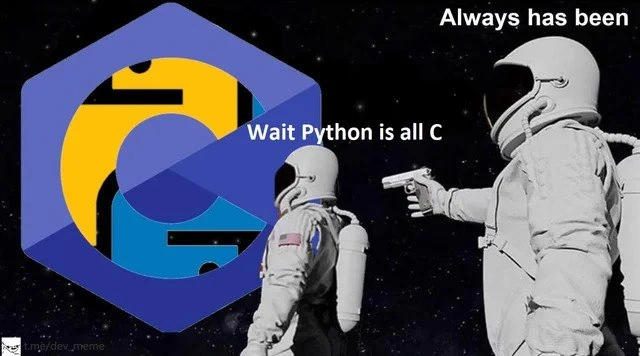
In this meme, two astronauts are floating in space. The first one looks at a big planet that has the Python logo on it and says, “Wait, it’s all C libraries?” The second astronaut (pointing a gun, implying he knew the truth all along) replies, “Always has been.” This is a popular internet meme format used to reveal an unexpected truth. Here it’s being used to point out something in programming: the Python language relies a lot on code written in the C language behind the scenes. If you’re a newer developer, this might come as a surprise. Let’s break down why it’s funny and what it actually means.

Python is a popular programming language known for being easy to read and write. We call Python a high-level language because it lets us write code in a way that’s closer to human language and abstracted from the machine’s details. You can do complex things in Python with relatively simple commands, and you usually don’t worry about things like memory addresses or CPU registers when you code in it. On the other hand, C is a lower-level programming language (part of the old-school C family of languages, which includes C++ and others). C code is much closer to the metal, meaning you have to manage more details of how the computer will execute your program. It’s harder to write in C (you have to think about manually managing memory, types, and so on), but in return, C can run very fast because it’s compiled directly into machine code that the computer’s hardware understands. Python, by contrast, is usually interpreted by an engine (for example, the CPython interpreter written in C). That makes Python more flexible and easier to write, but generally slower in execution than a compiled language like C for the same algorithm.

So how does Python often manage to be quick enough for practical use? The secret is that Python doesn’t do all the work by itself. A lot of Python’s functionality is actually a wrapper around code written in C. In programming, a “wrapper” typically means a piece of code that provides a friendly interface in one language while delegating the real work to another system or language. For instance, when you use Python’s math.sqrt(16) to get a square root, under the hood Python is calling the equivalent of C’s sqrt function from the C standard library. That C function is compiled and highly optimized, so it computes the result very quickly. From your perspective as a Python user, you just called math.sqrt and got a fast answer, but beneath the surface a C library did the heavy lifting. Many of Python’s built-in functions and modules work like this. Another example: calling the len(my_list) function in Python doesn’t loop over the list in Python bytecode to count elements one by one. Instead, the list object knows its length from the moment it’s created (stored in a C struct field), so len just retrieves that number from C data – making it almost instantaneous. Python’s sorting (list.sort() or the built-in sorted() function) is implemented in C as well (in CPython, it’s an implementation of a clever algorithm called Timsort, written in C for efficiency). In short, Python gives you high-level commands, but often those commands rely on efficient C libraries under the hood to do the real work quickly.

This extends to many popular libraries you might install. Ever wonder how the NumPy library can crunch huge arrays of numbers so fast in pure Python code? Hint: it isn’t purely Python code doing that math. NumPy internally uses code written in C (and Fortran, which is another compiled language) to implement those operations. When you call numpy.sum() on an array, NumPy quickly hands the job to a C routine that loops over the array in fast compiled code. The result is that you get C-like performance while writing Python. These special Python modules that include compiled C/C++ code are often called CPython extension modules. They are basically plug-ins for the Python interpreter. Developers write part of the module in C/C++ for speed, compile it to machine code, and then provide a Python interface to it. You import and use it in Python just like any pure Python module, but you’re actually running pre-compiled native code inside. Libraries like pandas, scikit-learn, TensorFlow, and many others do this – they bundle a lot of C/C++ behind a Python API. Even parts of Python’s standard library, like the json parser or the compression modules (gzip, zlib), use C code behind their Python interface to boost performance.

Now, let’s talk about dependencies and why the astronaut meme’s question mentions “C libraries” plural. When you use Python features that rely on C code, it means your Python program depends on those C components being present. In practice, Python’s package installer pip often takes care of this for you by providing pre-compiled binaries. For example, if you run pip install numpy, you’re usually downloading a wheel file that already contains the compiled C/Fortran parts of NumPy for your platform. You don’t see or deal with the C code at all; you just use NumPy. But sometimes you might encounter a library that isn’t pre-compiled for your system. If you try to install it, pip will download the source code (which includes C code) and attempt to compile it on your machine. If you don’t have a C compiler set up, this can result in error messages. Many new Python users have been puzzled by an error asking for “Microsoft Visual C++ Build Tools” on Windows or failing to find “gcc” on Linux when installing a Python package. That’s Python revealing its dependency on C code. It needs a C compiler to build that portion of the library because, yes, under the hood it’s not all Python. This is an aspect of Python’s dependency management: knowing that some Python packages bring along external compiled code. It’s also why, when distributing Python software, developers sometimes have to worry about platform-specific binaries or wheels – because there’s actual machine code in the mix, not just Python code.

So, the reason developers laugh at this meme is because it cleverly sums up a real situation: Many of us start out thinking of Python as this neat, self-contained, magically productive language. Then one day we realize a lot of its power comes from leveraging good old C. The front astronaut saying “Wait, it’s all C libraries?” is that moment of realization. The other astronaut replying “Always has been” is the veteran dev essentially saying, “Yup, this has been true the whole time, welcome to the club.” It’s funny in a lighthearted way because it points out how we sometimes take the convenience of high-level languages for granted. Python lets you do so much so easily, it’s easy to forget that behind the scenes, somewhere, somehow, the computer still needs to do the hard work – and often that work is happening in a lower-level language. In the end, Python is like a friendly conductor directing an orchestra of lower-level routines. You get to enjoy the simple syntax (the melody you hear), while C (and other low-level code) is the one playing a lot of the instruments to make sure the performance is fast and efficient. The meme jokes that this has always been the case, hidden in plain sight.

Level 3: Wrappers All the Way Down

This meme captures that classic “aha!” moment in software development when a high-level illusion is shattered by low-level reality. The image shows a familiar scene: one astronaut, gazing at the giant Python logo planet, is shocked and says, “Wait, it’s all C libraries?” This represents a developer who just realized that many of Python’s coolest features and speed boosts aren’t pure Python at all, but come from modules written in C. The second astronaut behind him – the seasoned engineer or simply the voice of truth – has a gun and dryly replies, “Always has been.” That punchline is both funny and a bit sardonic. It’s like the experienced coder saying, “Of course it’s all built on C. It always was, you just didn’t know.” We laugh because it’s a shared experience: many of us have had that exact revelation and can almost hear ourselves in that first astronaut’s voice.

Seasoned developers find this hilarious because it highlights a recurring pattern in our field. It’s pointing out that high-level languages often act as wrappers for lower-level, performance-tuned libraries. Python is a prime example, but it’s not alone in this regard. We grin at the meme because we remember a time when we thought our high-level code was doing all the work, only to peek under the hood and find an army of C routines carrying the load. It’s a reminder that modern programming is built in layers of abstraction. As the saying goes, it’s abstractions (or “turtles”) all the way down. Today’s shiny new language or tool almost always sits on top of yesterday’s technology. And that’s not a bad thing! It’s actually smart engineering – why reinvent the wheel when you can reuse solid, existing code? But it is a bit ironic. We choose Python to avoid dealing with nitty-gritty low-level details, yet Python itself is relying on those very low-level details, just handled by someone else’s proven C code. The meme distills that irony into a one-liner exchange.

In practical terms, anyone who has worked on real-world Python projects recognizes the truth in this joke. You inevitably encounter scenarios where the solution to a slow Python loop is to call a built-in function (crafted in C) or use a library that does the job in C/C++ under the covers. It’s almost an unwritten rule: if you need a speed boost in Python, find a way to delegate the work to a C-based library. We’ve all seen something like this:

  • The pip install surprise: A developer tries to pip install a Python package (say a JSON parser or a database connector) and suddenly the installer complains “error: Microsoft Visual C++ build tools not found” or some GCC error. In that moment they learn this “Python” package has C/C++ code that needs compiling. The reaction is “Wait… I need a C compiler for a Python library?” Yes – because under the hood, that package is part Python, part C. The experienced dev setting up the project already knew that little secret. Always has been.
  • The NumPy epiphany: A data scientist writes a slow pure-Python loop to process a huge dataset. It’s dragging, taking minutes. Then someone shows them that a numpy operation or a pandas one-liner can do the same in seconds. The reason? Those libraries are executing tight C/Fortran loops behind the scenes instead of sluggish Python ones. It dawns on them: “All this time, my ‘Python’ number-crunching was secretly calling optimized C code.” Yep. Always has been.
  • The mysterious crash: A Python web service suddenly dies with a segmentation fault. It’s startling, because normal Python errors throw exceptions, not outright crashes. Digging into the issue, the team finds the culprit: a bug in a C extension (perhaps a deep library like a PDF renderer or image processing module written in C/C++ that the Python code uses). In debugging this, the team jokes, “We’re debugging C code in our Python app – we’ve gone full circle!” It’s a real “behind the curtain” moment where you discover the Python process was executing native C code all along.

These experiences are so common that they’ve become an inside joke. The meme’s astronauts scene is basically a dev saying “I thought I was using pure Python” and reality replying “It was using C all along, my friend.” It’s poking fun at our dependency management reality: modern software is built out of many layers and dependencies, and a high-level language like Python leans on lower-level components for speed. Veteran engineers chuckle because the meme applies broadly: dig into any high-level system, and you’ll find something foundational beneath. Think about it – Java runs on a C/C++ JVM, JavaScript’s V8 engine is C++, even modern frameworks and tools often wrap native code. In Python’s case, the dependency happens to be explicit: the reference interpreter itself and many of its libraries are C.

The meme also hints at a programming language quirk: Python trades performance for ease of use, but cleverly gets some performance back by exploiting C. It’s like a magician’s trick – you don’t see the hard work because it’s happening offstage. There’s a truthful saying: “There’s no such thing as a free abstraction.” Python lets us ignore manual memory management and pointer arithmetic, but those chores still happen under the hood in C. The humor here is in that lightbulb moment when you realize your high-level code has been piggybacking on low-level code the whole time. It resonates with developers because it’s simultaneously a revelation and a confirmation of what we suspected: that ultimately, everything in computing boils down to lower layers. And admitting that with a smirk – “Always has been” – is a way of bonding over the shared knowledge. We’ve all been the first astronaut at some point, surprised by what’s really going on, and then the second astronaut later, smiling at the next person who is just discovering the same timeless truth.

Level 4: Beneath the Bytecode

Under Python’s polished syntax and dynamic features lies a core written in C. The primary implementation of Python (the one you probably use by default), CPython, is named that because the interpreter itself is a C program. When you run a .py file, CPython first compiles your code into bytecode (the human-readable .py becomes machine-friendly .pyc bytecode). This bytecode isn’t executed by magic – a C-based virtual machine inside CPython reads and executes those instructions. At runtime, your Python for loop or function call is being stepped through by a loop in C, manipulating C-level data structures for Python objects. In fact, the fundamental Python types like list, dict, and int are defined as C struct types in CPython’s source (think PyListObject, PyDictObject). Each Python object is really a PyObject in C, complete with reference counts and type information. Python’s memory management (allocating and freeing objects, garbage collection of cyclical references) is handled by C code as well. So the moment you do something basic like x = [] (creating an empty list), CPython invokes C functions to allocate the list object and manage its contents. There’s no avoiding it – beneath that simple syntax, you’re poking at C structures almost every time.

It’s not just the interpreter loop – many of Python’s most important libraries and standard modules are thin wrappers over efficient C libraries. For example, the math module calls into the C math library (libm) for blazingly fast operations, and the re module’s regex engine is implemented in C for speed. When you do import sqlite3 and interact with a database, that Python module is actually calling the SQLite engine written in C under the hood. These pieces are known as CPython extension modules: compiled binaries (often with file extensions like .so on Linux or .pyd on Windows) that CPython can load at runtime. They register new functions and types with the Python interpreter via the Python/C API. So a call to sqlite3.connect() in Python jumps into optimized C code that does the real work. This design gives Python its “batteries included” strength — those batteries (like SQLite, zlib for compression, OpenSSL for SSL/TLS, etc.) are often powered by C.

The wider ecosystem follows the same pattern. Many popular Python libraries – especially for compute-intensive tasks – are mostly C/C++ (or even Fortran) under the hood. Take NumPy for example: when you sum an array or do linear algebra with NumPy, the heavy lifting is done by vectorized C and Fortran routines (like BLAS/LAPACK) that crunch numbers at compiled speed, while the Python layer just marshals data to those routines. As a developer, you enjoy Python’s easy syntax and dynamic features, but behind the scenes you’re tapping into highly optimized low-level code. Python provides tools like ctypes and CFFI (C Foreign Function Interface) that let any Python code call native C libraries directly. It’s a deliberate design: Python excels at orchestrating and gluing components together, delegating raw performance work to modules written in a lower-level, faster language (usually C or C++). This layered approach leverages decades of optimized code for speed.

One important nuance: mixing these languages introduces some deep-down complexities. CPython uses a mechanism called the Global Interpreter Lock (GIL) to ensure that only one thread executes Python bytecode at a time. Why? Because Python’s interpreter internals (like the object memory manager and garbage collector, written in C) aren’t easily thread-safe at the fine-grained level. The GIL simplifies the C implementation and avoids race conditions by essentially serializing access to Python objects – a trade-off that famously limits multi-threaded CPU parallelism in Python. Extension libraries that perform long operations in C can release the GIL while they work, allowing another thread to run in the interim, but only one thread can be manipulating Python objects at any given moment. This is a direct consequence of Python’s C-based architecture: a language quirk of Python’s runtime (its threading model) is tied to decisions made in its C implementation.

Furthermore, because Python ultimately leans on lower-level code, error behaviors can sometimes leap beyond Python’s usual exceptions. If a C extension has a bug (say, writing to memory it shouldn’t), you might get a segmentation fault and see your whole Python process crash. That’s something pure Python code typically won’t do — it would just raise an exception you could catch. In essence, using these C libraries means inheriting some of C’s risks (and powers) within your Python app. Still, when everything works correctly, this integration of languages is wonderfully powerful: you get the productivity and simplicity of Python with the performance of C. It exemplifies the old joke that in modern computing, we’re always standing on the shoulders of the languages that came before. In Python’s case, it’s quite literal — beneath every elegant Python one-liner, there’s a mighty bedrock of the C family of languages making it possible.

Description

A meme using the 'Always has been' astronaut format to comment on the Python ecosystem. In a cosmic setting, one astronaut looks at a planet represented by the large, circular Python logo and asks, 'Wait, it's all C Libraries?'. A second astronaut stands behind the first, pointing a pistol at them, and states, 'Always has been'. The meme humorously illustrates the realization that many of Python's most powerful and high-performance libraries (e.g., NumPy, Pandas, TensorFlow) are not written in pure Python but are actually wrappers around highly optimized C or C++ code. For senior developers, this is a nod to the fact that Python's ease of use is often built upon the raw performance of lower-level languages, a fundamental architectural reality of the scientific computing stack

Comments

7
Anonymous ★ Top Pick Python is the universe's most beautiful and user-friendly frontend for a sprawling, chaotic universe of C pointers
  1. Anonymous ★ Top Pick

    Python is the universe's most beautiful and user-friendly frontend for a sprawling, chaotic universe of C pointers

  2. Anonymous

    Coding in Python feels like dictating features to an overworked C intern - while the GIL stands by as HR, ensuring only one thread can complain at a time

  3. Anonymous

    The moment you realize your "pure Python" ML pipeline is just a fancy orchestrator for BLAS, LAPACK, and a bunch of SIMD intrinsics you'll never debug directly but will definitely blame when prod goes down

  4. Anonymous

    The moment every Python developer realizes their 'pure Python' data science stack is actually just a thin wrapper around decades of optimized C and Fortran libraries. You thought you escaped pointers and manual memory management, but they were there all along - just hidden behind a comfortable `import numpy as np`. The real performance gains weren't the Pythonic syntax we wrote along the way; they were the compiled binaries we imported

  5. Anonymous

    Python is a beautiful DSL for calling C; if it’s fast you accidentally crossed the FFI into NumPy, if it’s slow you’re still babysitting the GIL

  6. Anonymous

    Python's dirty secret: a snake-oil salesman peddling C horsepower while you sip the interpreted Kool-Aid

  7. Anonymous

    Python is the nicest DSL for decades‑old C/Fortran; your profiler just labels it "NumPy"

Use J and K for navigation