If Programming Languages Were People: A Personality Chart
Why is this Languages meme funny?
Level 1: Classroom Characters
Imagine a classroom with a bunch of very different students, each with their own quirks. There’s one super hyper kid who’s always trying something new and trendy – starting a lemonade stand during recess and trading shiny Pokémon cards (that’s like the JavaScript person, always on a new project or fad). Then there’s another kid who’s really good at using everyone else’s tools: if there’s a group project, they’ll happily use pieces that others made and put it together (kind of like the Python person who builds things using libraries others created). You have a quiet, brainy friend who loves big words and complex puzzles – sometimes you don’t even understand what they’re saying, but they’re definitely smart (that’s our Haskell-like character with all the fancy terms). Now, don’t forget the hard-working older student who’s a bit tired – they’ve been in school a long time, they do their assignments out of duty, not fun, and they often look like they need a nap or maybe a coffee (that’s the Java-type person who’s just grinding through the day). There’s also a very careful friend who always double-checks everything and worries about safety – like they’ll remind everyone to tie their shoelaces and wear a helmet, and they’re also really kind and will help you if you’re sad (that’s similar to the Rust personality: super safe and caring). On the flip side, there’s a kid who’s stubborn and routine – they eat the same lunch every single day, and if one day they spilled their drink in front of everyone, they’d still insist nothing happened and it wasn’t a big deal (this one’s like the Go personality: set in their ways and in a bit of denial when things go wrong). We even have a trendsetter kid who loves being the first to have a new gadget or style, but sometimes they feel a little lonely or underappreciated because not everyone follows their lead (that’s our Kotlin-like friend, ahead of the curve but just wanting a thumbs-up from others). In this imagined class, each student’s behavior makes us giggle because it’s exaggerated – the class clown, the nerd, the tired guy, the cautious helper, the stubborn one – they’re all so different! This is exactly what the meme is doing: it’s pretending programming languages are people in a classroom or a friend group, each with extreme habits and personalities. It’s funny because we usually think of code as just tools, but here they’re acting like humans we know. The joke is that programmers often identify with their favorite coding language so much that it’s as if the language rubs off on their personality. So seeing these “language characters” interact in our imagination is like having a little cartoon in our heads – and it makes us laugh at how silly and diverse our tech world can be, just like a bunch of very different kids all stuck in the same class.
Level 2: Language Lowdown
Let’s unpack the meme in simpler terms. It’s comparing programming languages by joking about the personality of the typical programmer who uses each one. Imagine each language community as a different kind of person you might meet. We’ll go through each language mentioned, clarify any tech jargon, and explain why those particular traits are associated with that language’s users. This is a playful language comparison, so take it with a grain of salt – it’s meant in good fun rather than serious truth.
JavaScript – JavaScript is the main language for web development (making websites interactive in your browser) and it’s also used on servers with Node.js. It has a reputation for moving fast and being everywhere. In the meme, JavaScript’s “persona” is someone who’s very trendy and a bit chaotic. “Tags you in normie memes” means this person shares very mainstream, popular memes with you (a normie meme is just a common joke image that everyone on the internet gets, nothing too niche or nerdy). This fits JavaScript because its community is huge and very plugged into general internet culture. The lines “I’m an entrepreneur!” and “Invests in cryptocurrencies” poke fun at how a lot of JavaScript developers are involved in startups or side projects, and often interested in the latest tech fads like Bitcoin or crypto tokens. JavaScript was the backbone of many dot-com startups and modern app companies, so its developers are stereotyped as having that startup hustle mentality – always pitching a new app idea or jumping on a money-making trend. If you’re a newer developer who started with JavaScript, you might relate to always learning the “new framework of the month” or seeing peers brag about launching their own web apps. The meme humorously exaggerates that into a character who’s a social media butterfly and maybe a bit of a tech-bro opportunist too.
Python – Python is a very popular high-level programming language known for its simple syntax and versatility. It’s used in many areas: web backends (like Instagram is built with Django/Python), scientific computing, data analysis, machine learning, automation scripts, you name it. Because Python emphasizes readability and has a lot of pre-built libraries, even beginners can accomplish a lot by leveraging others’ code. The meme says Python’s coder “can’t multi-task”, which is actually referencing a technical detail: CPython (the standard Python interpreter) has something called the Global Interpreter Lock (GIL) that prevents it from executing multiple threads of Python code at exactly the same time. In plain terms, Python often runs only one thing at a time per process, so it’s not great at doing many CPU-heavy tasks in parallel. They’ve anthropomorphized that trait – imagining the Python programmer as someone who literally is bad at multitasking in daily life. Next, “takes credit for other people’s hard work” is a jab at how Python developers rely on a vast ecosystem of modules written by others. For example, if a Python dev builds a cool web app, under the hood they likely used frameworks and libraries created by other developers. It’s like finishing a group assignment using everyone else’s contributions but being the one to present it. It’s a playful critique: Python makes it so easy to reuse code that sometimes Python devs get a bit of glory for stitching pieces together (while the heavy-lifting code might be in C/C++ behind the scenes). “Seems to know everyone” reflects Python’s broad use – a Python programmer often interacts with people from many different tech domains. If you know Python, you probably have friends doing AI, others doing DevOps scripting, and some doing web apps. Python is almost a universal language in IT, so its users form connections everywhere, hence the personification of “knowing everyone.” Lastly, “smoked weed once” is the meme’s way of saying this Python person is mostly pretty straight-laced or conventional, with only a minor dabbling in “edgy” behavior. In other words, Python’s community isn’t seen as extreme or hardcore; it’s portrayed as fairly mild and normal (with the “wildest” thing being perhaps one experiment with marijuana, played for comedic effect). For an early-career developer, the takeaway is: Python folks are depicted as friendly and capable (thanks to lots of tools), but maybe not as technically hands-on or as hardcore as some others – and that’s okay. The meme is just teasing that Python can make programming feel easy enough that one might get credit beyond their direct effort.
C++ – C++ is a powerful, compiled language often used for systems software, game engines, and performance-critical applications. It’s quite complex and has been around for decades (it’s an extension of C, adding Object-Oriented features). Because of this, C++ programmers are stereotyped as more old-school and highly detail-oriented. The meme describes a C++ user as “awkward at parties”. This is hinting that many C++ developers might be more introverted or not very socially polished – it’s a lighthearted acknowledgment of the nerdier reputation systems programmers have (think of a shy engineer who’s more comfortable with code than small talk). “Always drives over the speed limit” is a metaphor for how C++ developers love speed and efficiency in their programs. C++ gives you low-level control (like manual memory management and direct hardware access), so you can make software run really fast. But going “over the speed limit” also implies recklessness – indeed, writing C++ can be risky; if you’re not careful with memory and pointers, you can crash your program or introduce security bugs. So the meme suggests a C++ coder might likewise be a bit reckless in life, pushing boundaries (maybe speeding while driving) just like they push hardware to the limit in code. “Superiority complex” refers to a common joke that C++ (and C) programmers sometimes look down on users of simpler languages. There’s a bit of truth here: on forums you’ll see arguments where a C++ dev might call languages like Python or JavaScript “too slow” or “for newbies,” implying C++ is for real experts. The meme exaggerates this into an outright ego thing – the C++ person thinks they’re better than others, period. Finally, “is genuinely a nice person deep down”. Despite the gruff exterior or elitist talk, many experienced C++ programmers are actually very helpful and kind when you get to know them. They mentor juniors, they contribute to open source, etc. So the meme gives a little heart to this character, saying essentially: “They might act superior, but they’re not truly mean.” For a junior developer: if you ever felt intimidated by a super experienced C++ colleague who seemed blunt or overly strict about code quality, you might later find they’re just passionate and are happy to help you improve. That’s the dynamic captured here. Technically, C++ is contrasted often with newer safer languages (like Rust, also in the meme) – keep in mind C++ has no safety wheels by default, and that shapes a lot of its culture around careful, veteran craftsmanship (and occasional arrogance about it).
Kotlin – Kotlin is a relatively new programming language (first released in the 2010s) that runs on the Java Virtual Machine. It’s become popular for Android app development and also wherever Java is used, because Kotlin is designed to be more concise and modern than Java. In the meme, Kotlin’s developer stereotype is portrayed as a kind of hip, somewhat emo (emotional) programmer. “Channels their severe depression through niche programming memes” suggests that this person is dealing with sadness or frustration, and instead of talking about it openly, they make or share very specific programming jokes online. There’s a whole subculture on Twitter and Reddit where developers use dark humor and memes as an outlet for stress or depression. By saying severe depression and niche programming memes, the meme implies Kotlin users might be those who are a bit disillusioned (maybe tired of the older languages) and find refuge in wry humor specific to programming. Why Kotlin specifically? Possibly because Kotlin is often adopted by developers who felt pain using Java and needed an expressive outlet. The meme is being facetious, of course – not all Kotlin devs are depressed – but it taps into the idea that switching to Kotlin is a form of rebellion/relief from Java’s drudgery. “Is always ahead of the trend” highlights that Kotlin programmers pride themselves on using a cutting-edge language. Early adopters of Kotlin were using it before it was cool (it got official support from Google for Android in 2017). So this trait paints the Kotlin user as someone who stays on the bleeding edge of technology, maybe the type who tries new frameworks, languages, and tools as soon as they come out. Think of that friend who was using Docker or Kubernetes long before everyone else, or who learned Rust in 2015 just for fun – that kind of forward-thinking person. “Just wants to be loved.” This is a more emotional, almost cute exaggeration. It implies that the Kotlin dev, despite projecting confidence (trendy, meme-y, etc.), feels underappreciated or insecure. Perhaps because Kotlin, while well-liked among those who use it, isn’t as widespread as Java, the developers might constantly have to prove its worth or ask others to give it a chance. In simpler terms, the meme jokes that the Kotlin programmer is saying “Please notice how cool my language is, somebody appreciate me!” For a junior dev, the context is: Kotlin is sleek and fun, but if you’re using it at a Java shop, you might feel like the odd one out – hence the desire for more love. Overall, this part of the meme is ribbing the Kotlin community as being a bit hipster (doing something cool but feeling lonely doing it).
Rust – Rust is a modern systems programming language that aims to replace C++ for many uses by offering memory safety guarantees without sacrificing performance. It’s known for concepts like the borrow checker and strict compile-time checks that catch bugs early. Rust is challenging to learn but produces very reliable, safe code. The meme’s take: “Rust developers are very careful people.” “Is very cautious” directly mirrors Rust’s philosophy of safety first. A Rust programmer tends to think about preventing errors (like null pointer dereferences, data races in threads) from the get-go. They’ll often talk about writing code that’s memory-safe and how Rust forces you to handle cases that other languages might ignore. So depicting the Rust person as inherently cautious – maybe the kind who looks both ways twice before crossing the street – humorously reflects that mindset. “Regularly makes political posts on Facebook” gives the Rust dev a bit of a different twist. It implies they are outspoken and have convictions, possibly beyond just coding. This might be referencing the observation that Rust’s community can be very passionate about various issues (not just programming techniques, but also how the community is run, inclusivity, open-source ethics, etc.). It suggests the stereotype of a Rust user is someone who frequently shares their strong opinions, possibly progressive ones, on social media. The meme is likely just exaggerating that some Rust folks are very online and vocal, not that it’s literally about party politics. Then, “will console you in times of need” shows the nice side of a Rust developer. Rustaceans (Rust fans) have a bit of a reputation for being welcoming and helpful to newcomers because they remember how tough learning Rust was for them, too. The word “console” might be a slight pun as well – writing output to the console is something every programmer does, but here it means comfort you when you’re upset. So the meme portrays the Rust dev as a good friend who’s dependable and supportive, aligning with how many people find the Rust community encouraging when you ask questions (and how Rust’s compiler itself tries to give friendly, detailed error messages to guide you). Finally, “May be closet Antifa.” Antifa refers to anti-fascist activists; saying someone is “closet Antifa” implies they secretly are very radical or protest-oriented but don’t openly admit it. This is a pretty extreme, tongue-in-cheek label to stick on a programmer. The likely intent is just to be absurd and maybe hint that Rust developers lean young and counter-culture. Since Rust is kind of an anti-establishment language in the systems programming world (challenging the old guard of C/C++), the meme jokes that maybe Rust devs also secretly are anti-establishment in a political sense. For a new developer, the key points to glean: Rust programmers are depicted as ultra-careful about code (true to Rust’s nature) and potentially ideological or very principled (exaggerated for humor). The overall image is a “careful rebel” – someone who meticulously avoids mistakes but might also be quietly intense in their beliefs. It’s a funny contradiction that captures Rust’s blend of discipline and passionate community spirit.
Java – Java is one of the most widely-used programming languages, especially in large organizations, for building server-side applications, Android apps (though Kotlin is catching up), and tons of legacy systems. It’s known for its verbose syntax and heavy use in corporate environments. The meme characterizes a Java developer in a rather negative light, reflecting burnout. “In a loveless marriage” is a metaphor saying the Java programmer’s relationship with their job/language is like a stale marriage – they might have been excited about Java years ago, but now they feel stuck with it, going through the motions without passion. Many developers start their career with Java (or spent decades with it) and some do end up feeling like they’re just maintaining old code with little excitement. “At some point enjoyed their work, now just slaves away for the paycheck” reinforces that narrative: it suggests the Java coder once had enthusiasm (maybe when Java was new in the late 90s or when they were a fresh grad), but now programming has become just a dull job to pay bills. This is obviously a stereotype – not all Java devs feel this way! – but it’s poking fun at the idea that enterprise Java jobs can be monotonous (fixing endless NullPointerExceptions, writing boilerplate code, etc.) leading to disillusionment. The humor here is a bit dark: it’s basically saying “this programmer is dead inside.” For a junior dev, it’s worth understanding that this is exaggeration born from truths: Java has been so stable and common that some older Java codebases are indeed boring or frustrating to work on, causing some programmers to lose their spark. Now, “Can probably out-drink you”. This line implies the Java developer can consume a lot of alcohol (out of habit or stress) and not get as affected as others – essentially they’ve built a high tolerance. Culturally, it might hint that the old-school Java dev goes out for beers often (perhaps because that’s their way to cope or because they come from a generation of office workers where grabbing drinks after work was common). It’s a bit of a macho joke: “they might be miserable, but they can chug five beers and still stand.” If we take it less literally, it’s just adding a rough edge to the Java persona, as if to say this person has been through war (metaphorically, in coding) and now drinks like a hardened soldier. For someone new to programming, the main idea is: the meme is teasing Java’s image as the domain of older, possibly bored enterprise programmers. It contrasts with, say, the excited entrepreneur image of JavaScript or the idealistic profile of Rust. The Java stereotype here is the seasoned, maybe tired professional who’s not in it for fun anymore. Again, this is a caricature – many Java devs love their work – but it taps into a real trend where people who spent a long time with one mainstream technology sometimes get jaded.
Haskell – Haskell is a purely functional programming language that often comes up in academic or research contexts. It’s not mainstream in industry (a few companies use it, but it’s relatively rare), yet it has a devoted fan base among those who appreciate its mathematical elegance. Because of this, Haskell programmers are stereotyped as exceptionally smart and somewhat disconnected from the day-to-day realities of typical software development. The meme says “Uses big words that no one understands.” This refers to the very advanced terminology in the Haskell world. Haskell devs talk about things like monads, functors, monoids, and other abstract algebraic concepts. To someone who’s never done functional programming, these words sound like gibberish or extremely high-brow. The stereotype is that the Haskell person might casually mention “Oh, that’s just a monad” in conversation, leaving everyone else either impressed or confused. So, the meme makes it a comical flaw – as if the Haskell programmer can’t help but speak over everyone’s head. Next, the line “Yeah, I like Rick and Morty, but the fanbase is toxic.” is basically putting specific words in the Haskell fan’s mouth. Rick and Morty is a smart, quirky sci-fi cartoon which famously (and humorously) has the reputation that some of its fans consider themselves intellectually superior for liking it. There’s a joke on the internet that “to really appreciate Rick and Morty you need a high IQ” – which of course led to people poking fun at how pretentious that sounds. By saying our Haskell person likes the show but thinks the fanbase is toxic, the meme suggests that they see themselves as the sensible smart person who enjoys intellectual stuff but distances themselves from the cringe crowd. In essence, it’s lampooning a kind of elitism or self-awareness. They want to be seen as high-IQ, but not like those other nerds. “Listens to Aphex Twin” is another very specific detail. Aphex Twin is an electronic musician known for complex, experimental music. Mentioning this implies the Haskell developer has a very niche, sophisticated taste in music – they’re not jamming to top 40 pop hits; they’re listening to something most people find weird or hard to get into. It’s an extension of the “I’m different (and possibly deeper)” personality trait. Finally, “Is an INTJ.” INTJ is one of the Myers-Briggs personality types, standing for Introverted, Intuitive, Thinking, Judging. Stereotypically, INTJs are analytical, strategic, and prefer logical planning – they are sometimes called the “Architect” or “Mastermind” personality. It’s one of the types most commonly associated with engineers and scientists. By labeling the Haskell person INTJ, the meme cements the idea that this is the ultimate rational geek – introverted, brainy, and maybe a little perfectionist. If you’re a junior dev and not familiar with all these references: basically the meme is describing the Haskell community as ultra-intellectual and out-of-the-mainstream. They use big theoretical words, they pride themselves on being different from “pop culture” programmers, they like artistic or cerebral music, and they fit the mold of a masterminding introvert. This is played for laughs because it’s basically saying “Haskell folks are the nerds among nerds” – a stereotype that is good-natured as long as we realize it’s exaggerated. In reality, not every Haskell programmer is a walking encyclopedia or a music snob, but the language’s learning curve and academic roots mean the community does have that brainy aura.
Go (Golang) – Go is a programming language created at Google, often used for cloud services, DevOps tools, and other infrastructure software. It’s designed to be simple, with a motto of keeping things straightforward and “boring” (in a good way, meaning stable and unsurprising). The meme, however, gives the Go programmer some rather eccentric attributes. “Is lowkey into conspiracy theories” implies this person quietly believes in some strange or fringe ideas. It’s not linking to a specific technical trait of Go but suggests maybe a mindset that doesn’t trust the norm. Perhaps this is a playful swipe at how Go came with some unconventional design choices (like excluding certain features that most other languages have), and some Go fans defended those choices with odd reasoning – which to outsiders felt like conspiracy talk. For example, for a long time Go didn’t have generics (the ability to write functions that work with any type), and some supporters would argue circles around why that was actually a good thing, which seemed a bit like denial or rationalization to others. This ties into the next points. “Always orders the same food” characterizes the Go user as very routine and not open to change. Technically, Go promotes one and only one style of formatting code (through a tool called
gofmt), and idiomatic Go code tends to all look the same. The language intentionally has a limited feature set because the designers want every Go programmer to have a common, simple approach. That ethos is reflected in this trait: a person who, say, goes to a restaurant and never tries anything new, ordering the exact same meal every time – just like a Go coder might solve problems in the same straightforward way every time, eschewing new or fancy techniques. This shows consistency but also stubbornness. The last attribute, “Pissed their pants in front of everyone last Thanksgiving but keeps denying it,” is the meme’s wild exaggeration. It describes a scenario where someone had a very embarrassing accident (wetting their pants at a big family gathering, which is pretty mortifying) and yet refuses to acknowledge it happened, even though everyone saw it. This is obviously not a literal accusation aimed at Go programmers! It’s metaphorical and meant to be ridiculous – the humor comes from the specificity and shock value of the claim. In the context of a tech stereotype, it suggests that the Go community might have had some big mess or mistake but collectively acts like everything’s fine. One way to interpret it technically: perhaps there were major Go projects or decisions that went poorly (like a notorious bug or an outage caused by Go), and Go enthusiasts downplay it or pretend Go has no flaws. It also echoes how, despite criticism (like “Go isn’t object-oriented enough” or “Go misses feature X”), die-hard fans would sometimes be in denial about those issues. For a beginner, the key understanding is: Go programmers are being humorously painted as stubborn and a bit odd. They stick to their habits (one way of doing things), might have slightly weird ideas they keep to themselves, and even if something goes wrong, they might not admit fault readily. This is all blown out of proportion to be funny. In truth, Go’s community is known for valuing simplicity and pragmatism – the meme just pushes that to an extreme where it becomes a stubborn refusal to adapt. The Thanksgiving pants anecdote is just the meme’s way of being over-the-top; it’s not referencing a real event but meant to make you laugh and think “what kind of person would that be?” Then you link it back to the concept of someone who never admits when their approach (or language) might have a flaw.
Big picture for Level 2: Every language here is depicted as a person with a mix of traits that tie back to the language’s real-world use or community reputation. This meme format is common in programming circles – it’s a tech meme format where we anthropomorphize languages or technologies. The idea is to capture differences in a relatable way. If you’re early in your career, you’ve probably noticed some languages have almost a culture around them (like the friendly Python tutors, or the hardcore C++ veterans, or the excited JavaScript framework junkies). This meme takes those general impressions and cranks them up. It’s both poking fun at and celebrating the diversity of developer culture: from the cautiously idealistic to the burnt-out practical, from the high-minded theoretical to the fast-and-loose practical. By understanding a bit about each language (JavaScript for web startups, Python as easy and everywhere, C++ for serious fast programs, Kotlin as new and cool Java alternative, Rust for safe coding, Java for big company code, Haskell for mathy stuff, Go for simple cloud tools), you can see why the joke pairs each with certain personality quirks. Remember, it’s satire – real individuals will vary a lot – but the humor lands because communities do often cultivate certain styles and attitudes.
Level 3: Pantheon of Code Personas
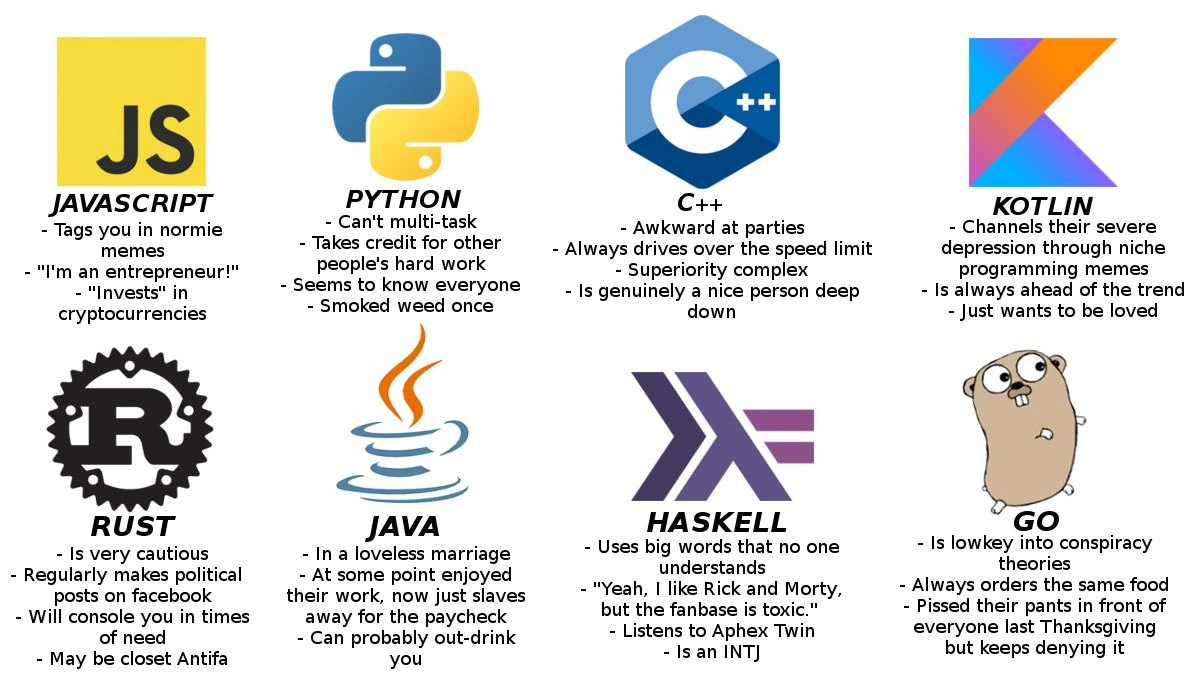
In the world of programming language wars, each popular language accumulates its own set of stereotypes — almost like a tech zodiac assigning personality traits to developers. This meme capitalizes on those language stereotypes and pokes fun at different dev communities by turning each language into an exaggerated character profile. It’s a satirical roll call of programmer personas, where a language choice supposedly says everything about a coder’s habits, attitude, and even vices. Experienced engineers will recognize this as classic developer humor: a tongue-in-cheek roast of the tribes that form around programming languages. Let’s break down these eight caricatures and the kernels of truth (or absurdity) behind each one:
JavaScript – Represented by the big yellow “JS” logo, the JavaScript dev is depicted as the hyperactive social-media-savvy hustler. “Tags you in normie memes” paints them as someone flooding your feed with mainstream internet jokes (a normie meme is a meme so mainstream even non-tech folks get it). This hints that JavaScript’s massive, pop-culture-saturated community loves shareable trends. The meme also quotes “I’m an entrepreneur!” – a jab at the JavaScript world’s startup hype culture. JavaScript is everywhere (browser, server, mobile via frameworks), so its devs often dabble in side projects, startups, or the latest hot framework, sometimes with a bit of overconfidence. The “invests in cryptocurrencies” line continues that theme: it satirizes the JavaScript scene as being full of tech bros chasing the next big thing (from NFTs to Bitcoin) without always thinking it through. A veteran developer chuckles here because we’ve all seen that overzealous JavaScript co-worker who has a new “million-dollar app idea” every week and who was all-in on crypto by 2017. The humor comes from mapping JavaScript’s fast-paced, trend-chasing ecosystem to a persona who is part shiny-object syndrome, part annoying Facebook friend – always doing something, not always in a grounded way.
Python – The Python logo square portrays a very different vibe: Python’s stereotype is the do-gooder who might not be as capable as they appear. “Can’t multi-task” is a sly technical in-joke: Python has a well-known limitation called the
GIL(Global Interpreter Lock), which means one Python process can’t effectively use multiple CPU threads at once. The meme anthropomorphizes this into a personality flaw – a Python dev who literally can’t handle more than one thing at a time. Next, “takes credit for other people’s hard work” hints at how Python’s power often comes from using a ton of libraries (many written in C/C++ or by other developers). In other words, a Python programmer might glue together existing packages (NumPy, Django, you name it) and end up looking productive without doing all the heavy lifting themselves – just like someone in a group project who slaps their name on the final report. “Seems to know everyone” alludes to Python’s ubiquity across domains: web developers, data scientists, sysadmins, academics – Python folks network across the entire tech industry. It’s the language that rubbed shoulders with everyone, from your database team to the machine learning researchers. And “smoked weed once” is pure comedic exaggeration: it paints this Python persona as generally straight-laced with a flimsy attempt at edginess. This line satirizes the Python community’s reputation for being relatively approachable, mainstream, and rather tame (Monty Python-inspired humor aside) – the Python dev isn’t exactly a hardcore rebel, but hey, they’ll claim that one wild college experience to seem a bit cooler. The seasoned engineer sees truth in how friendly and widespread Python culture is, while laughing at the joke that the worst vice a typical Pythonista might have is a single experimental puff in college.C++ – The C++ panel casts its dev as the grizzled speed demon with a touch of arrogance and surprising depth. “Awkward at parties” fits the stereotype of the low-level systems programmer: these are the folks who might be more at home debugging memory dumps at midnight than schmoozing at a company mixer. C++ is an old (born in the 1980s) and notoriously complex language, often attracting very detail-oriented, sometimes socially introverted engineers. “Always drives over the speed limit” is a nod to C++’s performance-obsessed nature. C++ lets you manage memory manually and squeeze out every ounce of speed, but just like reckless driving, that comes with risk – one wrong move and you crash (dangling pointers, anyone?). The meme personifies that by implying the C++ coder lives life in the fast lane (probably in a sports car they engineered themselves), pushing limits whether on the road or in CPU cycles. The “superiority complex” jab is a classic trope in language wars: C++ devotees often look down on higher-level languages, bragging about how those “scripting kiddies” don’t understand REAL programming (with pointers, bitwise arithmetic, and
$O(1)$ memory access). This captures a very real elitism that can crop up on forums when C/C++ experts dismiss languages like Python or JavaScript as toys. Yet, “is genuinely a nice person deep down” adds a twist – beneath the gruff RTFM exterior, that C++ guru who argued about algorithm optimization with you might actually be a helpful mentor when you earn their respect. Seasoned developers recognize this archetype: the cranky old-school programmer who grumbles about newbies and high-level abstractions, but will also stay up all night helping debug a tough crash. The humor comes from embracing the seeming contradiction – the C++ persona’s tough love attitude – and from the contrast with its rival caricature, Rust, which we’ll see is depicted as the careful Boy Scout to C++’s daredevil.Kotlin – The Kotlin square drips with millennial angst and the need for validation. Kotlin is a newer language (circa 2016 for 1.0 release) chiefly used for Android app development and as a modern improvement over Java. So it tends to attract young, trend-conscious developers who are tired of Java’s verbosity and excited about new toys. The meme nails this with “channels their severe depression through niche programming memes”. This paints the Kotlin dev as someone coping with their existential dread by making dark programming memes on obscure subreddits. It’s a bit meta: tech meme format itself is the conduit for their feelings. In other words, instead of crying, they’re sharing the latest “I have no life, I just code Kotlin” joke image at 2am. A cynical veteran knows this stereotype well – there’s a broader trend of devs bonding over depression memes on tech Twitter and Reddit, joking about burnout and imposter syndrome. The meme suggests Kotlin folks are especially prone to this, perhaps because Kotlin hasn’t yet conquered the world like Java did, and those who love it are a passionate niche. “Is always ahead of the trend” underscores that Kotlin developers pride themselves on using the next cool thing. They adopted Kotlin while many others were still stuck on Java, much like being the first in your friend group to get the new gadget. These are the early adopters, the ones blogging about cutting-edge language features or functional programming techniques before it was cool. And “just wants to be loved” is a stab at the language communities dynamic: Kotlin is often touted as wonderful, but it lives in Java’s shadow. The Kotlin dev persona here desperately craves mainstream validation and more wide adoption (maybe they’re tired of defending their language choice to skeptical Java old-timers). This mixes comedy with a tinge of pathos – the idea that behind the sarcastic memes and trend-chasing, the Kotlin crowd just yearns for industry love and a hug. For a senior engineer, this hits close to the ongoing Java vs Kotlin saga: Kotlin is technically excellent and loved by its users, but has to fight the legacy of Java’s huge established user base. The meme exaggerates that dynamic by portraying the Kotlin programmer as a sort of underappreciated emo hipster of the coding world.
Rust – The Rust logo box portrays its community as the cautious yet caring contrarian of programming. Rust is a systems language like C++, but designed with a focus on memory safety and correctness (no null pointers, no dangling references, strict compiler checks). Naturally, the meme says “is very cautious” – a perfect projection of Rust’s core philosophy (strict compile-time rules prevent risky behavior). A Rustacean (as Rust devs proudly call themselves) will double and triple-check their code because the language forces them to handle errors and ownership meticulously. The humor deepens when comparing this with C++’s stereotype: Rust is the seatbelt-and-helmet wearer to C++’s fast driver. Yet the meme’s next trait, “regularly makes political posts on Facebook”, pushes beyond pure tech. This suggests Rust users are opinionated not just in code debates but in real-world issues too. It hints at a perception that Rust’s community skews young, vocal, and perhaps socially progressive. (Indeed, Rust discussions often emphasize inclusivity and have strong Codes of Conduct – topics that can feel “political” in the broad sense of community values.) The edgy “may be closet Antifa” quip takes this to an absurd extreme – painting the Rust dev as secretly radical. This is an outrageous exaggeration for shock comedy, implying that beneath the ultra-cautious, wholesome helper exterior, the Rust programmer might harbor revolutionary tendencies. It’s so specific and politically charged that it’s clearly facetious – a bit of satire on developer culture where being extremely online and principled is common. Importantly, “will console you in times of need” casts the Rust person as the dependable friend. This could be a pun – Rust’s error messages and compiler are famously friendly and helpful, almost consoling new programmers with suggestions when something fails to compile. It also reflects how Rust’s community tends to be supportive on forums to those learning this tough language. Veteran developers grin here because they see a parody of the “Rust evangelist”: extremely careful in coding style, always advocating for safety, strongly opinionated about both tech and maybe society, yet undeniably helpful and passionate. The contrast between Rust and C++ personas in this meme is essentially a commentary on the two different philosophies in system programming today: one that embraces caution and modern values, and one that’s from the wild west era of coding, each lovingly caricatured.
Java – The Java panel comes off as perhaps the darkest and most brutally honest stereotype: the disillusioned corporate coder. Java has been enterprise king since the late 90s, powering banks, big business applications, legacy systems – in short, lots of big boring software that pays the bills. The meme captures the human cost of that with “in a loveless marriage”. It imagines the Java developer as someone who long ago committed to this language (and the career path around it) like one commits to a spouse, and now the spark is gone. They’re not in tech for love or curiosity anymore – just stuck in a relationship of convenience. “At some point enjoyed their work, now just slaves away for the paycheck” really twists the knife. This is a stereotype of the mid-career or senior Java programmer who’s been maintaining the same monstrous codebase for a decade, drowning in
FactoryFactoryclasses and XML configs, and has basically given up on any grand innovation. It’s a bleak caricature, but seasoned engineers have absolutely encountered colleagues like this: professionals who are competent and reliable but visibly burnt out, often because of monotonous projects and years of meeting corporate deadlines. It’s developer gallows humor, highlighting how a dream job in coding can, for some, devolve into just a job. Finally, “can probably out-drink you” adds a wry flourish – implying that these jaded Java veterans cope with their existential dread by drinking (be it copious coffee by day or whiskey by night). It’s also a wink at the older generation of programmers: back in the 90s and 2000s, the office culture around Java and C++ in big companies often involved post-work beer, and over years some of those folks built up a tolerance. The cynical joke here is that the Java dev has seen so much nonsense (endless meetings, legacy system outages at 3 AM, failed refactoring attempts) that they need a stiff drink, and they can handle it, too. For anyone who’s worked in enterprise IT, this hits home – it’s a developer persona we recognize with a mix of pity and camaraderie. It turns the Java vs everyone language debates on their head: rather than boasting about Java’s technical traits, the meme goes for a human angle, portraying the Java crowd as battle-weary survivors of the industry, deserving of both mockery and respect.Haskell – The Haskell box goes full-on intellectual hipster. Haskell is a purely functional language beloved by academics, researchers, and niche enthusiasts for its elegant math-like approach to programming (monads, lazy evaluation, lambda calculus roots – Haskell is proudly not mainstream). The meme distills this into “uses big words that no one understands”. Indeed, Haskell experts are famous (or infamous) for dropping terms like functor, monoid, and naturality into casual conversation, bewildering the uninitiated. It’s a stereotype that Haskell folks delight in abstract theory and have a somewhat esoteric communication style. Next, the quoted line “Yeah, I like Rick and Morty, but the fanbase is toxic.” is a brilliant cultural reference. Rick and Morty is a popular sci-fi cartoon with a reputation: fans of the show often proclaim how intellectual and high-IQ it is, to the point of obnoxiousness (there’s a whole meme about needing a high IQ to appreciate it). By having the Haskell person say they enjoy the show but hate the “toxic fanbase,” the meme mocks how Haskell users see themselves: smart enough to get complex things but distancing from anyone they deem lower-brow or cringy. It’s basically saying the Haskell programmer is elitist, even in their choice of cartoons – they’re self-aware about being elitist (“I like the show but ugh, those other fans give it a bad name”). “Listens to Aphex Twin” continues the elitism/hipsterism theme. Aphex Twin is an experimental electronic music artist known for complex, cerebral tracks – the kind of deep cut music that nerdy, avant-garde types glory in. This suggests the Haskell dev has a very niche, refined taste, even in music, preferring brainy IDM (Intelligent Dance Music) over anything mainstream. Finally, “Is an INTJ” references the Myers-Briggs personality types, with INTJ often nicknamed “The Architect” or “Mastermind” – a profile associated with strategic, analytical thinkers who are introverted and love complex systems. INTJ is famously over-represented in engineering and STEM fields. By flat-out labeling the Haskell person INTJ, the meme cements the archetype: the hyper-logical introverted nerd who thinks far ahead of the curve. Senior devs find this portrayal hilarious because Haskell has always held this mystique of being for the super-smart and somewhat aloof. We’ve all seen forum posts or talks by Haskell enthusiasts that, while brilliant, felt like they were delivered in another language (mathematically and metaphorically). This meme lovingly ridicules that aura. Essentially, the Haskell persona here is the embodiment of the “smartest guy in the room” trope – extremely knowledgeable, maybe a bit condescending (unintentionally), with a dash of counter-culture taste. It’s exaggeration, of course (not every Haskell coder is a pretentious music snob), but it resonates because Haskell’s community does pride itself on being intellectually rigorous compared to “vanilla” languages.
Go (Golang) – The Go language panel takes a turn into absurd, highly specific humor, which in itself is part of the joke. Go’s mascot is the goofy gopher, and the language is known for simplicity and pragmatism. Instead of focusing on technical aspects, the meme portrays a Go programmer as the quirky, stubborn oddball of the group. “Is lowkey into conspiracy theories” imagines a Go dev quietly entertaining wild ideas (maybe they’ve spent late nights on Reddit or have unconventional opinions about tech trends). This could be hinting at the contrarian streak in some Go proponents — for example, Go initially lacked features like generics and some devs fervently argued they weren’t needed, which to outsiders felt like conspiracy-level denial of reality. That ties nicely to the last trait: “Pissed their pants in front of everyone last Thanksgiving but keeps denying it.” This line comes out of nowhere and is deliberately over-the-top, making us picture a person who had a mortifying public blunder and is now gaslighting everyone that it never happened. For Go, this reads as a metaphor for how some die-hard Go enthusiasts handle the language’s flaws or past mistakes: total denial. A grizzled engineer might recall how for years Go maintainers and fans downplayed the need for generics (a way to write reusable code) or other missing features, essentially denying an obvious issue much like someone denying an embarrassing accident. “Always orders the same food” suggests an extreme fondness for routine or an aversion to change – Go’s philosophy is very much about doing things one simple, opinionated way (the language enforces a standard formatting, has a minimal feature set, and encourages sticking to its idioms). So the Go personality here is that friend who goes to the diner and orders the exact same plain burger every time for 10 years, and if you tease them about trying something new, they double down and insist they’ve got it right. The combination of these traits forms a caricature of a Go developer as someone peculiarly rigid and maybe a bit in denial, yet pretending everything’s cool. It’s arguably the most random and savage stereotype in the set – and that randomness is intentional. By tossing in the image of literally peeing one’s pants at Thanksgiving dinner, the meme breaks any expectation of politeness and leans into dark, awkward comedy. Senior folks recognize this as a hallmark of dev satire: include one wild card trait that’s so specific it’s ludicrous, essentially lampooning the tendency of language debates to devolve into personal pot-shots. It’s making fun of how in language comparison flame wars, someone eventually stops talking about code and says something ridiculous about the people instead. Here, Go’s turn is to be the butt of that extreme joke. Underneath the shock value, there’s a grain of tech commentary: Go’s simplicity-loving, change-averse culture can be admirable (consistency, focus) but also comical when taken too far (refusing to admit painful shortcomings, as if pretending that wet patch isn’t there). The overall humor is that each language “community” is being playfully dragged for well-known quirks, and Go’s quirk is an almost childish stubbornness couched in a funny story.
In essence, this meme is a developer culture satire that anthropomorphizes programming languages and their communities. Each square takes a jab at the tribe of programmers that swear by that language, mixing insider technical references (like Python’s lack of multitasking or Rust’s cautiousness) with personal-life absurdities (like Java’s drinking or Go’s Thanksgiving fiasco). The reason it clicks with experienced devs is because it’s roasting our own. Most of us have seen these archetypes in real life: the jaded Java veteran, the overzealous JavaScript rookie, the Haskell academic who genuinely uses the word monad in lunch conversation, the Rust evangelist with a manifesto, etc. We laugh because there’s a bit of truth in each stereotype, exaggerated to the point of caricature. It turns programmer personalities into a comedic panorama. A senior engineer, having survived many a “my language is better than yours” forum thread, appreciates how this meme format turns those divisive language wars into a unifying joke – everyone’s getting ribbed equally. After all, no matter what code we write, we’re all a little weird in our own special way, and this meme simply gives each language’s weirdness a witty, memorable description.
Description
An image that presents eight programming languages as if they were people with distinct personalities, arranged in a two-by-four grid. Each entry features the language's logo, its name, and a bulleted list of humorous, stereotypical traits. - JAVASCRIPT: 'Tags you in normie memes', '"I'm an entrepreneur!"', '"Invests" in cryptocurrencies'. - PYTHON: 'Can't multi-task', 'Takes credit for other people's hard work', 'Seems to know everyone', 'Smoked weed once'. - C++: 'Awkward at parties', 'Always drives over the speed limit', 'Superiority complex', 'Is genuinely a nice person deep down'. - KOTLIN: 'Channels their severe depression through niche programming memes', 'Is always ahead of the trend', 'Just wants to be loved'. - RUST: 'Is very cautious', 'Regularly makes political posts on facebook', 'Will console you in times of need', 'May be closet Antifa'. - JAVA: 'In a loveless marriage', 'At some point enjoyed their work, now just slaves away for the paycheck', 'Can probably out-drink you'. - HASKELL: 'Uses big words that no one understands', '"Yeah, I like Rick and Morty, but the fanbase is toxic."', 'Listens to Aphex Twin', 'Is an INTJ'. - GO: 'Is lowkey into conspiracy theories', 'Always orders the same food', 'Pissed their pants in front of everyone last Thanksgiving but keeps denying it'. The meme's humor comes from anthropomorphizing the languages based on well-known stereotypes about their technical characteristics, ecosystems, and developer communities. For example, Rust's 'very cautious' nature is a nod to its memory safety guarantees, while Java's persona reflects its reputation as a language for large, bureaucratic enterprise applications
Comments
7Comment deleted
This chart is how developers pick a language for a side project. The CTO picks a language for the company based on a 20-page Gartner report. The result is always Java
When prod face-planted, the stereotypes wrote themselves: Java drafted the incident doc, JavaScript hot-fixed live, Python wrapped the mess in a decorator, C++ dumped core, Rust refused without clear ownership, Kotlin blamed its Java parents, Go spun a goroutine to ignore it, and Haskell insisted the outage only exists in the wrong monad
The most accurate personality test in tech: which language you defend in architectural reviews that absolutely didn't need that language in the first place
This meme perfectly captures the tribal warfare of language communities - where Rust developers are one GitHub issue away from forking society itself, Haskell devs explain monads at parties nobody invited them to, and Java developers have that thousand-yard stare that only comes from maintaining Spring XML configs since 2008. Meanwhile, JavaScript is out there convincing VCs that their blockchain-powered NFT marketplace built with 47 npm packages is 'disrupting the paradigm,' while Python takes credit for the ML breakthrough that was actually just NumPy doing all the heavy lifting. The real joke? We've all been every single one of these at different points in our careers
Language review: C++ waved microbenchmarks, Rust refused to compile our ambiguity, Go denied the data race, Python offered a wrapper, Java booked a CAB, Haskell wrote a proof, JS pitched an ICO, Kotlin asked to be loved - so we shipped PowerPoint
We keep swapping languages hoping for personality upgrades; lifetimes fix dangling pointers, not org charts, and goroutines won't run stakeholders concurrently
Python can't multitask in relationships? GIL's got it serially committed, while C++ crashes the afterparty with dangling pointers