Python: From Mystical Snake Charming to 'Try Hello World'
Why is this Languages meme funny?
Level 1: Magic vs Training Wheels
Imagine there’s a grandmaster and a beginner. The grandmaster is like a wizard – say, someone who can charm a wild snake by playing a flute. It looks like magic, but it’s really skill earned over years. Now imagine a beginner who just got a brand-new fancy bicycle with all the bells and whistles, but they still have the training wheels on and aren’t sure how to ride it. They might turn to their friend (who is just as inexperienced) and ask, “Uh, how do I go forward?” and the friend might shrug and say, “Maybe start by pedaling, like we did on the tricycle?”
This meme is making a similar comparison with coding. The left side shows the old master who can do something impressive and complicated (control a snake = master the Python programming language) with just a simple tool (a flute = a basic text editor and knowledge). It’s almost magical how skilled he is. The right side shows new learners who have modern tools (fancy laptops, special programs that should help them), but they’re stuck on something very simple. One asks, essentially, “I’m lost, what do I do?” and the other says, “Let’s just do the very first baby step – make the computer say Hello to see if everything’s working.”
So, in everyday terms, it’s like comparing a seasoned chef who can cook a gourmet meal from scratch with just a pan and fire, to two rookie cooks who have high-tech kitchen gadgets but still ask “How do I boil water?” The meme is funny because it exaggerates the difference: the expert’s ability seems like magic, whereas the newbies, despite having help, are still wobbling with the basics (hence, using “training wheels”). It highlights that sometimes having all the tools in the world won’t help unless you also learn the fundamentals – and it does so in a lighthearted, silly way that anyone who’s been a beginner (at coding or anything) can relate to and laugh about.
Level 2: Hello World Debugging
Let’s break down the meme into its basic pieces and explain each part. On the left side labeled "Python Then," we have:
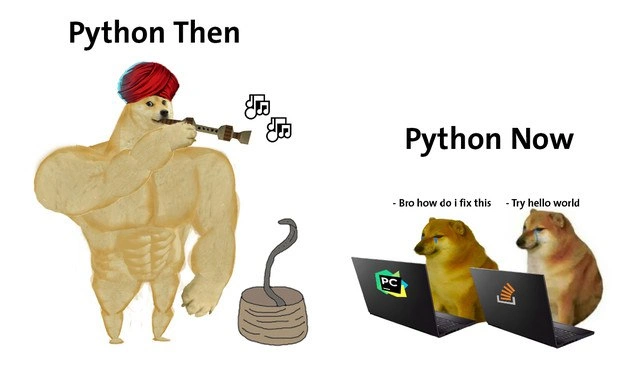
- Buff Doge in a Turban with a Flute: This strong Doge character (from the Doge meme template where a muscular Doge represents something formidable) is dressed like a snake charmer. In many cultures, a snake charmer plays a flute to hypnotize a snake, usually a cobra. Here, the snake charmer outfit and flute are an analogy for how early Python developers were like magicians with the language. The snake coming out of the basket is meant to be a Python snake. So, effectively we have a cartoonish vision of a programmer who can control Python effortlessly, just as a snake charmer controls a snake with music. The musical notes (♪) drawn near the flute emphasize that this Doge is successfully playing the tune – i.e., the code or technique – to make Python behave. “Python Then” implies this is how it was back in the day: one person alone with their code (and maybe a simple editor) could do powerful things. No fancy tools, just skill. It’s a way to show the old-school mastery over the language.
Now on the right side labeled "Python Now," we see:
Two Cheems with Laptops: Cheems is another meme character (a shiba inu dog like Doge, but depicted as smaller or less capable, often used to represent something weaker or more timid by comparison). Here, two Cheems dogs are sitting with their laptops open. They look much less intimidating than buff Doge. This immediately signals that we’re now looking at characters representing the modern typical Python users, who in the meme’s context are more like beginners or less experienced devs.
Laptop Logos: One laptop has the PyCharm logo (a green square with “PC”). PyCharm is an Integrated Development Environment specifically designed for Python. It’s basically a specialized application where you write code; it provides a lot of help like highlighting errors as you type, auto-completing code, organizing your files, and so on. The fact that one Cheems is using PyCharm suggests that nowadays, Python programmers heavily rely on such IDEs rather than just a text editor or command line. The other laptop shows an orange symbol that looks very much like the AWS Lambda logo (an orange circle with a lambda
λin it). AWS Lambda is a cloud service where you can run your code without managing a server – often used for deploying small Python functions to the cloud to handle things like web requests or events. This implies the Cheems might be working with or deploying code to AWS (in other words, using modern, cloud-based infrastructure as part of their development). So, the presence of these logos indicates two big facets of “Python Now”: using advanced tools/IDEs and using cloud services.Dialogue Above Them: The text in quotes is like a mini conversation between the two Cheems:
- First Cheems: “Bro how do i fix this” – in casual internet slang, he’s asking his buddy for help with a problem. It’s a very broad question (fix what exactly?), which hints at a lack of understanding; he doesn’t even specify the issue, implying he might be a bit lost.
- Second Cheems: “Try hello world” – this is the friend’s advice. “Hello world” refers to the simple program that just prints "Hello, World!" to the screen. It’s the most basic thing you can do in any programming language and is often the first thing you learn. The friend is basically suggesting, “Maybe you should go back to basics and see if even a simple program will run.” It’s a bit of a funny or sarcastic suggestion because normally such a basic step wouldn’t fix a specific problem – it’s more of a way to test if everything is set up correctly.
This exchange highlights a common scenario for beginners: sometimes when you (as a new programmer) run into a problem and you have no clue what’s wrong, a good troubleshooting step is to simplify. Running a “Hello, World!” program is a way to check, “Is my environment or setup fundamentally working?” It’s like if you’re learning to drive and the car won’t start, someone might say, “Okay, let’s make sure there’s gas in the tank.” It’s an elementary check.
So, the joke here is that the modern Python users (represented by Cheems) appear far less confident and knowledgeable. Even though they have powerful laptops, an IDE, and cloud services, they’re stumped enough that one of them can only suggest running the absolute simplest program as a fix. This contrasts with the old Python guru (buff Doge) who seemingly could handle any Python challenge with ease and needed nothing but a flute (i.e., raw skill) to succeed.
For a junior developer or someone new to this meme: it’s illustrating how Python’s community has changed. Back then, not as many people used Python, and those who did were often pretty experienced – they had to be, because they didn’t have today’s rich ecosystem of help. They are symbolized by the strong Doge: independent and highly competent. Today, Python is extremely popular and a lot of beginners are using it (which is a good thing!). But it means you see very basic questions being asked all the time – like on forums, you might literally see someone say “My code doesn’t work, what do I do?” without specifics. And you might see answers like “Have you tried running a simple example, like printing Hello World, to make sure your environment is okay?” The meme is basically one big visual joke about that situation.
Everything in the image reinforces this comparison:
- Snake charmer vs. laptop user: The old developer is doing something exotic and difficult (charming a wild snake) with minimal tools. The new developers are doing something that on the surface looks mundane (typing at laptops), but they have flashy modern tech (PyCharm, AWS) – yet they’re struggling.
- Musical notes vs. confusion: The left has musical notes, indicating success and a kind of artfulness. The right has a confused conversation, indicating uncertainty.
- Physical strength vs. dependency: Buff Doge’s muscles imply he “built up” strength by learning the ins and outs of coding. The Cheems duo having an IDE and cloud implies they depend on external help (the tools provide strength for them).
To clarify terms for those new to this:
IDE (Integrated Development Environment): A software application that provides a lot of features to help with coding (like debugging tools, code suggestions, etc.). PyCharm is one such IDE for Python. Using an IDE can make coding easier, especially when you’re starting out, because it catches mistakes and often gives clues on how to fix them.
AWS Lambda: A service that runs your code on cloud computers only when needed, so you don’t have to manage a running server yourself. It’s great for deploying things like a small Python function that should execute in response to an event (for example, when a user uploads a file, you might have a Lambda function process that file). The reason it’s on the laptop in the meme could be to indicate that today’s developers often jump into using cloud platforms even for learning projects. It’s a sign of how the environment has become more complex (you’re not just learning Python, you’re also learning about deploying code to cloud services).
“Hello, World!”: The simplest program to test a programming language. In Python, you’d write
print("Hello, World!")and it would output Hello, World! to the screen. It’s like the first baby step in coding. Recommending someone to try that is usually either a troubleshooting step or perhaps a bit of a joke implying that they should make sure they understand the basics.
The meme essentially uses humor to say: In the past, Python developers were like expert snake charmers, very skilled and working directly with the “snake” (Python). Today, Python is so widespread that even people who are just starting (and maybe don’t have that depth of knowledge yet) are using it with all these modern tools – and sometimes they’re so confused that they have to resort to the most basic “Hello World” to troubleshoot. It’s a commentary on the learning curve: Python is easy to pick up (so lots of newbies), but the ecosystem can be complex (so newbies often need very simple debugging steps). If you’ve ever been the person asking a basic question on a forum or the one answering with something like “try printing Hello World,” you’ll recognize this scenario and likely chuckle at how the meme exaggerates it with the Doge characters.
Level 3: Charming the Snake
On the left side of the meme (Python Then), we see a buff, hyper-muscular Doge wearing a red turban, skillfully playing a flute beside a coiled cobra. This imagery is a playful nod to the idea of a “snake charmer,” and here the snake clearly represents the Python language. This buff Doge symbolizes the early-generation Python developer – the kind of programmer who could coax performance out of Python with seemingly mystical skill. The musical notes floating around hint that this expert can make the snake (Python) dance to their tune. In the early days of Python (think late 1990s and early 2000s), the community was smaller, and many users were seasoned programmers or enthusiasts who had to do a lot with a little. These were the developers who might write a whole script from scratch in Vi or Emacs, optimize code by reading Python’s C source, or dig into PEP (Python Enhancement Proposal) documents to truly grok the language. They often had to manage without modern luxuries: no advanced IDE with IntelliSense, no Stack Overflow (it didn’t exist yet), and certainly no convenient cloud functions. Yet, they built impressive things. Like a traditional snake charmer mesmerizing a cobra, these folks mastered Python’s quirks through experience and deep understanding. The humor is that the Doge is hilariously over-muscular – implying that early Python users were incredibly strong in their skills (an exaggeration, of course, but that’s the joke).
Now, contrast that with the right side (Python Now). We have two smaller Doge characters known as Cheems, sitting at their laptops under the title “Python Now.” Each Cheems looks a bit bewildered. One laptop displays the green-and-yellow PyCharm logo (a popular Python IDE by JetBrains), and the other sports what looks like an orange AWS Lambda icon (Amazon’s serverless computing platform). Above them is a short exchange:
- Bro how do i fix this
- Try hello world
This side satirizes the experience of many modern Python beginners. The first Cheems has encountered some problem and, sounding a bit lost, asks his buddy for help (“Bro, how do I fix this?”). The friend’s advice – “Try hello world” – is comically basic. “Hello World” is the quintessential first program everyone writes when learning a new language; it simply prints out a greeting. So telling someone to try running a Hello World program as a way to fix an issue is tongue-in-cheek. It suggests that the problem might be so fundamental that we’re not even sure the person’s Python setup works at all. It’s similar to tech support asking, “Have you tried turning it off and on again?” If something’s really wrong, you go back to the absolute basics.
Why is this funny to experienced developers? It highlights a gap between then and now in the Python world. On one hand, we have the buff “snake charmer” who represents an era when using Python meant getting your hands dirty with the language’s guts – you had to know how to install packages manually, perhaps even compile Python from source on your machine, and if your code broke, you debugged by reading error messages and documentation (because who else was going to help you?). These were folks intimately familiar with Python’s philosophy (some could probably recite chunks of the “Zen of Python” by heart) and its inner workings like memory management or the ever-peculiar Global Interpreter Lock (GIL). They could enchant the snake through sheer know-how.
On the other hand, “Python Now” shows how accessible and widespread Python has become – and the side effect: lots of newcomers asking very basic questions. The Cheems with the PyCharm logo indicates that modern Python devs lean on powerful tools. PyCharm, for instance, will underline errors in red squiggly lines, auto-suggest code completions, and manage project setup for you. It’s Developer Experience (DX) on steroids, far removed from editing .py files in Notepad. The Cheems with the AWS Lambda logo hints that today’s projects often involve cloud services – you can deploy a Python function to the cloud in seconds. Incredible, right? But those conveniences can also be a crutch. The meme jokes that despite all these advancements (an IDE that auto-formats code! Cloud platforms that auto-scale functions!), some developers now struggle with fundamentals to the point where their peer’s best advice is essentially, “maybe start over with the simplest program and see if anything runs at all.”
This resonates with many experienced devs as dev humor because it’s a scenario we’ve seen: A newbie posts on a forum, “My Python app is broken, nothing works, help!” and the first response is, “Can you run print("Hello, world!") successfully? If not, you’ve got a bigger problem.” It’s funny in the meme’s exaggerated form, yet just plausible enough. Modern Python has such a huge ecosystem – web frameworks, data science libraries, automation tools – that beginners can dive straight into complex projects by following tutorials without fully grasping what’s happening under the hood. When something goes off script (like a pip dependency issue or an environment path misconfigured), they might be totally stumped. In those moments, the real solution is to step back and confirm the basics – exactly what “Try hello world” implies.
Another aspect here is the IDE dependence vs. old-school self-reliance. The buff Doge obviously isn’t using an IDE at all – he’s out there in the wild, charming a snake with no safety net. This is analogous to coding in a simple text editor or directly in a REPL, where you have to remember syntax and catch mistakes on your own. It builds strong “muscles” in terms of problem-solving and understanding. Now look at Cheems: using PyCharm means the environment often points out mistakes or even fixes them automatically. For example, if you misspell a variable, PyCharm will flag it immediately – you might never learn why it was wrong, just that the IDE corrected you. Over time, this can lead to a kind of complacency or lack of deep knowledge, which might explain why Cheems is asking, “How do I fix this?” (he’s used to the tool fixing things for him). And the friend’s jokey answer “Try hello world” could be read as a gentle nudge: Do you even know how to manually run a simple script outside of all these helpers?
Also, note the casual tone: “Bro how do i fix this.” That “Bro” and lack of punctuation captures how a lot of newbie questions sound in informal coding chats or Q&A forums nowadays. It’s not a carefully crafted, researched question – it’s a quick, somewhat clueless plea for help. This itself is a shift from the older days: questions on mailing lists or early Stack Overflow were often more detailed, because askers knew they needed to provide information to get help. The meme exaggerates by giving the second Cheems an equally casual (and not super helpful) answer: “Try hello world.” It’s like two novices slightly out of their depth, commiserating. And that dynamic – newbies leaning on each other with very basic advice – is something many in the community have seen and find humorously endearing (or mildly facepalm-inducing).
In summary, “Buff Doge vs Cheems: The Changing Face of Python Developers” underscores how Python’s user base has transformed. Python’s learning curve might seem low at the start (easy syntax, quick results with an IDE), but the widening part comes from the vast landscape of tools and libraries that can confuse newcomers. The buff Doge era was about mastering a small core and a few key libraries – a narrow but deep focus. The Cheems era is about breadth of tech (IDE, cloud, etc.) with shallower initial understanding – a wide but sometimes fragile grasp. The meme humorously suggests that the ultimate troubleshooting step for some of these overwhelmed newcomers is to retreat to square one: run the simplest program possible and check if even that works. It’s an affectionate poke at today’s Python scene through the lens of classic developer humor. Seasoned devs laugh because they remember being the buff charmer (or knew someone who was), and they definitely recognize the “try Hello World” kind of posts from sites like Reddit or Stack Overflow. It’s the kind of joke that says, “Python has changed a lot – and we’ve all seen it.”
Description
A two-panel 'Then vs. Now' meme contrasting perceptions of the Python language. The left panel, titled 'Python Then,' features a 'Swole Doge' - a muscular, powerful Shiba Inu - dressed as a snake charmer with a red turban, playing a flute to a rope 'snake' rising from a basket. This visually puns on the name 'Python' and portrays its origin or essence as something powerful and masterful. The right panel, 'Python Now,' shows two small, sad 'Cheems' Shiba Inus in front of laptops. One laptop has a PyCharm logo, the other a Stack Overflow logo. A dialogue bubble shows one asking, '- Bro how do i fix this', with the reply, '- Try hello world'. This panel satirizes the modern reality of Python's massive, often beginner-heavy community, where developers frequently turn to forums for help with basic problems. The meme humorously contrasts the language's powerful capabilities with its accessibility and the common struggles of newcomers

Comments
7Comment deleted
Python 'then' was about charming the GIL. Python 'now' is about charming the YAML parser in your CI pipeline
Python 2008: charm the GIL to shave nanoseconds off a C extension; Python 2024: negotiate 14 IAM policies so a Lambda can log “hello world” before the cold-start timeout
Remember when Python developers actually understood the GIL, metaclasses, and descriptor protocols? Now it's all 'import solution' and praying the dependency tree doesn't implode when pip decides to upgrade numpy
The evolution of Python development: from charming snakes with raw algorithmic prowess to two developers staring at PyCharm wondering if turning it off and on again counts as debugging. The snake's still there, it's just wrapped in so many abstraction layers and framework decorators that we've forgotten we're supposed to be charming it - not asking it how to write a for loop
Modern Python debugging: nuke the venv in PyCharm, write hello_world.py, and discover the only bug was your interpreter PATH - snake charming is still easier than wrangling pip
Python then: metaclass snake-charming; Python now: dependency charming - coaxing pip/poetry/conda into a venv while a manylinux wheel refuses to build and StackOverflow proposes 'hello world'
Snake charmers tamed one python with a flute; now we need a pack of confused Shibes to venv-activate a hello world