Skip to content
DevMeme
1492 of 7435
The Real Java Garbage Collector
Languages Post #1671, on Jun 7, 2020 in TG

The Real Java Garbage Collector

Why is this Languages meme funny?

Level 1: Taking Out the Trash

Imagine you have a big playroom where you’ve pulled out lots of toys. When you’re done playing, someone needs to put those toys back on the shelf so the room isn’t a mess, right? In a computer, programs kind of do the same thing with data – they create a bunch of “toy” data while running. In the Java programming world, there’s a special helper whose job is to automatically put away all the “toys” (pieces of data) that the program is no longer using. They call that helper the garbage collector, because it gathers up and throws out the computer’s unneeded stuff (like taking out the trash). Now, normally this helper is just part of the computer program – it’s invisible and you never see it, it just runs in the background cleaning up memory.

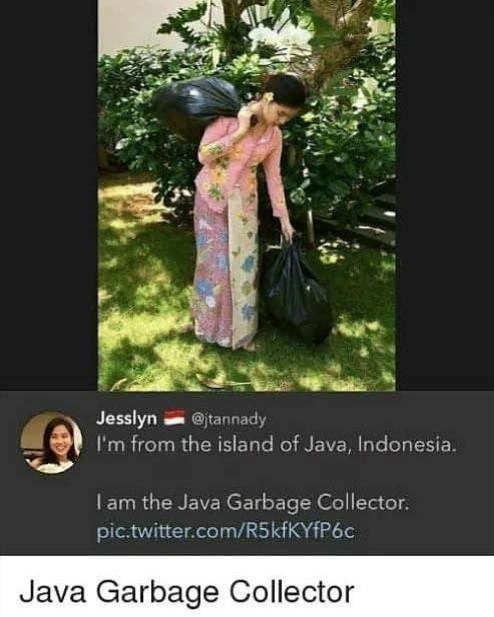
The funny picture makes a joke out of this by pretending the garbage collector is actually a real person from a place called Java. It shows a lady holding big trash bags, like she’s been cleaning up a yard. She’s from the island of Java in Indonesia (which is a real place that shares the name “Java”). So she jokes, “I am the Java Garbage Collector,” meaning two things at once: she’s literally a garbage collector in Java (the place) and, as a play on words, she’s the garbage collector for Java (the computer language). It’s like saying the computer’s cleanup helper went on vacation to Indonesia and we caught a picture of her taking out real trash! We find it funny because it takes a serious computer idea – cleaning up memory – and turns it into a real-life scene we can laugh about. It’s a bit like if someone from Turkey said “I fix bugs for Python” and showed a picture of themselves tending to actual pythons (snakes) – mixing up a programming term with everyday life. The “Java Garbage Collector” meme makes us giggle because it’s taking out the trash, literally and figuratively, at the same time.

Level 2: Meet Java’s Garbage Collector

Let’s break down the joke in simpler terms. Java is a popular programming language (with a coffee mug logo) that prides itself on automatic memory management. This means when Java programs run, they automatically clean up unused data from memory using something called a garbage collector. Now, in normal life a “garbage collector” is a person (or a garbage truck crew) who collects trash so your home and streets stay clean. In Java (the language), the garbage collector is not a person at all, but a part of the program that cleans up unused pieces of data (so your computer’s memory stays clean and doesn’t fill up with junk data). The meme plays on this double meaning in a fun way.

In the image, we see a young woman wearing a traditional Indonesian kebaya dress standing outside with lush greenery around. She’s holding two large black trash bags – one propped on her shoulder and one in her other hand – clearly looking like someone in the middle of collecting garbage. The twist is in the text shown below the image. It’s actually a screenshot of a tweet from a user named Jesslyn. In that tweet, she introduces herself by saying:

“I’m from the island of Java, Indonesia.
I am the Java Garbage Collector.”

She even has the Indonesia flag in her tweet name, signaling she’s truly from Java. So, what is she joking about? Java is not just a programming language; it’s also the name of an actual island in Indonesia. By saying she’s the “Java Garbage Collector,” she’s literally claiming to be a garbage collector (trash picker) from Java (the place). But to any programmer reading this, “Java garbage collector” immediately also means “the thing in Java that collects (programming) garbage”. It’s a perfect pun: one phrase, two very different meanings, combined in one person.

Let’s clarify the tech side a bit more. In programming, when we create data or objects, they take up space in the computer’s memory (think of memory as a big closet where data is stored). In some languages like C or C++, the programmer has to manually manage memory – which means after you’re done using some data, you should free up that space in the closet yourself. If you forget, the closet fills up with unused stuff (this bug is called a memory leak). However, Java is designed so that the programmer doesn’t worry about this cleanup. Java’s garbage collector automatically finds data that the program no longer needs and throws it away (frees the memory). It’s like having a cleaning robot that follows you around and picks up your toys when you’re done playing with them, so your room doesn’t get cluttered.

To illustrate, here’s a quick comparison between a language with manual memory management (C) and Java’s automatic garbage collection:

// C code - manual memory management
#include <stdlib.h>
...
char* message = malloc(100);  // allocate 100 bytes for a message
strcpy(message, "Hello World");
// ... use the message ...
free(message);               // manually free the memory when done
// Java code - automatic memory management
String message = new String("Hello World");
// ... use the message ...
// no need to free() explicitly - Java's garbage collector will later clean it up 
// once 'message' is out of scope or no longer referenced

In the C example, we explicitly called malloc (to allocate memory) and later free (to deallocate). In the Java example, we just created a new string. Java will automatically figure out when message is no longer needed and reclaim that memory. This automatic cleanup is precisely what the Java garbage collector does behind the scenes. It periodically checks for objects that your program isn’t using anymore (no variables refer to them) and removes them, freeing up space in the memory (heap). This prevents the program from running out of memory even if the coder forgets to clean up – which is a huge relief for developers and a big reason Java was considered more robust especially for beginners or large applications.

Now back to the meme: The woman in the photo is literally doing what a garbage collector does in real life – holding garbage bags, presumably having collected trash from the area. She’s from Java (the island), so she’s literally a “Java garbage collector.” It’s a play on words: she is actually from Java and actually collecting garbage. The bottom caption “Java Garbage Collector” drives the joke home by using the exact terminology a programmer knows. It’s funny to us because we never really imagine the Java language’s garbage collector as a person – it’s just a program feature. Seeing it portrayed by an actual person from a place called Java is unexpected and whimsical.

This kind of joke is a language quirk pun. It takes a term from computer science and shows it in a literal, everyday context. If you’re learning programming, you’ll notice we use a lot of common words (like “thread”, “heap”, “bug”, “daemon”, “garbage collection”) but they have special technical meanings. Here “garbage collection” in tech means cleaning memory, but normally it means picking up trash. The meme makes us think of both meanings at once. It’s also educational in a sneaky way: anyone who didn’t know about Java’s memory management might ask, “Wait, what does garbage collector mean in code?” and learn that it’s the part of Java that cleans up unused data automatically. And if someone didn’t know Java is an island, well, they just learned a geography fact!

To sum up, the elements of the meme combine to create the joke: a real person in traditional attire (so we infer she’s Indonesian), holding garbage bags (doing cleanup), plus the tweet text explicitly saying she’s from Java and calling herself the Java Garbage Collector. It merges the programming concept with the real-world concept in one image. The reason developers find this so amusing is that it’s a clever crossover between our coding world and actual world. It’s like seeing a pun come to life. And indeed, the original poster Jesslyn captioned it perfectly, essentially saying “Nice to finally meet you!” — as if the community has been waiting to see what the Java garbage collector would look like if it were a person. Now we know! 😄

Level 3: From Bits to Bins

For those of us who have lived and breathed Java (the programming language) in our careers, the phrase “Java garbage collector” instantly calls to mind a core piece of the runtime, not an actual person with a trash bag. That’s why this meme is a gem of developer humor: it yanks a jargon term out of context and gives it a hilariously literal twist. In day-to-day coding, we say things like “Don’t worry about deleting that object, the garbage collector will handle it,” and we’re referring to a background thread in the JVM. Seeing a photo of a woman from the actual island of Java holding garbage bags and claiming “I am the Java Garbage Collector” is an unexpected crossover between our mental tech world and reality. It’s like our internal mental image (perhaps a fuzzy concept of a cleanup process) suddenly got a face, a national flag, and a traditional outfit! Every experienced Java developer smirks at this because we’re so used to talking about garbage collection in abstract terms; the meme serves it back to us literally, catching us off-guard in the funniest way.

The humor here is a classic technical pun. It exploits the double meaning of Java (a programming language named after coffee and the Indonesian island known for its coffee) and garbage collector (a software routine and a person who collects trash). This double meaning is why the tweet by Jesslyn went viral among tech circles. She wrote, “I'm from the island of Java, Indonesia. I am the Java Garbage Collector.” and even included the 🇮🇩 Indonesia flag in her profile — an immediate tip-off for those familiar with the geography. The meme pairs her proud declaration with a visual of her literally hauling garbage bags. For developers, it’s chef’s kiss because it mashes together a bit of computer science (automatic memory cleanup) with a bit of world trivia (Java is an island of Indonesia) and plays on the language quirks we deal with. We often anthropomorphize software components in jokes (“the compiler is complaining”, “the garbage collector is working hard today”), but here it’s taken to an extreme literal level. It’s as if the JVM sent a real envoy from Indonesia to clean up our RAM. 😂 (Hey, if only fixing memory leaks in production were as simple as calling her up for help!)

From a seasoned developer’s perspective, this meme also tickles memories of how far we’ve come in programming. In low-level languages like C or C++, we had to manually manage memory — mismanage it and you’d get memory leaks or crashes. Then came languages like Java (mid-90s) emphasizing “write once, run anywhere” and safety, with garbage collection being a key feature. We vividly remember our introduction to Java and being relieved: “Wait, I don’t have to call free() on everything? The runtime cleans up for me? Nice!” It felt like having a cleaning service for our code’s mess. Of course, nothing is truly free: as seniors know, garbage collection can introduce performance pauses (the dreaded stop-the-world GC pause that might happen at the worst time, like during a high-stakes demo or heavy traffic on your server). We’ve spent time tuning GC parameters, reading GC logs, or choosing between GC algorithms (like deciding if CMS or G1 would cause fewer hiccups for our app). We joke about the GC as this invisible janitor: usually underappreciated, sometimes blamed when the app is slow (“Ugh, GC is thrashing again!”), but ultimately life-saving because it prevents our servers from running out of memory.

This shared understanding is what makes the meme so relatable. In the picture, Jesslyn is dressed in a bright, floral kebaya (traditional Indonesian attire), smiling and hefting actual trash bags — a far cry from the invisible process thread we discuss in architecture meetings. The caption “Java Garbage Collector” pasted below ties it all together for anyone who might not immediately catch the Twitter handle’s joke. It’s essentially saying: Here she is, folks, the one who’s been cleaning up all your stray objects in memory. It playfully imagines that the reason Java programs don’t crash from memory buildup is because this friendly person from Java island has been personally taking out the trash. It’s absurd in the best way.

Senior devs also appreciate the historical full-circle here. Fun fact: Java the language was named after Java coffee, a type of coffee from Indonesia’s Java island. (The language’s creators were apparently drinking a lot of coffee and the name just clicked – hence the coffee cup logo!) So the word “Java” in tech already had its roots in that island, indirectly. Now this meme kind of closes the loop: the island of Java gives us not only the name and coffee but also, comically, the “personnel” for cleaning up memory. It’s a goofy reminder that sometimes our tech terminologies borrow from real life (heap, stack, thread, garbage collection all sound like everyday words) and can be flipped back to real life for laughs. We chuckle because the meme is absurdly literal yet perfectly apt. It’s the kind of joke you show to your coding team during a caffeine break, eliciting groans and laughs in equal measure. And if a non-developer overhears “Java garbage collector” and sees this meme, for once they’ll actually get the reference without needing a PhD in computer science!

In essence, the meme resonates on multiple levels for an experienced programmer: it lampoons our habit of using abstract terms by imagining them as real, it nods at Java’s cultural name origin, and it highlights a beloved feature of high-level languages (automatic memory management) by comparing it to a real-world cleaning job. It’s lighthearted and clever, a nice break from debugging actual memory issues. And to Jesslyn, the self-proclaimed Java Garbage Collector: nice to finally meet you, indeed! We’ve been invoking you figuratively for years, and here you are in person with a grin and garbage bags, ready to tidy up our messes. 😄

Level 4: Mark-and-Sweep Saga

Deep inside the Java Virtual Machine, an automatic memory management mechanism works like a sophisticated cleaning crew. This is the famous garbage collector — a piece of software engineering sorcery that tracks and reclaims unused memory so developers don’t have to manually scrub the heap. It’s not magic, but it can feel like it: the GC automatically finds data your program no longer needs and frees it up, preventing memory from overflowing with “junk” objects. Under the hood, classic algorithms like mark-and-sweep are at play. During a mark phase, the GC starts from root references (active variables, stacks, static fields) and traverses the object graph, marking everything still in use. Then comes the sweep phase, which collects any unmarked (unreachable) objects — analogous to tossing out trash that no one’s using. This ensures that leftover objects from bygone function calls or out-of-scope variables get cleared away, much like a diligent janitor tidying up after hours. Modern JVMs even compact memory after sweeping, moving surviving objects together so the heap doesn’t get fragmented (think of it as organizing the bookshelf after removing unwanted books).

This process is dynamic and generational. In Java’s memory management, new objects are allocated in a Young Generation heap space, premised on the insight that most objects die young (the generational hypothesis). The garbage collector frequently cleans this nursery (young generation) via quick minor collections. Objects that survive multiple cycles get promoted to an Old Generation (they’ve proven they might stick around longer). This generational design makes GC more efficient: it spends most of its effort cleaning up lots of short-lived objects (like clearing daily trash) and less frequently touches the long-term objects (like doing a deep clean occasionally). Over Java’s history, the GC algorithms evolved from simple stop-the-world mark-and-sweep to advanced collectors like CMS (Concurrent Mark-Sweep) and G1 (Garbage-First). These fancy acronyms represent strategies to minimize pause times and maximize throughput. For example, G1 GC breaks the heap into regions and collects the “garbage-iest” ones first, aiming to meet specific pause time targets so your app doesn’t freeze too long when collecting rubbish. There are even nearly-pause-free collectors nowadays (ZGC, Shenandoah), which use nifty techniques like colored pointers and concurrency to clean up memory as unobtrusively as possible. All this research and engineering goes into making Java’s garbage collection feel automatic and smooth, so developers can sip their coffee while the JVM takes out the trash.

It’s worth noting that the term “garbage collection” in computing dates back decades (invented for Lisp in the 1960s by John McCarthy) – long before Java’s coffee-themed name came about. The fundamental challenge it addresses is how to reclaim memory without hurting the running program. The GC must carefully pause or coordinate with program threads to avoid conflicts – a phenomenon known as a stop-the-world pause when all application threads are momentarily halted. This is a delicate dance: too long a pause and users notice a hiccup (imagine if our real-world garbage collector stopped time whenever she picked up a bag – convenient for cleaning, but spooky for everyone else!). To mitigate that, modern collectors perform as much work as possible concurrently (in parallel with the program) or incrementally. They utilize clever tri-color marking algorithms and write barriers (tiny checkpoints in code) to track object changes during a collection cycle. All these mechanisms ensure memory is cleaned up safely without crashes or corrupting data. The end result? Java programs avoid most memory leaks and dangling pointers by design. The JVM’s runtime environment becomes a self-cleaning ecosystem, where the dreaded task of manual malloc/free memory management is handled by an ever-vigilant background process. It’s a beautiful interplay of computer science and engineering: a real-time graph traversal and memory recycling service running under our noses as we code business logic.

To put it in pseudo-code, a simple mark-and-sweep algorithm might look like this:

// Pseudocode of a simple Mark-and-Sweep garbage collector:
void garbageCollect(Heap heap) {
    // Mark phase: mark all reachable objects
    for (Object root : heap.rootSet()) {
        markReachable(root);  // recursively mark every object reachable from each root reference
    }
    // Sweep phase: free all unreachable objects
    for (Object obj : heap.objects()) {
        if (!obj.isMarked()) {
            heap.free(obj);   // reclaim memory for objects not marked as reachable
        }
    }
}

Each markReachable call would traverse pointers (object fields, references in arrays, etc.) depth-first, setting a flag on every object it can reach. Anything left unmarked after that traversal is truly orphaned garbage. The heap is essentially a big pool of memory where Java objects live, and once an object has no references pointing to it, it becomes eligible for collection. This approach prevents memory leaks by design: as long as nothing references an object, it eventually gets cleaned up. Contrast this with manual memory management (like in C/C++), where forgetting to free unused memory leads to leaks (memory that’s lost and can’t be reused). Java’s automatic garbage collector eliminates that class of bug at the cost of some runtime overhead and complexity in the JVM. It’s a classic computer science trade-off – a bit of runtime work for a lot of developer convenience and safety.

So when developers talk about the Java garbage collector, they’re usually referring to this behind-the-scenes process that keeps memory usage in check. It’s one of Java’s hallmark features and also a common subject of performance tuning (have you ever tweaked JVM flags like -Xmx or -XX:+UseG1GC to adjust GC behavior?). Thanks to these algorithms, Java programs can run for months or years, allocating millions of objects, without the programmers manually sweeping up anything – the system handles all the cleanup. Given this rich backdrop, the meme’s joke shines through: it anthropomorphizes the Java GC as a literal person from Java island taking out bags of trash. For a seasoned techie, it’s a delightful collision of runtime internals with real-world imagery. After all, behind every seemingly whimsical term in programming (like “garbage collection”) lies a serious engineering saga – here humorously summed up by one woman with two trash bags and a great sense of pun.

Description

This meme is a screenshot of a tweet that creates a clever, literal pun based on the term 'Java Garbage Collector.' The image is split into two parts. The top part is a photo of a woman in traditional Indonesian clothing, standing in a garden and holding two large black garbage bags. The bottom part is the tweet itself, from a user named Jesslyn (@jtannady), whose profile includes an Indonesian flag. The tweet reads, 'I'm from the island of Java, Indonesia. I am the Java Garbage Collector.' Below the screenshot, a caption reiterates, 'Java Garbage Collector.' The humor stems from the wordplay connecting a person from the geographical island of Java literally collecting garbage with the well-known 'Garbage Collector' in the Java programming language, which is a process for automatic memory management. It's a pun that resonates with anyone familiar with Java development


Comments

7
Anonymous ★ Top Pick Finally, a Java Garbage Collector that gives you a clear visual on what it's doing. Now if only it could be tuned with a single JVM flag
  1. Anonymous ★ Top Pick

    Finally, a Java Garbage Collector that gives you a clear visual on what it's doing. Now if only it could be tuned with a single JVM flag

  2. Anonymous

    Thrilled the Java Garbage Collector finally showed up - mind hauling off the 2 GB of “temporary” singletons that have survived more promotion cycles than our architects?

  3. Anonymous

    Finally found someone who can explain why Java's G1GC has such unpredictable pause times - turns out it depends on Indonesian weather patterns and how many bags need collecting that day. No wonder we switched to ZGC for our microservices

  4. Anonymous

    When you tell non-technical people you work on Java's garbage collector, they picture this elegant Victorian lady maintaining pristine gardens - not you frantically tuning G1GC parameters at 2 AM because your microservice is experiencing 500ms stop-the-world pauses and the on-call pager won't stop screaming. At least she gets to work in daylight and doesn't have to explain to management why 'just disable GC' isn't a viable solution

  5. Anonymous

    Spotted the Java GC IRL: does mark-and-sweep with black bags, stop-the-world every Saturday, and still won’t pick up anything you keep a strong reference to

  6. Anonymous

    Finally, a Java GC with deterministic pauses - no -XX flags, no safepoints, and throughput measured in bags per second

  7. Anonymous

    Unlike G1GC, she nails major collections without stop-the-world pauses or endless -XX flags

Use J and K for navigation