Skip to content
DevMeme
1494 of 7435
Automation: Grand Vision vs. Jenkins Reality
Automation Post #1673, on Jun 7, 2020 in TG

Automation: Grand Vision vs. Jenkins Reality

Why is this Automation meme funny?

Level 1: Big Dreams vs. Little Problems

Imagine a long time ago, people were super excited about big machines doing work for us – kind of like building a giant robot to help everyone. That’s the big dog in the meme, very strong and confident, saying “we will change the world with these machines!” Now imagine today, you have a little helper on your computer that’s supposed to do things for you automatically. That’s the smaller dog. But uh-oh – the little helper stops working and says “my task failed.” It’s like if you had a toy robot that was supposed to clean your room, and instead it just broke down and started blinking a red light. The difference is funny: one scene is all about a huge plan to save the world, and the other scene is about a tiny everyday hiccup. In other words, we went from dreaming about mighty machines changing history to dealing with a little computer program that won’t do our homework. It’s a silly way to show that sometimes our big dreams of automation turn into small frustrations today.

Level 2: Meet Jenkins, Our CI Butler

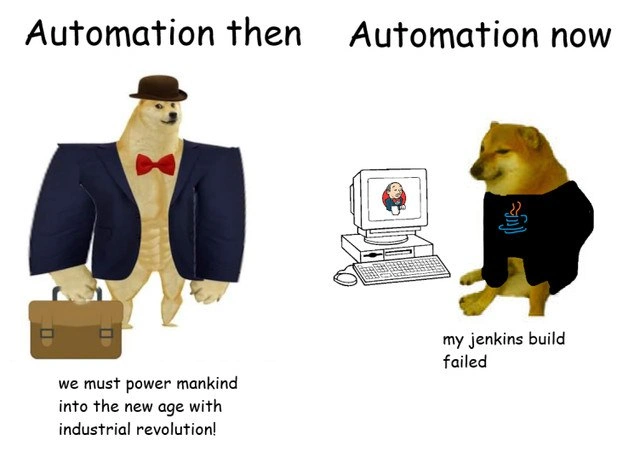
So, what exactly is going on in this meme? It’s comparing two very different kinds of automation. Let’s break it down in simpler terms. On the left, “Automation then” refers to the Industrial Revolution. That’s the period a couple of centuries ago when people started using machines to do work that was previously done by hand. Picture big steam engines, spinning gears, and factory assembly lines. These inventions automated tasks like weaving cloth or assembling products, which massively increased productivity. The text “we must power mankind into the new age with industrial revolution!” mimics the grand, optimistic tone from that era – people truly believed these new machines would change the world (and they did!). The Doge is shown all muscular and formal, symbolizing how powerful and serious those early automation efforts were for society.

On the right, “Automation now” is talking about automation in software development and IT. Instead of steam engines and factory machines, we have computer programs and scripts that automate routines for us. Jenkins, which you see on the little computer screen (that picture of a bow-tied butler), is a popular tool used in software development for Continuous Integration and Continuous Delivery (CI/CD). CI/CD automation means whenever developers update code, a system like Jenkins automatically builds the application (compiles the code, runs tests, etc.) and even prepares it for deployment. This saves developers from doing all those steps manually each time.

The Cheems dog on the right is wearing a black T-shirt with the Java coffee cup logo. This detail is a nod to the tech world: Jenkins itself is written in Java and often used to build Java projects (though it works with many languages). Cheems looks a bit dejected and is saying “my Jenkins build failed.” This is something a lot of developers have experienced: you push your code changes, Jenkins kicks off an automated build, and then — oops! — one of the steps in the pipeline failed. Maybe your code didn’t compile, or a unit test did not pass, or perhaps there was a configuration error. The result? Jenkins reports a build failure, usually with a red status indicator. It basically means the automation couldn’t successfully complete all tasks.

For someone new to this, imagine Jenkins as a diligent butler for developers (which is why its logo is a butler). Developers write a list of instructions for it, often in a file called a Jenkinsfile or via a web interface: for example, “First compile the code, then run the tests, then package the app.” This sequence of steps is called a pipeline. Once you commit your code, Jenkins the butler follows those instructions automatically. This is the essence of Build Automation in CI: you don’t have to manually run the build and tests on your own machine for every change — Jenkins does it on a dedicated server, every time, consistently. That’s Continuous Integration: integrating and testing each change continuously, so problems are caught early.

However, as convenient as that is, it also introduces new kinds of headaches. A newbie developer might expect, “Cool, everything is automated now, so it will just work!” But in reality, you often find yourself dealing with BuildFailures on the CI server that didn’t happen on your laptop. For example:

  • Environment differences: “It worked on my machine!” is a common reaction. Maybe the Jenkins server uses a slightly different configuration or OS, causing a script to fail.
  • Dependency issues: Perhaps your code relies on a library that wasn’t set up correctly on the build server, so the build fails until someone installs or updates that dependency.
  • Test instability: Sometimes tests that pass normally might randomly fail on Jenkins due to timing issues or resource constraints. This leads to the infamous flaky tests.
  • Configuration mistakes: If there’s a mistake in the pipeline script (say a wrong path or missing credential), Jenkins will stop and mark the build as failed.

When Jenkins reports “BUILD FAILURE”, developers have to investigate the logs (the detailed output). This can be frustrating, especially for newcomers: reading through a long log file to find out why your code didn’t compile or why a certain test failed. It’s a bit like debugging, but for the build process itself. Over time, developers learn to expect that a portion of their day might be spent fixing these automated pipeline issues – which is ironic because the pipeline is supposed to save time!

Now, why is this meme funny to people in tech? Because it sets up a huge contrast: Automation used to be about transforming society with machines, and now, in a developer’s daily life, automation often just means running build jobs on Jenkins – and even that can go wrong. It’s taking something grand and comparing it to something trivial and annoying. If you’ve ever felt proud setting up an automated process, only to be humbled by it failing with some silly error, you’ll get the humor. The left side is the ideal of automation; the right side is the reality we deal with. It’s poking fun at our modern DevOps struggles: we have amazing tools like CI/CD pipelines, yet we still end up troubleshooting them as if we were mechanics covered in grease – except our “machines” are made of code.

In simple terms, this meme uses the popular “Swole Doge vs Cheems” format to compare then vs now. Swole Doge (buff dog) represents how people used to talk about automation as this powerful, world-changing force. Cheems (small dog) represents how we talk about automation now in our daily work – often with a bit of disappointment or frustration, like complaining about a Jenkins job. It’s a fun way to say: “Automation used to sound heroic; now it’s just part of our routine and sometimes a headache.” Everyone in DeveloperHumor or tech memes has seen or lived that Jenkins pipeline fail scenario, so we can laugh at ourselves through this cartoonish comparison.

Level 3: Factories to Failures

In the Industrial Revolution era, automation was a grand, world-changing ideal – think giant steam-powered machines and assembly lines revolutionizing factories. The left side of this meme (the buff “Swole Doge” in a suit) channels that 19th-century ambition: “we must power mankind into the new age with industrial revolution!” This was automation as a heroic concept, eliminating manual labor on a massive scale. Fast forward to today’s DevOps culture, and automation usually means something far less majestic: a Jenkins CI/CD pipeline kicking off a build. The right side (the meek “Cheems” doge in an oversized Java T-shirt) perfectly captures the modern reality: “my Jenkins build failed.” It’s a hilarious contrast between lofty historical rhetoric and the mundane frustrations of contemporary software BuildSystems_CICD.

For seasoned developers and DevOps/SRE folks, this meme hits home because we’ve lived both sides of that contrast (metaphorically, at least). We regularly champion automation – “Automate all the things!” – but in practice, our daily “automation” often involves babysitting a flaky Jenkins server or debugging Continuous Integration hiccups. Jenkins (represented on Cheems’s CRT monitor by its butler logo) is a widely used automation server that runs build pipelines. It’s powerful, but it’s also notorious for random BuildFailures and finicky configurations. The joke here is that the same word automation spans centuries of innovation yet yields very different emotional reactions: awe and optimism back then, eye-rolls and debug logs now. DevOps engineers today might not be wrangling steam engines, but wrestling with a stubborn build script at 2 AM can feel just as intense (and far less glorious).

Why is this funny from a senior perspective? It’s the difference in scale and narrative. In the past, automation’s promise was epoch-making progress; today, automation is an everyday Jenkins pipeline that might break because of a misconfigured environment or a failed unit test. Every experienced developer knows the pain of a red “failed” build status halting their workflow. We’ve gone from industrial barons heralding a new age to a developer muttering “not again” at a broken pipeline. It’s an irony almost every software team can relate to: the ContinuousIntegration pipeline – meant to save time – sometimes creates extra work when it fails.

To put the contrast into perspective, consider this side-by-side comparison of automation then vs now:

Automation Then (Industrial Revolution) Automation Now (DevOps CI/CD)
Bold vision: machines liberate humans from toil Practical reality: scripts relieve devs of manual builds – when they work 🙃
Huge mechanical contraptions (steam engines, looms) Complex software setups (Jenkins servers, build agents, plugin maze)
Fueled a historic leap in productivity and industry Speeds up deployments and testing for each code commit (vital, but incremental)
Failures meant sparks flying or factory downtime Failures mean red pipelines, cryptic console logs, and developer downtime
Motto: “Power mankind into a new age!” 🚂 Motto: “Ugh, my Jenkins pipeline failed again.” 💻

The meme exaggerates for effect, of course. Industrial-age automation dramatically changed the world, whereas a Jenkins pipeline failing is a trivial daily annoyance in comparison. But that’s exactly why it’s funny. Automation as a concept carries futuristic, almost utopian vibes, yet here we are in 2020, using a Java-based server with a cartoon butler to automate our software builds – and often it just complains with a failure. The muscular Doge wearing a bowler hat embodies the pride and optimism of early automation pioneers. The Cheems Doge, small and slouching by the CRT monitor, embodies the humbled developer dealing with CI/CD headaches. It’s a classic tech humor pattern: epic past ideals vs. prosaic present reality. Every senior dev chuckles (perhaps a bit bitterly) because we’ve all confidently set up “automated” pipelines believing we’re streamlining progress, only to spend the next day digging through build logs when “automation now” doesn’t live up to the hype. In short, the meme uses Swole Doge’s industrial revolution bravado and Cheems’ Jenkins build failure malaise to poke fun at how far – or how little – our notion of “automation” has come.

Description

A two-panel meme using the 'Swole Doge vs. Cheems' format to contrast historical and modern automation. The left panel, labeled 'Automation then,' features a muscular, well-dressed Doge in a suit and bowler hat, exclaiming, 'we must power mankind into the new age with industrial revolution!'. This represents a powerful, ambitious vision. The right panel, labeled 'Automation now,' shows a small, sad Cheems dog wearing a black sweater with the Java logo. He is slumped over, looking dejectedly at a retro computer monitor displaying the Jenkins butler logo, with the caption 'my jenkins build failed'. The meme humorously juxtaposes the world-changing ambition of the Industrial Revolution with the mundane, often frustrating reality of modern software development, where a simple failed CI/CD pipeline can be a source of great despair. It's a relatable joke for any developer who has wrestled with complex build systems

Comments

7
Anonymous ★ Top Pick We dreamed of automating the world into a new industrial age, but we ended up just spending our days debugging Groovy scripts in a Jenkinsfile
  1. Anonymous ★ Top Pick

    We dreamed of automating the world into a new industrial age, but we ended up just spending our days debugging Groovy scripts in a Jenkinsfile

  2. Anonymous

    Industrial automation once ran on steam; ours runs on an 850-line Jenkinsfile that collapses the moment someone renames a branch - so much for progress

  3. Anonymous

    The real industrial revolution was convincing management that a 45-minute Jenkins pipeline that fails 30% of the time due to flaky tests is actually an improvement over the 5-minute manual deployment that worked every time

  4. Anonymous

    We went from 'automating the means of production' to 'my build failed because someone pushed to master at 4:47 PM on a Friday.' The industrial revolution promised to free humanity from manual labor; Jenkins just freed us from the illusion that automation would ever actually work on the first try

  5. Anonymous

    Automation then ran factories; automation now is a Jenkins pipeline that fails because Maven pulled a transitive minor bump and a flaky integration test hit a Nexus hiccup - the only thing truly continuous is the on-call

  6. Anonymous

    The Industrial Revolution ran on steam; ours runs on a Groovy DSL duct-taping bash to Maven until one flaky test red-balls the pipeline and idles the entire org

  7. Anonymous

    Industrial automation built empires; modern CI/CD builds our midnight resentment, one flaky stage at a time

Use J and K for navigation