Skip to content
DevMeme
2945 of 7435
Python vs. C++: The Freedom to Crash Your Own Computer
Languages Post #3252, on Jun 15, 2021 in TG

Python vs. C++: The Freedom to Crash Your Own Computer

Why is this Languages meme funny?

Level 1: Cautious Friend vs. Daredevil Friend

Think of it like this: you have two friends and you’re about to do something really obviously dangerous – let’s say you’re about to put a metal bowl in the microwave (a super bad idea that could make sparks or a fire). One friend is the cautious type, like a protective older sibling or a sensible adult, who immediately shouts, “Wait, you can’t do that! That’s against the rules – you’ll break something!” This friend is acting just like Python in the meme: stopping you right away because what you’re doing is clearly unsafe.

Your other friend is a total daredevil. When he sees you about to do the same dangerous thing, his eyes light up, he gives a wild grin and yells, “Cowabunga, do it!” as he eagerly presses the microwave’s start button. He knows it’s crazy, but he wants to see what happens. This reckless friend is like C++ in the meme – he doesn’t try to stop the bad idea at all, he actually encourages it, consequences be damned.

Now, why is this funny? Because we’ve given personalities to programming tools. Python is portrayed as the careful friend who follows the rules and keeps you out of trouble, and C++ is the crazy friend who breaks the rules and doesn’t warn you about the trouble you’re diving into. When you imagine programming languages acting like people, it highlights their differences in a silly, memorable way. In real life, if you listen to the cautious friend (Python), nothing too bad happens – you get scolded but you’re safe. If you follow the daredevil friend (C++), you might end up with a broken microwave (or a crashed program). Seeing those two side by side – one saying “No way!” and the other saying “Woohoo, let’s go for it!” – makes us laugh because we can guess exactly which approach leads to a mess. It’s a fun way to compare being careful versus being reckless, just like the two programming languages.

Level 2: Python Says No, C++ Says Go

For someone new to coding, here’s what’s going on in this meme: it’s comparing how two programming languages, Python and C++, deal with a obviously bad piece of code (the kind of code that could crash your program or “break your computer”). In short, Python will stop you or warn you when you’re about to do something wrong, whereas C++ will often let you do it without a peep, and only later might you see the program crash or act crazy. It’s a lighthearted way to contrast their behavior.

Python is a high-level, interpreted language, which means it runs your code line by line and can check for many errors as the program is running. Python is designed to be user-friendly and safe. If you try something that doesn’t make sense or is not allowed, Python will usually throw an error (raise an exception) right away and halt the program at that point. It’s like Python saying, “I won’t do this, it’s not allowed.” For example, if you attempt to access an element from a list that isn’t there (maybe your list has 3 items and you try to get the 10th item), Python will immediately raise an IndexError and tell you the index is out of range. If you try to divide a number by zero, Python will raise a ZeroDivisionError rather than produce some nonsense result. If you call a function with the wrong number of arguments, Python will complain with a TypeError. These are all runtime safety checks – Python is constantly watching out for certain common mistakes and it refuses to continue when it finds one. The meme shows this with the Halo character saying “Wait. That’s illegal.” under the Python label. That’s basically a humorous way of showing Python’s reaction: it hesitates or stops when you write “illegal” (bad) code. You’ll get a clear error message and a traceback (a report of where in the code the error happened). While an error can be frustrating, it’s actually Python being helpful, saying “Something’s wrong here, I won’t go further.” Crucially, these errors in Python happen before anything catastrophic occurs – you get a Python exception, but your overall system is safe (the Python interpreter won’t let your mistake wreak havoc beyond the program).

C++, on the other hand, is a lower-level, compiled language that prioritizes performance. It gives the programmer a lot of freedom – and with that freedom comes responsibility. The key difference is that C++ does not automatically check for many errors at runtime. Many mistakes that Python would catch, C++ will quietly ignore (at least until the consequences manifest later). For instance, if you have an array of 3 ints in C++ and you try to read the 10th element, what happens? C++ will compile that code without complaints. When you run it, it will attempt to read whatever is at that memory location beyond the array. This is a serious error, but C++ doesn’t immediately stop you or throw an error. Often, the result is either some garbage value (some random bits in memory) or a program crash. A crash that results from accessing memory you shouldn’t is called a segmentation fault (or segfault for short). That term basically means your program hit a memory boundary it wasn’t supposed to cross, and the operating system immediately killed it to prevent damage. In C++ (and C), segmentation faults are a common way programs fail when there’s a bug like this. The meme’s bottom half with the Ninja Turtle shouting “COWABUNGA IT IS” is portraying C++’s attitude: even if the code is obviously risky or wrong, C++ just goes “Alright, full speed ahead!” and runs it anyway. There’s no immediate check or error message like in Python. The bad news might only come later when the program crashes or misbehaves. This kind of scenario in C++ is termed undefined behavior – meaning the language doesn’t define what should happen, so anything can happen. It’s unpredictable.

Let’s consider a simple scenario that reflects the meme’s “stupid code” example. Suppose we have an array (or list) of three numbers and we intentionally try to access an index that’s out of bounds:

# Python example: Out-of-bounds list access
numbers = [1, 2, 3]
print(numbers[5])  
# This will raise IndexError: list index out of range 
# Python immediately stops and tells you that index 5 is invalid for this list.
// C++ example: Out-of-bounds array access
#include <iostream>
int main() {
    int arr[3] = {1, 2, 3};
    std::cout << arr[5] << std::endl;  
    // This is undefined behavior in C++.
    // There is no automatic check, so this line tries to read memory it shouldn't.
    // It might print some garbage value or cause a crash.
}

In the Python code, numbers only has indices 0, 1, 2. If you try numbers[5], Python immediately knows this is invalid. It will throw an IndexError and output a message like “list index out of range” at that line, then stop the program. You’d instantly know you did something wrong with the list indexing.

In the C++ code, arr has 3 elements (valid indices 0, 1, 2). But the code attempts arr[5]. The C++ compiler will compile this just fine – it doesn’t know at compile time that 5 is out of range (or rather, it doesn’t bother to check; it assumes you meant to do that). At runtime, the program will attempt to access the memory at arr[5]. This is beyond what you allocated for the array. Two things can happen, both not good: (1) If that memory address happens to be accessible, it will read whatever random data is there and print a meaningless number (this is a silent logical error, your program might keep running with wrong data); or (2) if that memory address is not allowed (protected by the system), the program will immediately crash with a segmentation fault. In either case, C++ itself prints no friendly error message at the point of the mistake – it just plows ahead. You might only see the aftermath (weird output or a crash). This exemplifies how C++ “yells COWABUNGA!” and goes for it. It’s both scary and impressive – scary because such bugs can be hard to find, impressive because this lack of checking is partly why C++ can be so fast. It never spends time asking “Are you sure about this?” – it just does it.

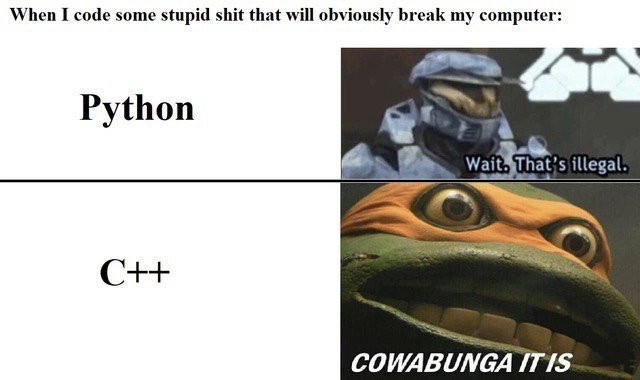
The meme’s images are borrowed from internet pop culture to symbolize these behaviors. The top image with the Halo Spartan saying “Wait. That’s illegal.” is used to represent Python catching a bad operation and complaining. The bottom image is a Teenage Mutant Ninja Turtle (Michelangelo) with a crazy expression and the text “COWABUNGA IT IS,” representing C++ happily doing something wild. “Cowabunga!” is that character’s catchphrase when they’re about to do something bold or reckless, so it fits perfectly here. The text at the very top of the meme, “When I code some stupid shit that will obviously break my computer:”, sets up the scenario. It’s basically the meme author admitting, “Alright, I wrote some code that’s asking for trouble.” Then the punchline is comparing how Python and C++ each respond. Python essentially says, “No way, I won’t run that.” C++ says, “Haha, okay, let’s run it!” This contrast is funny to developers because it’s exactly what those languages feel like when you use them. Python is like a car with lots of safety features (seatbelts, airbags, warnings), and C++ is like a high-powered race car with no safety features – if you know what you’re doing, you can go extremely fast, but if you screw up, the crash is going to be spectacular.

Level 3: Exceptions vs Explosions

For experienced developers, this meme prompts a knowing grin because it distills a common real-world difference between the two languages. The setup text is, “When I code some stupid shit that will obviously break my computer:” – that’s the developer admitting, tongue-in-cheek, “I just wrote some really bad code.” Now, how do the languages react? The meme answers with two iconic images: on the top, labeled Python, a Halo Spartan incredulously says “Wait. That’s illegal.”; on the bottom, labeled C++, an over-excited Ninja Turtle screams “COWABUNGA IT IS!”. It’s a perfect snapshot of their personalities. Python is portrayed as the strict rule-follower that immediately objects to dangerous behavior, whereas C++ comes off as the crazy daredevil that welcomes the madness.

In day-to-day coding terms, this is downright accurate. If you do something obviously wrong in Python, it won’t hesitate to flag it. Imagine you attempt to access a list index that’s way out of range or you add a string to an integer by mistake. Python will raise an exception on the spot and give you a stack trace pointing exactly to the line of code where things went wrong. It’s annoying to get an error, sure, but it’s also incredibly helpful – Python essentially fails fast. It’s telling you, “Nope, you can’t do that,” right when the mistake happens. As a result, Python developers often catch bugs early in the development cycle, because the language runtime refuses to let blatant errors slide. We’ve all seen that red text traceback in Python that, while intimidating to newbies, is actually a big bright sign saying “Here’s the bug!” In a way, Python acts like an assertive safety inspector in your program: it will blow the whistle the moment it sees something break the rules. This tendency has saved many of us from hours of debugging; the error messages might be unwelcomed, but they’re usually clear about what went wrong and even where.

Now think of C++. If you write the same kind of bug in C++, the compiler will likely remain calm and compile your program successfully, especially if the mistake doesn’t violate syntax or type rules. C++ assumes you know best. So you run your compiled program, and then the fun starts. Maybe nothing bad happens immediately – sometimes you get lucky for a while – but then out of nowhere the program might crash, or start printing bizarre outputs. Cue the dreaded segmentation fault or other random malfunction. For many of us, our early C/C++ days involved that shock: “It compiled fine... why did it just crash without a clue?” That is the essence of undefined behavior in C++: the program did something the language spec doesn’t allow, but instead of an error message, you get chaos. It’s like planting a bug that explodes later. Debugging such issues can be a nightmare, because the symptom (the crash or weird behavior) might occur far from the original mistake. Experienced devs have countless war stories: a stray memcpy overflowing a buffer that causes a segmentation fault much later in a completely different part of the code, or an uninitialized pointer that intermittently causes data corruption. In these moments, one can almost hear C++ laughing “Cowabunga it is!” as it jumps off the cliff with you. The meme hits home because we’ve been there: Python would have stopped us with a clear error at the point of the mistake, but C++ lets us jump off, and only after we’re in free-fall do we realize something’s terribly wrong. It’s the difference between exceptions (Python’s method of yelling about a problem) versus explosions (C++’s method of not saying anything and then everything blows up).

The humor also rides on our familiarity with these two language communities and their LanguageQuirks. Python is often jokingly seen as the “safe” or “beginner-friendly” language – it has garbage collection, it won’t let you mess with pointers directly, it gives helpful errors. C++, on the other hand, has a reputation as a powerful but perilous tool – “sharp knives” and footguns everywhere (features so potent they can shoot you in the foot if used incorrectly). There’s an ongoing friendly rivalry (LanguageWars) between fans of these languages. Python developers might tease C++ folks like, “hey, enjoy debugging those segfaults,” and C++ folks might retort, “have fun with your slow Python interpreter and hand-holding.” This meme plays right into that banter. It’s essentially a LanguageComparison joke: it caricatures Python as the law-abiding Spartan, enforcing the rules, and C++ as the wild Ninja Turtle, breaking the rules with a grin. Importantly, both sides of this joke are relatable to seasoned devs. We know Python’s runtime safety can be a lifesaver (or at least a time-saver), and we also know the thrill (and terror) of C++’s unrestricted power. The meme exaggerates them to comedic extremes: Python physically saying “Wait, that’s illegal” (as if the language is shocked you even tried that), and C++ enthusiastically yelling “COWABUNGA IT IS” as it launches your ill-advised code toward its likely demise. It’s funny because it’s true enough. In real life, of course, good C++ engineers use tools like address sanitizers, unit tests, and careful code reviews to catch these issues, and Python code can certainly crash or encounter fatal errors if you ignore exceptions. But the core truth remains: Python tends to catch you before you fall, C++ often only catches you after you’ve hit the ground. And every experienced developer has a few scars (or at least vivid memories) from learning that difference the hard way. That shared understanding is exactly what this meme taps into, making it resonate in programming circles.

Level 4: Wait, That's Undefined

At a deep technical level, this meme is highlighting how Python and C++ handle dangerous or erroneous operations very differently, due to fundamental design choices like memory safety and runtime checking. In C++, if you perform a clearly unsafe action – say you access memory outside the bounds of an array, dereference a null pointer, or cast data to the wrong type – the language doesn’t stop you at compile time or runtime. Instead, C++ invokes what the language specification politely calls undefined behavior (UB). In practical terms, anything can happen when you hit undefined behavior. Your program might crash spectacularly (often with a segmentation fault when you touch memory the OS hasn’t allowed), or it might silently corrupt data, or even appear to work fine while doing something wrong behind the scenes. The classic joke is that with undefined behavior, “the compiler is allowed to make demons fly out of your nose” – meaning the language runtime offers no guarantees at all about the result. Why would a language ever allow such chaos? It’s largely due to C++’s philosophy of maximizing performance and giving programmers low-level control. C++ (inherited from C) follows a “zero-overhead” principle: it doesn’t build in runtime checks for things like array bounds by default, because that could slow things down. The compiler more or less says, if you insist on doing something risky, I’ll compile it and let you do it. It trusts that you, the developer, know what you’re doing. This is like a powerful sports car with no automatic safety features – blazing fast, but if you make a wrong turn, boom – no one is there to save you. Seasoned C++ developers are all too familiar with this; many have tales of chasing down bizarre bugs caused by a stray pointer or an off-by-one error that the compiler happily ignored until the program blew up.

On the other side, Python is built with a very different philosophy: it prioritizes safety and ease of use, even if that means sacrificing some performance. Python code runs in an interpreter (a virtual machine) that actively performs runtime safety checks. When you attempt something obviously invalid in Python – like referencing a list index that’s out of range, dividing by zero, or performing an operation on incompatible types – Python will immediately raise an exception (such as IndexError or ZeroDivisionError or TypeError) and refuse to continue executing that faulty operation. It’s essentially Python saying, “Wait, that’s illegal.” The operation is stopped right then and there with a clear error message, rather than blindly proceeding. For example, if you try to use a variable that hasn’t been defined, Python won’t try to guess; it will throw a NameError and halt at that line. If you somehow write code that overflows a number, Python will transparently switch to a big integer representation rather than overflowing into nonsense data. If you make a deeply recursive call that risks crashing the stack, Python will break out with a RecursionError once you exceed a certain depth. All these checks are like safety barriers. They add overhead, but Python’s design accepts that cost to help developers avoid crashes. In short, Python provides guardrails: it won’t let you do many of the “stupid” things without protest, whereas C++ provides a rocket engine and says “use at your own risk.”

This boils down to a core difference in language design. Python is a high-level, memory-safe language that errs on the side of caution – it’d rather give you a loud error than let your program continue in a corrupted state. C++ is a low-level, high-performance language that gives you raw power – it assumes you’ll use that power wisely, and if not, the fallout is on you. The humor in the meme comes from personifying these philosophies with two pop culture references: a Halo Spartan and a Ninja Turtle. In the top half, Python is depicted as the Halo Spartan saying, “Wait. That’s illegal.” This is perfect engineer humor because Python indeed feels like the one calling out “Illegal move!” when it encounters bad code. In the bottom half, C++ is the wide-eyed Teenage Mutant Ninja Turtle yelling “COWABUNGA IT IS,” which captures C++’s notorious willingness to charge ahead with an unsafe operation. It’s practically shouting, “Sure, go for it!” The juxtaposition is funny because it’s so true in practice: Python will balk and throw an error at things that C++ will blithely run, potentially wreaking havoc. Anyone who has worked with both languages recognizes this scenario and likely smirks at how accurately the meme exaggerates it. Under the hood, it’s a commentary on runtime error handling versus no-holds-barred execution – a geeky topic, but presented in a quick visual gag.

Description

A two-panel meme comparing Python and C++. The top panel, labeled "Python," shows a character from the Halo video game series in blue armor saying, "Wait. That's illegal," reacting to the header text "When I code some stupid shit that will obviously break my computer:". The bottom panel, labeled "C++," shows a determined and crazed-looking close-up of a Teenage Mutant Ninja Turtle with the caption "COWABUNGA IT IS," enthusiastically embracing the same dangerous coding practice. The joke contrasts Python's safety features and abstractions, which prevent many types of catastrophic errors, with C++'s low-level capabilities. In C++, developers have direct memory access and fewer safety nets, giving them the "freedom" to write code that can easily cause segmentation faults, memory leaks, or crash the entire system. The meme resonates with experienced engineers who understand the trade-offs between high-level safety and low-level power

Comments

29
Anonymous ★ Top Pick Python will throw an exception if you try to shoot yourself in the foot. C++ will let you shoot yourself in the foot, and it'll even let you do it with a multithreaded, template-metaprogrammed, laser-guided shotgun
  1. Anonymous ★ Top Pick

    Python will throw an exception if you try to shoot yourself in the foot. C++ will let you shoot yourself in the foot, and it'll even let you do it with a multithreaded, template-metaprogrammed, laser-guided shotgun

  2. Anonymous

    Python gently raises an exception; C++ disables RTTI, cranks -Ofast, slides a raw pointer under the stack canary and whispers, “Postmortem’s on Friday, cowabunga.”

  3. Anonymous

    After 20 years in the industry, I've learned that C++ doesn't prevent you from shooting yourself in the foot - it just gives you a fully automatic weapon with unlimited ammo and asks if you'd like to aim at both feet simultaneously for better performance

  4. Anonymous

    Python: 'You can't just dereference a null pointer!' C++: 'Haha, segfault go brrr.' The eternal dichotomy between a language that holds your hand and one that hands you a loaded gun with the safety off - both will get the job done, but only one lets you shoot yourself in the foot with style. Python developers write code that crashes gracefully with a stack trace; C++ developers write code that crashes so hard it takes the OS with it, then spend three days in Valgrind wondering why their perfectly valid pointer arithmetic summoned a demon from /dev/null

  5. Anonymous

    In Python the runtime says “that’s illegal”; in C++ the compiler nods, inlines your bad idea, and lets UB make it faster - until -O3 in prod turns it into a heisenbug

  6. Anonymous

    Python gives a traceback; C++ gives a clean build, a 3am segfault, and occasionally a CVE with your initials

  7. Anonymous

    Python's your mom vetoing the bad idea; C++ hands you root and whispers 'YOLO' into the kernel panic

  8. @affirvega 5y

    That's funny and all but can you give me an example of such program?

    1. @hyperborea_tech 5y

      any virus lol

      1. @paul_thunder 5y

        it will not break your PC. It can only harm data on your PC

        1. @hyperborea_tech 5y

          Oh thank you душнила) I think in terms of simple users) If you can't use your PC its obviously broken for a reason

          1. @paul_thunder 5y

            no it is not

            1. @prirai 5y

              We aren't talking about hardware breaking here.

          2. @affirvega 5y

            No need to be so harsh :D Although he's technically right I support your position, that "Break my computer" means to stop OS from running normally

    2. @Stepan_Poznyak 5y

      Block coolers Make PC work on 100% Profit

      1. @RiedleroD 5y

        apple be like

    3. @Vlasoov 5y

      Compiler bomb

      1. @azizhakberdiev 5y

        WTF!?

        1. @Vlasoov 5y

          --fstack-model=medium 😎

  9. @azizhakberdiev 5y

    int main() { int* a = new int(0); delete a; sleep(10000); a = 1; while (true) { a++; } }

    1. @abel1502 5y

      First, why do you even allocate an array, if you delete it and then overwrite the provided address on the next lines? Second, all you do is increment a value infinitely, and, as you don't ever dereference it, the fact that it's a pointer doesn't matter. Moreover, since integer overflow cannot overflow any memory, all this program does is runs forever without a hope of breaking anything in any way, and it can be trivially stopped by any means available to the user. It's a bad example, overall

      1. @azizhakberdiev 5y

        new int is not array, it is request to allocate free memory from anywhere on ram delete returns it back to os which can give that to other processes. But I didn't make the pointer a null pointer so I would probably accessed to memory which does not belong me

        1. @azizhakberdiev 5y

          And continue accessing it again and again infinite

        2. @abel1502 5y

          You seem to misundersand c(++) pointer mechanics and and dynamic memory. First, as referencing an array and a pointer are literally the same operation (a[i] and *(a + i) do exactly the same thing and are even compiled in the same way. Of course, that's only true if a isn't of a custom type with an overloaded operator[], but that's not the case. And no, i shouldn't be multiplied by the type's size, that is done automatically with pointer addition), so when I called a an array, I meant the same as a pointer. Second, the new operator with a literal type does the same as calloc, and that is, allocates a new chunk of heap memory of your process and returns a pointer to it (except, when calloc would return nullptr, new would throw an exception, but that's besides the point). The heap occupies a definite and limited chunk of space, so you definitely won't get an address of a random place in memory. Third, when you do a = 1, you don't change the value at which the pointer points, but change the address itself. (What you probably wanted to do was *a = 1). And the same goes for a++ - it only increases the address without touching the memory it refers to. And finally, every modern os switches the cpu into protected mode, which, among other features, introduces virtual addresses for user-space programs, as well as memory segmentation and access rights, so even if you were to actually write at random addresses, the most you'll be able to achieve is tamper with the memory of your process, and if you try to write to or read from unmapped or protected pages, you'll get a segmentation fault. In particular, all addresses below 0x4000 or something like that are always invalid in user mode, and the regions where your code resides are protected from writing by default, so your attempts to write anywhere among them would just crash your own program. To map a chunk of another processes' memory to your address space, there exists a syscall (at least in Windows, but most certainly in other OS'es as well). There are no means to map an arbitrary chunk of ram on any modern OS that aims to provide at least any security. I've worked with C and assembler quite a lot, and so I know them and the low-level computer architecture quite well, so trust me - crashing the system would be a lot harder than that.

          1. @abel1502 5y

            In DOS, however, the approach of completely overwriting the memory with garbage would have worked, since DOS, being a 16-bit OS, didn't utilize protected mode (because it didn't exist at the time) and thus allowed for any kind of tampering with the system's internals, including referencing video memory directly or using BIOS syscalls

          2. @azizhakberdiev 5y

            Yes, thanks, I recently started cpp (it is obvious I think), I'm actually js dev. Pointers and refs are tricky themes for me, in js there was no need do make any pointers and fix memory leaks.

            1. @abel1502 5y

              Good luck with your studies then

    2. @abel1502 5y

      And even if you attempted to write something at those addresses in the loop, it would've just segfaulted on the first iteration. It isn't trivial to crash the system with the cpu in user mode, you'd need to employ some syscalls at the very least

    3. @ZgGPuo8dZef58K6hxxGVj3Z2 5y

      Would this actually run? I have never tried this yet

Use J and K for navigation