Big O Notation Surprise: From Linear to Logarithmic
Why is this CS Fundamentals meme funny?
Level 1: Clever Shortcut
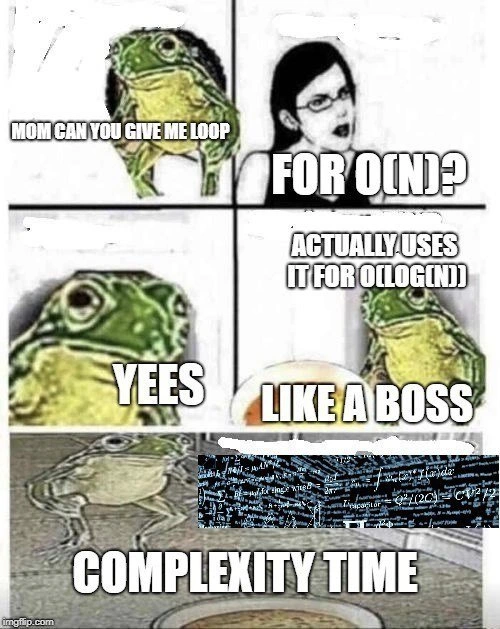
This meme is saying that the frog found a clever shortcut to solve a problem much faster. Imagine you have a big stack of homework to check one by one – that would take a long time, right? Instead, the frog found a way to check it by skipping quickly through the stack, like opening a book to the middle instead of reading every page. He asked his “mom” if he could do a normal big job (going through everything one by one), but then he secretly did a special trick to finish the job in only a few steps. In the end, the frog feels super proud and says he did it “like a boss,” which means he did it really skillfully and confidently. It’s funny because we don’t usually imagine a frog bragging about doing math faster, but here it makes us laugh and also cheer for the frog’s smart thinking!
Level 2: Loops and Logarithms
Let’s break down the technical joke here. In programming, a loop is a way to repeat an action, usually over a list of items. If you have N items and you check each one with a loop, that’s called a linear time operation, denoted $O(N)$ in Big O notation. Big O notation is just a fancy way to describe how the run time of an algorithm increases as the input size (N) grows. So, $O(N)$ (pronounced “O of N”) means if you double N, you’ll roughly double the work – the time scales in a 1:1 linear fashion with the number of elements.
Now, $O(\log N)$ (read “O of log N”) is a much faster scaling. Logarithmic time means that instead of checking every single item, you cut down the problem dramatically at each step. A classic example is binary search: imagine a sorted list of names – instead of scanning one name after another (which is $O(N)$), you can jump halfway and see if the name you want is in the first half or the second half, then repeat on the correct half. Each guess eliminates half of the remaining items, so you find the name in only about $\log_2 N$ steps. For example, with 1,000 items, linear search might check all 1,000 in the worst case, but binary search will find what you need in about $\log_2(1000) \approx 10$ steps! That’s the power of logarithmic time. Doubling the list size doesn’t double your steps – it just adds one extra step (since $\log_2(2000) \approx 11$). In general, $O(\log N)$ algorithms are those clever ones that halve (or otherwise proportionally reduce) the work each iteration.
So when the frog asks for a loop, the “mom” assumes it’s for a normal $O(N)$ task – like looping through all items straightforwardly. But the frog actually uses it for an $O(\log N)$ task, which is unexpected. It’s like a kid asking for one cookie and somehow turning it into a cake. In coding terms, he might be using the loop in a non-traditional way: for example, a while loop that doesn’t increment by 1 each time, but maybe multiplies an index or narrows a range. Consider this pseudo-code comparison:
# Linear loop example (O(N)):
for i in range(N):
do_something(item_list[i]) # processes each item one by one
# Logarithmic loop example (O(log N)):
i = 1
while i < N:
do_something(i) # processes at this index (or range step)
i *= 2 # i grows exponentially, halving remaining iterations each time
In the first loop, do_something runs for every i from 0 to N-1 (so N times). In the second, i jumps by doubling, so it runs maybe 😊 7 times for N=100 (since 1, 2, 4, 8, ..., up to >=100). The second loop’s iterations grow logarithmically. It’s doing far fewer steps, achieving the same goal more efficiently. This is a common performance trick in algorithm design: replace a linear scan with a strategy that eliminates large chunks of data each step.
Let’s connect this to the meme text:
- “MOM CAN YOU GIVE ME LOOP” – The dev (as a frog) is asking to use a loop, like a kid asking a parent for a tool or permission. It’s phrased in a meme-y, childlike way for humor.
- “FOR O(N)?” – The mom/authority figure responds, checking if it’s for a normal linear time use. It’s as if she’s saying, “You’re just going to do a simple loop that takes proportional time to the input size, right?” This panel sets the expectation of a routine approach.
- “ACTUALLY USES IT FOR O(LOG N)” – The small caption reveals the twist: the frog uses that loop to implement something much more efficient than expected. This is the core joke: you thought it’d be a basic loop, but surprise, it’s a logarithmic-time algorithm! It implies the frog has cleverly written the loop to cut the work down (maybe doing something like binary search or repeatedly doubling as in our example).
- “YEES” – The frog’s face close-up, triumphant and drawn-out “yes,” shows he’s extremely pleased with himself. He pulled off the stunt successfully.
- “LIKE A BOSS” – Now the frog is calm, sipping from a coffee cup, looking proud. “Like a boss” means he did it in an expert, confident way. This phrase became a meme to celebrate doing something cool or skillfully. Here it humorously elevates nerdy code optimization to rock-star status.
- “COMPLEXITY TIME” – The bottom panel’s big text is a play on the term “time complexity.” It’s as if declaring that it’s time to talk complexity, or that the frog’s moment of glory is all about algorithm complexity. The chalkboard full of equations behind him drives home that this is some serious math/CS achievement. It’s tongue-in-cheek, because in reality, optimizing a loop’s Big O is rarely a cinematic moment – but in the meme world, our frog gets a dramatic impact font caption and background full of formulas to celebrate the feat.
All these elements together create a fun time_complexity_joke. You have to know what $O(N)$ vs $O(\log N)$ means to get it, which is why it falls under niche developer humor. It’s poking fun at the pride developers feel when they optimize code. The frog basically did a performance optimization – turning a slower approach into a faster one – and the meme format humorously magnifies that pride to “boss level.” Any junior developer learning about Big O notation will eventually learn that $O(\log N)$ is way better than $O(N)$ for large N. This meme is like an inside joke reinforcing that lesson: if you can make your code logarithmic, you’ve done something right (and you earn bragging rights, at least among your peers!).
Level 3: Big O Swagger
This meme perfectly captures a bit of developer humor around performance optimization. It’s a time_complexity_joke celebrating that smug satisfaction when you make your code run faster than expected. The frog starts by innocently asking, “Mom, can you give me loop”, which in programming is like asking for permission to write a simple for loop. The mom (depicted by the blurry figure with glasses) responds, “For O(N)?,” as if verifying the loop will be used for a normal linear-time task. This sets the stage: typically, a loop implies visiting N items for an $O(N)$ workload. But the punchline drops in the tiny caption straddling the panels: “Actually uses it for $O(\log N)$”. Ah, the O(log N) flex! The frog secretly uses that loop in a super-efficient way, achieving logarithmic time complexity instead of linear – a clever subversion that only folks fluent in BigONotation will catch. It’s the kind of cheeky move that makes seasoned devs smirk, because who hasn’t dreamed of turning a slow loop into an uber-fast algorithmic shortcut?
By the next panels, our frog is grinning “YEEES,” utterly pleased with himself, and then sipping coffee “LIKE A BOSS.” This is the classic like_a_boss_format meme payoff: doing something ordinary in an extraordinary way and basking in the glory. The phrase “like a boss” itself is meme-speak for “I did something awesome with total confidence.” Here it’s applied to a nerdy context – optimizing time complexity – which makes it absurd and delightful. The frog literally has “COMPLEXITY TIME” declared at the bottom, standing tall in front of a chalkboard filled with intimidating equations. That imagery exaggerates the genius mode vibes: he’s not just coding, he’s conducting high-level complexity sorcery. It’s a playful nod to how developers feel when they crack a tough performance problem or drop some serious algorithm design knowledge in a code review. You can almost hear the silent brag: “I took your plain $O(N)$ loop and made it $O(\log N)$, no big deal.”
The humor works on multiple levels. On the surface, it’s the silly contrast of a frog and a “Mom” talking in Impact font captions about loops and Big O – inherently funny because it’s so out-of-place. But for developers, it hits home as a performance optimization parody. We’ve all seen code where someone replaces a slow linear approach with a faster method (like using a binary search instead of scanning, or employing a clever bit trick) and then struts a bit because the code is now exponentially more efficient. It’s a humblebrag every coder dreams of. The meme format itself (multi-panel frog_meme with bold Impact captions) is intentionally goofy, which makes the CS topic more approachable and comical. Essentially, it’s celebrating a moment of programmer triumph – turning up the efficiency dial – with the over-the-top attitude of a meme hero. Any developer who’s wrestled with algorithm complexity analysis or squeezed better performance out of a loop will chuckle at this frog’s Big O swagger.
Level 4: Logarithmic Legend
In algorithmic theory, our frog pulled off an elegant trick: transforming a linear $O(N)$ process into a logarithmic $O(\log N)$ one. This is a drastic improvement in terms of algorithm complexity analysis. Why? Because logarithmic time grows incredibly slowly with input size. If you double the input, a linear algorithm doubles its work, but a log-time algorithm barely notices the increase. It’s the difference between scanning every item in a list and binary searching through it by halving the search space each step. Formally, if each loop iteration cuts the problem size in half, after $k$ iterations you have roughly $N \cdot (1/2)^k \approx 1$ item left. Solving $2^k \approx N$ gives $k \approx \log_2 N$ iterations. That’s why a simple change like using binary search or a divide-and-conquer strategy can drop an $O(N)$ loop down to $O(\log N)$ time. Complexity time, indeed! The chalkboard crammed with formulas in the meme’s final panel humorously evokes the kind of algorithm complexity analysis we do on a whiteboard: think summations, recurrences, and the trusty Master Theorem for solving $T(n) = T(n/2) + O(1)$ (which yields $T(n) = O(\log n)$). It’s as if the frog derived the math to prove his approach is exponentially faster. (Side note: in Big O notation, the base of the log is irrelevant – $\log_2 N$ vs. $\log_{10} N$ only differs by a constant factor, so we just write $O(\log N)$ for any base. But given the frog’s halving trick, base 2 fits perfectly here.) This level of optimization is like an algorithmic superpower – our amphibian friend is flexing some serious CS_Fundamentals muscle by harnessing the math that underpins high-performance algorithm design.
Description
A surreal, deep-fried multi-panel meme that jokes about algorithmic complexity. In the first panel, a distorted frog asks, 'MOM CAN YOU GIVE ME LOOP'. The second panel shows a woman with glasses asking, 'FOR O(N)?'. In the third panel, the frog replies, 'YEES'. The fourth panel subverts the expectation, showing another frog with the text, 'ACTUALLY USES IT FOR O(LOG(N)) LIKE A BOSS'. The final, bottom panel shows a stretched frog next to a block of complex mathematical equations with the caption 'COMPLEXITY TIME'. The humor stems from the subversion of expectations in a technical context. A standard loop is often associated with linear O(n) time complexity. The developer (represented by the frog) cleverly implements a much more efficient logarithmic O(log n) algorithm, a move that is considered a mark of a skilled programmer. The meme celebrates the satisfaction of finding an optimized solution where a simpler, less efficient one was expected
Comments
19Comment deleted
The difference between a junior and a senior dev: a junior sees a loop and thinks O(n), a senior sees a loop and immediately wonders if they can get away with O(log n)
“Nice flex turning the hot loop into O(log N)… now do the part where we stop hitting the database N times so your algorithmic virtue doesn’t stay I/O-bound.”
When you tell the PM it'll take O(n) time to search the database but secretly implement a B-tree index because you know they'll add 'just one more requirement' that would've made the linear scan crawl to a halt in production
Ah yes, the classic developer move: confidently optimizing from O(n) to O(log n) only to discover your 'elegant' solution has introduced so many edge cases, nested conditionals, and auxiliary data structures that the constant factors now dominate runtime for any dataset under 10 million records. Meanwhile, the naive O(n) implementation your junior colleague wrote runs faster in production because it fits in L1 cache. But hey, at least your code review comments about Big O notation made you look smart before the performance regression tickets started rolling in
Ask for O(n), ship for(i=1;i<n;i*=2); then burn O(n) minutes debating the log base in code review
Ask for a loop vaguely; let stakeholders assume O(n!) doom while you drop O(log n) elegance
Turned a "just add a loop" request into O(log n); felt like a boss - until the flame graph showed 93% spent on JSON parsing and TLS handshakes
Can anybody explain it? Comment deleted
Algorithm optimization Comment deleted
https://www.freecodecamp.org/news/big-o-notation-why-it-matters-and-why-it-doesnt-1674cfa8a23c/ Comment deleted
It was quite hard to read it Comment deleted
How could he use O(n) algorithm as O(log n)? Is that quick sort, or what? Comment deleted
Perhaps it is probabilistic algorithm. Simple classic one, hiring problem (or in another words finding maximum value linearly), makes use of the random distribution that turns expected average from O(n) to O(logn) Comment deleted
Woah Comment deleted
You see, if the probability distribution of values are uniform, then with first pick we have 1/n chance of hitting max, then 1/n-1 and so on. We notice that we have the Harmonic series, which is bounded by logn Comment deleted
So, if you “randomly” permute the array before feeding into such algorithm, you can turn linear expected average to logarithmic Comment deleted
Permuting is O(n) :P Comment deleted
You need to pick random offsets each iteration Comment deleted
And presumably keep a hashmap of which ones are visited already making complexity even higher Comment deleted