IRL CAPTCHA: Defeating Automated Ticket Systems
Why is this Security meme funny?
Level 1: No Robots Allowed
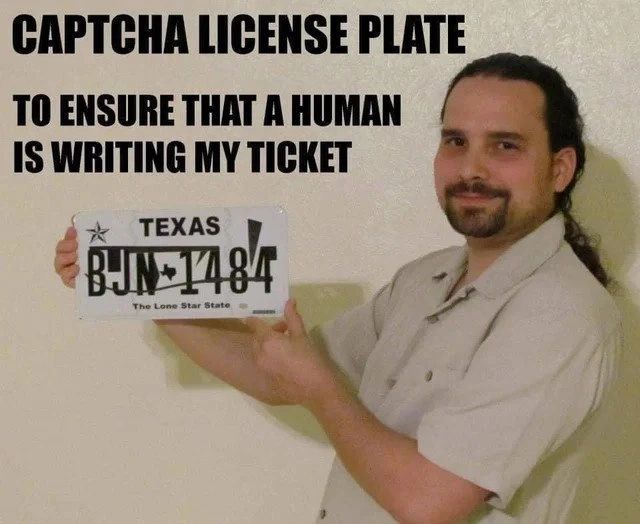
Imagine there’s a robot camera that gives out speeding tickets by reading car license plates. Now imagine a clever driver who really doesn’t like that robot camera. What does he do? He makes his car’s license plate look like a puzzle that only humans can read, but robots cannot. It’s just like when you draw your name in super squiggly, crazy letters – your friends can still tell it’s your name, but a machine or someone who doesn’t know the trick would be totally confused. In the picture, the man’s license plate has jumbled, stretched-out numbers and random lines, kind of like a secret code. The joke is that the poor robot traffic camera will look at that plate and go, “Huh? I can’t understand this!” 🤖❓. That means it can’t automatically give him a ticket. Only a real human police officer could read the plate and write a ticket. In simple terms, he put up a big “No Robots Allowed!” sign on his car. It’s funny because we usually see computers making us pass tests to prove we’re human (like those annoying squiggly words online), but here a human is making the computer pass a test – and the computer can’t! The driver found a sneaky way to outsmart a robot, and that role reversal makes everyone laugh.
Level 2: CAPTCHA vs Camera
In this meme, a man proudly holds up a Texas license plate that looks like one of those scrambled CAPTCHA puzzles you hate solving when logging into websites. The big text on the image calls it a "CAPTCHA LICENSE PLATE" and says it’s "to ensure that a human is writing my ticket." In plain terms, he’s making his car’s plate so hard for a computer to read that any automated ticketing camera will be stumped. Only a real human police officer could figure out the plate number to write a ticket. It’s a cheeky play on HumanVsMachine: the guy is basically putting a “No Robots Allowed” sign on his car’s identification.
Let’s break down the pieces:
- CAPTCHA: This stands for Completely Automated Public Turing test to tell Computers and Humans Apart (a mouthful, we know!). A CAPTCHA is those tests on the internet where you might see distorted letters or a grid of images and you have to pick out all the traffic lights or bicycles. Websites use them as challenges that humans find easy (we can read messy text or recognize a cat in a photo) but bots or automated programs find hard. If you solve it, you prove you’re not a malicious script.
- License Plate Recognition: Many cities use traffic cameras or parking enforcement vehicles with cameras to catch violators. These cameras use software (often powered by Machine Learning) to read the license plate number from a photo — this tech is called Automatic License Plate Recognition (ALPR), which is basically a specific kind of Optical Character Recognition (OCR). OCR is when a computer extracts text from images, like scanning a printed page and turning it into digital text. ALPR is just OCR tuned for license plates: it looks for the plate in the image, then reads the numbers and letters.
- The Trick: The license plate in the image is deliberately printed with distorted characters, almost like graffiti art or those squiggly CAPTCHA letters. For example, the plate number
BJN1484isn’t printed in the normal clear font – instead, the1and8are elongated and crossed by extra lines, and all the characters are a bit warped. This confusion of shapes is easy for your eyes to still read (you can tell it says BJN1484 if you focus), but it’s hard for a computer program. The software expects clean, separated characters. If letters are merged together or have random stripes, the computer’s pattern-matching falls apart. It might not recognize those figures as any valid letters at all.
So why do this? Because traffic_ticket_automation is a real thing. Think of a speeding camera on the highway or a red-light camera at an intersection: when it catches someone, it automatically snaps a photo of the car’s plate and the automation system issues a ticket by mail. No human in the loop. Similarly, some parking authorities drive around with cameras that scan every parked car’s plates to see who’s overstayed or has unpaid fines. It’s all algorithmic. By making a plate essentially a captcha_in_real_life, the driver ensures any automation will likely fail to read it. The phrase “to ensure that a human is writing my ticket” is him saying: “If I’m going to get a ticket, I want a real person to have to do the work!” It’s a bit of a rebel move against faceless technology.
For a junior developer or someone new to these concepts, it’s useful to connect this to familiar experiences. You know those times you had to prove you’re not a robot online by deciphering wavy text or clicking on pictures of crosswalks? That’s done because bots aren’t as good as humans at those tasks. Now imagine a traffic camera as a kind of robot that’s trying to read a car’s license plate number. What this guy did is like giving that robot camera a super hard puzzle – the camera sees the plate, but the numbers are all funky and don’t make sense to its programming. It’s an OCR fail by design. Meanwhile any human police officer looking at that plate might squint and still read “BJN 1484” (since our brains are great at handling messy visuals). Essentially, he’s evading the machine’s eyes. This is humorously highlighting how AI/ML isn’t foolproof: a little chaos in the input, and the fancy automation might just shrug and pass the task back to a person.
It’s worth noting, this is more of a joke than a serious recommendation. In the real world, tampering with your license plate to make it unreadable is usually illegal (authorities don’t like that, for obvious reasons). But as a concept, it tickles tech folks because it’s a clever intersection of Security and Automation. We constantly deal with bots vs. humans on the web, and now here’s that idea applied to everyday life. It’s a classic bit of computer_vision_humor: showing how a rigid machine can be outsmarted by a bit of creative mischief. You could say the driver found a bug in the system – the “system” being automated enforcement – and is exploiting it in the silliest way. For anyone who’s struggled to get a machine learning model to handle edge cases, the joke hits close to home. It’s the real-life version of saying, “Dear robot, I’ve read your manual and I know your weaknesses. Good luck catching me on camera!”
Level 3: Plate Against the Machine
On the surface, this meme lampoons the cat-and-mouse game between automation and those who find creative ways to confound it. Here we have a Texas license plate deliberately styled like a CAPTCHA challenge – those distorted text images used on websites as a reverse Turing test. In other words, the driver has turned his plate into an adversarial example to trick an AI. It’s like he’s deploying a real-world anti_OCR_strategy so that any automated license plate reader (ALPR) system will throw its virtual hands up and admit defeat. The bold caption even spells it out: “CAPTCHA LICENSE PLATE – TO ENSURE THAT A HUMAN IS WRITING MY TICKET.” This one-liner brilliantly flips the script: usually CAPTCHAs ensure a human is on the user side, but here it’s ensuring a human ends up on the enforcer side. It’s a high-tech arms race moment – AutomationGoneWrong for the poor traffic camera that can’t do its job, and a victory for human cunning.
Under the hood, automated ticketing systems rely on computer vision techniques, specifically Optical Character Recognition (OCR), to read plates. Modern license_plate_recognition software often employs machine learning models (like convolutional neural networks trained on thousands of plate images) or old-school image processing (edge detection, pattern matching). These systems expect clean, standard lettering. Throw in funky distortions – overlapping characters, random slashes through digits – and you exploit their weaknesses. The meme’s plate number “BJN✦1484” is purposefully warped: the 1 and 8 are stretched and overlaid with lines, mimicking the noisy backgrounds and slashed text of a classic CAPTCHA. To a computer, that kind of distortion is pure chaos. The algorithm might struggle to segment where one character ends and the next begins. Is that a “1” next to an “8”, or some unknown symbol? A human can use context and ignore the garbage (we effortlessly read past the slashes and weird scaling), but a rigid OCR system often just freezes or misreads (classic OCR fail). We can almost hear the frustrated silicon brain of the traffic cam: “Please select all images containing a valid plate number...” 🤖🚫.
This is essentially AI humor in action. The meme is funny to developers and security folks because it exposes how narrow AI’s perception can be. It’s a tongue-in-cheek example of MachineLearningHumor: the driver has found a low-tech hack to outsmart high-tech surveillance. In machine learning terms, he’s feeding the model data it wasn’t trained to handle – the real-world equivalent of feeding nonsense into a neural net to get nonsense out. In fact, there’s a whole field studying these kinds of shenanigans, known as adversarial machine learning. Researchers have shown that by adding a few carefully crafted stickers or noise to a stop sign, they can fool a self-driving car’s vision system into thinking it’s a speed-limit sign. Here, our crafty driver applies the same principle to his traffic_ticket_automation nemesis: if the camera can’t parse the plate, it can’t automatically issue a ticket. It forces a fallback to the one thing the automation was meant to replace – a human operator. Security professionals might chuckle at this because it highlights a fundamental truth: every automated system has edge cases a clever user (or attacker) can exploit. It’s the HumanVsMachine saga playing out in everyday life. Today’s offense: a captcha_in_real_life on a license plate. Tomorrow’s defense? Perhaps smarter AI that can read through the distortion – until the next round of counter-measures. It’s an endless loop of AI_ML one-upmanship.
To put it technically, the meme underscores the limitations of pattern recognition algorithms. An ALPR system might follow a pipeline like this:
# Pseudocode for a simple license plate recognition process
image = capture_frame_from_camera()
plate_region = find_license_plate_region(image) # locate plate in the photo
chars = segment_characters(plate_region) # isolate each letter/number
plate_text = ""
for ch_img in chars:
plate_text += ocr_recognize(ch_img) # read each character via OCR
print("Detected Plate:", plate_text)
# If plate_text is gibberish or empty, the system fails to recognize the plate.
Now imagine what happens when plate_region contains jumbled, overlapping symbols like the meme’s CAPTCHA license plate. The segment_characters step might split BJN1484 into a bizarre set of fragments (since the 1 and 8 are merged by a slash). The OCR might then mis-read those fragments – BJN✓i8⁴ or some nonsense – or return nothing at all. In essence, the plate becomes an alpr_evasion tactic: the automated eye sees “???” and throws an error. The only recourse is to hand the task to a human officer who can visually decipher “BJN1484” despite the tricks. From a security perspective, it’s reminiscent of how spammers and hackers constantly try to outwit automated defenses, and how defenders raise the bar. Here the driver is the trickster, treating the policing AI as the target of a prank.
There’s an ironic justice in this meme that seasoned devs appreciate. We’ve all groaned at CAPTCHAs online – squinting at warped letters or clicking endless traffic light images – all because sites want to ensure we’re not bots. That frustration is now humorously mirrored: the machine gets a taste of its own medicine. The driver effectively says, “Alright robo-cop, prove you are human enough to read this!” It’s the HumanVsMachine saga turned into a visual gag. In the bigger picture, it reflects how even the best Automation systems have blind spots. When those systems are enforcing rules (like traffic laws), people will inevitably discover loopholes or hacks. It’s a playful reminder that for all the power of AI and automation, a bit of creative Security through obscurity can reduce an algorithm to a clueless bystander. And as any cynical veteran coder might smirk: if you’ve ever muttered “It’s always the edge cases”, well, here’s an edge case on a Texas plate proving that point on the open road.
Description
The image shows a man with a slight smile holding up a Texas license plate. The top of the image has a caption that reads, "CAPTCHA LICENSE PLATE TO ENSURE THAT A HUMAN IS WRITING MY TICKET". The license plate itself is designed to look like a CAPTCHA challenge: the characters "BJN-1484" are rendered in different fonts, sizes, and orientations, with some letters distorted and a black line striking through the middle, making it difficult for a machine to read. The joke is a clever, real-world application of a web concept. It's a physical defense against Automated License Plate Readers (ALPRs), which use optical character recognition (OCR) to identify vehicles for tolls or traffic violations. For experienced engineers, this is a humorous take on the ongoing arms race between automation/AI and human-driven countermeasures, translating a digital security mechanism into a tangible object to exploit the weaknesses of computer vision systems

Comments
8Comment deleted
It's all fun and games until the ticketing system is upgraded to a reCAPTCHA and he has to get out of his car to click on all the squares that contain a traffic light
CAPTCHA license plate: an on-prem adversarial patch that makes the ALPR microservice throw “NeedsHumanReviewException,” effectively rate-limiting my speeding tickets to manual mode
After spending 15 years optimizing OCR algorithms to 99.9% accuracy, we've now reached the endgame: deliberately making text unreadable to prove we're not the machines we spent our careers building. The real irony? The traffic camera's ML model was probably trained on CAPTCHA datasets
When your threat model includes both speed cameras AND their OCR pipelines. This is essentially adversarial input for automated license plate readers - the physical world equivalent of adding imperceptible noise to fool a neural network. Though I suspect the real CAPTCHA here is convincing the judge that 'BJN' isn't just 'BIN' with extra steps, and that you were simply implementing defense-in-depth against automated enforcement systems. Bonus points if the plate actually passes the Turing test but fails every ALPR system's confidence threshold
The vanity plate with entropy so high, traffic cam OCR throws a 422 Unprocessable Entity - human cops barely pass the solve rate
Edge compute meets edge cases: my plate is a CAPTCHA so their ALPR pipeline (YOLO + Tesseract + heuristics) escalates to manual review, guaranteeing a human SLA for my speeding tickets
CAPTCHA license plate: my adversarial example that forces the ALPR pipeline to human-in-the-loop - hit 99% OCR F1 and you can write the ticket
Lol Comment deleted