Python is just a C framework. Change my mind
Why is this Languages meme funny?
Level 1: The Hidden Helper
Imagine you have a cool remote-controlled toy car. You have a remote in your hand (that’s Python), and it lets you drive the car around just by pressing buttons. Now, inside the toy car, there’s a bunch of electronics and motors (that’s C) actually making the wheels turn and the car move. You don’t see those electronics working; you just see the car zipping around when you press the remote’s buttons.
This meme is joking that Python is basically like that remote control – it’s an easy way to send commands – and C is the machinery inside doing the real work. Saying “Python is a C framework” is like saying “Hey, that remote is just an accessory for the car’s internal mechanism!” It’s funny because usually we credit the remote (Python) for being so easy and fun, but we forget there’s a powerful engine under the hood (C) making it all possible. In simpler terms, the meme pokes fun at Python by calling it a simple add-on around C, kind of how a puppet is controlled by a puppeteer. It’s a playful way to remind us that behind our friendly Python programs, there’s a harder-working helper (written in C) doing the heavy lifting. And that little twist in perspective is what makes tech folks chuckle.
Level 2: Layers of Languages
Let’s break down what the meme’s text means in practical terms. The sign in the image basically says: “Python is a C framework.” In normal developer language, that’s a very odd claim! Usually, Python is referred to as a programming language, and C is another (very different) programming language. The word framework typically means a collection of code (like a library or toolset) that helps you build applications in a given language. For instance, Django is a web framework for Python — it’s a bunch of Python code that helps you handle web requests, database access, etc., so you don’t have to write everything from scratch. By contrast, calling Python itself a “framework” for C isn’t how we usually speak. It sounds backwards: we don’t normally say a whole language is just a framework for another language.
So why does the meme say that? It’s referencing the fact that the most common implementation of Python is written in C. Specifically, when we install Python from python.org or use the Python that comes on our computer, we’re usually getting CPython. CPython is the name of the official Python interpreter program, and it’s written in the C language. What that means is: when you write Python code (say a script like hello.py), the thing that actually reads and runs your code is a program (the interpreter) that a bunch of developers wrote in C and compiled. That C program understands Python syntax, it knows how to create Python objects in memory, how to do a loop, how to add numbers, and all that good stuff. You as the Python programmer don’t see C at all – you just write Python and run it – but under the covers, the Python interpreter doing all the work is powered by C.
Think of it like this: Python the language is like a set of rules and syntax (the keywords, the def for functions, the for loops, etc.), but to actually execute those rules, you need an engine. CPython is that engine, built using the C language. So the meme-maker is cheekily saying Python is nothing more than a “framework” around C, i.e., a bunch of convenient structures on top of C code.
To a newer developer, this might be a surprising concept. We often don’t consider what our tools are made of. When you run a Python program, you might picture it just magically running on the machine. But in reality, there’s an interpreter process running (the python executable) which is doing all the work, and that process is written in another language (C). It’s the same idea as knowing that your favorite app might be written in Python, but ultimately it runs on Windows which is largely written in C/C++... layers on layers.
Let’s clarify some key terms to make sure this all makes sense:
Python: A high-level, easy-to-read programming language. It’s interpreted (meaning it’s usually executed by another program rather than directly by the computer’s CPU). Developers love it for quick development and its huge ecosystem of libraries.
C: A lower-level programming language that’s been around since the 1970s. It’s compiled, which means code you write in C is translated (by a compiler) into machine code that the CPU can execute directly. C gives you a lot of control over the computer’s memory and is used to build operating systems, interpreters, and other foundational software. It’s part of the C family of languages (which also includes C++ and others).
Framework: In software, a framework is like a toolkit or foundation you use within a language to build something. For example, in Python you might use the Flask framework to build a web server – Flask provides structure and functions so you don’t have to code everything from zero. A framework is usually written in the same language you’re using it with (Flask is written in Python, for Python developers). That’s why calling Python a C framework is humorous: it implies Python is just a toolkit you use when programming in C, which is a role reversal! Typically, you don’t “program in C” by writing Python… rather, you might embed Python in a C program, but that’s advanced use.
Interpreter vs Compiler: An interpreter is a program that executes code line by line (or statement by statement). Python’s interpreter reads your Python code and does what it says on the fly. A compiler, on the other hand, translates code from one language (say, C) into a lower-level language (machine code) all in one go, producing an executable file you can run. Python is usually run via an interpreter (CPython), whereas C uses a compiler (like GCC or MSVC) to create an executable. The meme leans on this difference: Python doesn’t run “by itself” – it needs that interpreter infrastructure (written in C) to run, whereas C programs after compilation run natively on hardware. So you could cheekily say the Python interpreter is like a special C program that knows how to handle Python syntax.
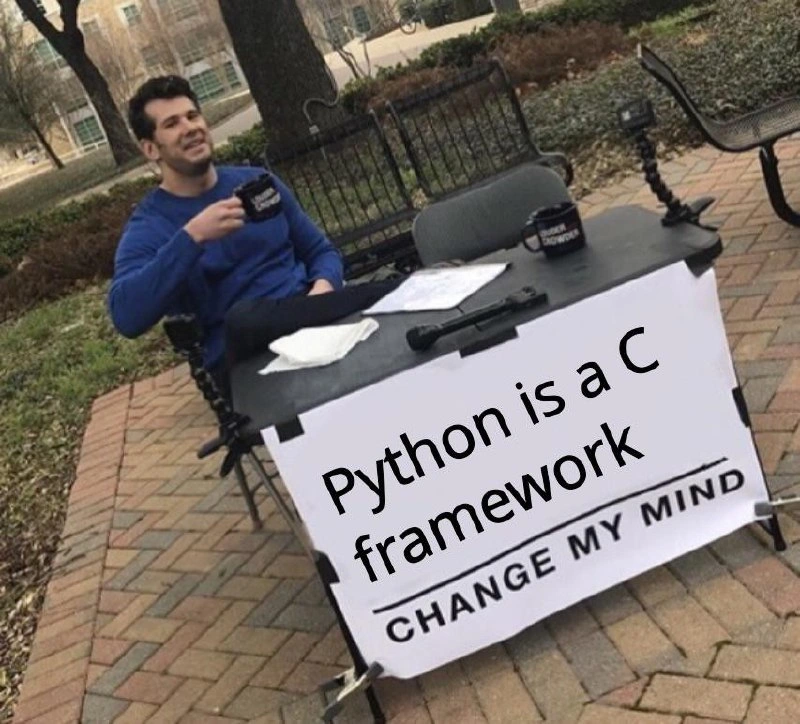
Now, the image itself: it’s using the “Change My Mind” meme format. This typically shows someone at a table (often the comedian Steven Crowder in the original meme) with a sign that has some bold statement and the challenge “Change My Mind.” In our meme, the man at the table is asserting “Python is a C framework,” and essentially saying “prove me wrong!” or “fight me on this.” The photographer’s angle and campus setting are identical to the famous meme, so it’s instantly recognizable. If you’re new to this meme, just know it’s a popular way on the internet to state an opinion in a deliberately provocative or humorous way and invite debate. The double 🤔🤔🤔 emojis in the post caption reinforce that it’s a thought-provoking, tongue-in-cheek claim. And the hashtags #Python and #C indicate the topic of the debate (so people from both language communities see it and join the fray).
For a junior developer or someone early in their programming journey, what’s the takeaway? It’s actually an interesting insight: languages can be implemented in other languages. Python (the language) isn’t tied to C forever — there are other implementations like Jython (Python running on the Java Virtual Machine) or PyPy (Python implemented in Python itself, with a JIT compiler). But CPython, the most widely-used Python, is indeed written in C. This design makes Python very accessible (because C runs on virtually every device) and reasonably fast for an interpreted language (since a lot of the heavy lifting happens in optimized C code). So while the phrasing “Python is a C framework” is facetious, it points to the real architecture of how Python runs. It’s the kind of fact you learn as you delve deeper into programming: the tools you use are built from other tools, and knowing that can give you a deeper appreciation. Plus, it’s a reminder not to get too holy-war about programming languages—at the end of the day, they often cooperate under the hood (Python leveraging C, C being used to build higher-level conveniences, etc.).
So if this meme left you scratching your head, don’t worry! It’s less an insult and more an inside joke. It’s saying, “Ha, you know that nice Python language? It owes a lot to C. 😉” And indeed, many of us owe a lot to both Python and C in our daily tech lives.
Level 3: Abstractions All the Way Down
For experienced developers, seeing “Python is a C framework – CHANGE MY MIND” on that campus table sign triggers a knowing grin 😏. It’s a classic case of techie semantic humor: technically, the main Python interpreter (CPython) is written in C, but calling Python a “framework” for C is a cheeky re-framing that flips our usual way of thinking about programming languages. This kind of statement is designed to stir the pot in the everlasting language wars — those lighthearted (and sometimes serious) debates comparing programming languages and their merits.
Why is this funny to a seasoned dev? Because it’s technically true in the narrowest sense and hilariously misleading in a broader sense. Python is a high-level language, prized for its readability and ease of use, while C is a much lower-level language known for manual memory management and raw speed. When someone quips that Python is “merely a C framework,” they’re being a bit of a provocateur. It’s like saying, “Hey, your fancy intuitive language is just a thin veneer over my old-school C.” This resonates with developers who remember or have participated in debates where one person tries to diminish a technology by pointing out its dependencies or implementation. It’s a form of semantic pedantry: focusing on definitions in a mischievous way.
Consider the shared experience: you’re in a discussion about Python vs. C performance. A C veteran might smugly point out, “Well, Python itself runs on a program written in C, so how great can it be?!” This meme distilled that energy into the Change My Mind format. It satirizes the guy who would set up a table on campus (or on Reddit) to argue this exact point to everyone passing by.
Industry Context: It’s well-known that CPython (the standard Python implementation) is written in C. Senior devs have likely seen this come up when dealing with Python’s performance or interfacing with system libraries. For example, Python’s speed bottlenecks are often bypassed by writing critical sections in C (using C extensions or libraries like NumPy, which is largely implemented in C). In practice, Python acts as a “glue” language: you write high-level logic in Python, but under the hood (or when doing heavy computation), you’re invoking highly optimized C/C++ code. It’s not uncommon to hear a joke like “Python is just a convenient wrapper for efficient C libraries.” The meme is basically that joke turned up to 11 by phrasing it as if Python itself is nothing more than a fancy API.
This hits on the concept of a language abstraction layer. Seasoned developers recognize that all high-level languages abstract lower layers. The phrase “abstractions all the way down” comes to mind: at some level, everything in software eventually boils down to machine code and electrons. Python abstracts away memory management and low-level details, but those details still have to happen somewhere – and that somewhere is inside the C code of the interpreter and the machine code that C ultimately compiles into. By that logic, you could retort with equally tongue-in-cheek expansions: “Oh, Python is a C framework? Then C is just an assembly framework, and assembly is just a ones-and-zeroes framework!” This reductio ad absurdum is well understood by veterans, which makes the original claim all the more amusing. It’s a reminder of how far down the rabbit hole you can go with such arguments.
The Change My Mind meme format itself adds to the humor for those familiar with it. It originated from a viral image of a man at a table with a controversial statement on a sign, inviting people to argue. In dev circles, we often see it used for playful hot takes (“Tabs are better than spaces — change my mind” or “Git is easy — change my mind”). It signals that the person is deliberately stirring debate. So a senior engineer sees “Python is a C framework” in that format and immediately recognizes it as a facetious challenge, not a serious academic claim. It pokes fun at the endless language comparisons discussions we’ve all seen in forums and lunch breaks.
Finally, there’s a layer of self-aware humor here: most developers who love Python also respect C, and vice versa; the ecosystem isn’t an either-or so much as a partnership. But we enjoy ribbing one another. The Python dev might respond, “Yeah, and that C code is running on an OS written in C, which runs on firmware written in C… so what’s your point?” The C dev might say, “Exactly, everything comes back to C, bow down!” It’s this relatable humor of developers taking pride in their tools and teasing each other about it. Everyone knows it’s in good fun (most of the time!), which is why this meme format — a dude smugly sipping coffee while inviting you to fight him over a hyperbolic statement — is perfect. It captures the tech humor vibe where we argue about serious-sounding things that are ultimately just part of the great tapestry of software abstraction.
Level 4: Bytecode Beneath the Hood
At the most granular level, this meme hints at Python’s interpreter internals and how our high-level code ultimately relies on lower-level mechanics. Under the hood, the main implementation of Python (appropriately named CPython) is essentially a large C program that interprets Python code. In other words, when you write Python, it doesn’t magically run on the hardware by itself – the CPython engine (written in C) reads your .py files, compiles them into an intermediate form (bytecode), and then executes that bytecode using C routines. This process is analogous to a virtual machine written in C that fetches and runs Python instructions.
To get technical, CPython’s runtime includes a big loop in C (in the file ceval.c) that does something like: read the next bytecode instruction, and call the corresponding C function to perform that operation. For example, if your Python code adds two numbers, the CPython interpreter handles that by invoking a C function internally (like PyNumber_Add). Here’s a conceptual peek:
# Your Python code:
x = 2 + 3
// Inside CPython's C code (conceptual example for bytecode evaluation):
if (opcode == BINARY_ADD) {
PyObject *right = POP(); // get the PyObject for 3
PyObject *left = POP(); // get the PyObject for 2
PyObject *result = PyNumber_Add(left, right); // call the C function to add
PUSH(result); // push the result back onto the stack
}
In this simplified snippet, the BINARY_ADD bytecode triggers C code to do the addition. All Python objects (like integers, lists, etc.) are actually C structures in memory (for instance, a Python integer is a PyLongObject under the hood). So when this meme proclaims Python is a “C framework,” it’s referencing the implementation detail that Python’s execution core and object model are written in C.
Now, academically speaking, calling Python a “C framework” is tongue-in-cheek; Python is a language, not a library or framework in the conventional sense. But the joke has a kernel of truth: CPython uses the C runtime and memory management. In fact, many high-level languages bootstrap on C for portability and performance. C acts as an intermediary between Python code and the raw machine instructions – a role traditionally filled by assembly in lower-level programming. This layered design is what lets Python be interpreted: instead of compiling directly to machine code, Python relies on that C-based virtual machine (and by extension the C compiler and OS) to do the heavy lifting.
From a computer science perspective, this speaks to language abstraction layers. Python sits on top of C, which sits on top of assembly, which ultimately sits on hardware. Each layer abstracts the one below. There’s even a famous notion that “interpreters all the way down” could continue: you could argue C itself is a “framework” on top of assembly, assembly on top of binary, and so on – that’s the infinite regression of abstraction this meme facetiously points at. And indeed, historically, language implementations often start in C because of its efficiency and ubiquity (e.g. the first Java virtual machine was in C; many Lisp interpreters were written in C). Over time, some languages become self-hosting (written in their own language), but Python’s primary runtime has remained C-based for decades for pragmatic reasons.
In summary, at this deep-dive level we appreciate the nitty-gritty: Python’s syntax and dynamic features are made possible by a C-powered engine chugging away behind the scenes. The meme exaggerates this reality by labeling Python as merely a “framework” around C – a semantic stunt that leverages the truth that without C (in CPython), Python wouldn’t work as we know it. It’s a playful jab at how much the elegant Python language owes to good old low-level C code keeping it all together.
Description
This meme uses the popular 'Steven Crowder's Change My Mind' format. The image features a man in a blue long-sleeved shirt sitting confidently at a black table outdoors on a brick patio, holding a mug. On the table is a large white sign with bold black text that reads, 'Python is a C framework'. Below this, in a smaller font and underlined, is the phrase 'CHANGE MY MIND'. The meme template is typically used to present a controversial or debatable opinion as a challenge. The technical joke here lies in the nuanced truth of the statement. The most common Python implementation, CPython, is written in the C programming language. This means the Python interpreter itself is a C program, and all Python code is executed by this C application. For senior developers, this is a humorous oversimplification that blurs the lines between a programming language, its implementation, and a framework, sparking a classic semantic debate about software abstractions

Comments
41Comment deleted
Saying Python is a C framework is like saying a car is just a gasoline framework. It's not wrong, but it completely misses the point and is guaranteed to annoy the purists
Fine, call Python a framework - just remember every time you forget a `Py_DECREF`, you’re technically leaking memory in your ‘frontend.’
After 20 years of explaining to executives why our Python microservices need more RAM than the entire Apollo program, I'm starting to think maybe we should just admit we're running a very elaborate C interpreter with really nice syntax sugar and a garbage collector that kicks in right when you're demoing to the board
The provocative claim that 'Python is a C framework' brilliantly captures a truth that makes Pythonistas uncomfortable: beneath all those elegant list comprehensions and duck typing lies thousands of lines of C code doing the heavy lifting. It's the programming equivalent of discovering your artisanal coffee shop sources beans from the same supplier as the gas station down the street - technically accurate, philosophically devastating, and guaranteed to start arguments at any tech meetup
Python as a C framework? Only if 'import' is your FFI and the GIL your global mutex - check the flamegraph
If Python is a C framework, the GIL is the built-in global mutex decorator and pip is just a dependency injector for .so files
CPython: the framework that hides C so well, until your hot loop begs for extensions
one of those posts that should have comments disabled Comment deleted
C is a Python framework Comment deleted
And C is framework for assembly Comment deleted
I mean C and C++ they both good if they have real package manager but python ? Man its really good when i have some small or webproject Comment deleted
> Man its really good when i have some small or webproject we have that thing called nodejs (bun lol) Comment deleted
No i mean for backend i use django very good and straight framework i didnt work with js but people told me go type script instead Comment deleted
expressjs for example Comment deleted
C and C++ is like Android and Python is an iPhone. It's all you need to know. If you wanna be cool use an iPhone Comment deleted
that's incredibly wrong in ways I don't care to explain right now Comment deleted
Apple comparsion, as usual, sound more like "If you dumb enough to listen sales manager who tell you that you're cool just when you use their product...and that enough for you to trust them and believe on yourself and what you use" Comment deleted
More like the exact opposite, since iOS is mostly native and Android uses Java & lots of abstraction layers :P Comment deleted
Developers who are using C have no friends Comment deleted
my gf uses C for her projects sometimes Comment deleted
i still use c for my projects, but since im technically not a developer i am allowed to have friends still😁 Comment deleted
Also > gf uses C Comment deleted
let it be more impossible in your eyes We are both programmer girls Comment deleted
> has a gf > is a gf Comment deleted
cc @purplesyringa Comment deleted
thanks for the cc btw Comment deleted
Only if each framework translates the code to it's own bytecode (yes, Python has it) Comment deleted
no, python doesn't have its own "bytecode" it's called IR (intermediate representation) Comment deleted
I heard it from Guido. Comment deleted
that's exactly what bytecode is Comment deleted
IR translates to bytecode Comment deleted
IR is bytecode Comment deleted
Any programming language is a C framework if you stretch your imagination wide enough Comment deleted
tell me how fortran is a C framework Comment deleted
Probably meant grandfather. 👨🦳 Comment deleted
lmao Comment deleted
yes way, getting girlfirends is not that hard, but the part about C is definitely cap Comment deleted
I beg to differ Comment deleted
y Comment deleted
yeah i mostly prefer rust these days Comment deleted
as a python user can confirm that it indeed is Comment deleted