The 'Quick Call' Before a Deadline Ambush
Why is this Deadlines meme funny?
Level 1: Finish Line Moves
Imagine you’re running a race, and you can see the finish line up ahead – you’re tired but happy because you’re about to win. Then, just as you’re a few steps away, someone in charge suddenly says, “Wait! We decided you need to run a little more, we’ve added two small laps. It won’t take long, just go do it now!” And they move the finish line farther down the track right before you cross it. How would that feel? Pretty frustrating and unfair, right? You were just about to be done, and now you have extra distance to cover with no extra time.
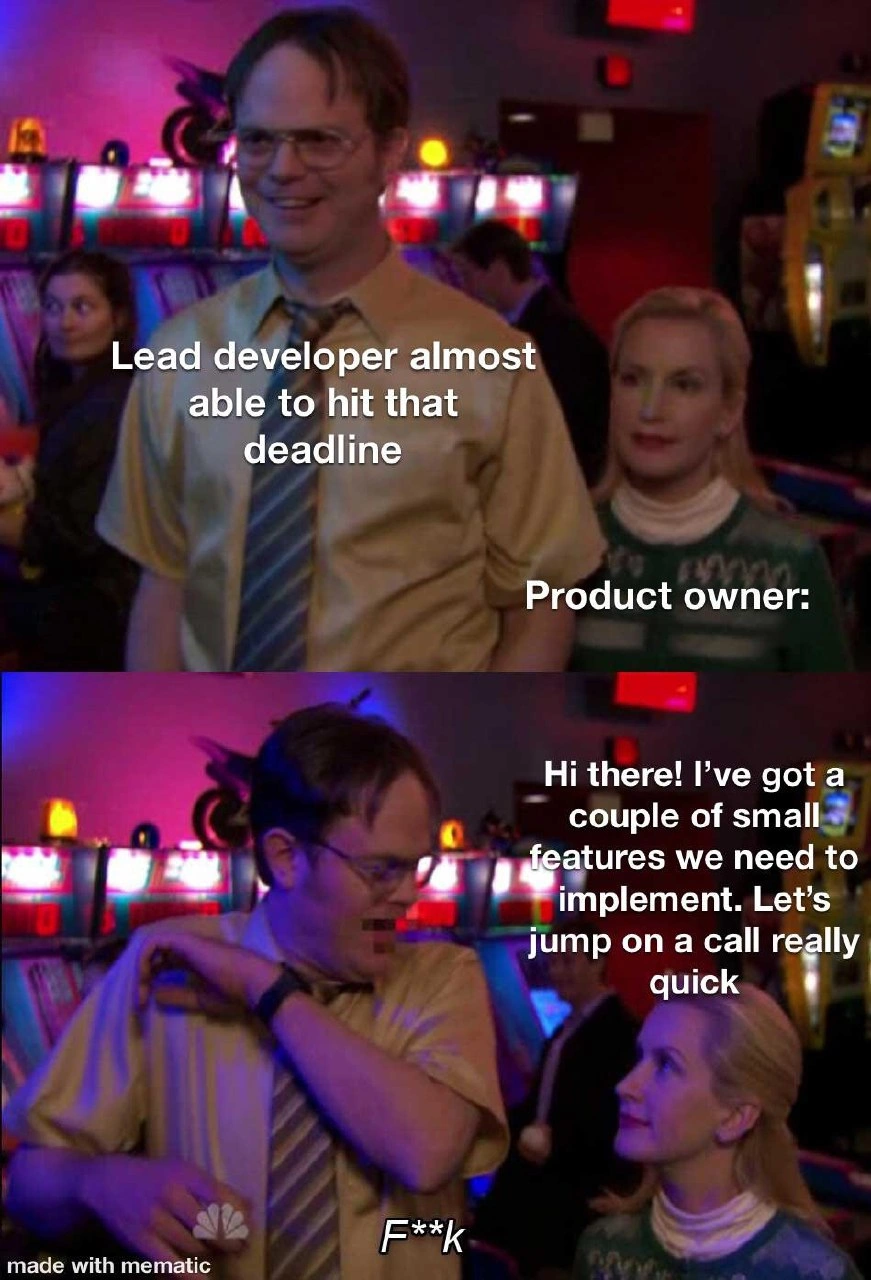
That’s exactly what’s happening in this picture, but with a work project. The developer (like the runner) almost finished everything by the due time (the finish line). He’s relieved and happy in the first image because he thinks he made it. Then the product owner (like the race official) comes and says, “Hey, I know you’re about to be done, but here are a couple more things to do real quick!” It’s like giving him two more chores at the last minute. In the second image, you can see the shock on the developer’s face. He’s basically thinking a big “Oh no!” (that’s the “F**k” caption, a not-so-nice word showing he’s upset).
For a simple everyday analogy, imagine you spent all afternoon cleaning your room before a deadline (say, before a friend comes over at 5 PM). At 4:55 PM, you’re done and feeling proud. Then your parent walks in and says, “Actually, can you also clean the living room and kitchen in the next five minutes? It’ll be quick!” You’d probably freeze in disbelief and feel a knot in your stomach, right? That’s the feeling here. The developer did everything he was asked, and right when he’s about to deliver, he’s being asked to do a bit more, with no extra time. It’s funny in the meme because we recognize this pattern: it always seems like just when you’re done, someone finds extra work for you. We laugh because we know that face he’s making. It’s the face of someone whose finish line just got moved, and now he might be stuck working late to catch up.
Level 2: Quick Fix, Long Night
Let’s break down what’s happening in this meme in more straightforward terms. We have a lead developer who is this close to finishing work by a tight deadline. In Agile terms, he’s at the end of a sprint (a 1-2 week focused period to deliver a set of features). The phrase “already impossible sprint deadline” means the timeline was unrealistically short to begin with – hitting it was going to be a minor miracle. He’s the one in the yellow shirt, looking cautiously optimistic in the top image. The smaller caption “Product owner:” next to the woman behind him indicates she represents the Product Owner role – the person responsible for deciding what features the product should have and in what order. In a Scrum team, the product owner manages the sprint backlog (the list of features to build in that sprint) and is the liaison between stakeholders (like clients or management) and developers.
Now, according to Agile best practices, once a sprint is underway, you shouldn’t add new tasks until the next sprint. Changing plans mid-sprint is generally discouraged because it disrupts the team’s focus and flow. Adding new features at the last minute is exactly what the term scope creep means – the scope (the planned work) creeps larger and larger due to continuous additions. It’s called “creep” because it often happens gradually or sneakily, but in this meme it’s happening very blatantly right before delivery. Scope creep is a major reason projects miss deadlines. Here it’s not even creeping, it’s leaping in at the worst possible moment.
The text in the bottom frame – “Hi there! I’ve got a couple of small features we need to implement. Let’s jump on a call really quick” – is shown next to the product owner character, indicating she’s saying this to the dev. She’s basically asking to add more work immediately, with literally seconds or minutes left on the clock. By calling them “small features” and wanting a quick call, it sounds like she’s trivializing the effort (“oh, it’s just a tiny thing, it won’t take long, let’s discuss right now”). But developers know that even “small” changes can have big ripple effects. For example, adding one new feature might mean: updating the code, writing new unit tests for it, fixing or adjusting other parts of the system to accommodate it, and then re-running the whole test suite or redeploying the application. If this feature touches the database or an API, you might have to alter database schemas or contract tests, etc. Nothing is truly isolated, especially at the last minute when everything is intertwined and fragile. That’s why the dev’s reaction is to physically recoil.
In that bottom image, the lead developer (the man in the tie) is shown startled, pulling away with an expression of dismay. The subtitle “F**k” (censored, but we know what it is) at the bottom perfectly captions his feeling – a mix of shock, frustration, and dread. It’s an involuntary facepalm moment. He’s not actually saying it out loud to the product owner (that would be unprofessional), but the meme lets us peek into his mind. It’s the same reaction many of us have had internally when, say, a manager swings by your desk at 4:45 PM on Friday with “one quick thing to do before you go.” That single expletive sums it up: “We are so screwed.”
The reason this scenario causes such developer frustration (one of the common tags) is that when you’re right at the finish line of a project, your brain is fully focused on wrapping things up – polishing, testing, deploying. A sudden meeting overload (“Let’s jump on a call really quick”) throws off your concentration and eats up precious time. Meetings are notorious for breaking a developer’s “flow” state. And this isn’t even a scheduled meeting – it’s impromptu (“surprise_sync_call”), meaning the developer must immediately context-switch away from coding to discuss new requirements. That context switch has a cost: when he returns to coding, he’ll need time to get back in the zone, further delaying progress.
Let’s clarify some terms:
- Sprint: In Agile, a sprint is a short, fixed-length time period (often 1 or 2 weeks) in which a team commits to completing a set of work. At the end, you ideally have a potentially shippable product increment. Here the sprint deadline is the end of that time window.
- Scope Creep: This refers to new features or requirements being added to a project after planning is done, without adjusting time or resources. It “creeps” in and makes the project bigger than originally intended. It’s usually something to avoid or manage tightly, because it can derail timelines. In the meme, scope creep happens in a very extreme way (right before delivery).
- Product Owner (PO): A role in Scrum (Agile framework) responsible for defining and prioritizing the work. The PO decides which features go into a sprint. They are supposed to say “no” to extra work mid-sprint unless it’s critical, but here the PO herself is introducing new features at the last minute – definitely an Agile no-no and a sign of stakeholder pressure from above.
- Deadline Pressure: The stress of an upcoming deadline. The team probably has been rushing to meet it. “Already impossible deadline” suggests they were likely going to have to crunch (work extra hard, maybe overtime) to meet it even before these new asks.
- Meetings/Meeting Overload: Too many meetings, especially unscheduled ones, can be very disruptive. A “really quick call” might not actually be quick – even a 15-minute call can break an hour or two of focused work when you account for the interruption and context switching. It’s a common frustration for developers who need long stretches of concentration to solve problems or write code.
Visually, the meme uses a scene from a TV show (“The Office,” with Dwight Schrute as the developer and Angela as the product owner, funnily enough). The arcade background is just part of the scene’s setting – but it unintentionally adds a symbolic layer. An arcade game often involves trying to beat a clock or get a high score under pressure, which mirrors the dev racing against time to finish the sprint. The lead dev’s relaxed dress code (short-sleeve shirt, tie loosened) shows he’s probably been working intensely (maybe late hours, hence tie loosened) and was about to relax, thinking he made it. The product owner popping up is like that unavoidable “GAME OVER” moment.
The caption text overlay makes it clear who’s who and what’s happening. The top text “Lead developer almost able to hit that deadline” tells us the situation: he’s almost done, victory in sight. The small “Product owner:” label by the other person sets up that she’s about to speak. Then the bottom text is effectively her dialogue (the dreaded request) and his immediate guttural response (“F**k”). The reason this resonates with so many in software is that it captures a common scenario in tech companies: management requesting last-minute changes and developers feeling the pain of it. It highlights the conflict between Stakeholder expectations (“just do this one more thing for the release”) and the reality of software development (even small changes require work, testing, and can introduce risk). Newer developers might not have experienced this yet, but eventually, many face a moment where a project’s scope changes unexpectedly late in the game. It’s a big lesson in learning to manage expectations and sometimes in learning to say “This will have to go in the next release” – if your company’s culture allows that.
In summary, the meme is pointing out an Agile pain point in a humorous way: even though Agile is supposed to handle change gracefully, human nature and business demands lead to scope creep panic. And when does it happen? Right before the deadline, turning what should have been a triumphant finish into a scramble. The tags like #DeadlinePressure, #ScopeCreep, #MeetingOverload, #DeveloperFrustration all encapsulate the elements at play. It’s a cautionary tale (told with a laugh) about how “small features” and “quick calls” can snowball into a long night for the development team.
Level 3: Scope Creep Strikes Back
For seasoned developers, this meme hits like a war flashback. You’ve been crunching for two weeks on an impossible sprint deadline, burning the midnight oil, and you’re finally about to hit “deploy” with moments to spare. Enter the product owner, tapping you on the shoulder (or pinging you on Slack) at the 11th hour: “Hi! I know it’s late, but I’ve got a couple of small features we need to implement. Let’s jump on a call really quick.” Cue the lead developer’s face in the meme, going from weary optimism to utter horror. It’s the classic scope creep ambush — a familiar Agile pain point where suddenly your sprint backlog isn’t worth the Post-it notes it’s written on.
Why is this funny? Because it’s painfully real. Every senior engineer has lived through a “surprise sync call” like this. The phrase “a couple of small features” from a stakeholder or client is basically code for “I’m about to torpedo your delivery timeline.” There’s dark humor in the predictable absurdity: of course the Product Owner comes with last-minute changes literally seconds before the deadline. Of course they call it a “quick call” – as if a spontaneous meeting and new feature development at T-minus 5 minutes is no big deal. It’s akin to a horror movie trope in software development circles: the scope-creep call always comes right before the final girl (or dev) escapes the release. We laugh because otherwise we’d cry.
This meme perfectly captures an agile anti-pattern. In proper Scrum, once a sprint starts, the scope is frozen until the next sprint – that’s the theory. In reality, business pressures and stakeholder expectations can steamroll process. The Product Owner character here (with that eager, oblivious smile in the first panel) represents management or clients who either don’t understand or ignore the cost of late changes. Maybe a big client just rang them up with an ultimatum, or a VP had a last-second brainwave – and now it’s the dev team that will pay the price. The lead developer’s recoiling reaction and the captioned expletive “Fk”** (censored but obvious) is something we’ve all done internally while outwardly maintaining a forced calm on the Zoom call: “Sure… we can try to squeeze that in.”
The humor also lies in the silent calculation every senior dev does in that moment. You can practically see him computing in his head: “Alright, adding these ‘small’ features means re-opening the code I just finished, writing new unit tests, updating the deployment scripts, and fixing inevitable side bugs... each ‘small feature’ is at least another late night.” The lead dev knows that “small” is a lie – any change at the last mile causes a cascade. It’s like pulling a Jenga block from the bottom of a tower labeled “Release Plan” just when you thought you were done. The tower’s now swaying, but management still expects it to stand.
In true cynical veteran fashion, there’s an unwritten rule: the likelihood of scope creep is directly proportional to how tight the deadline already is. If the deadline is impossible, some manager will make it even more impossible. The meme’s arcade setting even adds to the irony: maybe the dev took a rare breather (at a company offsite or a team outing to an arcade), finally smiling thinking the nightmare was over. And right then, the scope creep monster appears with a friendly “Hi there!” – game over, insert another quarter (or rather, another week of overtime). The #DeadlinePressure and #ReleasePressure are real – this is a scenario where you end up in a late-night deployment or a weekend sprint, fueled by bitter coffee and gallows humor.
Ultimately, experienced engineers are nodding (or wincing) at this meme because it illustrates the gap between Agile theory and real-world practice. Agile preaches communication (#communications) and responding to change, but when surprise requirements pop up at the worst time, it often means the team will suffer. It shines a light on a common organizational failure: lack of planning or stakeholder discipline turning a sprint into a last-minute death march. Everyone knows it’s a bad idea – it torpedoes quality and morale – yet it keeps happening. This shared exasperation is the punchline. As the saying goes in dev circles, “Fast, cheap, good – pick two.” Here they picked fast and cheap, and the developer’s sanity (good) is the thing sacrificed. We laugh, ruefully, because we’ve all worn that loosened tie, felt that late-stage panic, and muttered that exact same four-letter word under our breath as the sprint scope blows up.
Level 4: The Iron Triangle Trap
At the most fundamental level of project physics, this meme highlights a classic software engineering paradox: the triple constraint (aka the Iron Triangle of scope, time, and resources). In theory, Agile methodology encourages embracing change (“welcome changing requirements, even late in development” says the Agile Manifesto). But in practice, if you inject new scope at the zero hour without adjusting time or resources, something’s gotta give. It’s like expecting a for loop to finish on schedule after dynamically increasing the loop count at runtime—algorithmically, O(deadline + Δscope) just doesn’t compute.
From a theoretical perspective, late scope changes exploit the planning fallacy and Hofstadter’s Law (“It always takes longer than you expect, even when you account for Hofstadter’s Law”). Here, even if the lead dev’s carefully buffered plan skirted the edges of that impossible sprint deadline, a last-second feature request at zero hour blows up any remaining buffer with exponential effect. We’re basically seeing the cost of change curve poking its head: changes are cheap early on, but brutally expensive (in time or quality) at the end. The product owner’s “couple of small features” triggers a combinatorial increase in things to test, integrate, and deploy under extreme time pressure.
This is the Agile-until-it’s-not conundrum. Agile promises flexibility, yet the underlying math resembles a conservation law: if new work is added without removing or extending something, technical debt or burnout accrues to compensate. It’s akin to the law of conservation of energy, but for project stress—deadline pressure is neither created nor destroyed, only transferred into late-night engineering heroics. Over decades of software history (from waterfall to Scrum to Kanban), scope creep at the last minute has remained a stubborn constant, defying any silver-bullet process. In academic terms, we might call this the Scope Creep Singularity: as a deadline approaches, the probability of a “quick call” injecting new requirements approaches 1, and the remaining time available approaches 0. The resulting spike in complexity and risk is practically a law of nature in our field. In short, this meme’s humor is rooted in an almost Newtonian certainty of software projects: when an unstoppable feature request meets an immovable deadline, expect a loud bang (and maybe a 2 AM deploy).
Description
A two-panel meme using a scene from the American TV show 'The Office', featuring the characters Dwight Schrute and Angela Martin in a dimly lit, colorful setting like an arcade or casino. In the top panel, Dwight is smiling smugly and confidently. Text overlay identifies him as 'Lead developer almost able to hit that deadline' and Angela, standing beside him, as 'Product owner:'. In the bottom panel, the mood shifts dramatically. Dwight now looks stressed and annoyed, making a brushing-off motion with his hand on his shoulder. Angela is looking up at him and speaking, with a text bubble that reads, 'Hi there! I've got a couple of small features we need to implement. Let's jump on a call really quick'. A censored curse, 'F**k', is written near Dwight's head. The meme humorously captures a universally dreaded scenario for developers: last-minute scope creep initiated by product management just as a project is about to be completed. The phrase 'a couple of small features' is a well-known red flag, often masking significant work that jeopardizes the deadline
Comments
7Comment deleted
In the project management dictionary, 'a couple of small features' is defined as 'an un-estimated epic that will require at least three hotfixes post-deployment'
You can estimate velocity all you want, but nothing travels faster than a PO saying "it’s just two tiny features" five minutes before code freeze
After 20 years in this industry, I've learned that 'a couple of small features' is product owner speak for 'I hope you weren't planning on seeing your family this quarter' - and that 'quick call' will somehow spawn three Jira epics, a new microservice, and a complete rearchitecture of the authentication layer
The classic 'couple of small features' right before a deadline is the product management equivalent of 'just one more thing' in a Columbo episode - except instead of solving a murder, you're committing one against your sprint velocity and any hope of work-life balance this week
PO at T−2h: “couple of small features” - a scope injection that invalidates your burndown, blows the WIP limit, and converts the sprint goal into a postmortem
'Couple of small features' - the PO special that turns a one-day hotfix into a three-sprint monolith refactor
‘A couple of small features’ at code freeze are cross‑cutting concerns in trench coats - they vaporize your flow efficiency, nuke WSJF, and convert the error budget straight into calendar time