When a C++ Dev Writes Python
Why is this Languages meme funny?
Level 1: Kitten Tail Surprise
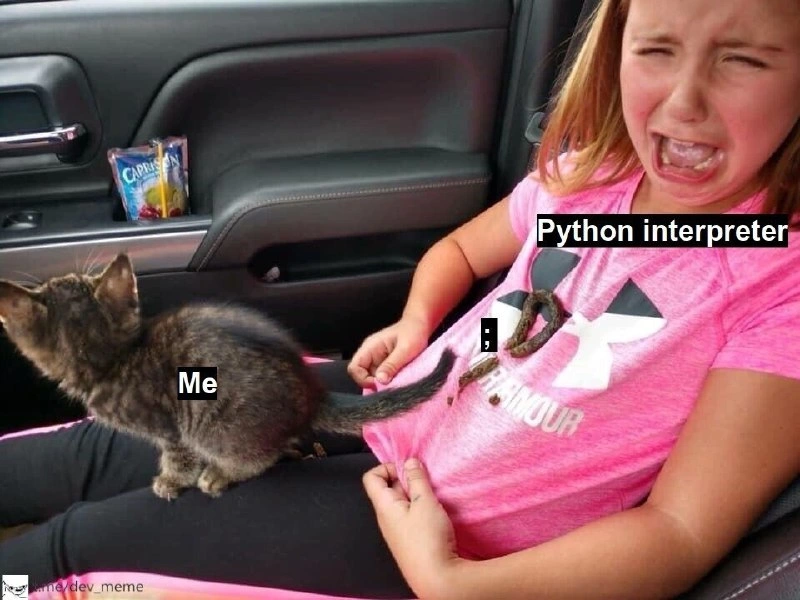
Imagine you’re playing with a tiny kitten on your lap. The kitten suddenly flicks its tail and pokes your tummy. You weren’t expecting that, so you jump and let out a yelp! The kitten wasn’t trying to hurt you; it just moved its tail out of habit. In other words, this meme is showing that kind of situation: you (the kitten) did something small out of an old habit, and the computer (like the startled person) wasn’t expecting it. It’s funny because a tiny innocent mistake leads to a big, silly reaction — just like a little kitten’s tail causing a huge surprise.
Level 2: Semicolon Stowaway
Let’s unpack the joke in simpler terms. In the photo, a tiny kitten labeled “Me” is innocently sitting on a girl’s lap. The girl is labeled “Python interpreter” – that’s the program that runs Python code. The kitten’s tail, which is poking into the girl’s waistband, has a label with a ; (semicolon). The poor girl’s face says it all: she’s upset and surprised. This setup is a visual metaphor for a common programmer blunder:
- Semicolon (
;): This is a punctuation mark that languages like C, C++, Java, and JavaScript use to mark the end of a statement. It’s like a period at the end of a sentence, but for code. In those languages, every instruction must end with a semicolon, or the computer won’t understand where one command ends and the next begins. - Python interpreter: Python doesn’t use semicolons to end lines. Instead, each new line is automatically the end of the statement (and indentation marks blocks of code). The Python interpreter is the program that reads your Python code. It’s very picky about Python’s own syntax (which relies on newlines and whitespace), and it doesn’t expect extra semicolons. If it sees a semicolon in an odd place, it might get confused and throw a syntax error (basically saying “I don’t understand this little symbol here”).
- Old C muscle-memory: “Muscle memory” means doing something automatically because you’ve done it a million times before. If you coded in C or Java for a long time, your fingers are trained to hit that
;key at the end of every line. It’s a hard habit to break. So cross-language habits like this can sneak into your work when you switch to a language like Python. You might end up typing a semicolon without even thinking about it – a rogue semicolon appears in your Python code. - Syntax error: This is what happens when you break the rules of a language’s grammar. For instance, putting a semicolon randomly in Python can make Python go “Huh? This isn’t supposed to be here.” An example:
In Python, that semicolon afterx = 10 if x > 5; print("Large")x > 5is not valid. Running this code would result in aSyntaxError: invalid syntaxbecause Python doesn’t know what to do when it sees the;there. It’s expecting either a colon:to start an indented block, or just the end of the line, but not a semicolon. In short, the semicolon is unnecessary in Python and can even break the code if placed in the wrong spot.
Now, how does all that relate back to the meme? The kitten (the programmer, i.e. “Me”) isn’t trying to cause trouble; it just does what it’s used to doing (flicking that tail / typing that semicolon). The girl (the Python interpreter) is startled because from Python’s perspective, that little semicolon is an unexpected intruder. The tail-as-semicolon is a clever visual pun: the cat’s tail literally stands in for the ; character poking into a place it doesn’t belong. If you’ve ever had a cat surprise you by poking or scratching you, you know it can make you jump! Likewise, a stray semicolon in Python can make the interpreter (and any programmer reading your code) react with, “Hey, what’s that doing here?”
This meme falls under syntax humor and relatable humor for programmers. It’s syntax humor because it plays on a small syntax detail (the semicolon) causing a big reaction. And it’s relatable because many of us have made this exact mistake when moving from one programming language to another. The photo choice — a cat and a surprised human — taps into that classic cat meme vibe the internet loves, making the joke even more accessible. In summary: Python doesn’t need a semicolon at the end of each line, but old habits from C/Java often make us put one anyway. When we do, Python (like the shocked girl in pink) will either complain or at least give a confused “Why is this here?” kind of reaction. It’s a light-hearted reminder: check your code’s waistband for any unwelcome tails (semicolons) before Python starts yelping!
Level 3: Ghost of Semicolon Past
Even seasoned developers who switch between languages carry around the ghosts of syntax past. In this meme, a tiny rogue ; character from our C programming days haunts our shiny new Python codebase. It's a classic cross-language slip-up: after years of reflexively ending every line with a semicolon in languages like C, C++, or Java, your fingers still tap that key even while writing Python. The result? An unnecessary semicolon lurking in code where it doesn't belong — like a cat’s tail sneakily poking somewhere it really shouldn’t.
Why is this scene so instantly recognizable and funny to developers? Because it lampoons a universal programming quirk. Python is famously whitespace-sensitive and prides itself on having a clean syntax with no required statement terminators. But here comes the semicolon — a vestigial artifact of other languages — and the Python interpreter reacts like an unsuspecting person getting poked by a kitten’s tail. We’ve all experienced a moment where our old habits collided with a new language’s rules, often resulting in a perplexing SyntaxError or at least a moment of “Oops, not again!” frustration.
Consider this real-world scenario many of us have faced:
# Muscle memory kicking in from C/Java:
count = 42;
print("The answer is", count);
When a Python interpreter encounters those stray ; characters, it doesn’t technically freak out like a strict compiler might — Python will mostly ignore an extraneous semicolon at the end of a line. But that single keystroke can still throw off the Zen-like groove of Python code. It’s as if you inserted a tiny piece of C syntax grit into Python’s otherwise smooth whitespace engine. Linters (tools that check code style) will flag it with something like E703 (a PEP 8 style warning for a statement ending in a semicolon) as if saying, “Hey, who let this thing in here?” Indeed, the interpreter (and any Pythonista reading your code) gives you that same disapproving look as the girl in the meme — “What’s this semicolon doing here?!”
The humor goes deeper for veteran developers who remember the pain of forgetting semicolons in languages where they’re mandatory. In C or Java, omitting a semicolon is a rookie mistake that triggers immediate compile-time errors. After years of having that drilled into your brain, it’s almost traumatic not to type it. Enter Python: suddenly the presence of a semicolon is optional or even superfluous. The cognitive dissonance is real! The meme captures that moment of misplaced muscle memory. It cleverly anthropomorphizes the Python interpreter as a person who’s being unexpectedly prodded, illustrating how Python reacts to such punctuation intrusions — with surprise and a bit of drama.
This also touches on a bit of language history. Semicolons were born from the design of early compilers and grammar parsers: in languages influenced by ALGOL (like C, C++, Java, JavaScript), a semicolon definitively says “end of statement” so the compiler can separate instructions. Guido van Rossum, when creating Python, deliberately chose significant newlines and indentation to make code visually cleaner, eliminating the need for noisy delimiters. The trade-off? The human has to remember not to supply those delimiters out of habit. The meme personifies that trade-off: one tiny character out of place causes an outsized reaction. The developer humor here comes from recognizing how a harmless leftover character from one language (;) can feel like a cat scratch in another — a minor irritation that every multi-language programmer has winced at.
In summary, “When old C muscle-memory lands a rogue semicolon in Python” is such relatable humor because it’s so true. The image uses a silly cat scenario to portray a very real developer experience: carrying over cross-language habits can lead to syntactic misunderstandings. The small kitten (the programmer) means no harm, but their trailing tail (that pesky semicolon) accidentally upsets the Python interpreter (the unsuspecting victim of our habit). It’s a little slice of shared programmer life — a language quirk turned into a visual gag that senior devs chuckle at and think, “Yep, been there, done that (and apologized to the interpreter).”
Description
This meme uses the 'Girl Crying with Cat' format to illustrate a programming language syntax joke. The image shows a young girl in a pink shirt, visibly distressed and crying, sitting in a car seat. On her lap is a small, brown tabby kitten. The girl is labeled 'Python interpreter', the kitten is labeled 'Me', and on the girl's shirt, near the kitten's rear, is a semicolon ';' next to a brown, poop-like shape. The visual gag equates a developer ('Me') accidentally using a semicolon in Python code to a cat making a mess. The humor stems from Python's syntax, which, unlike languages such as C++, Java, or JavaScript, does not use semicolons to terminate lines. While technically not always a syntax error, a semicolon is considered un-pythonic and a 'code smell.' The meme personifies the Python interpreter as reacting with disgust to this foreign and unnecessary syntax, a sentiment shared by many experienced Python developers who value clean, idiomatic code

Comments
7Comment deleted
The Python interpreter is fine with semicolons; it just treats them as the start of a multi-statement line it knows you're not smart enough to finish correctly
Twenty years of compiling C and one stray ‘;’ later - Python reminds you that indentation is for code blocks, not punctuation therapy
After 20 years in the industry, I've negotiated with Fortune 500 CTOs, architected systems handling billions of requests, and debugged race conditions in distributed systems... but I still get personally offended when Python throws an IndentationError because I mixed tabs and spaces in a config file I wrote at 2 AM
The Python interpreter is like that adorable kitten that seems harmless until you realize it's been silently coercing your types, ignoring your expectations about scope, and waiting until runtime to tell you that 'NoneType' object has no attribute 'your_career'. You think you're in control with your duck typing and dynamic nature, but then it casually informs you at 2 AM in production that you can't concatenate a string and an integer - something a statically-typed language would have caught at compile time while you were still caffeinated enough to care
Python REPL hangs tighter than the GIL on a 128-core server - scream all you want, that single thread ain't escaping
Every time I hit ':', the interpreter treats whitespace like a quota - four spaces minimum, tabs trigger an incident, and the postmortem blames PEP 8 and a missing .editorconfig
Python will happily no‑op a stray ';', but your pre‑commit (Black + flake8 E703) escalates it to a full-blown code‑review incident