Skip to content
DevMeme
1405 of 7435
Literal Python Code Review
Languages Post #1578, on May 14, 2020 in TG

Literal Python Code Review

Why is this Languages meme funny?

Level 1: Snake Checking Homework

Imagine you’re doing your homework on the living room couch, and your pet snake crawls up to see what you’re working on. It lifts its little head and seems to stare at your notebook, almost like a teacher peeking over your shoulder to check if you got the answers right. You might start giggling at how silly and unexpected that is, but you could also feel a tiny bit nervous, thinking “uh oh, even my snake is checking my work!” Of course, a snake can’t really understand your homework, and that’s exactly what makes it funny. It’s a playful, make-believe situation: usually a teacher or a parent checks your work, but here it’s your own pet doing it in a very serious way. The humor comes from that surprise — something normal (getting your homework looked over) is happening in a totally unexpected way (by a snake!). This little scene shows how we sometimes feel when someone looks at what we’ve done: a bit self-conscious, but it’s also kind of cute and funny when you imagine it’s your pet giving you a “review.”

Level 2: Snakes and Syntax

Let’s break down the joke in simpler terms. First, Python is a very popular programming language. When someone says “my Python code,” they mean the code they wrote in the Python language. Python (the language) is known for its clean and easy-to-read syntax (the rules for writing code). Now, python (with a lowercase “p”) is also the name of a family of snakes – including species like boa constrictors and ball pythons. In everyday life, these two meanings of “python” are completely unrelated: one is a tool for coding, and the other is a type of reptile. This meme is funny because it mashes those two worlds together. The text “My Python checking my Python code” is a play on words. It sounds like someone’s Python program is checking their code, but the picture shows that it’s actually their pet python snake doing the checking! This kind of joke is called a pun (using one word with two meanings to be playful). In the programming community, especially among folks who use Python, people love these little word tricks. The language’s name makes it easy to create a python_snake_pun like this, and it’s a perfect example of a pun-based meme that only works because “Python” can mean two things.

Now, what does “checking my code” mean here? In software development, whenever you write some code, it’s common to have a code review. A code review is like having someone proofread an essay you wrote, except they’re reading your code instead of English sentences. Usually a teammate or friend (or sometimes an automated program) will look at your code to find mistakes, suggest better ways to do things, and make sure it follows certain guidelines. The goal is to improve the overall quality before your code becomes part of the main project. If you’re a new developer, the first time you go through a code review it might feel a bit scary – kind of how you’d feel if a teacher was grading your homework while you watched. You worry about what errors they’ll find or if they’ll think you did a good job. These little worries are the pain points people mean when they talk about code reviews being tough: it’s normal to feel nervous, but you also learn a lot from the feedback. The good thing is that code reviews are there to help, not to punish. They catch bugs early and help everyone on the team write better code. For example, a reviewer might say something like, “Hey, this function is really long – maybe break it into two smaller ones,” or “I think you forgot to handle what happens if the user gives no input here.” This kind of advice makes the code more reliable and easier to understand. So while it’s a bit uncomfortable to have mistakes pointed out, it makes you a stronger programmer in the long run.

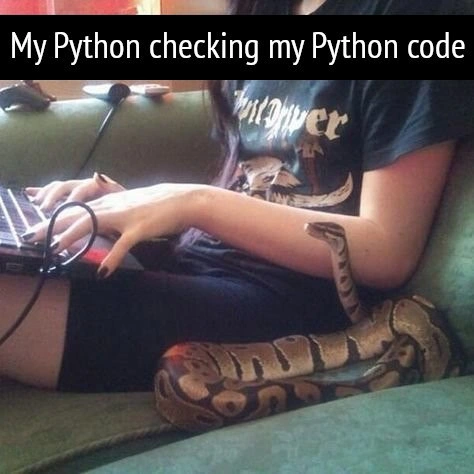
In the meme, though, the reviewer isn’t a person or a software tool – it’s a pet snake! That’s where the big twist comes in: it’s a literal code review by a snake. “Literal” here means we’re taking the idea very directly. The phrase “Python checking my code” usually would mean a program (like the Python interpreter or some script) is verifying the code. But the meme shows literally a real snake doing the checking with its eyes. Of course, snakes can’t actually read or program, but we suspend reality for the sake of the joke. The person in the picture is sitting with their laptop on their lap, and that large, brownish snake is comfortably coiled on their legs too. The snake’s head is raised up and facing the laptop screen, which makes it look like this reptilian buddy is deeply interested in the code on the screen. It’s almost like the snake is a curious coworker or a strict supervisor, which is a hilarious idea. This scenario is a play on how many of us have our pets around when we work or code. If you’ve ever seen funny pictures online, a pet on a laptop is a common sight — cats love to walk across keyboards or sit right on them, and dogs might rest their head on your knee while you type. Here it’s a snake on a lap during coding time (definitely a more unusual pet than a cat or dog!), which makes the scene extra memorable. The humor lies in treating the snake as if it were just another developer friend checking your work. The developer is calmly typing, and the snake looks like it’s quietly observing, as if to say, “I’m just making sure you didn’t miss anything.” It’s easy to imagine the snake giving a little nod of approval for good code or a disapproving tongue flick for a mistake. This is a classic bit of developer humor: imagining our pets or objects as part of the programming process, because it brings a silly, humanizing touch to the abstract world of coding.

Another thing to note is that Python (the programming language) has some well-known rules and conventions that help keep code tidy. For instance, in Python you have to indent your code (add spaces at the beginning of a line) to show where blocks of code begin and end. If you get the indentation wrong, the code won’t run and you get an error. There are also guidelines like using meaningful variable names and a preferred naming style called snake_case for variables and function names. (Funny enough, the term snake_case isn’t derived from the animal directly but it fits perfectly here — it just means all letters are lowercase and you use underscores _ to separate words, like writing my_variable_name instead of myVariableName.) In a normal code review, a teammate might remind you to follow these rules: “Hey, make sure to use snake_case names for your functions,” or “Be careful, your indentation is off in this part.” In this meme’s imaginary world, you can picture the snake doing that job! It’s as if the snake is a nitpicky senior developer or a tool giving feedback. Maybe the snake lets out a quiet hiss when it sees you mix up your tabs and spaces (a common newbie mistake in Python), or it coils a bit tighter when your function names don’t follow the convention. This is the meme’s way of saying even the snake cares about clean, proper code. We can also compare the snake to a linter. A linter is a tool that automatically checks your code for mistakes or style issues, kind of like a spellchecker for code. If you run a linter on your Python code, it might point out things like “unused variable” or “line too long”. In our funny scenario, instead of a program highlighting those, it’s the pet snake seemingly noticing them. Obviously, that’s just pretend — the snake isn’t really reading anything — but it personifies the idea that good Python code should meet certain standards, and any observer (even a scaly one) would be able to tell.

In summary, this meme is entertaining on a couple of levels. The most obvious joke is the wordplay: Python the language vs. python the snake. That alone can make someone smile, especially if they’ve heard of Python in either context. But it gets even better for those who code: it mixes a common programming practice (code review) with an absurd visual (a snake reviewer). It’s saying, “writing code can be fun and full of surprises.” If you’re new to coding, it’s a lighthearted reminder that while getting your work checked might make you a bit nervous, it’s actually a normal and helpful part of learning — and it doesn’t have to be so serious all the time. We can even laugh imagining a snake as the one giving the feedback. And if you don’t program at all, you can still laugh at the idea of a pet acting like a studious human. It’s a goofy, charming image. So, the next time you hear the word “Python,” remember it might not just be a snake or a language in isolation — in the world of tech jokes, it could very well be a snake peeking at a computer screen, making sure you’ve written your code just right!

Level 3: Serpentine Code Review

In this meme, a developer literally has a ball python snake curled up on their lap while typing away on a laptop. The snake’s head is raised inquisitively toward the screen, almost as if it’s critically reviewing the code. The caption sets up the joke clearly:

“My Python checking my Python code.”
This line immediately plays on the double meaning of Python — both the popular programming language and the python serpent. It’s a classic case of a developer pun where one word carries two contexts at once. Here, my Python refers to the actual pet snake, and my Python code means the code written in the Python language. For an experienced developer, this juxtaposition of a real python with the coding world is hilariously absurd and endearingly relatable.

On a serious note, every seasoned programmer knows the importance of a thorough code review in maintaining software code quality. Usually, these reviews are done by human colleagues or via automated tools before code is merged into the main codebase. The process involves scrutinizing each other’s code to catch bugs, point out bad practices, and suggest improvements. It can feel intense — having your work inspected closely can make any developer a bit anxious. In this scene, that reverence for code quality is personified by a slithery, scaly reviewer. The ball python, acting like a senior engineer with scales, appears to be scanning each line for errors or inefficiencies. It’s as if the snake is ready to hiss whenever it spots a bug or something non-Pythonic (not following Python’s recommended style and best practices). The humor hits home because it exaggerates a familiar scenario: we often joke that our code will be judged, and here even a reptile seems to be judging it!

Python as a language is famous for emphasizing readability and elegant style. There’s even an official style guide (PEP 8) that many developers treat as gospel when writing Python code. In real code reviews, especially in Python projects, reviewers frequently comment on things like indentation consistency, clear naming of variables, and using idiomatic Python constructs (the kind of stuff that makes code “clean” or Pythonic). Now imagine our reptilian reviewer applying those same exacting standards. Perhaps the snake is checking that you indented your code with 4 spaces instead of mixing in a tab by mistake (a big no-no in Python). Or maybe it’s verifying you named your variables in snake_case rather than using camelCase – quite fitting that a snake would insist on snake case for naming conventions! This scaly critic might even flick its tongue disapprovingly at functions that get too long or code that isn’t following the “Zen of Python” guidelines (import this reveals that Zen, whose first rule is “Beautiful is better than ugly.”). In essence, the meme humorously suggests that even a snake can appreciate well-structured Python code and will call you out if your code has a bad smell (pun intended — snakes “smell” the air with their tongues, and here it’s sniffing out poor code).

Furthermore, experienced devs will know that code reviews aren’t always done by humans; we have automated processes policing our code too. Python projects often use static analysis tools known as linters (like pylint or flake8) that automatically check your code for errors, bad patterns, or style deviations. These tools are basically automated code reviewers – little pieces of software that comb through your program and flag anything suspicious or non-compliant. If you think about it, a linter is like an invisible pet snake living in your text editor, constantly on the lookout and ready to hiss warnings at any variable name that doesn’t conform or any unused import it finds. The meme’s snake can be seen as the physical embodiment of these vigilant Python linters (or the Python interpreter itself, which will unhesitatingly spit out an error if your syntax is wrong). It’s as though the language’s spirit is right there on your lap, giving immediate feedback. This connection will resonate with seasoned developers: it highlights that in the world of software, even our tools (and now our pets, in jest) are doing code review. That’s a slice of developer life where the boundaries between the coder’s world and everyday life blur in a whimsical way.

Beyond the technical aspects, the meme taps into shared developer experiences and anxieties. Getting a peer review can sometimes feel intimidating — it’s a bit like performing on stage with someone looking over your shoulder. That’s why developers joke about code reviews as if they’re being judged by all-seeing, all-knowing entities (think of the classic “rubber duck debugging” or a stuffed animal on your desk acting as an observer). Here it’s a literal snake that seemingly has opinions on your logic! The image is funny because it’s literal code review by a non-human, but it’s also relatable: many of us work from home with our pets near us, and pets often get curious about what we’re doing. It’s not uncommon to have a cat stroll across the keyboard or a dog attempt to nudge your arm during a late-night coding session. A snake is a more exotic companion, which makes the scene even more surreal. Yet, on a metaphorical level, it captures that feeling of “even my pet could find this bug” or “my tools are judging me” – an exaggerated way to poke fun at our own imposter syndrome. The developer in the photo has the snake curled calmly on their lap, suggesting a kind of casual camaraderie and comfort — until you notice the snake’s curious gaze at the screen, which mirrors a code reviewer’s concentrated stare. It’s easy to imagine the person thinking, “Uh oh, my snake might actually find that mistake I’ve been glossing over!” This is a playful spin on code review pain points: the nervousness about having mistakes pointed out, transformed into a silly situation that makes us laugh instead of sweat.

One delightful layer for the well-initiated is the nod to Python’s origin and iconography. Despite the serpentine name, Python the language was actually named after the British comedy troupe Monty Python, not directly after the reptile. Guido van Rossum, Python’s creator, chose the name because he was in a playful mood and wanted something short and memorable (he was reading Monty Python scripts at the time). However, over the years, the snake imagery naturally crept into Python’s branding and culture — after all, it’s too perfect a visual pun to ignore. The official Python logo features two interlocking snakes, and community events often use snake mascots. So here the meme comes full circle: it literalizes the snake connection that was originally just an inside joke in the language’s name. A veteran Pythonista can appreciate the irony — the comedy group’s name gave the language its name, which gave us the snake logo, and now we have an actual snake seemingly poring over actual code. It’s a multi-layered geekiness that mixes computing history with everyday programming life. The fact that the snake in the photo is specifically a ball python (a commonly kept pet snake known for its gentle nature and habit of curling up) is the cherry on top. Ball pythons often coil calmly and curiously poke their heads around, which is exactly what this one is doing. It’s as if the language’s mascot itself came alive to do a code review cameo on a unsuspecting developer’s lap. How’s that for developer humor merging with reality?

Description

The image features a person, likely a woman, sitting on a green couch and typing on a laptop. Curled up next to them is a live ball python snake. The snake has its head raised and appears to be looking at the laptop screen, as if inspecting the code. The humor comes from the literal interpretation of the text overlay, "My Python checking my Python code." This is a classic pun that plays on the double meaning of 'Python' - both the programming language and the reptile. The joke is simple, visual, and highly relatable to any programmer who has worked with the Python language, tapping into the developer community's fondness for puns and literal humor

Comments

7
Anonymous ★ Top Pick The snake is actually a very effective code reviewer. It's great at finding whitespace errors and identifying any code that doesn't follow a strict, linear path
  1. Anonymous ★ Top Pick

    The snake is actually a very effective code reviewer. It's great at finding whitespace errors and identifying any code that doesn't follow a strict, linear path

  2. Anonymous

    Pair-programming with my literal python: wildcard import? it constricts; mutable default arg? it hisses; a thread pretending the GIL isn’t real? keyboard’s gone - best PEP 8 enforcement I’ve ever deployed

  3. Anonymous

    After 20 years in the industry, I've finally found a code reviewer that's less venomous than my last tech lead - though it still occasionally wraps itself around my project and slowly squeezes the life out of it through dependency hell

  4. Anonymous

    When your code reviewer is a literal Python, at least you know the feedback will be constructive - it'll either constrict around the bugs until they're eliminated, or it'll just silently judge your lack of PEP 8 compliance while occasionally hissing at your use of global variables. Either way, it's probably more helpful than that one senior dev who just comments 'needs refactoring' on every PR without elaboration

  5. Anonymous

    Finally found a linter that enforces four‑space indents by constriction - and hisses every time I reach for typing.Any

  6. Anonymous

    The ultimate GIL enforcer: grips your code single-threaded and squeezes out every concurrency illusion

  7. Anonymous

    Asked a real Python to review my Python - he hissed at the tabs, insisted on mypy, and offered a mutex stronger than the GIL

Use J and K for navigation