Inflated Job Titles: Instagram Model vs. Gamer Hacker
Why is this DevCommunities meme funny?
Level 1: Playing Pretend
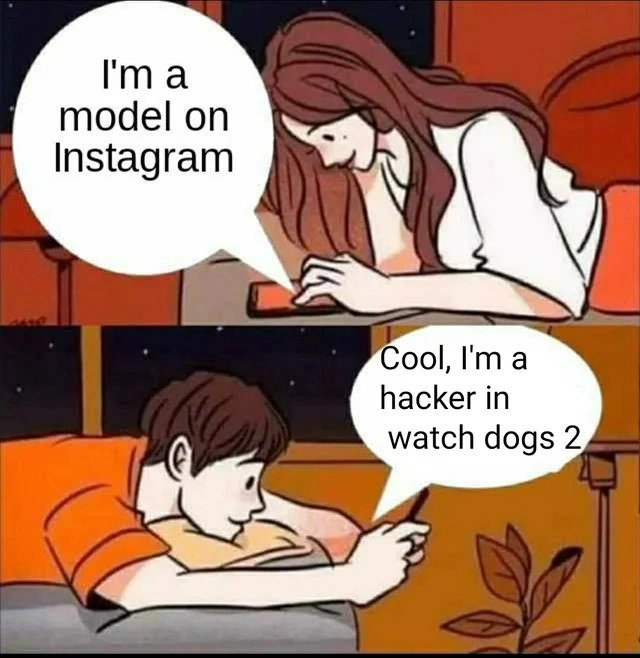
Imagine two kids on a playground playing make-believe. One kid is taking pictures with a toy camera and says, “I’m a famous photographer!” Then the other kid, holding a video game, laughs and says, “Cool, and I’m a world-class racecar driver in my racing game!” You’d probably smile because you know they’re both just pretending. That’s exactly what’s happening in this cartoon, but with grown-ups and their gadgets. One person is saying they’re a model because they post pictures on Instagram, and the other person jokes back that they’re a hacker because they play a hacking video game. It’s funny because neither is doing the real thing – posting pretty pictures online is like playing pretend model, and pressing buttons in a game to “hack” is like playing pretend hacker. It’s just like dress-up or pretend time, but on phones and computers.
We laugh because we all understand the difference between pretend and real here. It’s like if you built a little house out of blocks and said, “Look, I’m an architect,” and your friend who’s playing a cooking game says, “And I’m a chef!” Those titles sound grand, but in reality, you’re just having fun. The meme makes us giggle by showing grown-ups essentially doing the same thing: using playful make-believe titles from the internet and games. It reminds us of how easy it is to call ourselves something cool online, even though it’s not the same as doing it for real. In simple terms, it’s a joke about pretending to be something just because you did a fun version of it on your screen. And just like kids playing pretend, it’s all in good fun.
Level 2: Online Titles vs Real Skills
This meme compares two people who give themselves fancy labels based on what they do online. In the first panel, the woman says she's a “model on Instagram.” Instagram is a social media app where people share photos, and some users — often called Instagram models — post glamorous pictures of themselves. You might have heard the term “influencer”; it’s similar. Essentially, anyone can claim to be a model on Instagram if they have a following and good photos, even if they aren’t modeling for real magazines or companies. It’s a self-appointed title in the social media world.
In the second panel, the man replies, “Cool, I’m a hacker in Watch Dogs 2.” Watch Dogs 2 is a popular video game (particularly well-known in GamingCulture) where you play as a hacker in a big city. The game lets you do things like break into (fictional) computer systems, control traffic lights, and generally cause mischief with high-tech gadgets. It’s part of the game’s fun roleplay_hacking element – you feel like a super cyber ninja, but only inside the game’s story. By saying he’s a hacker in Watch Dogs 2, the guy is joking that playing a hacker character in a video game is equivalent to being a real hacker.
Now, in real life, a hacker (especially in CyberSecurityMemes and serious contexts) means someone who is very skilled with computers and networks, often finding clever solutions or breaking into systems (with or without permission). It takes a lot of knowledge to be a true hacker: programming, understanding security, networks, cryptography, all that complex stuff. By contrast, anyone can be a “hacker” in the Watch Dogs game by just following the game’s rules and pressing the right buttons on a controller. No actual coding or security cracking knowledge is required — the game does it for you. So the guy’s response is making a funny comparison: it’s as if he’s saying, “If you can call yourself a model just by using Instagram, then I can call myself a hacker just by playing a video game.” He’s pointing out that both titles are a bit exaggerated given the context.
This joke also hints at a broader idea of virtual_identity or online persona. People often have an online self that might sound impressive, but it doesn’t always match their actual expertise. For example, someone might call themselves an “entrepreneur” because they sell stuff on eBay, or a “writer” because they post long Facebook statuses. Here we have “model” because of Instagram posts, and “hacker” because of a video game. It’s a playful way to say talk is cheap — or rather, titles are easy to claim on the internet.
The post message adds an extra layer: “And I’m a programmer in Scratch.” Scratch is a beginner-friendly programming platform often used by kids to learn coding concepts. It has a colorful, Lego-like interface where you drag and drop code blocks to make characters move or do tasks. It’s awesome for learning, but it’s very simplified compared to professional programming. By saying “I’m a programmer in Scratch,” someone is humorously joining the conversation, implying, “If being a hacker in a game counts, then hey, I’ll count my basic coding practice in Scratch as being a real programmer!” This is the same kind of tongue-in-cheek exaggeration. Early-career developers or students might chuckle at that because many started with simple tools like Scratch or basic HTML, yet we all know that doesn’t instantly make you a Google software engineer.
In summary, the meme uses GamingReference and social media culture to poke fun at how people label themselves. It’s comparing online titles vs. real skills. The woman and man in the comic aren’t truly a professional model or a real hacker — they just play those roles in certain virtual contexts. If you’re new to tech or social media, it’s a lighthearted lesson: just because you can do something in a game or on an app doesn’t automatically give you the full status of that role. It takes more work and real-world experience to be the genuine article. The humor here is in recognizing that gap. After all, a real cybersecurity expert might use tools like nmap or write exploits, not just tap an Xbox controller button labeled “Hack”. And a professional fashion model attends photoshoots and signs contracts, not just posts weekend selfies. The meme playfully reminds us to keep our online persona claims in perspective – it’s great to enjoy games and social media, but everyone in tech knows there’s a difference between simulating something and actually doing it in real life. 😉
Level 3: Pwned by Pretenses
At first glance, this two-panel comic sets up a showdown of self-proclaimed tech and social media titles. The top panel shows a woman casually saying, "I'm a model on Instagram," and the bottom panel features a man smirking at his phone replying, "Cool, I'm a hacker in Watch Dogs 2." For seasoned developers and security folks, the humor cuts deep: it's highlighting the inflation of titles in virtual spaces. In the real world, HackerCulture treats the term hacker with a mix of respect and caution – it implies serious coding chops, knowledge of networks, maybe even the dark arts of cyber intrusions. But here, our guy has earned his “hacker” badge by playing Watch Dogs 2, an open-world video game famous in GamingCulture for letting players role-play as vigilante hackers in a fictional San Francisco. He’s basically saying, “Oh, you’re calling yourself a model just because you post on social media? Then by that logic, I’m a super-elite hacker – after all, I mash buttons to hack things in a video game.” It’s a tongue-in-cheek way to call out how online personas can sometimes oversell real-world skills.
This resonates in tech humor circles because we’ve all met folks who beef up their title with a pinch of virtual swagger. Ever seen someone who wrote a few lines of Python declare themselves a “software engineer” on LinkedIn? Or a person who tweaks a WordPress theme once and suddenly claims “web developer” status? 🙄 The meme plays on that exact disparity. Here, Instagram model and video game hacker are parallel in their virtual identity flexing: both are achievements that certainly take some effort (building a following, completing game missions) but don’t necessarily equate to the traditional definition of model or hacker in professional realms. It’s a gentle roast of people who self-appoint lofty titles thanks to low-barrier platforms.
In developer terms, it’s like calling yourself a kernel engineer because you edited an /etc/sysctl.conf once. The Security angle is especially juicy: real cybersecurity experts spend years honing skills like penetration testing, understanding exploits, and protecting systems. In Watch Dogs 2, hacking is as simple as pushing a button to pwn a traffic light or siphon a bank account – it’s hacking on easy mode, scripted and pre-packaged. This contrast is pure TechHumor gold. The guy’s boast translates to: “If posting filtered photos makes you a model, then pressing ‘X’ to hack a virtual bank makes me Kevin Mitnick.” Seasoned readers recognize that both characters are slightly delusional indulging in fantasy.
There's also a bit of lore here for those in on the joke: Watch Dogs 2 is part of a series that Ubisoft marketed heavily to gaming and tech enthusiasts. It’s basically hacker cosplay with parkour. Meanwhile, being an “Instagram model” is a modern phenomenon – in the social media era, you don't need a Vogue cover to claim model status, just an Instagram account and enough selfies. The meme’s format even inspired a follow-up punchline in the post message: “And I'm a programmer in Scratch.” 😂 Scratch, of course, is a beginner-friendly programming environment for kids. That one-liner caps the joke by dragging it into our domain as developers – if playing a hacker game makes you a hacker, then hey, dragging some code blocks in Scratch makes me a full-fledged software engineer! The senior crowd reading this likely chuckles and maybe winces in recognition, because we’ve all seen titles thrown around too loosely. In the end, the meme cleverly satirizes roleplay_hacking and social media vanity by equating them – it’s a gentle reminder that virtual achievements often don’t equal professional credentials. And as any battle-hardened programmer will tell you, real hacking or modeling is a tad more complicated than hitting a button or striking a pose on your phone.
Description
A two-panel comic depicting a text exchange. In the top panel, a woman with long brown hair, wearing a white shirt, is looking at her phone and a speech bubble says, "I'm a model on Instagram." In the bottom panel, a man in an orange shirt is also on his phone and replies, "Cool, I'm a hacker in watch dogs 2." The meme satirizes self-proclaimed, often inflated, job titles by creating a false equivalence. The humor lies in the man's sarcastic response, which equates the perceived legitimacy of being an 'Instagram model' to the fictional expertise of being a hacker in the video game 'Watch Dogs 2.' For developers, this resonates with the experience of hearing people claim technical skills they don't possess. The original post caption, "And I'm a programmer in scratch," reinforces this joke by adding another layer of a simplified, non-professional identity being presented as a serious title
Comments
7Comment deleted
Claiming you're a hacker because you played Watch Dogs is like calling yourself a DevOps engineer because you successfully merged a feature branch without conflicts
Yeah, and I’m a cloud-native distributed-systems architect - my “Hello, world” fan-outs through six Lambdas, a Kafka topic, and a Grafana dashboard nobody opens
When she says she's an Instagram influencer but you've spent 200 hours perfecting your ctOS exploits in Watch Dogs 2 - suddenly explaining that your 'hacking' involves pressing square to breach firewalls feels less impressive than her 10k followers and brand sponsorships
The real hacker move here would be explaining that Watch Dogs 2's depiction of hacking is about as realistic as claiming 'Instagram model' is a sustainable career path with proper error handling and rollback strategies. Both require you to suspend disbelief about scalability, security implications, and the actual effort-to-reward ratio - though at least the game has better documentation than most social media algorithms
Her: curated selfies. Him: fictional hacks. Dev: 'I once diff-resolved a 10k-line merge conflict blindfolded.'
Listing 'hacker in Watch Dogs 2' on your resume is the security equivalent of bragging about 100% coverage from auto-generated tests
Perfect startup hires: Instagram model and Watch Dogs 2 hacker - vanity metrics maxed, threat model nonexistent