Skip to content
DevMeme
1404 of 7435
A Developer's True Desire: Dark Mode Memes
DeveloperExperience DX Post #1577, on May 13, 2020 in TG

A Developer's True Desire: Dark Mode Memes

Why is this DeveloperExperience DX meme funny?

Level 1: Hearts & Candy

Imagine you and your friend are lying on the grass, looking up at fluffy clouds in the sky. You turn to your friend and say, “People say that when we look at clouds, we see whatever we want the most.” You’re hoping your friend will say something really nice – maybe that they see a cloud shaped like you and them together or a big heart 💖. Something super sweet and loving.

Now your friend looks at the clouds very carefully. You ask, “What do you see, buddy?” You’re all excited, thinking maybe they’ll say, “I see us being best friends forever,” or something warm and fuzzy. Your friend turns to you with tears in their eyes (so you really think it’s going to be something heartfelt!) and they say, “I see… a gigantic piece of candy, floating in the sky.”

🍭 A huge candy?!

That’s totally not what you expected, right? You expected something about friendship or love, but they just said the first thing on their mind – and it was candy. It’s like their biggest wish in life is to have candy, even in a moment that was supposed to be about the two of you sharing a nice feeling. You’d probably burst out laughing because it’s such a silly and honest answer. Instead of romance, their brain went straight to dessert!

In the meme’s story, the girl wanted the boy to say something romantic that they see in the cloud (like a heart or them together). He said something romantic (“I see us together forever”), but it turns out he was fibbing. What he really saw (and really wanted) was something more like the candy scenario – except in his case, it’s not candy, it’s his favorite way to look at computer stuff.

So the funny part is just like our candy cloud: one person expects love, but the other person’s mind is on their favorite thing instead. It’s showing in a playful way that sometimes people (especially jokey computer-loving people) might care about funny little preferences a lot – so much that even during a lovely romantic moment, they’re secretly dreaming about that thing.

In everyday terms: it’s as if a kid went “Wow, that cloud looks like a big chocolate bar!” right when you thought they were about to say something really nice about being friends. It makes you laugh because it’s unexpected and a bit cheeky. The boy in the comic basically did that – he chose his version of “candy” (something he loves a lot, which is having things in dark mode so they’re easy on his eyes) over a mushy-gushy moment. And that goofy mismatch is why the scene is funny and endearing.

Level 2: Hearts & Hex Codes

Stepping down to a more introductory view, let’s clarify the key terms and ideas for a less experienced developer (or someone just outside the dev world). First off, what exactly is “dark mode”? Dark mode is a display setting where the typical color scheme is inverted: instead of dark text on a light background (like black letters on white paper), you get light text on a dark background (like white or light gray text on a black screen). For example, a code editor in dark mode might have a black background with bright-colored code, and a website in dark mode might use deep navy or black as the background with light text. Many people find this more comfortable, especially in low-light environments, because it produces less glare. It’s easier on the eyes when you’re coding late at night or browsing on your phone in a dark room.

Now, what do we mean by “dark-mode friendly memes”? This just means memes (funny images or comics shared in the community) that won’t blind you if you’re viewing them with a dark-themed app or website. A “friendly” meme for dark mode often has a transparent background or a dark background, so that it displays nicely on a dark interface without showing a big white box. In this particular meme, the creator drew the comic with white outlines on a black background specifically so that it would look good in dark mode. In other words, it natively respects the dark theme. If someone posted a normal comic with a bright white background to a forum where everyone’s in dark mode, it would be like suddenly shining a flashlight in your face – not very friendly! This has become a little etiquette point in Dev Communities: if you share images, try not to assault everyone’s eyes.

The categories listed (UX/UI, DeveloperExperience_DX, DevCommunities) give us hints:

  • UX/UI: This stands for User Experience / User Interface. It’s all about how users interact with software and how the software looks and feels. Dark mode is a UX/UI feature – it improves the user’s experience by offering a different look that can be easier to read in certain conditions.
  • Developer Experience (DX): This is like UX but specifically for developers. It refers to making tools or content more comfortable and effective for programmers. A documentation site having dark mode, or a meme being readable in dark mode, are little things that improve DX. It’s the kind of detail developers really appreciate.
  • Dev Communities: These are groups of developers often found online (like subreddits, Stack Overflow, Discord servers, etc.) where they discuss, share, and joke about code and tech life. In these communities, certain jokes and cultural quirks develop – one of them is the collective obsession with dark mode.

Let’s break down the meme’s storyline in simple terms:

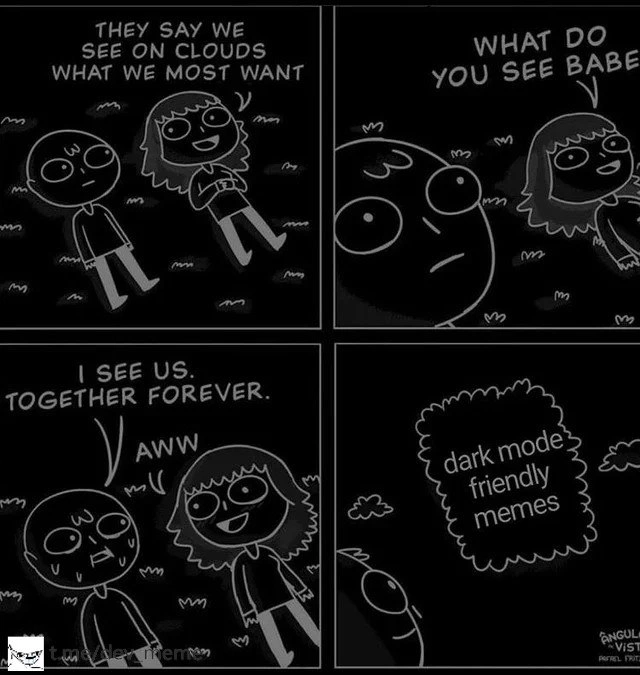
  • Panel 1: A girl and a guy (the guy is presumably a developer) are lying on the grass at night, looking up at the clouds. She says, “They say we see in clouds what we most want.” In plain terms, there’s a saying that if you look at clouds, your imagination will make them look like the things you desire most in life. This sets a romantic and dreamy mood. We expect they’ll share something personal.

  • Panel 2: She asks him, “What do you see babe?” She’s curious and probably hoping for a sweet answer – maybe he’ll say he sees a heart or their future together or something lovey-dovey.

  • Panel 3: He responds, “I see us. Together forever.” with tears in his eyes. That is an extremely romantic thing to say! It implies he’s looking at a cloud and sees the two of them side by side, forever. She reacts with “aww.” This panel makes it look like he gave the perfect answer, and she’s touched. The tears in his eyes make it even more dramatic, like he’s so moved by the thought of being together forever that he’s crying from happiness. So far, everything seems like a sweet, if a bit clichéd, romantic comic.

  • Panel 4: Here’s the twist – we see what the cloud actually looks like from their perspective. Instead of a shape of a couple or a heart, the cloud has text in it (drawn in the sky): “dark mode friendly memes.” It’s drawn as a dark blob (since the sky is dark, the cloud is actually depicted in reverse, as a black shape outlined in white) with the phrase written inside. This means that when he said he saw “us together forever,” he was either fibbing to make her happy or interpreting that phrase somehow as them together (which would be really stretching it!). Realistically, it reveals that what he actually wants most (as per the saying) is just… more memes that are easy on the eyes in dark mode. It’s a punchline because it’s so unexpected and absurd in a romantic context. The girlfriend is thinking “aww how romantic,” while we, the audience, discover he’s actually being a total nerd in that moment.

So why is this funny to developers? It’s the contrast between romance and nerdy priorities. The girl is expecting a heartfelt, human answer. The guy’s true thought is about a feature of software/memes. It’s like if someone asked, “What’s your dream in life?” and instead of saying “to be happy with you,” the person said “to have all websites offer dark mode.” It’s intentionally ridiculous – nobody would actually say that in that situation with a straight face. But within dev humor, it pokes fun at how much we techies can prioritize little technical comforts.

There are also some key terms to explain that appear in the tags and which make this meme even more relatable:

  • DarkMode: As explained, a display setting with dark background. Developers often switch everything to dark mode. You might have noticed apps like Twitter, Reddit, or your code editor offering a “night mode” or “dark theme” – same idea.
  • RelatableDeveloperExperience: This tag suggests that the meme is about a situation or feeling many developers can relate to. Indeed, a lot of developers have had the experience of being almost addicted to dark themes. Many of us chuckle because we’ve joked about how even our memes or documentation should have dark themes.
  • UXDesign & UXIrony: The meme involves a design preference (UX design) used in an ironic way. It’s ironic because normally dark mode discussions are for design meetings or tech forums, not romantic stargazing moments! The irony is what makes it comedic.
  • MemeCulture: Within tech circles, there’s a whole meme culture that uses these inside jokes. You kind of have to know about devs’ love of dark mode to fully get why this is funny. Meme culture in dev communities often riffs on these shared obsessions (like “tabs vs spaces” fights, or “it works on my machine” excuses, etc.). Dark mode is definitely one of those big shared topics.

One more little detail: “Hearts & Hex Codes” as the title of this level is a fun way to think about it. Hex codes are how colors are represented in coding and web design. For example, the color black is #000000 (hexadecimal for 0 in red, green, and blue), and white is #FFFFFF (hex for the max 255 in red, green, blue). So when we talk about romance, we think of hearts ❤️; when developers talk about dark mode, we think in terms of hex color codes for dark backgrounds and light text. The guy in the meme basically chose hex codes (the dark color scheme for memes) over the heart (the romantic implication).

So, in summary at this level: The comic sets up a sweet scenario but flips it on its head by revealing the guy is secretly geeking out about a user interface color theme. It’s funny because it’s an exaggeration of real life – developers do care a lot about dark mode, just not usually at the expense of basic romance! But the exaggeration makes the joke clear. Even if you’re new to programming, you’ve probably encountered the option for dark mode on your phone or apps; imagine someone loving that feature so much it clouds (pun intended) their mind all the time. That’s the core laugh: a big romantic moment reduced to “I just want my memes in dark mode.” It’s silly, it’s lighthearted, and it’s very much an inside joke among tech folks.

Level 3: Till Dark Mode Do Us Part

Now let’s look at the humor from an experienced developer’s perspective. This four-panel comic sets up a romantic scene – a couple lying on the grass, gazing at the night sky clouds. Typically, one might expect a cheesy, heartfelt exchange (think: “I see an angel” or “I see us together forever”). And indeed, in the third panel the boyfriend says just that: “I see us. Together forever.” It makes the girlfriend go “aww.” But the punchline (revealed in the final panel) is that he’s actually seeing something totally different: a cloud shaped as the words “dark mode friendly memes.” 😂

For anyone steeped in developer culture, this twist is hilariously on-point. It highlights the almost zealous love developers have for Dark Mode. In real life dev communities, dark mode isn’t just a feature – it’s practically a lifestyle. Many programmers spend long hours staring at screens, often in dimly lit rooms or late at night during coding sprees. A bright white background (light mode) can feel like staring into a flashlight. So, over the years, there’s been an almost universal rallying cry: “Can we have a dark theme for this?”

This comic is poking fun at that developer priority. It’s exaggerating the idea that a true developer’s heart might belong less to romantic ideals and more to a well-themed interface. The phrase “Till dark mode do us part” encapsulates the joke: it’s like the dev made a marriage vow not to his girlfriend, but to dark mode itself!

To give a bit of context, around the time this meme was posted, just about every major app or site was adding a dark mode option – often after persistent public demand.

  • Stack Overflow (the Q&A site for programmers) finally rolled out an official dark theme after years of users begging for it.
  • GitHub introduced a dark mode, met with celebratory memes and tweets.
  • chat applications like Slack and Discord? Developers switched to those specifically praising their dark themes.
    There’s a running joke that the first thing a developer does in any new tool or IDE is hunt for the “🌙 Dark Mode” toggle. Some will flat-out refuse to use an app if it doesn’t have a dark theme available, or they’ll use community-made CSS hacks to force it.

So when the boyfriend’s eyes well up with tears as he says “I see us together forever,” the seasoned dev reader might smirk knowingly. Those could be tears of joy at envisioning a world filled with dark-mode-optimized memes! Or perhaps he’s emotional because he’s not actually being truthful to his girlfriend – he’s professing eternal love, but deep down his heart is screaming for better UX consistency in his memes. It’s an absurd juxtaposition: eternal romance vs. eternal night mode. And in this joke, night mode wins.

The meme also cleverly uses its art style to reinforce the joke. It’s drawn in a monochromatic white-on-black style. In other words, the comic itself is dark-mode friendly! It’s like a meta-joke: the meme practices what it preaches. In developer forums, you’ll often see comments like:

User1: “Bright theme meme! My eyes, my eyes! 🔥”
User2: “OP please, some of us are in dark mode 24/7. Could you invert the colors?”
User3: “Ahh, thank you for this dark mode friendly version 🙏.

Posting a blindingly white meme to a dark-themed developer subreddit at 2 AM might get you mock-scolded. Conversely, a meme like this one – already optimized for dark mode – earns appreciative chuckles because it’s literally practicing good Developer Experience (DX) etiquette.

Let’s unpack the social dynamic too: The girlfriend expects a sentimental answer (maybe she sees a fluffy heart in the clouds). The boy pretends to match that expectation with a romantic answer, but what’s actually in his head is 100% geek priorities. It’s playing on the stereotype that developers can be socially awkward or overly focused on tech. In reality, plenty of devs are perfectly romantic 😊, but the stereotype in humor form exaggerates the truth that “sometimes we just can’t stop thinking about code/tech, even in romantic moments.” Here it’s the romance_vs_dark_mode conflict: love versus that sweet dark theme release.

So, on a senior dev level, this comic hits a couple of insider truths:

  • Developers and Dark Mode: It’s a huge thing. If a site or app lacks a dark mode, you’ll hear about it. It’s become a pillar of good UX for dev-centric products.
  • Meme Culture Adaptation: Dev meme creators actively consider their audience. A dark-mode friendly meme (like this all-black comic) is more likely to be shared and upvoted because it respects the audience’s preferences (and literal eye comfort).
  • Expectations vs. Reality: There’s an ironic gap between what non-devs might expect a dev to care about and what we actually obsess over. The girlfriend (non-dev in this scenario) expects a heartfelt vision; the dev’s mind serves up a UI setting. It’s tongue-in-cheek commentary on developer priorities.

In summary, the humor works on multiple levels for an experienced audience. It’s not just the words “dark mode friendly memes” in the cloud; it’s everything that phrase stands for in dev life: caring about little technical comforts even in big emotional moments. The guy’s “together forever” ends up applying more to him and his beloved dark theme than to the couple — a playful jab at how devs can sometimes jokingly “marry” their favorite tech habits. And admit it, if you’ve ever been blinded by a bright meme while scrolling in bed, you totally understand his commitment! 😉

Level 4: Pareidolia & Contrast Ratio

At the deepest technical level, this meme touches on both human perception and UI design principles. The setup is a classic example of pareidolia – our brain’s tendency to see meaningful images (like animals or faces) in random patterns (like cloud shapes). The twist is that the developer’s subconscious doesn’t conjure a romantic image at all, but rather a UX preference: “dark mode friendly memes.” This suggests that his deepest desire (at least humorously) is for content optimized for dark mode. This obsession isn’t just a quirky preference; it has some grounding in how we design comfortable visual interfaces.

In user interface design and UX (User Experience) research, a big focus is on contrast ratios and readability. Dark mode – meaning light text on a dark background – can provide very high contrast. According to the Web Content Accessibility Guidelines (WCAG), good legibility requires a certain contrast ratio between text and background colors (generally at least 4.5:1 for normal text). The contrast ratio is calculated from the relative luminance of the foreground (text) and background colors. For example, pure white text on pure black background yields an extremely high contrast ratio:

$$
Contrast = \frac{L_{\text} + 0.05}{L_{\background} + 0.05}
$$

If L_text (the luminance of the text color) is at its maximum (for white, 1.0) and L_background is at its minimum (for black, 0.0), the contrast becomes $\frac{1.0 + 0.05}{0.0 + 0.05} = 21$, or 21:1. That’s about the highest contrast you can get on a display. Dark mode interfaces often approach this high ratio (white on black), which is great for visibility. But interestingly, too much contrast can introduce its own issues – a phenomenon known as halation, where bright text on a dark background might blur or create a glowing effect, especially for people with astigmatism. Essentially, the sharp difference in light intensity can cause light to bleed in the viewer’s vision, making text harder to read. This is one reason designers sometimes soften pure white text to a light gray for dark mode (reducing that 21:1 contrast a bit to ease the eyes).

There’s also some neat visual physiology at play. Our eyes have rod and cone cells: cones handle color in well-lit conditions (daylight or “photopic” vision), and rods handle low-light (night or “scotopic” vision) and are very sensitive to brightness changes but color-blind. When you’re in a dark environment, your eyes rely more on rods. A bright white background on your screen can feel like staring at a lightbulb because your pupils are dilated for the dark, and suddenly there’s intense light – ouch! Dark mode mitigates this by keeping the overall screen luminance low, which is gentler on rod-dominated vision in darkness. In other words, dark mode aligns with our eyes’ nighttime settings. The comic humorously implies the developer has so internalized this comfort that even his cloud fantasies revolve around it.

From a tech standpoint, making something “dark mode friendly” means designing it with appropriate contrast and maybe even detecting user preferences. Modern CSS offers the prefers-color-scheme media query, which lets web developers automatically switch a site’s theme based on the user’s OS setting (light or dark). For instance, you might write CSS like:

@media (prefers-color-scheme: dark) {
  body {
    background-color: #000000;
    color: #FFFFFF;
  }
}

This ensures that if someone has dark mode enabled system-wide, they’ll get a dark-themed webpage with a black background and white text. Technologies like this arise because Developer Experience (DX) and user experience considerations showed that a significant portion of users (especially developers) will literally modify apps or use plugins to enforce dark mode if it’s not provided. There are even browser extensions that invert colors on every page to create a “dark mode” for sites that lack one. The demand is that strong.

We can even get super-technical and talk hardware: on OLED displays (common in modern phones and high-end monitors), black pixels use no power (since each pixel is an LED that is off when displaying true black). So dark mode isn’t just a visual preference – it can also save battery life. A meme that’s “dark mode friendly” (mostly black) is ironically also battery-friendly on those screens. It’s like efficiency meets comfort.

All these factors – human psychology, readability algorithms, accessibility standards, and hardware behavior – explain why dark themes are so beloved by tech folks. So in the meme, when the dev sees a cloud shaped as the words “dark mode friendly memes,” it’s a nerdy way of saying his head is in this technical space. It’s a mashup of romantic pareidolia with a dash of HCI (Human-Computer Interaction) theory. The joke lands because it’s comically over-technical: instead of seeing love in the clouds, he literally sees a UI design requirement. That’s taking “head in the cloud” to a whole new (dark) level!

Description

A four-panel comic strip drawn with white lines on a black background, making it inherently dark-mode friendly. In the first panel, a boy and a girl are lying on the grass looking at the sky, with the text: 'THEY SAY WE SEE ON CLOUDS WHAT WE MOST WANT'. In the second panel, the girl turns to the boy and asks, 'WHAT DO YOU SEE BABE'. The third panel shows the boy, visibly sweating and nervous, replying, 'I SEE US. TOGETHER FOREVER.', to which the girl lovingly responds, 'AWW'. The final panel reveals the punchline by showing what the boy is actually looking at: a cloud shaped like a thought bubble containing the words 'dark mode friendly memes'. The humor stems from the classic bait-and-switch where a romantic moment is comically interrupted by a developer's niche, practical desires. For senior developers, this resonates because the preference for dark mode is a deeply ingrained part of the culture, valued for reducing eye strain and improving focus during long coding sessions, making it a comically mundane thing to wish for
Comments

7
Anonymous ★ Top Pick My ideal relationship is like my IDE: dark, doesn't judge my questionable life choices at 3 AM, and understands that my deepest desire is just less eye strain
  1. Anonymous ★ Top Pick

    My ideal relationship is like my IDE: dark, doesn't judge my questionable life choices at 3 AM, and understands that my deepest desire is just less eye strain

  2. Anonymous

    After two decades of prod deploys, my idea of “together forever” is a dark-mode palette that nails WCAG-AA, uses zero !important, and survives the next rebrand

  3. Anonymous

    After 15 years of explaining why we can't just "make it pop more" and why dark mode isn't just inverting colors, you realize the real relationship goal is finding someone who understands that accessibility features are actually just good UX that benefits everyone

  4. Anonymous

    The real measure of a senior engineer's maturity isn't their system design skills - it's when they realize that 'together forever' means finding someone who also respects your dark mode preferences and doesn't send you blinding white-background screenshots at 2 AM during an incident

  5. Anonymous

    She saw hearts in the clouds; I saw memes engineered for OLED longevity and 4K retina survival past midnight deploys

  6. Anonymous

    After too many 3am pagers, prefers-color-scheme: dark graduated from a CSS hint to an SLO for my retinas

  7. Anonymous

    Dark mode is the cheapest enterprise modernization: add prefers-color-scheme, watch tech debt fade to #000, and ship the press release

Use J and K for navigation