Python Habits Meet Java Semicolons
Why is this Languages meme funny?
Level 1: Different Homework Rules
Imagine one teacher says every sentence must end with a period, and another teacher says the line break is enough. If you move to the first class and forget the periods, your homework gets marked wrong. The funny part is watching someone panic and add periods everywhere, even in places where they do not solve the real mistake.
Level 2: Grammar With Consequences
A compiler is a program that checks and translates source code before it runs. A syntax error means the code does not follow the grammar of the language. In Java, many lines that perform actions or declare variables must end with ;. In Python, normal line breaks usually mark the end of a statement, so semicolons are rarely used.
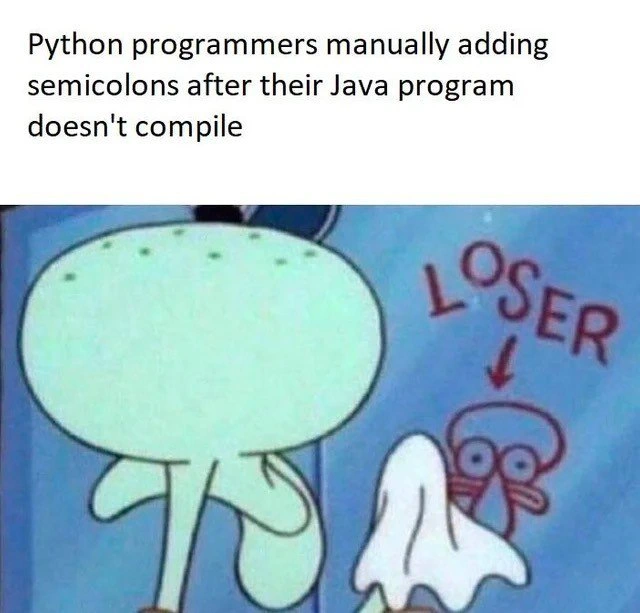
The image is making fun of someone who learned Python habits first and then tried to write Java. When their Java program fails to compile, they start adding semicolons by hand. That can be necessary, but it can also become a guessing game if they do not read the compiler message carefully.
For a newer developer, this is a familiar moment: you switch languages and suddenly tiny details matter. A program can be logically reasonable but still rejected because the language expects a specific shape. The meme's LOSER label exaggerates that embarrassment, turning an ordinary beginner mistake into a dramatic public roast.
Level 3: Semicolon Shame Spiral
The caption says:
Python programmers manually adding semicolons after their Java program doesn't compile
Then the reaction image points at the unfortunate programmer with "LOSER". The cruelty is cartoonish, but the technical pain is real: moving between languages means moving between different rules for where a statement ends. Python uses newlines and indentation as major parts of its syntax. Java uses braces for blocks and semicolons to terminate many statements. A Python developer who hits a Java compiler error may correctly suspect missing semicolons, then incorrectly turn that into a ritual: add semicolons everywhere until the red squiggles stop.
The senior-developer joke is that semicolons are often the first symptom, not the diagnosis. Java may be complaining because of a missing import, a type mismatch, an undeclared variable, a method outside a class, or a brace that wandered off to start a new life. Adding semicolons manually can fix one class of syntax error while hiding the larger issue: the developer is still thinking in Python's execution model while writing Java's grammar.
// Java expects statement terminators here.
String name = "Squidward";
System.out.println(name);
// But a semicolon cannot fix a broken type model.
int count = "three"; // still wrong
The humor also comes from muscle memory. Developers do not merely know syntax; they develop reflexes around it. Python encourages a clean visual flow where indentation communicates structure. Java asks for more explicit punctuation and static type declarations. Neither style is inherently "better" in this joke. The funny part is the awkward migration phase where the compiler becomes a disappointed language tutor and the programmer starts treating punctuation as a debugging strategy. We've all been there; some of us just left fewer semicolon fossils behind.
Description
The top text reads, "Python programmers manually adding semicolons after their Java program doesn't compile". Below it is a cartoon reaction image where one character points at another labeled "LOSER" with an arrow. The meme jokes about programmers moving from Python's whitespace-oriented, semicolon-free style into Java's stricter statement syntax and responding to compiler errors by mechanically sprinkling semicolons. It captures the friction of switching languages when muscle memory and syntax rules disagree.
Comments
1Comment deleted
The semicolon is not the migration plan; it is just the compiler's way of asking whether you read the onboarding docs.