Pizza Party as Compensation Strategy
Why is this CorporateCulture meme funny?
Level 1: The Wrong Help
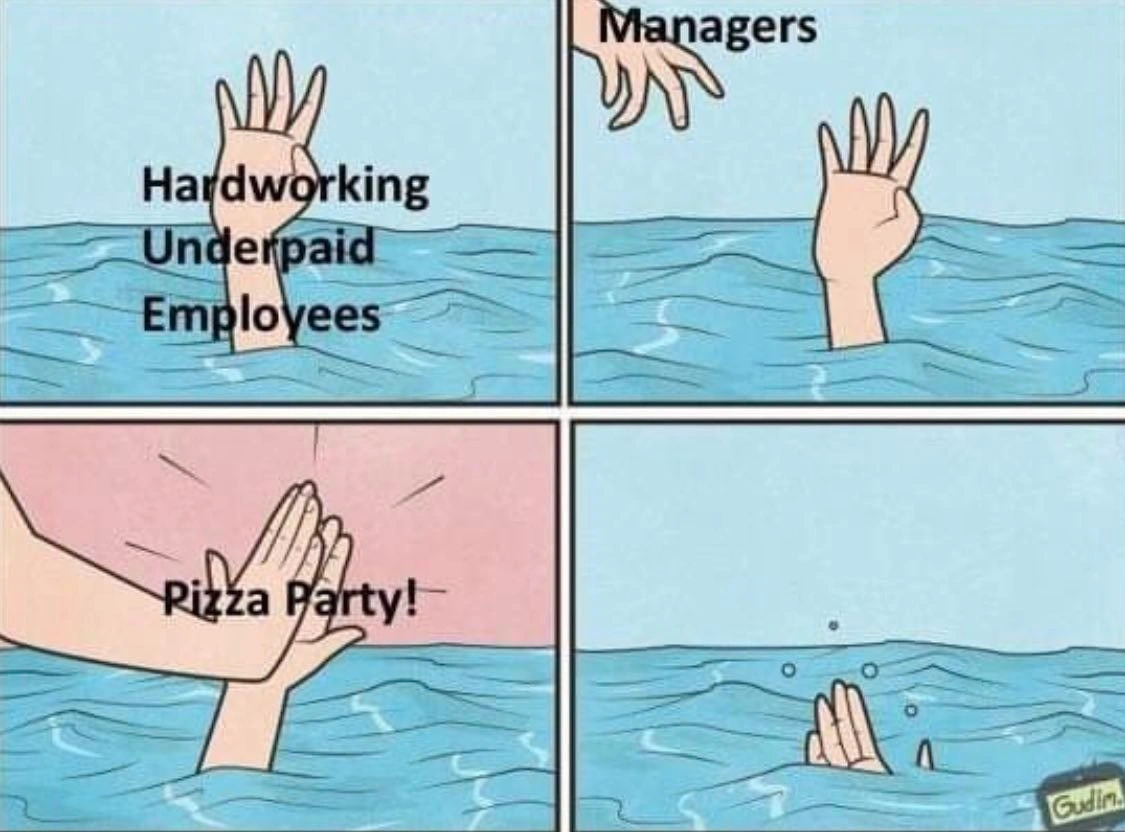
Imagine someone is stuck in a pool and raises their hand because they need to be pulled out. Another person walks over, smiles, gives them a high-five, and leaves them in the water. That is why the meme is funny and a little painful: the employees need real help, but management gives them a tiny celebration and acts like the problem is solved.
Level 2: Benefits Without Relief
In workplace terms, compensation is not just salary. It includes raises, bonuses, benefits, time off, promotion opportunities, workload expectations, and job security. Corporate culture is the set of behaviors a company rewards in practice, not the values printed on the wall. When those two things conflict, employees notice quickly.
The four panels show that conflict visually. The drowning hand represents employees who are overworked and underpaid. The manager hand looks like it might help, which creates the setup. Then the manager gives a high-five labeled "Pizza Party!", which means the company is offering a cheap morale booster instead of meaningful help. In the final panel, the employee hand sinks lower, because the original problem was never addressed.
For junior developers, this can be a sharp early-career lesson: perks are not the same as support. Free food, swag, game nights, and upbeat announcements can be pleasant, but they do not replace fair pay, sane deadlines, good tooling, mentorship, or enough people to do the work without burning out.
Level 3: Morale as Patch Notes
The comic's structure is brutally efficient: an employee hand is drowning, a manager hand reaches down, and the rescue turns into a high-five. The visible labels do all the damage:
Hardworking Underpaid Employees
Managers
Pizza Party!
The humor is not that pizza is bad. Pizza is fine. The joke is that a symbolic morale gesture is being offered where a structural fix is needed. The hand labeled "Hardworking Underpaid Employees" is not asking for vibes; it is visibly in distress. In developer workplaces, that distress usually maps to chronic overtime, understaffed teams, stagnant compensation, unclear promotion paths, production support load, and management expectations that keep expanding faster than headcount.
The high-five is the perfect management anti-pattern because it converts a cry for help into a moment of performative alignment. Nobody has to discuss salary bands, retention risk, sprint capacity, burnout, or why the same people keep absorbing every urgent request. Instead, the organization can say it "invested in culture" by buying lunch. Somewhere, a spreadsheet probably called it an engagement initiative and went home proud of itself.
For engineering teams, this lands because the same pattern appears in more technical clothing: replacing incident prevention with an all-hands thank-you, replacing sustainable staffing with "hero culture," or replacing process repair with a morale event after the deadline slips. The pizza party is funny because it is a small, concrete object standing in for a large refusal to solve the real problem.
Description
The image is a four-panel comic of a hand sticking out of water as if asking for help. The first panel labels the hand "Hardworking Underpaid Employees"; the second labels a reaching hand above it "Managers". In the third panel, the manager hand high-fives the struggling hand with the text "Pizza Party!", and in the fourth panel the employee hand sinks below the water. The meme criticizes corporate and management culture where symbolic morale gestures are offered instead of compensation, staffing, or structural fixes.
Comments
1Comment deleted
A pizza party is just a one-time bonus with worse tax treatment and no impact on retention metrics.