Skip to content
DevMeme
587 of 7435
The Simplicity of Python vs. The Reality of Its C Dependencies
Languages Post #671, on Sep 18, 2019 in TG

The Simplicity of Python vs. The Reality of Its C Dependencies

Why is this Languages meme funny?

Level 1: Looks Can Be Deceiving

Imagine you see a toy that does an awesome trick when you press a button – maybe a robot that dances or a toy car that zooms around with one switch. Pressing that button is super simple for you, right? One tiny action, big result. But inside that toy, there are a bunch of gears, circuits, and batteries making the magic happen. The outside button makes it look easy, but there’s a whole hidden mechanism doing the hard work.

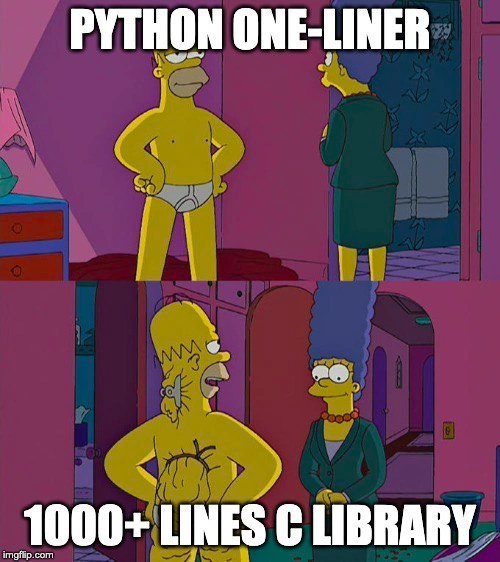
That’s exactly what this picture is joking about with computer code. The front of Homer Simpson, looking confident in one panel, is like that easy one-button press (or a single line of code that looks very simple). The back of Homer – messy and not so pretty – is like opening up the toy and seeing all the complicated wires and gears (the many lines of code that were hidden). It’s funny because it reminds us of a common feeling: sometimes something seems quick and simple, but only because a lot of hard work was already done out of sight.

Just like a duck gliding smoothly on a pond looks calm, while under the water its feet are paddling like crazy, a short line of code can hide a lot of unseen effort. We laugh because looks can be deceiving – what seems simple on the surface may actually have a lot going on behind it, whether it’s Homer’s hidden side or a tiny bit of code relying on a ton of other code to really work.

Level 2: Small Code, Big Library

This meme jokes about how a tiny piece of Python code can secretly use a huge amount of other code behind the scenes. The top part shows Homer Simpson confidently standing in his underwear labeled “PYTHON ONE-LINER.” That represents a short, simple Python command – something like print(sorted(my_list)) or data = get_data_from_web(). In Python (a popular high-level programming language), you can often do a lot with just one line of code. It feels magical because Python handles the details for you.

But the bottom part of the image reveals the back of Homer labeled “1000+ LINES C LIBRARY.” This is telling us that the reason the Python one-liner works so easily is that it’s relying on a much more complex foundation written in C. C is a lower-level programming language. “Lower-level” means it’s closer to the computer’s hardware and requires writing more steps to do the same thing. So, something you do in one line of Python might take hundreds or thousands of lines in C. In the picture, Homer’s backside is messy and hairy – symbolizing the messy, complicated C code that we usually don’t see when we use the nice Python one-liner.

Let’s break down the idea with a simple example:

  • In Python, you could write a one-liner to, say, find the largest number in a list:
    largest = max([3, 1, 7, 5])  # Python one-liner to get the maximum
    
    This single line max(...) is very neat. But behind it, the Python interpreter is calling a function (probably written in C) that goes through each number to find the largest. If we did that manually in C, it might look like this:
    int numbers[] = {3, 1, 7, 5};
    int largest = numbers[0];
    for (int i = 1; i < 4; ++i) {
        if (numbers[i] > largest) {
            largest = numbers[i];
        }
    }
    // 'largest' now holds the max value, 7
    
    That C code is more verbose (longer) and “closer to the metal.” Python was calling something similar under the hood anyway! The meme is poking fun at this contrast.

What is a library? In programming, a library is a collection of pre-written code that you can use so you don’t have to write it all yourself. Python has lots of libraries, and many of them (like numpy for math or PIL for images) are actually written in C for speed. When you do import numpy and then use a one-liner like numpy.sum(my_array), Python is quickly handing off that work to the C code in NumPy. That C code is much faster and longer, but you never see it directly – you just see the result in Python.

Dependencies: A dependency is just a fancy word for “something your code needs to work.” If your Python one-liner uses NumPy, then NumPy (and its C code) is a dependency of your program. The meme highlights how a simple script might depend on a huge codebase. This can sometimes lead to what developers jokingly call “dependency hell” – that situation where your project has so many libraries and layers that it becomes tricky to manage. For example, an innocuous one-liner might require installing a heavy C library on your system, and if something goes wrong with that library, your one line of Python won’t run. It’s both amazing and a little daunting that such a small piece of Python can pull in a lot of other code.

High-level vs Low-level: Python is high-level, meaning it’s designed to be easy for humans to read and write. C is low-level, meaning it’s closer to how the machine actually processes instructions (you have to manage memory and tell the computer exactly what to do step by step). High-level languages like Python often sacrifice a bit of performance in exchange for convenience. To win back speed, they use low-level implementations internally. That’s why many Python libraries are written in C: you get the ease of Python syntax with the speed of C code. It’s a best-of-both-worlds scenario – but it also creates the funny visual of a tiny bit of Python code riding on top of a mountain of C code.

In summary, the meme is showing a truth in programming: simple-looking code can hide a lot of complexity. That Python one-liner you’re proud of? It might be quietly running an entire engine built with thousands of lines of C. As a newer developer, it’s a reminder not to be fooled by appearances. It’s great that you can do so much with high-level languages, but always remember there’s more code (written by other people) working behind the scenes to make that “magic” happen!

Level 3: The Ugly Underbelly

At first glance, that Python one-liner stands tall and proud like Homer Simpson showing off from the front. It’s sleek, confident, and deceptively simple. But the punchline comes when Homer turns around, revealing a hairy, lumpy backside labeled “1000+ lines C library.” This is a witty take on code abstraction – how a high-level language like Python can hide a ton of low-level complexity under the hood. Seasoned developers recognize this instantly: that neat one-liner is probably calling into a compiled C extension or a heavy library dependency. In other words, you wrote one line, but you’re standing on the shoulders of thousands of lines of low-level C code.

In practice, this scenario plays out whenever we use Python’s powerful libraries or built-ins. For example, calling re.findall(pattern, text) in Python might feel like a quick regex one-liner, but behind the scenes there’s a decades-old C regex engine doing the heavy lifting (with hundreds of lines handling all the edge cases and performance tricks). Likewise, doing dataframe.sum() in pandas looks clean, but internally it might invoke highly-optimized C/C++ loops. This contrast between the clean front-end (Python syntax) and the messy back-end (C implementation) is exactly what the meme humorously exposes, much like Homer’s front vs. back pose.

Why is this funny to experienced devs? It’s the “sleight of hand” we’ve all seen in modern programming:

  • Abstraction’s Double-Edged Sword: High-level languages (Python, JavaScript, Ruby) let us accomplish complex tasks in few lines by abstracting away details. But that abstraction doesn’t eliminate complexity; it merely hides it in frameworks and libraries. The meme nails this by showing the polished facade versus the ugly truth behind it.
  • Dependency Irony: We often brag “I solved it in one line!” while omitting “…plus a 10MB dependency.” It’s a gentle jab at software bloat and dependency hell: your simple script might drag in a huge binary or require compiling a C library under the hood. Homer’s back embodies that unwieldy bulk we prefer not to think about when copy-pasting that pip install command.
  • Language Comparison: This is a classic Python vs C situation. Python is a high-level interpreted language known for concise syntax. C is a low-level programming language known for efficiency and verbosity. The humor comes from Python taking credit for power that actually comes from C. It’s as if Python is striking a superhero pose (like Homer’s chest-out stance) saying “look what I can do,” while C is the unsung sidekick doing the grunt work (the hairy back). In the world of CodeQuality, Python shines for brevity and readability, but here we’re reminded that it often achieves that by leveraging robust, lower-level code.
  • Shared Industry Experience: Any programmer who’s peeked beneath the covers of a high-level library has had a “Homer turning around” moment. Maybe you happily used a one-line framework.optimize() call, then opened the GitHub repo out of curiosity and went “D’oh!” at the thousands of lines of C/C++ and even assembly implementing that “magic.” This meme hits that shared memory, prompting a knowing, slightly nervous laugh – we’ve all been Homer, showing off the front while hiding the hairy back.

In essence, the meme playfully highlights a core Code Abstraction Principle: “All abstractions are leaky.” Your Python code might feel far removed from the machine, but eventually, reality (and C code) leaks through – whether in the form of a segmentation fault from a C extension or simply the need to install a platform-specific wheel for that one-liner to work. It’s a funny reminder that simplicity at the surface often relies on complexity underneath. Seasoned devs find this hilarious and true: elegant Pythonic interfaces frequently wrap old, battle-tested C libraries (written by folks who probably have some war stories of their own). Just like Homer’s tidy front vs. messy backside, our high-level code can only stay pretty because someone else’s code is handling the ugly parts out of sight.

Description

A two-panel meme using the 'Homer Simpson's Back Fat' format from The Simpsons. In the top panel, Homer Simpson is seen from the front, looking relatively normal in his underwear, with the caption 'PYTHON ONE-LINER'. This represents the clean, simple, and concise nature of a high-level Python command. The bottom panel shifts the perspective to show Homer's back, which is a mess of flab held together by numerous clips and clamps. This panel is captioned '1000+ LINES C LIBRARY'. The meme humorously illustrates the concept of abstraction in software, where the simplicity of a high-level language like Python often masks the immense complexity of the underlying, performance-critical libraries written in lower-level languages like C

Comments

7
Anonymous ★ Top Pick That elegant Python one-liner is doing the programming equivalent of ordering takeout. Meanwhile, the C library is in the kitchen, butchering the cow and hand-milling the flour
  1. Anonymous ★ Top Pick

    That elegant Python one-liner is doing the programming equivalent of ordering takeout. Meanwhile, the C library is in the kitchen, butchering the cow and hand-milling the flour

  2. Anonymous

    Python one-liner in PR: “Elegant, self-documenting!” SRE skims the flamegraph: “Cool - our ‘hello world’ now depends on a 2004 C module with a CVS merge conflict comment and its own malloc.”

  3. Anonymous

    Writing `df.groupby().agg()` in a design review: "Look how clean our analytics pipeline is!" Meanwhile, pandas is frantically malloc'ing like it's Black Friday at a memory store

  4. Anonymous

    This perfectly captures the moment a senior engineer realizes their elegant `import numpy as np` one-liner is actually invoking thousands of lines of highly optimized C code, BLAS routines, and decades of numerical computing research. It's the programming equivalent of ordering a simple coffee and discovering an entire supply chain, roasting facility, and agricultural ecosystem behind it. Python gives you the abstraction; C gives you the performance. The real skill is knowing when to appreciate the magic and when to peek behind the curtain - usually right before that performance review where you need to explain why your 'simple Python script' needs 64GB of RAM

  5. Anonymous

    Abstraction win: 1 LOC in Python, +1200 LOC in C, +3 build scripts in CI - only the first shows up in your PR size metric

  6. Anonymous

    Python one-liner: np.dot(a, b). Underneath: a thousand lines of C/Fortran; when prod segfaults, the stack trace starts in Python and ends at libblas.so - suddenly you’re a systems engineer again

  7. Anonymous

    Python one-liner: elegant bliss. C library: a 1000-line novel where Chapter 1 is just '#include <stdlib.h>'

Use J and K for navigation