Skip to content
DevMeme
586 of 7435
Escaping Area 51 with Forbidden C++ Knowledge
Languages Post #670, on Sep 17, 2019 in TG

Escaping Area 51 with Forbidden C++ Knowledge

Why is this Languages meme funny?

Level 1: Secret Plus One

Imagine you heard about a super-secret new toy that’s even cooler than the coolest toy you have. Let’s say everyone loves the game console PlayBox 5, but you find out there’s a hidden PlayBox 6 that nobody else knows about, locked away in a high-security lab. In this meme’s story, a person (like a sneaky kid 😃) somehow sneaks into a secret base and grabs that next-level toy, then bolts out the door. Now picture the alarm going off and a guard chasing after them, yelling “Stop! Give that back!” It’s a funny, crazy chase scene – kind of like a cartoon where one character steals something super valuable (maybe a pie from a windowsill or a special gadget) and the authority figure is running to catch them.

The “toy” in this meme isn’t a real toy at all, but something only computer folks care about – a new programming language that’s supposedly one step better than the best one they have now. You might not know what that is, but think of it like a secret recipe or a magic card that grown-up programmers would love to get. The reason it’s funny is because it’s so exaggerated and silly. Normally, you can’t hold a programming language in your hand and run away with it, and nobody would send riot police after you for learning some new code! But here we pretend it’s this ultra-special thing, so important that it’s kept with the aliens at Area 51. It’s like a game of make-believe: “I’ve got the precious thing and you can’t catch me!” Seeing the person run with a big grin, clutching that secret, while a guard desperately chases them, gives us a goofy sense of excitement. It’s the same kind of laugh you’d get from watching a kid steal a cookie from the cookie jar and the parent playfully chasing them around the kitchen. The meme is basically a big, nerdy wink – imagining a world where a tiny “plus” upgrade is a priceless treasure and running away with it makes you feel like the ultimate clever trickster.

Level 2: One More Plus

Let’s break this down in simpler terms. First, C and C++ are programming languages. C (created in the early 1970s) is a very influential language used to build things like operating systems, embedded systems, and other programs where you need to be close to the computer’s hardware. It’s powerful and fast, but fairly low-level (you manage a lot of details yourself). C++ came later (1980s) as an extension of C. In fact, its original name was “C with Classes” because it added the concept of classes and objects (the basis of object-oriented programming) on top of C. Later it was nicknamed C++ as a pun: in the C syntax, count++ means “add one to count”. So C++ literally implies “C + 1”, an incremented version of C. This naming is a bit of CodingHumor in itself that became official! C++ kept almost everything from C but added lots of new features over time (like richer standard libraries, templates, exceptions, etc.), so you can think of it as C but with more capabilities (and complexity).

Now, what on earth is C+? Here’s the catch: there is no real C+ language used in programming – it’s made up for the joke. The meme imagines a secret upgrade beyond C++. If one plus + made C into C++, maybe another plus (or some kind of plus) gives you an even more advanced language. In reality, the next steps after C++ took different names. For example, C# (C Sharp) by Microsoft was a new language inspired by C++ and Java, and funnily, the # symbol can be seen as four plus signs arranged in a grid. There’s also a language called D which cheekily is like “the next letter after C,” implying a successor. But none of these are called “C+”. The meme’s C+ is a purely fictional concept meant to exaggerate the idea of version increment. It’s like saying, “We had C (good), then C++ (better)… hey, what if there’s something even better that we skipped, called C+?” It’s intentionally a bit confusing because normally you’d think C+ (one plus) sounds less than C++ (two pluses). But the meme implies this C+ is an upgrade – maybe a government-secret super-language that outshines C++ in performance or ease of use.

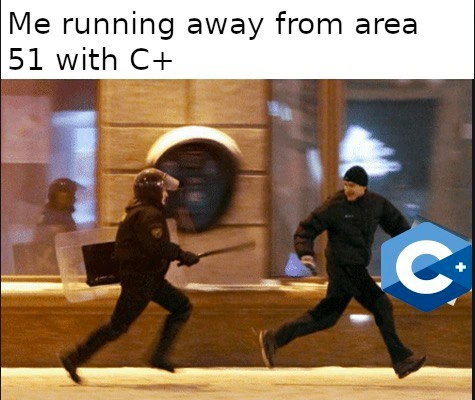
The setting is Area 51, which is a real high-security Air Force base in Nevada, famous in pop culture for alien conspiracy theories. People joke that Area 51 holds all the crazy advanced tech (like UFOs or alien inventions) that the public isn’t allowed to see. In mid-2019, there was an Internet meme and joke event about “storming Area 51” – a bunch of folks online jokingly planned to run into the base to “see them aliens,” and it spawned countless memes. One popular meme format was: “Me leaving Area 51 with <X>”, where X is some coveted, outrageous thing you’d hypothetically find inside. For example, people joked about leaving Area 51 with a pet alien, with a lightsaber, with futuristic weapons, etc. The meme we’re analyzing is exactly that format but tailor-made for programmers. It says “Me running away from Area 51 with C+,” meaning the poster imagines they broke in and stole a new programming language so advanced it’s been kept secret from the public. The image of the guy running with the C+ logo and a riot officer chasing him is a humorous visualization. It’s basically a nerdy running_away_meme: the developer has snagged forbidden tech and is making a run for it, with the “authorities” in hot pursuit to take it back.

For a junior developer or someone new to coding, the funny part comes from understanding a few things:

  • Naming and “++”: In programming, ++ is an operator that increases a number by one. For instance:

    int x = 5;
    x++;
    // now x is 6, because x++ means x = x + 1
    

    So when a language is called C++, it’s like saying “C plus one.” It signals that C++ is built on C but adds more. This is a quirky naming convention – most languages or software use version numbers (like 2.0, 3.0) or dates, but here it’s an inside joke turned official name. So if you get that ++ means one step up, the idea of C+ is playful because it’s as if someone made a half-step or an alternate step. It’s not an official progression (nobody released a “C+”), which is exactly why it’s funny to pretend it exists secretly.

  • You can’t normally “steal” a language: Programming languages aren’t physical objects; they’re collections of ideas, syntax rules, and usually an implementation (like a compiler). If a new language exists, people publish it or open-source it – they don’t lock it in a vault. So the meme is being absurd on purpose. Stealing C+ from Area 51 is like saying you physically took the only copy of this ultra-advanced code. It’s a goofy concept – normally if you discovered a new language, you’d just copy the files or share the specification, not run down the street with it under your arm! This exaggeration is what makes it CodingHumor: it mixes how non-technical folks imagine secrets (you steal a device or a blueprint) with something very technical (a programming language spec).

  • Area 51 guard chasing: The officer chasing the runner signifies how forbidden this imaginary C+ must be. It’s as if the government REALLY doesn’t want anyone to have this “slightly better C++.” This adds to the joke: we don’t usually think of programming knowledge as guarded by armed officers. It’s a playful way to say C+ is extremely special or powerful (in make-believe). The image is actually a random real photograph of a riot policeman chasing someone (unrelated to Area 51), but it serves the meme’s story. The runner’s happy smirk (if you look closely) and the fact he’s holding a giant C+ logo make it clear this is all in jest.

  • The constant version one-upmanship: As a new developer, you might notice that tech is always updating. We go from one version of a language or framework to the next (Java 7 to Java 8 to Java 11… Python 2 to Python 3… etc.). In the C/C++ world, C++ itself has updates every few years (C++11, C++14, C++17, C++20, named after the year). There’s a feeling of an arms race – each new version adds features, hopefully making the language better or at least more powerful. The meme takes that to a comical extreme: what if an entirely new language version was such a leap that it’s kept secret by the military? Calling it C+ (just a tiny tweak in the name) jokes that even a small change (one plus sign) could mean a giant secret leap in capability. It’s riffing on the way we name things more than any actual feature. Don’t worry, you didn’t miss a real language release – it’s all made up for fun.

In summary, for a junior audience: this meme is funny because it combines a trending meme format (running out of Area 51 with a stolen secret) and a programmer inside-joke about language names. It personifies an imaginary programming language (C+) as if it were a tangible prize. If you know that C++ is an upgraded C, you’ll grin at the idea of a C+ floating out there. And if you remember the Area 51 hype, you’ll appreciate the absurd scenario of risking it all to grab that “next big thing” in coding. It’s a little bit of geeky wish fulfillment (“if only I could get my hands on the ultimate coding tool!”) wrapped in a silly chase scene.

Level 3: Classified Code Contraband

At the highest complexity, this meme mashes up a niche programming joke with a 2019 pop-culture phenomenon. The image shows a motion-blurred nighttime chase: a riot police officer (shield and baton in hand) sprinting after a civilian who’s clutching a large blue C+ logo. The top caption reads “Me running away from Area 51 with C+”. This references the viral Area 51 raid meme of September 2019 – when thousands joked online about storming the top-secret military base to uncover hidden aliens and technology. In developer circles, the joke is given a TechHumor twist: the precious contraband isn’t an alien gadget, but a mythical programming language upgrade called C+. The humor comes from treating a programming language (an abstract set of instructions) as a physical treasure so special that it’s guarded in Area 51. It’s DeveloperHumor gold: combining a mainstream meme template (outrunning authorities with stolen secrets) with an inside joke about programming LanguageQuirks and version names.

Why C+? For seasoned coders, the very notion is a tongue-in-cheek incremental language version joke. We all know C++ as the popular systems programming language that evolved from C. In C++ (and many languages), the ++ operator literally means “add one to a number.” Naming a language C++ was itself a playful nod by its creator (Bjarne Stroustrup) meaning “the next iteration of C.” So, seeing C+ implies “one level beyond C++”, as if we took C’s evolution even further by adding one more plus. It’s absurd and delightful at the same time. There is no real C+ language – that’s the point. It’s a satirical dig at the constant arms race of programming languages where each new version or paradigm tries to one-up the last. Developers often joke about “what comes after C++? C#? D? Maybe C++++?” Here, Area 51 is cast as the secret vault of ultimate tech, so advanced that even programming languages have classified upgrades. The meme suggests that C+ is so powerful or coveted that the only way to obtain it is to literally steal it from a government facility protected by riot police. It’s a perfectly ridiculous scenario that lampoons how we dramatize new tech.

For experienced developers, this hits a funny bone because it echoes real trends in language development and hype. There’s always chatter about the next big thing to replace C++ – whether it’s D, Rust, Go, or something totally new – but none of those have the cheeky naming continuity of just adding a plus. The meme exaggerates this LanguageComparison by pretending the ultimate successor is simply “C with one extra plus.” It’s poking fun at how naming conventions work in our field. (Fun fact: There actually is a language called C# (“C sharp”), and the # symbol can be viewed as two vertical and two horizontal plus signs – essentially C++++. Yes, the naming of C# was partially a play on having more pluses without literally writing more + characters!) By presenting C+ as a top-secret prize, the meme also satirizes how developers lust after new features or performance boosts. It’s as if C++ wasn’t enough – we need that extra “+” for ultimate greatness. Seasoned coders will recall endless debates on C++ vs other languages, the massive complexity of C++ standards (templates, undefined behaviors, oh my!), and how every new C++17/C++20 standard feels like Christmas for some and a headache for others. The idea that somewhere a better, streamlined, or more powerful C+ exists (maybe given to us by aliens 😜) is a humorous reflection of those yearnings.

Even the imagery contributes to the joke’s depth. The fleeing man’s hand is edited to carry a blue hexagon logo that resembles the official C++ logo but with one plus missing – a visual Easter egg for insiders. It makes C+ look “official,” as if it’s a tangible product like a file or device. The riot officer in pursuit heightens the absurdity: picture the C++ standards committee or the programming language police chasing down a rogue developer who grabbed the forbidden prototype of a new language standard. It’s an exaggerated metaphor for how tightly some innovations are guarded or how dramatic tech hype can feel. In reality, programming languages aren’t stolen from bunkers; they’re created via years of research and community discussion. But by framing it as a high-stakes heist, the meme humorously acknowledges the almost fanatical excitement (and maybe conspiracy-level secrecy) that can surround revolutionary tech advances. Older devs might also chuckle remembering other version-naming jokes (like “++” being literally in the name, or jokes about Java 2 vs Java++ that never was). It’s a little wink at the LanguageQuirks of our industry: sometimes the only difference between mundane and cutting-edge is a plus sign 😉. In sum, at this senior level, the meme cleverly plays on the culture of continuous improvement in programming languages, the whimsical naming conventions we’ve adopted, and the shared fantasy that somewhere out there is a magic upgrade (be it C+ or some other holy grail of code) that we’d drive to the desert at midnight to obtain. The humor lands because it’s both ridiculous in literal terms and sharply on-point as an exaggeration of developer life.

Description

A meme referencing the 2019 'Storm Area 51' internet phenomenon. The image depicts a man in black clothing running frantically away from a riot police officer who is in pursuit with a baton. The C++ language logo is superimposed over the running man. The caption at the top reads, 'Me running away from area 51 with C++'. The humor comes from the idea that the most valuable, secret, or dangerous alien technology one could steal from the secretive Area 51 base is the C++ programming language itself. This joke resonates with senior developers who understand C++'s reputation for being incredibly powerful but also notoriously complex, difficult to master, and fraught with potential for dangerous errors like memory leaks and segmentation faults

Comments

7
Anonymous ★ Top Pick The real secret of Area 51 isn't aliens; it's the forbidden knowledge of how to compile a C++ project on the first try without a single linker error
  1. Anonymous ★ Top Pick

    The real secret of Area 51 isn't aliens; it's the forbidden knowledge of how to compile a C++ project on the first try without a single linker error

  2. Anonymous

    Grabbed “C+” from Area 51 - now the ISO committee’s sprinting after me yelling, “You can’t just skip 17 years of bikeshedding and ship sane defaults!”

  3. Anonymous

    After 15 years in the industry, I've finally discovered where they keep the documentation that explains why C++ template error messages are 500 lines long - turns out it's classified at the same level as alien technology

  4. Anonymous

    After 20 years of C++, you're not running away from Area 51 with the language itself - you're fleeing with the forbidden knowledge of why `delete[]` exists separately from `delete`, why move semantics seemed like a good idea at 3 AM during the C++11 committee meeting, and the dark truth that 'undefined behavior' isn't a bug, it's a feature that keeps junior developers humble and senior developers employed

  5. Anonymous

    C+: the classified fork of C++ where UB throws, templates compile before lunch, and the ABI is stable - no wonder they’re chasing me

  6. Anonymous

    Classic off-by-one: stole a '+', turned C++ into C+, and now ASan is the riot cop while UB is my getaway car

  7. Anonymous

    C++ PRs: Armored in templates so dense, reviewers hit escape velocity before spotting the UB

Use J and K for navigation