Skip to content
DevMeme
588 of 7435
JavaScript Frameworks and the Pace of Evolution
Frameworks Post #672, on Sep 18, 2019 in TG

JavaScript Frameworks and the Pace of Evolution

Why is this Frameworks meme funny?

Level 1: Can’t Keep Up

Imagine you just learned all the rules to your favorite game, and you’re really good at it. But then, every week, the game makers add a bunch of new rules and change how the game works. Even the best players and coaches would be scratching their heads and checking the rulebook each time, right? That’s what this joke is about, but with building websites. There are these things called JavaScript frameworks which are like big sets of instructions and tools to help make websites and apps. New ones come out so often that even expert programmers feel like, “Whoa, I have to look this up, I’ve never seen this one before!” The meme says that if people grew new body parts every other day (which is a silly idea), even doctors would have to pull out a book or phone and search for what the heck this new organ does. It’s funny because we expect doctors to know every part of the human body by heart. In the same way, we often expect computer experts to know every new tool or framework. But when new tools pop up constantly, nobody can know them all off the top of their head. So even the experts end up Googling for answers. The heart of the joke is that things in tech change so fast that everyone has to keep learning all the time — even the pros. And it’s a little comforting and comedic to realize that feeling lost sometimes isn’t just you being inexperienced; it’s that the “rules of the game” are changing nonstop, and even the gurus are flipping through the manual along with you.

Level 2: Framework Fatigue

JavaScript frameworks are tools or libraries that provide ready-made structure and components for building web applications. For a newcomer, think of a framework as a set of pre-built Lego blocks and rules that help you construct a website or app without starting from scratch. Examples of popular frontend frameworks (past and present) include Angular, React, Vue.js, Ember, and many more. Each framework has its own style and philosophy: for instance, Angular (originally AngularJS for version 1.x, then completely revamped in Angular 2+) is a full-featured framework that gave you everything (routing, forms, etc.) out of the box, whereas React is more of a library focusing only on the view/UI layer, relying on additional libraries for things like routing or state management. Because web development challenges are always evolving (how to make sites faster, more interactive, easier to maintain), developers keep inventing new frameworks to solve problems or improve upon older solutions. This leads to the rapid proliferation of frameworks – new ones coming out every year (or even every few months).

Now, framework fatigue is the term used to describe the feeling developers get when they’re exhausted by how frequently they’re expected to learn a new framework. Imagine you just spent months learning React, and you feel pretty good about it, but then suddenly everyone is talking about a new framework like Svelte or a new version of Angular. It can be overwhelming, especially for junior developers, to keep hearing “Oh, you haven’t tried XYZ framework yet?” The meme jokes that the rate of new JavaScript frameworks is so high that it’s like humans growing new organs constantly. Normally, doctors learn all the organs in medical school and those don’t change, right? But if humans evolved new organs all the time (a crazy idea, used for humor), even doctors would have to hit Google to figure out what these new organs are and how they work. In the tech world, that’s exactly what happens to developers: you might be an expert in last year’s framework, but a brand-new one appears and suddenly you’re googling “How do I do routing in NewFramework.js?” or reading docs as if you were a beginner again. This is often light-heartedly accepted as part of developer culture – there’s even a saying that a developer’s job is 90% Googling and 10% writing code. That’s an exaggeration, but it feels true on days when you’re struggling with unfamiliar tech.

The Google-it culture among devs isn’t about being lazy; it’s a survival skill. With so many frameworks and tools, nobody can memorize everything. So being good at quickly searching documentation or finding answers on Stack Overflow is incredibly valuable. This meme’s popularity in the software community (especially on Twitter) comes from every developer instantly recognizing themselves in it. It’s poking fun at the hype-driven nature of frontend development (new framework announcements cause waves of excitement and anxiety) and reminding everyone that even seasoned developers have to continuously learn. For junior developers, the key takeaway is: don’t panic. If you feel like you’re always behind because there’s a new JavaScript framework you haven’t learned, know that everyone else is frantically learning and googling too – even the developers who seem super experienced. The frameworks may change at a dizzying pace, but the fundamentals of programming change much more slowly. Focus on learning the basics (JavaScript itself, and general principles like how web browsers work, or concepts like state and components). Then picking up a new framework becomes easier — it’s just a different flavor built on those fundamentals. And remember, using Google or official docs to figure out a new technology isn’t a sign of weakness; it’s just part of being a developer in an industry obsessed with the latest and greatest tools.

Level 3: Darwinian Development

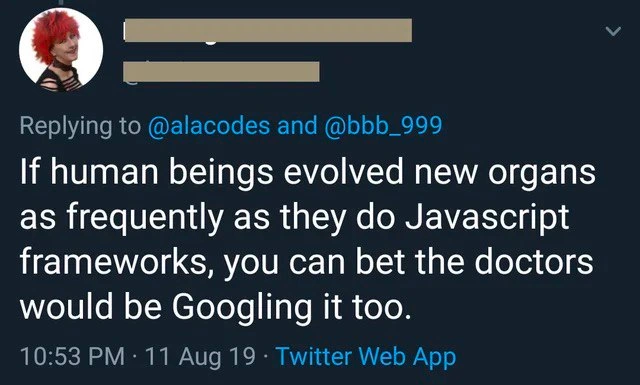
In the fast-paced world of JavaScript frameworks, evolution happens at breakneck speed. This meme wryly observes that new front-end frameworks emerge so frequently that even veteran developers are constantly Googling how the latest one works. The tweet’s analogy compares it to biology: if humans evolved brand new organs as often as JavaScript sprouted new frameworks, then even expert doctors (who normally know the human body inside-out) would be frantically searching online to understand these mysterious new body parts. It’s a clever way of highlighting framework fatigue — developers feel overwhelmed by the proliferation of JavaScript frameworks just like doctors would be overwhelmed if new organs popped up every other week. The humor lands because it’s relatable tech humor: no matter how experienced you are, the onslaught of “yet another JS framework” can make anyone feel like a confused newbie again, resorting to Google for answers.

On a deeper level, this speaks to the framework churn in frontend development. In the last decade, we’ve seen a rapid succession of frameworks: one day it’s Backbone.js and Ember, then AngularJS rules the land, only to be dethroned by React and Vue.js, and now we have newcomers like Svelte and the next shiny tool of the month. Each framework evolves to address shortcomings of its predecessors or to introduce new paradigms (from MVC to virtual DOMs to reactive state). The industry’s hype cycle encourages this quick turnover: developers hop onto the “next big thing” in hopes of better performance, easier development, or simply to ride the latest trend. Hype-driven development can be as chaotic as rapid biological mutation. A seasoned engineer might sarcastically quip that JavaScript frameworks undergo natural selection: only a few survive long-term (like React), while many others become extinct (anyone still building new apps with ExtJS or KnockoutJS?). Industry trends and open-source culture fuel this frenzy — it’s so easy to publish a new library or framework to npm that every few months there’s a new contender for the crown.

From a senior developer’s vantage point, the meme cuts to a painful truth: keeping up with frontend technology feels like an endless race. Just when you’ve mastered one framework’s intricacies, a wild new framework appears (often announced with great fanfare at some conference or on Hacker News). Teams feel pressure to adopt or else risk being “left behind.” This results in real-world dilemmas: Do we rewrite our perfectly working app in the new framework du jour? Do we need to hire new specialists? The FrameworkChurn joke comes with a knowing sigh — many of us have lived through rewrites or have had to learn three different frameworks in as many years. The tweet is basically saying, “Don’t feel bad, even experts would struggle if their field changed this rapidly.” It normalizes the “just Google it” culture in development. In practice, even rockstar devs have Stack Overflow and documentation open daily because no one can memorize every new API or tool that emerges. It’s an open secret in tech: adaptation is more valuable than rote knowledge. So when we see doctors in the meme’s scenario resorting to Google, we laugh in solidarity; even the pros would be searching under such absurdly fast evolution. The meme brilliantly captures the absurdity and exhaustion of modern web development, where survival belongs not necessarily to the “fittest” but to the most adaptable (or as the joke implies, the best at Googling). In short, this tweet-driven gag highlights a core truth of our industry: the FrontendFrameworks landscape changes so often that staying current can feel like biological warfare — evolve or risk becoming a dinosaur, and don’t worry if you need to search for answers, because everyone else is too.

Description

A screenshot of a tweet from a user with bright red hair. The tweet, posted on August 11, 2019, reads: "If human beings evolved new organs as frequently as they do Javascript frameworks, you can bet the doctors would be Googling it too." This is a classic piece of developer humor that satirizes the extremely rapid proliferation of JavaScript frameworks in the web development ecosystem. The joke's core is the analogy comparing the overwhelming speed of technological change in frontend development to the slow, biological process of evolution, creating a humorous absurdity that resonates with developers who experience 'framework fatigue' - the feeling of being unable to keep up with the constant stream of new tools

Comments

7
Anonymous ★ Top Pick The half-life of a JavaScript framework is roughly the time it takes to finish its 'Getting Started' tutorial. By then, it's already a legacy system
  1. Anonymous ★ Top Pick

    The half-life of a JavaScript framework is roughly the time it takes to finish its 'Getting Started' tutorial. By then, it's already a legacy system

  2. Anonymous

    Modern frontend work feels like emergency medicine: graft a shiny new React liver onto a jQuery torso, pray the Webpack blood type matches, and hope the patient hits 99.9 % uptime before the next framework mutation

  3. Anonymous

    The only difference between JavaScript frameworks and production incidents is that at least incidents have post-mortems explaining why they shouldn't happen again - meanwhile, we're on our third 'revolutionary' state management library this quarter

  4. Anonymous

    The JavaScript ecosystem has achieved what evolution couldn't in millions of years: making 'survival of the fittest' a weekly event. At this rate, senior developers aren't measured by years of experience, but by how many framework obituaries they've attended. React hooks? That's practically Cambrian era now. The real skill isn't mastering frameworks - it's developing the emotional resilience to watch your production stack become 'legacy' before the sprint retrospective ends

  5. Anonymous

    In JavaScript, the only stable API is Google; everything else is semver theater

  6. Anonymous

    JS frameworks evolve so fast, even our monorepo's git history begs for mercy via force-push

  7. Anonymous

    Frontend is in Darwin-driven mode - by the time the hospital standardizes on kidney.js LTS, nephron‑next ships with new lifecycle hooks and a hydration step that breaks half the body

Use J and K for navigation