Python And Assembly Type Truce
Why is this Languages meme funny?
Level 1: Same Words, Different Reasons
It is funny because Python and Assembly are like two people both saying, "I do not need labels on my boxes." Python says it because the boxes are smart and tell you what is inside when you open them. Assembly says it because the boxes are just boxes, and if you put soup, rocks, or fireworks in one, that is your problem.
Level 2: Types Versus Bytes
A data type tells a program what kind of value something is: an integer, string, boolean, list, pointer, and so on. A type system uses that information to prevent certain mistakes, like adding a number to a date or calling a string as if it were a function. Some languages require declarations such as int count = 3;. That is called static typing when the type is checked before the program runs.
Python is usually described as dynamically typed. You do not write the variable type in advance:
value = 235
value = "now I am text"
The variable name can point to different objects over time, and Python checks whether an operation makes sense while the program runs. That is convenient, but it means some mistakes appear later than they would in a stricter language.
Assembly language is different. It is low-level programming close to the machine instructions. You often specify sizes like byte, word, or dword, but those are storage widths, not rich application-level types. A CPU register does not care whether its bits represent a signed integer, an address, a character, or part of a floating-point value unless the instruction being executed treats them that way. Early-career developers often meet this pain when they first learn that the same raw bits can be interpreted in multiple ways, and the machine will not stop them from choosing the wrong one.
Level 3: Opposite Ends Agree
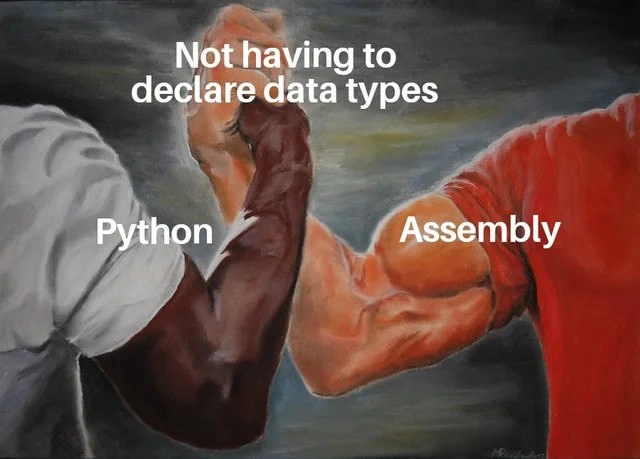
The handshake meme works because the visible labels put two wildly different worlds into the same pose:
Not having to declare data types
On the left is Python, the friendly high-level language where a variable can be bound to an integer now and a string later because the runtime carries type information with the object. On the right is Assembly, where the CPU is not thinking in Python-style values at all. It sees registers, addresses, opcodes, flags, and byte widths. The joke is that both sides can say "I do not declare data types," but they mean almost opposite things.
In Python, not declaring types is an ergonomic feature. The interpreter lets the programmer write x = 235 and move on, because x is a name pointing at an object whose type is known at runtime. In assembly, not declaring high-level types is closer to a survival exercise. The post message, mov word [bx], 0235h, is a perfect little artifact: word tells the assembler the operand width, [bx] points at memory, and 0235h is a hexadecimal immediate value. That is not the same as saying "this variable is an integer" in a type system. It is saying "place this many bits at this address and may the next instruction agree with your life choices."
This is why experienced developers enjoy the LanguageComparison absurdity. Python hides representation so the programmer can focus on behavior; assembly exposes representation so completely that "type" becomes whatever discipline the programmer, assembler, ABI, and hardware convention collectively manage to maintain. One language refuses to burden beginners with declarations. The other refuses to protect anyone from confusing bytes, pointers, signedness, and layout. Same slogan, different blast radius.
Description
The image uses the classic muscular handshake meme format, with two flexed arms clasping hands against a dark painted background. White text above the hands reads "Not having to declare data types," the left arm is labeled "Python," and the right arm is labeled "Assembly." The joke is that Python avoids explicit type declarations through dynamic typing, while assembly avoids them because it operates close to raw registers, memory, and instruction operands rather than high-level language types. It is funny because two languages from opposite ends of the abstraction stack share a surface trait for almost completely opposite ergonomic reasons.
Comments
15Comment deleted
Python skips type declarations to be friendly; assembly skips them because every byte is your problem now.
Its funny how modern coders doesn't know a type named "word", which represents a 2 bytes positive number. Comment deleted
it's funny how modern coders don't know that what a "word" is depends on the architecture Comment deleted
In what exactly architecture "word" is not a type? Comment deleted
no, I mean a "word" isn't always 2 bytes big - it depends on the cpu architecture (although most modern ones do have 2 byte - sized words afaik) Comment deleted
Ahh, i see. Comment deleted
Arguably, in the i386 arch, a word is actually 32 bits, although it is called dword "for backward compatibility reasons" ) Comment deleted
I mean, I guess that's correct, aye. We were talking about the data-type word in C though, and afaik that's always 2 bytes in all x86 derivatives Comment deleted
C does not have a "word" data type. I would say "int" is the closest to the "machine word" concept you imply. Comment deleted
it doesn't? my bad, I'm not a C coder - I'm barely able to read C code. Comment deleted
And it's even more funny modern coders rarely know that the standard allows "char" to be, say, 4 bytes. Comment deleted
it's also funny how java defines 'char' as an UTF-16 codepoint, making ascii storage as chars impractical. Also they're used like signed 16-bit numbers in calculations. signed. did I say funny? I meant sad. Also the official javadocs (links) say "The char data type is a single 16-bit Unicode character, […]" - why is this weird? The Unicode standard deliberately doesn't use the word 'character' because of its ambiguity - they only use code unit, codepoint, grapheme and glyph afaik Comment deleted
Funny I first learned about word/dword before I learned to program due to CheatEngine haha Comment deleted
js: am i a joke? Comment deleted
Yes. Comment deleted