Skip to content
DevMeme
3592 of 7435
The Unread Gospel: Release Notes
Documentation Post #3929, on Nov 14, 2021 in TG

The Unread Gospel: Release Notes

Why is this Documentation meme funny?

Level 1: Always Read the Instructions

Imagine you got a new LEGO set or a cool remote-control toy. Instead of reading the little instruction booklet that comes with it, you just start putting it together or turning it on right away. Pretty soon, the car you're building is missing a wheel and doesn't drive straight, or the toy isn't working right because you put a part in the wrong place. Then you finally look at the instructions and realize there was a clear step-by-step guide you ignored. You'd probably slap your forehead and say, "Oops, I should have read that first!"

This meme is making the same point, but for computer software. The release notes are like the instruction booklet for a new update. If you read them before you do the update, you'll know how to do it correctly and avoid messing things up. In simple terms, it's telling developers that a few minutes of reading the instructions can save them from a lot of trouble later on. It's funny because it’s so obvious – just like knowing you should read the directions – yet people often skip it and then chaos ensues. The meme is basically Lisa Simpson standing there, reminding everyone: "See? If you just read the instructions, everything would be fine."

Level 2: Release Notes Realities

For a newer developer, this meme is a friendly reminder wrapped in a joke: always read the release notes before you upgrade or deploy software. Let's unpack the key terms and ideas:

  • Release Notes: These are the official lists of changes, improvements, and known issues that come with a new version of software. Think of it as a document saying what's new in version 2.3.1 of a library or app. It usually highlights any steps you might need to take when upgrading, such as changing a configuration, updating how you call a function, or being aware of new features/bugs. It's basically the software's "what changed and how to deal with it" guide.
  • Skipping the notes: The meme implies that many developers don’t bother reading these updates. When they skip them, they can miss critical information. It's like jumping into a new game or gadget without reading any instructions. The result? Surprises. In the meme text, "Many issues can be avoided if you just read the Release Notes" means a lot of errors and bugs that happen after an update are totally preventable. If the team had just read the documentation ahead of time, they would have known what to adjust or watch out for, and those issues wouldn't occur.
  • Post-deploy chaos: "Deploying" means putting new code or a new version of an app into a live environment (production) or at least into a testing environment. Post-deploy chaos refers to everything going wrong right after a deployment. Imagine pushing an update to your website and then nothing works as expected – pages are crashing, features are broken, alarms are going off. That's chaos after deployment. The meme jokes that such chaos often happens because someone missed reading the part of the release notes that said "By the way, you must change X setting or update Y dependency for this version." In other words, chaos comes from not knowing what changed.
  • Integration problems: This means different parts of a system (or different systems) aren't working together smoothly. For example, say you update a service that other services rely on, and that update changed how they communicate (maybe the data format or an API endpoint). Now the other services don't understand the responses or requests – things start failing because the pieces no longer fit. These are integration issues. Release notes usually warn about such changes ("We've changed the API contract; update your calls accordingly..."), so if you don't read them, you only discover the problem when things break and systems can't talk to each other.
  • Support tickets: In a professional setting, a support ticket is basically a user-reported problem or an internal bug report saying "Hey, X is not working after the update!" So when the meme talks about avoiding issues, it also implies fewer angry calls and bug reports after a release. If users or other teams don’t notice any breakage, they won’t file tickets for developers to fix. Reading release notes ahead of time helps you deploy in a way that doesn’t trigger all those problems (for example, by doing required configuration changes or data migrations first), so the users never experience a glitch to report.

For example, consider a library upgrade scenario. Suppose a library you use releases a new version, and the release notes clearly say: "Removed function old_method(). Use new_method(param) instead." If you didn't read that notice and just upgraded blindly, your code might still call old_method(), and then things blow up. It would look like this in code:

# Before updating (using v4.0 of the library):
result = library.old_method(42)

# After updating to v5.0 of the library:
result = library.old_method(42)
# Boom! This line will error out in v5.0,
# because old_method() was removed (exactly as the release notes warned).

When that error happens, you'll realize the library did warn you about this change in the release notes. The meme is basically saying: don't let that happen to you. Read those notes beforehand and you can avoid this nasty surprise.

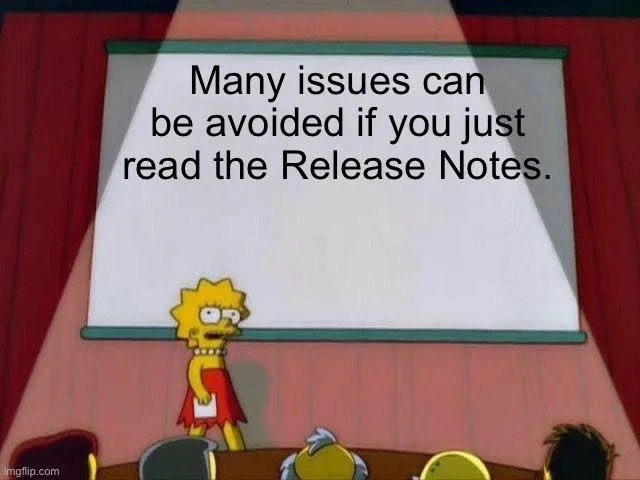
Now, about the image itself: it uses the popular Lisa Simpson giving a presentation meme template. In the picture, Lisa Simpson (a character from The Simpsons) is on stage pointing to a slide that displays the text of the meme. This format is often used to state a truth or advice in a straightforward, school-projector style. Lisa is often portrayed as the voice of reason in the show, the one who states the obvious or speaks truth to a clueless crowd. Here, her slide reads, "Many issues can be avoided if you just read the Release Notes." It's as if she's giving a no-nonsense lecture to an audience of developers. The silhouettes of people watching represent us (the developers) who need to hear this advice.

The humor comes from how straightforward the advice is. It's almost too basic — of course you should read the instructions! Yet in real life, a lot of us ignore release notes and then act surprised when things break. It’s a kind of gentle mockery of our own bad habits. In software teams, reading release documentation is considered basic good practice, part of proper release management (the process of handling and communicating software releases). It's similar to reading the instructions before using a new appliance or assembling furniture. When teams practice continuous integration and continuous deployment (CI/CD), they’re updating code and software components all the time. A CI/CD pipeline is like an automated assembly line that builds, tests, and deploys your application. If something in that pipeline fails because of an update, the first question a seasoned engineer will ask is, "Did you read the release notes for that update?" Often the answer is no, and then everyone immediately understands why the failure happened.

There's even a well-known phrase in tech circles: RTFM, which politely stands for "Read The Friendly Manual." It's a tongue-in-cheek way of saying that the answer to your problem is probably already written in the documentation, so you should go read it. This meme is basically a variation of that classic advice (an RTFM, but specifically for release notes). The core message is the same: taking a little time to read the provided docs can save you from a lot of headaches.

So for a junior developer or anyone new to this, the takeaway is clear: whenever you're dealing with updates – whether it's a new library version, a framework upgrade, or deploying a new release of your own app – take a moment to read the release notes or changelog. It might feel like an extra step, but those few minutes of reading can alert you to changes that would otherwise catch you off guard. Think of it as reading the "What's New" or the instruction manual before you start pressing buttons. It’s a simple habit that makes a big difference. As the meme humorously points out, that habit can be the difference between a smooth, boring deployment and a chaotic, hair-on-fire emergency rollout.

Level 3: Changelog or Chaos

At the senior developer level, this meme hits home as a reminder of countless late-night firefights. The slide's text, "Many issues can be avoided if you just read the Release Notes," is basically a polite version of RTFM applied to modern release cycles. Every experienced engineer has war stories: the 3 AM on-call page because an update broke production, only to discover the fix was buried in a release note everyone ignored. It’s a textbook example of how skipping the docs can cause an issue that was completely preventable.

Lisa Simpson, the voice of reason on that stage, represents the frustrated tech lead or ops engineer giving a presentation about process hygiene in a dimly lit all-hands meeting. The humor is that it's an obvious truth that somehow gets ignored sprint after sprint. It's a jab at our industry pattern where brilliant developers will eagerly refactor code or adopt the latest framework but won't spend five minutes reading a version's changelog. We embrace complex CI/CD automation and fancy build pipelines, yet skip basic documentation. The meme is calling out that contradiction, and it’s a hallmark of shared developer humor in dev teams.

In real terms, skipping release notes can cause:

  • Integration hell: The new version of a library jumps from 1.x to 2.0 (a major release) and deprecates an API or changes a data format. Suddenly your microservices can't talk to each other. The deployment fails because you missed the one-liner in the notes about an updated config or a required environment variable rename. That semantic versioning strategy (the major version bump) clearly signaled a breaking change, but it only helps if you actually read the details.
  • Broken builds in CI: Your CI/CD pipeline lights up red. A dependency update introduced a new required step (maybe a database migration or an environment flag). The pipeline didn't magically know that – but the release notes did mention it. Oops.
  • Support ticket storms: After a rushed deploy on Friday (naturally), users flood the support queue with bugs that were actually known issues or expected changes. The Monday post-mortem reveals the team skipped the release notes section that explained the behavior change. Cue the facepalms and urgent hotfixes.

This "Lisa Simpson presentation" format is often used for precisely these obvious yet ignored truths. In The Simpsons, Lisa is the intelligent, rational character trying to convince an oblivious audience – exactly like a senior developer trying to convince a team of devs. The meme’s cynicism comes from the fact that everyone in the audience (the dev team) knows they should read the docs, but they often don't until they're knee-deep in a crisis. We’ve all seen it: the first question after a deploy disaster is, "Did anyone read the release notes?" followed by an awkward silence.

There's an underlying commentary on release management and team culture here. Well-run projects treat release notes as first-class citizens of a deploy, meticulously documenting breaking changes, new features, and fixes. But in fast-paced teams, folks often push upgrades assuming everything is fine. Product managers assume devs read every word of the change log; devs assume "if it was important, someone would have told me." The meme calls out that disconnect. It's saying that communication matters – the release notes are there for a reason. This ties directly into the developer experience (DX): when teams pay attention to clear documentation and actually follow the release guidelines, the daily developer life has fewer fire-fights and panicked rollbacks. In other words, good DX isn't just about fancy tools or frameworks – it's also about not being woken up at 3 AM by an issue a 3-minute read could have prevented.

In fact, the humor here is that something as unglamorous as reading a text file (the release notes) could avert drama that all our high-tech fixes then scramble to solve. It’s a bit of documentation humor mixed with survivor’s wisdom: we laugh because we've all been there. Skipping that boring step (reading the notes) and then acting surprised when things break is a rite of passage in development, albeit a painful one. This gallows humor resonates with seasoned engineers – we chuckle and cringe at the same time, knowing a tiny bit of diligence could have been the difference between a smooth deployment and a weekend in firefighting mode. In essence, this meme is a senior-level PSA wrapped in sarcasm: knowledge is power, and sometimes that knowledge is just sitting in a neglected changelog waiting to save the day.

Description

The meme uses the "Lisa Simpson Presentation" format. Lisa Simpson stands on a stage in front of a large projector screen, presenting a simple, bold statement: "Many issues can be avoided if you just read the Release Notes." The audience is partially visible in the foreground. This meme captures a universal frustration in software development: end-users, and sometimes even other developers, failing to read documentation, leading to preventable problems and unnecessary support overhead. For experienced engineers, it’s a humorous nod to the often-thankless task of writing documentation that goes unread, highlighting a breakdown in communication and a common source of inefficiency in the development lifecycle

Comments

14
Anonymous ★ Top Pick We spend two weeks writing detailed release notes just so users can speedrun creating duplicate bug tickets for issues we already fixed and documented
  1. Anonymous ★ Top Pick

    We spend two weeks writing detailed release notes just so users can speedrun creating duplicate bug tickets for issues we already fixed and documented

  2. Anonymous

    We’ll debate zero-downtime migrations for two weeks, then skim the release notes like a cookie banner and act shocked when the “minor” upgrade drops a breaking schema change

  3. Anonymous

    After 20 years in tech, I've learned that release notes are like terms of service agreements - everyone clicks 'I agree' without reading them, then acts shocked when their production environment catches fire because they missed the part about the deprecated API endpoint that now returns XML instead of JSON

  4. Anonymous

    This is the software equivalent of a surgeon saying 'many complications can be avoided if you just read the patient's chart' - technically true, universally ignored, and the source of 3am production incidents. Senior engineers know that release notes are where framework authors hide the sentence 'we changed the entire authentication flow' between 'fixed typo in README' and 'updated dependencies.' The real tragedy is that we've all been Lisa at some point, earnestly documenting breaking changes in CHANGELOG.md, only to field Slack messages at 2am from someone who upgraded a major version in production without reading that we deprecated the entire API they depend on

  5. Anonymous

    Battle-tested architects know: one skipped release note deprecation warning equals six months of 'mysterious' API drift in prod

  6. Anonymous

    Every SEV-1 I have handled starts with minor upgrade and ends when someone finally reads the release notes: set FEATURE_FLAG_MIGRATION=true before deploy

  7. Anonymous

    SemVer says it’s a patch; the release notes quietly flip a default and schedule your weekend

  8. @ax1lewf 4y

    No, no I don't think I will. I'll better waste few hours googling and then read the Release Notes

  9. @interfejs 4y

    Many issues can be avoided if only developers would write up Release Notes

    1. @TERASKULL 4y

      >*bug fixes and improvements* >*no information from developer* >refuses to elaborate further >leaves

      1. @RiedleroD 4y

        delta dev grindset

        1. @TERASKULL 4y

          oh yea

    2. @qtsmolcat 4y

      Well it's obvious - Bugfixes

  10. @slnt_opp 4y

    World_if_something_works_as_it_should.jpg

Use J and K for navigation