Skip to content
DevMeme
3590 of 7435
The Unseen Art of Infrastructure vs. Viral Trends
Infrastructure Post #3927, on Nov 13, 2021 in TG

The Unseen Art of Infrastructure vs. Viral Trends

Why is this Infrastructure meme funny?

Level 1: Backstage vs Onstage

Imagine a school play where there are two kids with very different jobs. One kid works backstage every day after school, setting up the stage, hanging up the curtains, fixing the lights, and making sure all the props are in the right place. He spends a lot of time making everything perfect so that the play can go smoothly. Another kid just learned a short dance to perform on stage during the play – maybe it took him an afternoon to practice two cool dance moves. Now, when the day of the play comes, the second kid goes onstage, does his two fun dance moves, and the whole crowd claps and cheers for him. He’s the star of the show for those few moments. Meanwhile, the first kid is standing off to the side, unseen, even though without him working hard behind the curtain, the show literally couldn’t happen (there’d be no lights or props!). It feels a bit unfair, right? The hardworking kid did all the important stuff to make sure everything works, but it’s the kid doing the quick shiny dance who gets all the attention and praise. This meme is funny for that exact reason: it’s showing a silly, backwards situation that we recognize in real life. We laugh because we know the “backstage” person deserves some applause too, yet often they don’t get it. The joke highlights how sometimes the people doing the quiet, essential work are overlooked, while those doing something flashy and fun in front of everyone get all the credit. It’s like saying, “See how ridiculous it is that the real hero isn’t noticed?” – and that mix of truth and irony is what makes it amusing.

Level 2: Cables vs Clout

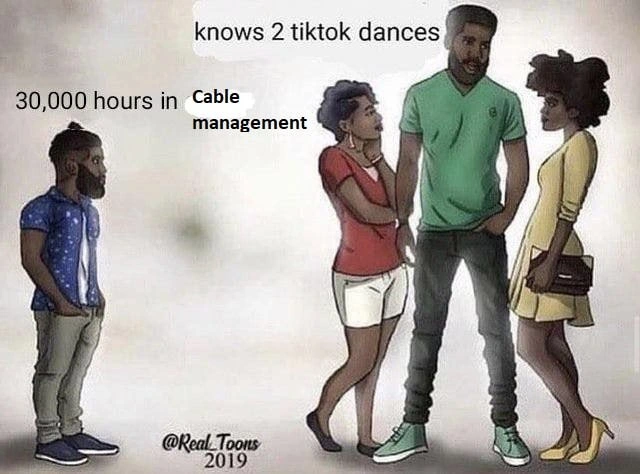
Let’s break down the gist of this meme in simpler terms. On the left side, we have an experienced systems administrator (sysadmin) or network engineer who has spent a huge part of his life doing cable management. Cable management means organizing all the wires in a computing setup so that they’re neat, labeled, and easy to work with. Think of a giant room full of computer servers (that’s a data center): there are hundreds or thousands of cables connecting all the machines – power cables, network (Ethernet) cables, fiber optics, etc. A cable management “veteran” is someone who has painstakingly routed and arranged these cables so they don’t turn into a big tangled mess. They use cable ties or Velcro straps to bundle related wires, color-code them, label each end with tags, and run them along racks in orderly pathways. It’s a slow, careful process that might sound mundane, but it’s crucial for keeping the servers running smoothly. Well-managed cables mean you can replace a server or fix a network issue quickly without pulling on the wrong wire and causing a bigger outage. After tens of thousands of hours doing this, that person is a master of hardware organization – the unsung hero who ensures the backbone of the internet is tidy and reliable. Within IT circles, having nicely managed cables is actually a point of pride (and yes, there are even jokes and humble-brag photos about beautifully arranged server racks). But outside of those circles, most people don’t even know this job exists, let alone give it applause. If a system admin did their job perfectly, you’d never notice anything – your internet, apps, and services would just work. That means these experts often get attention only when things break (and then it’s usually people yelling “Why is the site down?!” rather than “Great job on those cables!”). So the left side of the meme represents a highly skilled, behind-the-scenes tech person, possibly a little shy or not used to the spotlight, whose contributions are important but mostly invisible.

Now, on the right side, we have a guy who “knows 2 TikTok dances.” TikTok is a massively popular social media platform where people share short videos, often doing dances, lip-syncs, or viral challenges. When we say someone “knows 2 TikTok dances,” it implies they’ve learned a couple of the trendy choreographed moves that are circulating online. It’s a lighthearted way to say this person has put in minimal effort or skill (learning two short dances isn’t very hard or time-consuming) yet is somehow getting a lot of attention for it. In the meme drawing, this TikTok dancer is taller, confident, and has two women looking at him admiringly – a classic depiction of social popularity or clout. In internet slang, “clout” means influence, fame, or popularity, especially on social media. So essentially, the right side character has gained social clout (at least in the cartoon scenario) by doing something that’s fun and visible, but not particularly deep in skill. Two dances might take, what, a few hours of practice total? It’s practically nothing compared to the 30,000 hours (which is about 15 years of full-time work!) that the cable guy invested in his expertise. Yet, the joke is that the social reward is completely flipped: the one with decades of substantial skill is overlooked, and the one with a couple of viral tricks is the star of the moment.

For someone newer to tech or this kind of humor, the meme is pointing out a real-life feeling many tech folks have had. The work that infrastructure and hardware people do (setting up servers, running cables, keeping the internet’s plumbing in order) is super important, but it happens behind closed doors in server racks and data centers. It doesn’t make headlines, and it doesn’t usually make you popular at parties. On the other hand, doing something that grabs quick attention – like being good at a trending app or dance – can make you instantly popular, even if it doesn’t contribute much beyond entertainment. It’s a skills vs. popularity contrast. We see a bit of this even in workplaces: for example, the IT support person who keeps everything running might get less credit than the guy who gives a flashy presentation (or the company’s social media marketer who does fun posts). The meme exaggerates it to make it funny: 30,000 hours of deeply useful work = nobody notices; 2 short dances = everyone is impressed. It resonates with junior developers and seasoned engineers alike, because it highlights a truth about human nature and tech culture: people often value what they can see and enjoy immediately more than the important stuff that stays hidden in the background. It’s poking fun at that imbalance in a single, easy-to-get snapshot.

Level 3: Networking vs Networking

This meme pits actual networking (the physical wires and hardware side) against social networking (internet clout from TikTok fame) – and it’s highlighting the absurd gap in recognition between the two. On the left, we have a battle-hardened infrastructure specialist – a guy who’s spent 30,000 hours in cable management. That’s an entire career dedicated to keeping server racks tidy, Ethernet cables labeled, and connections running flawlessly. He’s basically the human embodiment of a well-organized patch panel. On the right, we have someone who “knows 2 TikTok dances,” basking in attention as if he just solved world hunger. Two admiring onlookers fawn over him, while the veteran cable guy stands off to the side, practically invisible despite being the one who makes all our modern digital conveniences possible. It’s a darkly funny commentary on how wildly different society values deep technical skill versus trivial entertainment.

In real terms, the sysadmin on the left has likely untangled nightmare wiring at 3 AM, crawled under raised floors, and perfected the art of routing CAT6 cables with militaristic precision. Proper cable management in a data center is an unsung art form: color-coded wires, neatly velcro-strapped bundles, and meticulously labeled ports. This obsessive organization isn’t just for show – it prevents outages and makes troubleshooting possible. (Ever tried tracing a single cable in a spaghetti mess during an outage? Exactly.) Yet, as crucial as this work is, nobody outside the server room gives a damn until something breaks. The only spotlight this guy sees is the dim glow of a rack-mounted flashlight during a maintenance window. Meanwhile, our TikTok dilettante waltzes in with maybe a few hours of practice in front of a phone camera, and suddenly he’s Mr. Popular. Two dance moves learned = two people swooning – talk about disproportionate return on investment. It’s a classic case of the tech world’s “unsung hero” versus the social media butterfly. We’re laughing (and maybe grimacing) because many of us have felt that sting: the critical work that keeps everything running is virtually invisible infrastructure, appreciated only when neglected, whereas flashy, easy-to-digest fluff gets instant praise.

To put the contrast in a cheeky table:

Person What They’ve Mastered Recognition Received
Veteran Cable Technician (≈30k hours) Decades spent mastering structured cabling – organizing thousands of cables in server racks, optimizing airflow, preventing network disasters before they happen. Vital for keeping the world online, but gets zero glamour. Outside of IT circles, no one says “Wow, those cable bundles are sexy.” Usually noticed only if something goes wrong (and then it’s complaint time).
TikTok Dance Enthusiast (2 dances) Learned two viral choreographies (probably the “Renegade” and whatever was trending last week) and pressed record on a phone. Instantly labeled “cool” and showered with attention. Two onlookers in the meme are practically starry-eyed. Society gives a quick dopamine jackpot for a catchy 15-second clip, no background effort or infrastructure knowledge required.

The humor cuts deep: the attention economy rewards things that are eye-catching and immediate – here, goofy dance videos – while the invisible backbone of technology (like good cabling or solid system administration) lives in the shadows. It’s funny because it’s true. Every seasoned SystemsAdministrator or hardware veteran chuckles at this with a touch of pain: we’ve seen smooth-running systems taken for granted and trivial digital flukes blown out of proportion. This meme basically says, “Here’s the guy literally holding up the internet with zip ties and cable labels, and here’s the guy holding up a phone doing a jig – guess who gets the high-fives?” The answer, depressingly, is not the one with the label maker and the crawling cabling bruises. And as cynical as it is, we can’t help but laugh at how perfectly it captures that reality. After all, without the left-hand guy’s 30,000 hours of work, the right-hand guy’s 15 seconds of fame wouldn’t even stream.

Description

This is a meme using a comic-style illustration. On the left, a man stands alone, looking dejected, with the text '30,000 hours in Cable management' floating above him. On the right, another man is flanked by two admiring women, with the text 'knows 2 tiktok dances' above him. A watermark in the bottom left corner reads '@Real_Toons 2019'. The meme humorously contrasts deep, meticulous, and often invisible technical expertise with superficial, trendy social skills. For senior engineers and infrastructure specialists, it's a relatable commentary on how society often undervalues the immense effort and skill required to maintain the physical layer of technology, while rewarding fleeting, popular trends. It's a nod to all the unseen work that keeps the digital world running
Comments

7
Anonymous ★ Top Pick The guy on the right might get the attention, but the guy on the left is the only one who knows which cable to unplug to take down the TikTok servers
  1. Anonymous ★ Top Pick

    The guy on the right might get the attention, but the guy on the left is the only one who knows which cable to unplug to take down the TikTok servers

  2. Anonymous

    I spent a decade making 10,000 cables look like a single Bézier curve, but the guy who can floss for 15 seconds is suddenly our “customer-experience architect” - guess jitter is only acceptable when it’s on social media

  3. Anonymous

    After 15 years of perfecting cable management, you realize the person who zip-tied everything to the nearest rack post and called it 'agile infrastructure' got promoted to CTO because they gave a TED talk about 'embracing chaos in the datacenter.'

  4. Anonymous

    After three decades of meticulously routing fiber optics through raised floors and managing power distribution in mission-critical datacenters, nothing quite captures the existential dread of modern tech hiring like watching a 22-year-old with 'strong communication skills' and a viral LinkedIn post get the infrastructure architect role you applied for. At least when the entire rack goes down because someone didn't understand proper cable strain relief, you'll know exactly who to blame - and they'll probably make a TikTok about the outage

  5. Anonymous

    Cool kids master 2 TikToks; SREs log 30k hours turning rack spaghetti into CAP-compliant bliss

  6. Anonymous

    Org reality: knows two TikTok dances gets the spotlight; the 30,000-hour cable-management engineer gets us five nines - clean topology beats choreography

  7. Anonymous

    If I rebrand cable management as 'layer-1 observability' and attach a Grafana KPI, does it finally outrank 'knows 2 TikTok dances' in the promo packet?

Use J and K for navigation