On-Call SRE During a 'Minor' Outage
Why is this OnCall ProductionIssues meme funny?
Level 1: Crickets in the Crowd
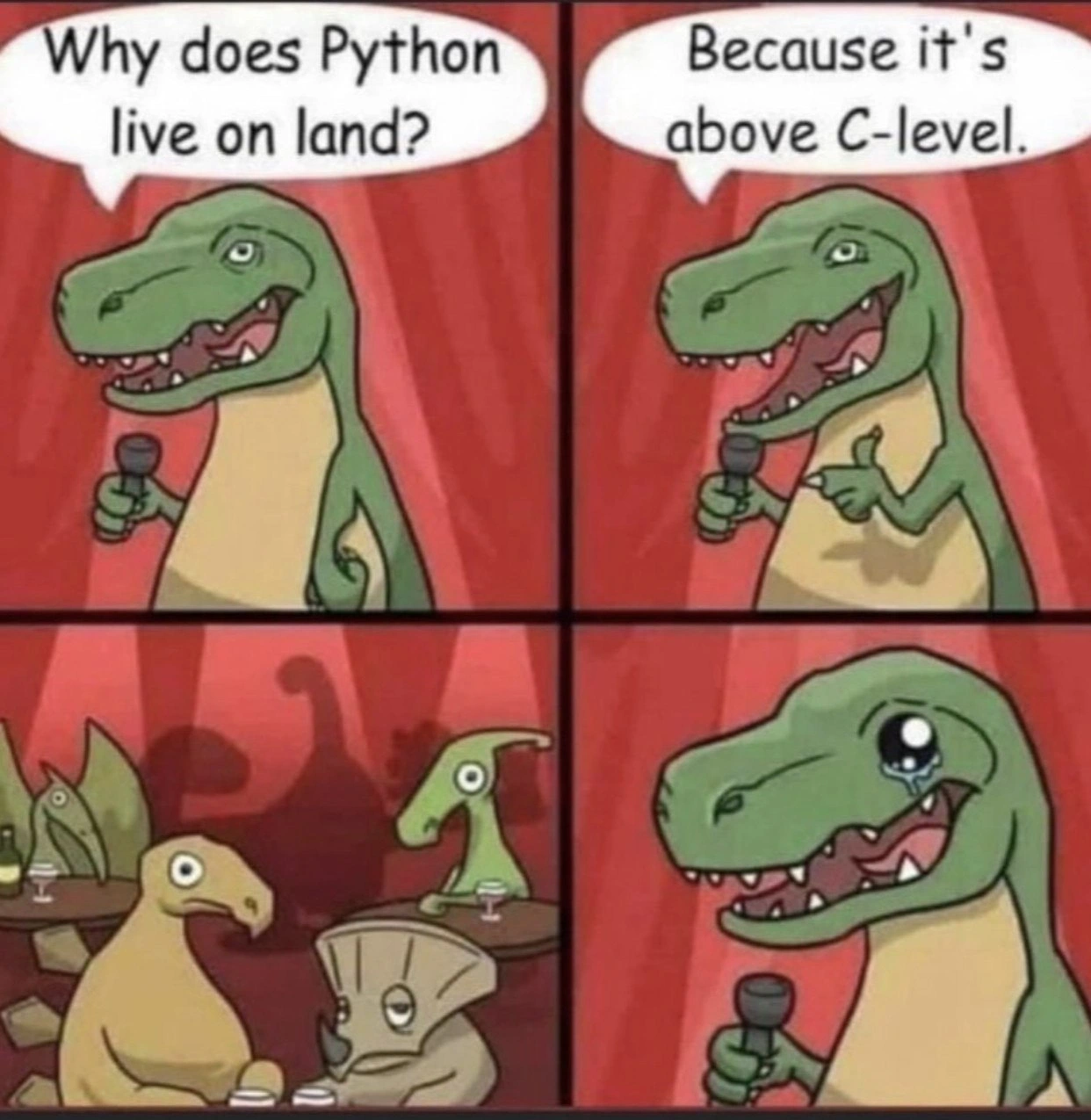
Imagine your dad proudly delivers a corny joke at the dinner table – something like a silly play on words he finds hilarious – but everyone else just sits there in total silence. Dad keeps grinning hopefully, but you can see a tiny tear of embarrassment because nobody laughed. That’s exactly what’s happening in this picture. The green dinosaur tried to tell a pun (a joke with words that sound alike) about Python and C, expecting it to be super funny. But the other dinosaurs in the audience didn’t even chuckle; they just stare with blank faces, like when a joke completely misses the mark. The poor dino on stage is smiling on the outside, but crying a little on the inside (literally, with a tear down his face) because his big joke fell flat. In simple terms: it’s funny and a bit sad, because we’ve all seen someone tell a joke that nobody laughs at. The meme is showing that awkward moment when a joke-teller realizes the joke didn’t work – a clownish dinosaur making a clever-sounding quip, and getting nothing but quiet in return. You feel a mix of second-hand embarrassment and goofiness. Even if you don’t get the tech reference, you can laugh at how badly the joke went over. It’s like telling a dad joke so cheesy that the whole room just goes silent — leaving the jokester to smile through the heartbreak.
Level 2: C-level vs Sea Level
At its core, this cartoon sets up a simple play on words. The dino comedian asks:
“Why does Python live on land?”
“Because it’s above C-level.” 🥁
The joke substitutes “C-level” for the phrase “sea level.” In everyday terms, living above sea level means you’re on land (not underwater). Here “C-level” is a nod to the C programming language (since the letter C is pronounced just like “sea”). So the punchline is saying Python lives on land because it’s above C. This hints that Python is a higher-level language than C. In programming, a high-level language like Python is one that is more abstracted from the computer’s hardware. That means when you write Python code, you don’t have to manage low-level details like memory addresses or manual garbage collection – the language/runtime takes care of those for you. Python code is often described as closer to human language, and you run it with an interpreter (like the program that executes Python code for you).
By contrast, C is considered a lower-level (some say “mid-level”) language. It’s closer to the computer’s machine code. With C, you have to deal with more nitty-gritty details: you manually manage memory (e.g. allocating and freeing memory), use pointers to reference locations in memory, and you must compile your code into an executable program that the machine can run. C doesn’t hand-hold the programmer as much – which gives you more control and performance, but also more responsibility. So in the joke, Python “lives on land” because it operates at a higher level of abstraction (further from the hardware ocean depths 🏝️), whereas C is nearer to the water’s surface at “C-level” (sea level 🌊) in terms of abstraction. It’s a fun way to say Python is above C (literally above it in altitude, figuratively higher-level in design).
Now, why the awkward silence? The last two panels show the audience of fellow dinos not laughing at all. In comedy terms, the joke fell flat. This dinosaur standup_comedy scenario is a goofy mirror of real life moments in tech. The meme highlights HumorInTech that sometimes doesn’t connect: maybe the joke was too corny, or the audience already knew it. In developer circles, people often crack LanguageComparison jokes (pitting one programming language against another). For example, someone might tease that one language is “superior” or make puns about their names – it’s a common type of DeveloperHumor. But not every crowd finds these funny. Here, the silent cartoon audience implies that the other developers have probably heard this exact pun before (“above C-level” has been floating around as a goofy phrase). It’s basically a bad_developer_joke in their eyes – the kind that only gets a polite smirk at best. The poor T-Rex on stage is still smiling, but that single tear indicates he knows the audience_silence means his big joke bombed. We all recognize that “tough crowd” moment. The humor comes from the relatability: even a nerdy, well-intentioned pun can be met with blank stares if it’s old news. In short, Python being a high-level language is a factual concept, and turning that fact into a joke (“above C-level”) is pretty clever – but the meme’s punch is that sometimes clever isn’t enough to get a laugh, especially among dinosaur-aged software veterans. 🦖🎤
Level 3: Altitude of Abstraction
This meme leans into a classic programming_language_pun about language abstraction levels. In the first panels, our T-Rex comedian asks, “Why does Python live on land?” and then smugly delivers the punchline, “Because it’s above C-level.” This is a wordplay on “above sea level” – equating Python being a high-level language to living on land (above the water), while implying C is lower down near the “sea.” Technically speaking, Python operates at a higher level of abstraction than C. In software terms, abstraction level refers to how far removed a language is from raw machine code. Python is a high-level language: it handles lots of details (like memory management and complex data types) for you. C is considered lower-level (closer to the metal, dealing with bytes and pointers directly). So the joke hinges on the idea that Python lives comfortably “above” C in the abstraction hierarchy – above C-level. It’s a clever mashup of a common phrase with insider tech knowledge about high_level_vs_low_level languages.
However, the humor here isn’t just the pun – it’s also the cringe-worthy silence that follows. The third panel reveals an audience of other dinosaurs at their tables, all staring blankly. No applause, no laughter – just audience_silence. This silent treatment is painfully familiar to any developer who’s dropped a cheesy language joke in a room of jaded seniors. The meme is poking fun at that “tough crowd” dynamic in HumorInTech: the dino comic encapsulates how a joke that’s too obvious or overused will land below sea level (i.e., completely flop) with experienced engineers. Seasoned devs have heard every LanguageComparison gag and LanguageWars quip under the sun – so our poor T-Rex gets stone-faced stares instead of laughs. The final panel, with the dino smiling through a tear, perfectly captures the mix of DeveloperHumor and pain: he’s realizing his above C-level zinger was met with deadly silence.
On a deeper level, the meme lightly satirizes the language wars culture. For years, programmers have playfully (and sometimes seriously) debated which language is “better” or more “advanced.” Jokes like this Python-vs-C pun are the kind of low-hanging fruit you see on forums and at meetups. A junior dev might excitedly crack an abstraction joke, only to find senior colleagues rolling their eyes because, well, they’ve been around that block. Python is often praised for being easy to write (thanks to being high-level), while C is respected for being powerful and efficient (closer to hardware). There’s real technical context here: for instance, the main implementation of Python (CPython) is actually written in C. So in one sense, Python literally runs on top of C – it’s “above C” in the software stack! 🐍✨ But in terms of humor, these meta facts don’t always land with a bang on stage; they land with a thud. The meme’s dinosaurs could even be a tongue-in-cheek nod: in tech slang, “dinosaur” can refer to something outdated or an old-timer. Here the audience might symbolically be grizzled veteran devs (ancient beasts of coding) who find the newbie pun prehistoric. They’ve endured so many bad_developer_jokes that one more groaner triggers nothing but a collective unimpressed stare. It’s a funny, relatable scenario for anyone who’s tried to amuse peers with nerdy wordplay only to get NULL feedback. In the end, the meme nails that awkward truth: even a well-crafted tech pun can bomb if the crowd considers it fossilized humor. The concept may be above C-level, but the laughter is below sea level – leaving our dino comic hero to bravely grin through the humiliation.
Description
This meme features the popular 'This is Fine' dog format. A cartoon dog sits in a room that is completely engulfed in flames, calmly sipping from a mug. The dog is labeled 'The on-call SRE,' and the flames are labeled 'cascading failures.' The dog says, 'This is fine.' The meme captures the feeling of surreal calm and helplessness that an on-call engineer experiences during a major production incident. For senior engineers and SREs, it's a deeply relatable depiction of trying to maintain composure and methodically debug a system that is actively collapsing around you, often at 3 AM

Comments
7Comment deleted
That's not a 'production fire'; it's the system's emergent behavior demonstrating self-healing by aggressively purging all the bad data
Sure, Python lives above C-level, but the moment it hits a tight CPU loop the GIL drags it straight back underwater
The joke's cute, but wait until you explain to the junior devs that Python's "above C-level" until you need actual performance, then suddenly everyone's writing C extensions and pretending the GIL doesn't exist
This joke perfectly captures the eternal tension in software engineering: Python developers enjoy their garbage-collected paradise while C programmers manually manage memory like digital janitors. The real irony? Both camps secretly know that 'above C-level' also means Python devs spend less time debugging segfaults and more time debugging why their pip dependencies broke again after a minor version update
Python stays above C-level so it never drowns in dangling pointers - unlike my legacy codebase
Everything’s “above C-level” until the p99 latency starts drowning users - then someone quietly ships a C extension and calls it Python
Python’s “above C-level” until your hot path needs a C extension - then it’s snorkeling with gdb