The Siren Song of a New Framework
Why is this LegacySystems meme funny?
Level 1: Where Do Computers Come From?
Imagine if someone told you a silly story about how new computers are born – like saying a “mommy” computer chip and a bunch of “daddy” resistors get together and somehow a baby computer pops out. 🤖 It’s a totally funny idea because we all know machines aren’t alive, but it paints a cartoon picture that’s easy to laugh at. It’s just like telling a child that babies come from storks or from the birds and bees: it’s a made-up story to explain something really complicated in a simple (and absurd) way. In truth, computers are built by people in factories, not grown from seeds or eggs. But picturing those tiny electronic parts acting like they’re swimming and meeting each other is so goofy and adorable that it makes us smile. The meme is basically a techie joke, pretending for a moment that computer parts have a little life of their own – we laugh because it’s such a crazy make-believe story compared to the real world.
Level 2: Hardware Reproduction 101
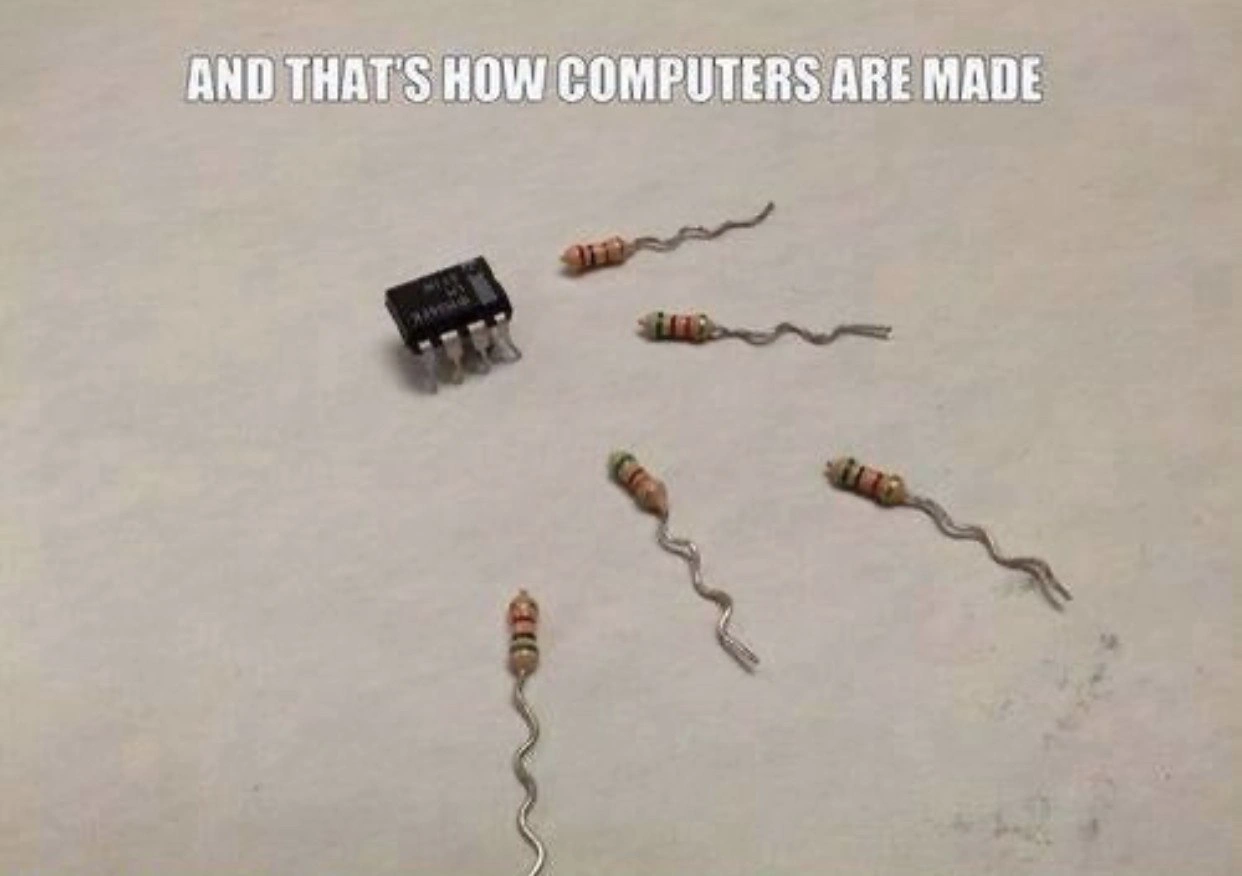
In the picture, we see a tiny black rectangle with metal legs (an IC chip) and a bunch of small tubular pieces with stripes (these are resistors). The IC (short for Integrated Circuit) in an 8-pin DIP package is basically a little electronic device that can perform some function – for example, it could be a timer, a sensor driver, or part of a microcontroller. It has 8 metal pins that would normally plug into a socket or a circuit board, allowing it to connect to other parts of a circuit. The resistors are basic electronic components whose job is to resist or limit electric current. Each resistor here has two long wire legs (leads) and colored bands around the body. Those color stripes aren’t just decoration – they’re a code that tells you the resistor’s value in ohms (which is the unit of resistance). These particular resistors are the old-school through-hole type, meaning their wire leads are meant to go through holes on a printed circuit board and be soldered on the other side. In the meme, someone has bent the resistor leads into a squiggly shape, making them look a bit like tiny sperm cells with wiggling tails.
What’s going on is a play on the phrase “the birds and the bees,” which is a classic way to refer to explaining to children how animals (or humans) have babies. The meme replaces that with a tech twist – you could call it “the birds and the bits.” The black IC is acting like an “egg,” and the five resistors are acting like “sperm” trying to reach it. The caption at the top says, “AND THAT’S HOW COMPUTERS ARE MADE,” mimicking the tone a parent might use after giving a simple explanation of where babies come from (“and that’s how you were born!”). It’s basically saying: this is the secret of how baby computers happen!
Of course, this is all tongue-in-cheek. Computers and chips aren’t actually made by electronic components reproducing like animals. In real life, making a computer involves manufacturing lots of parts in factories and then assembling them, kind of like high-tech Lego pieces, not growing them. An integrated circuit like that black chip is created in a semiconductor fab (a specialized factory with machines that etch tiny circuits on silicon wafers). Once the chips are made, people (or robots) put the chips and resistors together on circuit boards so that the whole thing works as a device. There’s no concept of a “mom” chip and “dad” resistor creating a new baby chip – that’s just a humorous analogy. The meme is funny to engineers because it’s such an oversimplification that it becomes absurd. It imagines electronic parts acting like living creatures in order to parody how someone totally new to electronics might wrongly imagine a computer coming to life. In reality, building even a simple gadget requires careful design and assembly – nothing just magically spawns by sticking parts together without power and a plan! But by presenting it in this goofy way, the meme gets a laugh. It’s basically saying, explaining tech to non-techies can feel like making up a story sometimes. And here, that story is made hilariously literal with resistors as little “swimmers” and a chip as the “egg.”
Level 3: Fabrication Fairy Tale
To a seasoned hardware engineer, this image reads like a cheeky fairy tale about electronics. At first glance we recognize the parts instantly: a black 8-pin DIP chip (a classic Dual In-line Package integrated circuit) sitting there like a tiny electronic “egg,” and five bent resistors with wiggly leads approaching it. These are standard 1/4-watt through-hole resistors – the kind with colored stripes that we’ve soldered onto countless circuit boards. Bending their metal leads into squiggles makes them resemble little tadpoles or sperm cells. The white text caption up top, “AND THAT’S HOW COMPUTERS ARE MADE,” is phrased exactly like the punchline to a parent’s birds-and-bees story. It’s the climax of a whimsical explanation no real engineer would ever give with a straight face. We immediately appreciate the absurd simplification at play.
The humor here comes from anthropomorphizing inert electronic components – basically giving life-like roles to pieces of hardware – in order to parody how non-engineers might imagine technology works. It’s a nerdy twist on the classic “where do babies come from?” lesson, except now it’s “where do computers come from?” Seasoned engineers laugh because we know the semiconductor fabrication process is extraordinarily intricate (involving cleanrooms, lasers, and chemical processes) compared to this silly “five resistors and an IC have a baby” scenario. We’ve spent years learning that you need masks, photolithography, doping, etching, metal deposition, etc., to make even a simple chip. So the idea that a loose resistor could magically swim over and fertilize an integrated circuit is hilariously wrong. It’s the ultimate “if only it were that simple!” moment. If building a new microprocessor was as easy as letting some components get frisky on a workbench, companies wouldn’t be pouring tens of billions into R&D and silicon fabs. Every hardware developer chuckles at the thought: we’d just keep a box of resistors next to a CPU and wait for the stork… err, courier to deliver a new one.
There’s also an inside-joke layer for those of us in Hardware and EmbeddedSystems fields. In real life, an 8-pin DIP like that might be something like a NE555 timer chip or an op-amp – a modest little device, not a full “computer”. And those resistors would normally be used to control voltage or current in a circuit, not to start a family! By staging them this way, the meme pokes fun at how outsiders might misconceive electronics. Many of us have had well-meaning friends or family ask, “So do the parts sort of grow into a computer?” or other amusing questions about our work. We end up simplifying our explanations a lot, but not this much. This image is like an engineer’s daydream of giving a deliberately outrageous answer: “Yes, indeed, when a mommy microchip and a daddy resistor love each other very much, they make a baby computer!” It’s funny because it exaggerates the gap between high-tech reality and a childlike fable.
Yet, on another level, the gag tickles our nerd brains with a grain of truth-in-jest. Integrated circuits are sometimes called “silicon families” (we talk about “die” and “daughter boards” in technical terms), and a computer is born from putting many components together – albeit by design and soldering, not by natural procreation. Those of us who have hand-assembled circuits on a breadboard smile at the scene: we’ve placed ICs and resistors together plenty of times, though never in such a biologically suggestive arrangement. The use of retro through-hole parts is intentional too: they’re chunky and recognizable, perfect for this theatrical tableau, even if modern electronics now use tiny surface-mount components instead. The meme blends engineering insider knowledge (identifying the parts and knowing how chips are really made) with pure imaginative silliness. That contrast – between the dull, complex truth and the wildly simplistic “fairy tale” – is exactly what makes hardware geeks smirk and maybe share this meme with the comment, “Explained my job to my kids today…”.
Level 4: Moore’s Law vs Mother Nature
This meme highlights a fundamental contrast between biological reproduction and semiconductor fabrication. In reality, microchips aren’t born from a union of parts – they’re meticulously manufactured in high-tech facilities. Modern chip fabrication relies on processes like photolithography and doping, not anything remotely resembling sperm and eggs. Instead of one component “fertilizing” another, engineers use masks and ultraviolet light to etch billions of tiny circuits onto a silicon wafer. Cutting-edge chips use extreme ultraviolet (EUV) lithography with light wavelengths around 13.5 nm (nanometers) to carve out features only a few dozen atoms wide. Each transistor on a chip might be ~5 nm in size – that’s about one hundred-thousandth the width of a human hair. By contrast, the resistors in the meme are huge (several millimeters long) and utterly macroscopic. The scale difference is mind-boggling: a resistor lead is like a highway compared to the nano-scale wires inside an IC.
In actual semiconductor manufacturing, a single silicon wafer goes through hundreds of processing steps to create many identical chips at once. First a layer of photoresist (a light-sensitive chemical) is applied, then patterns of circuitry are projected with intense light onto it (using masks kind of like stencils). The areas hit by light get chemically altered, allowing selective etching of the underlying silicon or deposited metals. This process is repeated layer by layer, building up intricate 3D structures of transistors, capacitors, and yes, even tiny resistors (as regions of doped silicon). The term “integrated circuit” means all those components are fabricated together as one unit. It’s a far cry from physically mating separate components; everything is crafted in unison on the wafer and later sliced into individual chips (called “dies”). In other words, chips don’t self-replicate – we have to painstakingly create each one. (As a fun fact, engineers do use the word “resist” in chipmaking, but it refers to the photoresist material, not a resistor component chasing romance!).
Because chip fabrication is so complex and precise, it requires an ultra-clean environment and insanely advanced equipment. Semiconductor fabs (fabrication plants) operate in cleanrooms where even a single speck of dust could ruin countless circuits. The machines that print today’s tiny circuits – especially those EUV lithography systems – are among the most sophisticated devices ever built, costing over $100 million each. Constructing a new state-of-the-art fab can run $5 to $20 billion and take years of development. These facilities use plasma light sources, giant multi-element mirrors, and quantum-level physics to push Moore’s Law forward (keeping transistors shrinking and chip density doubling roughly every two years). All of that effort yields wafers full of chips that are then cut out and packaged (for example, into the familiar black plastic DIP package seen in the meme). So when an engineer sees a handful of 5¢ through-hole resistors “swimming” toward a 50¢ 8-pin chip, the absurdity is immediately clear. The meme is basically proposing a “reproduction” mechanism that ignores the entire multi-billion-dollar industry and decades of science behind real chip creation. It’s a playful fantasy: if electronics could procreate in a literal sense, we’d be out of a job (and TSMC’s ~$100 billion market cap would vanish overnight). In short, silicon doesn’t mate – it’s manufactured. The probability of an IC plus a resistor spontaneously yielding a baby chip is $P(\text{IC}+\text{resistor}\to \text{new chip}) \approx 0$. Creating new computers is advanced chemistry and physics, not romance.
Description
This meme uses the 'Distracted Boyfriend' format. The boyfriend, labeled 'Me,' is looking over his shoulder at a passing woman labeled 'A shiny new JavaScript framework.' His current girlfriend, looking angry and neglected, is labeled 'The legacy jQuery codebase I'm supposed to be maintaining.' This meme perfectly illustrates the temptation developers face to chase new, exciting technologies while being saddled with the responsibility of maintaining older, less glamorous systems. For senior engineers, it’s a timeless joke about the conflict between innovation, resume-driven development, and the cold, hard reality of technical debt

Comments
7Comment deleted
The main difference between a junior and a senior dev is that the senior knows how to look at the shiny new framework without letting the legacy system catch them
If only TSMC could swap its 3 nm EUV line for a couple of amorous ¼-watt resistors, the chip shortage would’ve been over last fiscal quarter
This explains why every hardware project ends up with way more resistance than planned - and why the chip always insists it's the parent process
Ah yes, the miracle of semiconductor reproduction - where a single 555 timer and a handful of resistors can spawn an entire Arduino ecosystem. Though in production, we've found that surface-mount components reproduce much faster than through-hole variants, which explains why you can't find DIP packages anymore. Natural selection favors the 0402s
Brooks’s Law for hardware: throwing resistors at a DIP‑8 doesn’t make a computer - best case you tweak the RC constant, worst case someone updates a slide claiming capacity doubled
Stakeholder-friendly fab model: resistors swim toward a DIP; three respins, a yield issue, and a marketing deck later, it’s an “AI accelerator.”
Explains Moore's Law: exponential transistor growth via relentless resistor gamete bombardment