Market Perception of Big Tech AI Spending: The Microsoft vs. Meta Double Standard
Why is this IndustryTrends Hype meme funny?
Level 1: Teacher’s Pet vs Troublemaker
Imagine you’re in a classroom. There are two students who both decide to start a really big science project – something wild like building a robot that could win a fair. Each student asks the teacher for a huge allowance (say, $100) to buy parts. The first student is the teacher’s favorite, always doing great projects. When that kid announces the ambitious robot plan, the teacher smiles and says, “Wow, what a vision! Great idea!” Everyone is excited and thinks this big project will be amazing because this student has succeeded before. Now the second student – who has a bit of a troublemaker reputation – makes the exact same proposal: “I also want to spend a lot of money to build a robot.” But this time the teacher frowns and a warning bell rings. The teacher and the class panic, saying, “Oh no, this is a bad idea! Stop – it’s not appropriate!” People even start saying, “Forget it, it’s going to fail – don’t even try.” It’s the same project and the same amount of money, but the reactions are totally opposite. Why? Because of reputation. The first kid is trusted to turn big ideas into success, just like Microsoft is trusted by investors when it spends on the next big thing (AI). The second kid is seen as likely to mess up, kind of how Meta has worried people by spending a lot before without clear results. The joke is funny in a “that’s so unfair but true” way – it shows how two people (or companies) can do the same thing and one gets praised while the other gets scolded. It’s a simple playground example of a double standard: if the popular kid does something huge, it’s genius; if the class troublemaker does the same, it’s “uh-oh, here we go again.” That unfair twist is what makes us chuckle, because we recognize the pattern from real life.
Level 2: Vision vs. Panic
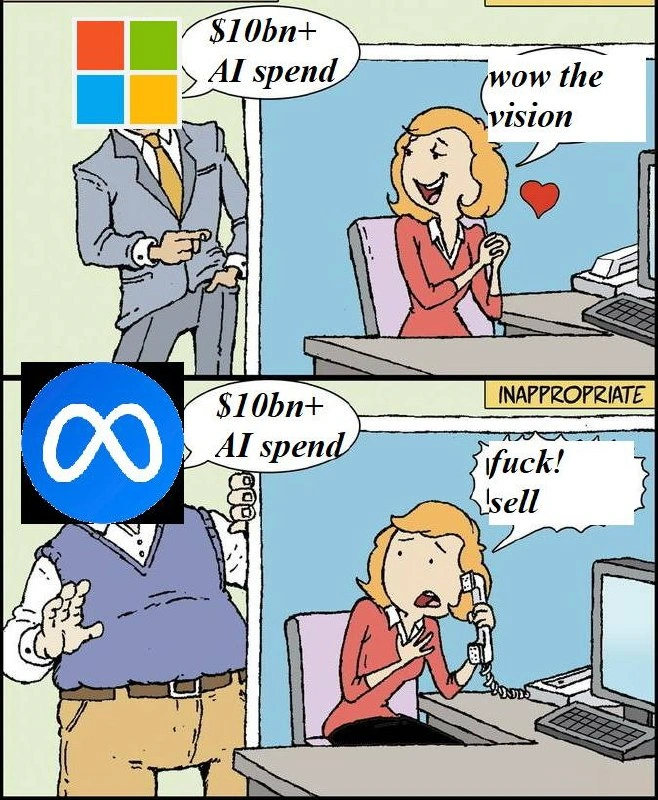
Let’s break down what’s happening. The comic uses the logos of Microsoft (the four-color window) and Meta (the blue infinity symbol) as faces to personify those companies. Both company characters proudly state they’re spending “$10 billion+” on AI (that’s ten billion dollars, an enormous sum!). In real life, big tech firms often invest billions in new technology – for example, building huge data centers with specialized chips for training AI models, hiring top researchers, etc. That’s what “AI spend” means: pouring money into AI research and infrastructure. Now, the twist is how the investor reaction differs between the two panels. In the first panel, an office worker hears Microsoft’s news and is enthusiastic – she clasps her hands and even a little red heart appears, saying “wow, the vision.” She’s basically applauding Microsoft’s plan as forward-thinking or visionary. This mirrors how analysts or the stock market often react positively when Microsoft announces big investments in trendy areas like AI. Microsoft has built up trust by successfully launching products (Office, Azure cloud, GitHub Copilot, etc.), so people assume its $10B AI project will pay off.
In the second panel, the same woman hears Meta’s identical claim of spending $10B on AI, but this time her reaction flips to alarm. There’s a yellow “INAPPROPRIATE” sign above – indicating that she (and by extension, investors) think Meta’s spending is out of line. She’s on the phone shouting “f**k! sell,” which is cartoon shorthand for “Sell the stock now! This is bad news!” It’s a panicked, negative reaction. Why the panic for Meta? Context: Meta (formerly Facebook) recently poured billions into projects like the Metaverse (virtual reality/world-building tech) with little immediate return, which made investors nervous. So Meta has a reputation for big spending that might not pan out. Even if Meta now says “it’s for AI,” many investors fear it could be another costly gamble. This difference in market perception is the crux: Microsoft’s $10B in AI is seen as a smart, hype-aligned investment (cool new AI features in Windows, Bing, etc.), whereas Meta’s $10B announcement prompts a “here we go again” skepticism. In simpler terms, there’s a double standard: one company’s huge tech investment is viewed as genius, the other’s as foolish, largely because of their reputation and recent history. The meme’s humor comes from this absurd inconsistency. It’s portraying the AI hype cycle and financial double standard in a way even newer developers can grasp. If you’ve just started in tech, you might notice how buzzwords affect people: when a well-regarded company adopts a hot trend, everyone cheers, but if a less-favored company tries the same, folks roll their eyes. This comic exaggerates that idea with AI spending. The heart emoji and “wow the vision” show love for AI innovation when Microsoft does it, and the panicked “sell!” shows distrust when Meta does it. It’s a lesson that in tech (and stocks), who is making an announcement can matter more than what they’re announcing.
Level 3: Billion-Dollar Bias
The meme spotlights a financial double standard in tech’s AIHype era. Both panels show a big-tech exec bragging about spending $10B+ on artificial intelligence. In the top panel, the character with a Microsoft logo for a head announces the massive AI/ML investment – and an onlooking employee reacts with starry-eyed admiration (clasped hands, heart floating, saying “wow, the vision”). In the bottom panel, a figure with Meta’s infinity logo makes the exact same $10B AI spend claim – but now a warning sign labeled “INAPPROPRIATE” hangs overhead. The once-adoring onlooker is suddenly panicked on the phone yelling, “f**k! sell”. The joke highlights how market perception can completely invert responses to identical news depending on who’s behind it. It’s biting TechIndustryHumor about investor reactions and hype: when Microsoft pours billions into AI, it’s hailed as bold innovation; when Meta does, it’s treated as reckless misadventure. This reflects an ai_capex_double_standard born from each company’s track record and Wall Street’s mercurial sentiment. Microsoft’s huge AI bet (like its multi-billion stake in OpenAI for GPT-powered features) is lauded as visionary strategy aligning with current AIIndustryTrends. Meta’s similar level of spending, however, triggers flashbacks to its costly metaverse detour – investors fear another boondoggle. In other words, the same $10B becomes “brilliant” or “boneheaded” purely due to branding and narrative. This meme cleverly exposes the IndustryIrony: in a hype-driven market, who spends the money matters more than what it’s spent on. The top panel oozes optimism for Microsoft’s AI push – likely seen as a natural extension of its cloud and enterprise strength – while the bottom panel drips skepticism toward Meta’s motives, given its recent history. It’s a sharp commentary on TechHypeCycle fickleness: a market perception gap where one tech giant’s ambitious AI research budget is a heroic moonshot, and another’s is a sign to run for the exits. The humor cuts deep for anyone who’s watched investors flip-flop on trends: it’s a meta_vs_microsoft tale of two reputations, proving that in tech, reputation is a force multiplier. The meme resonates with developers and industry vets who’ve witnessed similar IndustryTrends_Hype waves – it’s funny because it’s true that the AI craze gets selectively glorified or vilified. Essentially, the comic is a PhD-level satire of how CorporateCulture and market hype can spin identical facts into opposite stories.
Description
A two-panel comic meme illustrating the starkly different investor reactions to AI spending by Microsoft and Meta. In the top panel, a well-dressed man in a suit, with the Microsoft logo for a head, says, '$10bn+ AI spend.' An admiring woman at her desk looks on with a heart above her head, thinking, 'wow the vision.' In the bottom panel, a less dapper man in a sweater vest, with the Meta logo for a head, makes the exact same statement: '$10bn+ AI spend.' The panel is labeled 'INAPPROPRIATE,' and the same woman is now on the phone in a panic, yelling, 'fuck! sell.' This meme satirizes the hypocrisy and narrative-driven nature of the stock market and tech industry sentiment. It points out that while both companies are investing massive sums in AI, Microsoft's spending is praised due to its successful ventures like OpenAI, while Meta's is viewed with skepticism and fear, likely colored by its costly and thus-far unprofitable metaverse pivot. For senior tech professionals, it's a cynical but accurate commentary on how public perception and past performance can drastically alter the interpretation of identical strategic decisions
Comments
11Comment deleted
It's all about the narrative. One is 'aggressively investing in the future of intelligence,' the other is 'desperately burning cash to make legs work in VR.' Same spend, different pitch deck
Lesson learned: the exact same $10B GPU cluster is “strategic moat” if it can be amortised under Office 365, but “burn rate” if it renders cartoon legs - time to re-label our tech debt as ‘AI adjacency’ before the next earnings call
The same $10B AI investment announcement: when Microsoft does it, it's 'strategic vision and OpenAI synergy,' but when Meta does it, it's 'Zuckerberg burning cash on the metaverse pivot 2.0.' The only difference between visionary and delusional is your last quarter's earnings report
When Microsoft burns $10B on AI, analysts call it 'strategic cloud infrastructure investment.' When Meta does it, they're pricing in the cost of convincing everyone the metaverse wasn't just an expensive Second Life reboot. Same CAPEX, different P/E ratio - turns out market sentiment is just vibes with a Bloomberg terminal
Same GPU invoice; bind it to E5 uplift and it type‑checks as “strategy” - leave it as future revenue and Wall Street calls sell()
Same $10B+ AI burn rate, but Microsoft's gets 'visionary' - Meta's just triggers the investor CAP theorem: no Consistency, all Partition
Same $10bn AI spend - if your GPUs compile into Azure SKUs, it’s “vision”; if they compile into slightly better engagement, it’s “sell.” Business model is the architecture
At least they open their Ai models 🤷 Comment deleted
I gotta admit running llama3 on-device is kinda cool Comment deleted
Yess I ran 2bit quantized llama3 on integrated GPU and it worked somewhat! Comment deleted
is everything alright? Comment deleted