The Hidden Leviathan of the Backend
Why is this Backend meme funny?
Level 1: Calm on Top, Busy Below
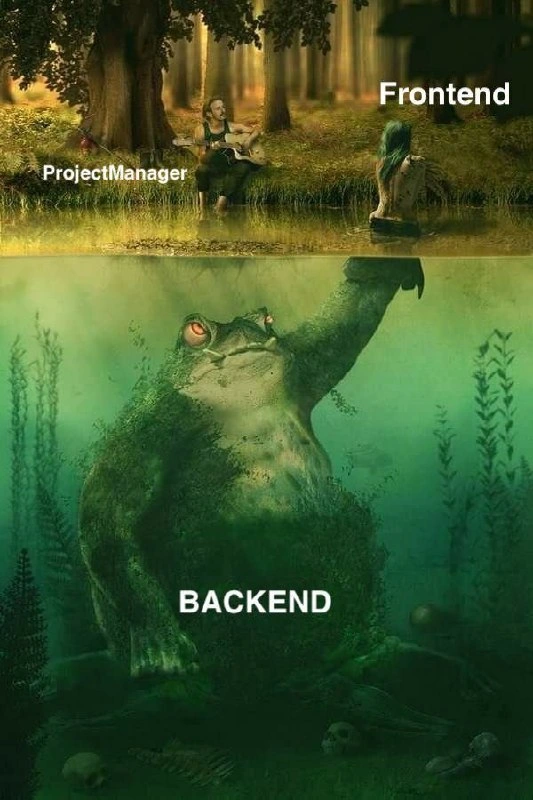
Imagine a duck swimming on a pond. On the surface of the water, the duck looks calm and graceful, just gliding along. But if you could see under the water, you’d notice the duck’s feet paddling super fast to keep it moving. This meme is funny for a similar reason: what we see on the outside of a project is nice and peaceful (like the duck above water, or the pretty front end of an app). But out of sight, under the water, there’s a lot of hard work happening (like the duck’s busy feet, or the huge backend code working behind the scenes). In the picture, a project manager is enjoying the beautiful part he can see (the mermaid representing the front end), unaware that a giant frog monster (representing all the hidden work in the back end) is just below the surface. It’s like when something looks simple, but actually a lot of effort is secretly making it happen. We find it funny because the project manager is happily strumming a guitar, totally clueless about the big scary frog underwater. It’s a way of saying: just because something looks easy, doesn’t mean it was easy to do! The meme uses this clear above-and-below water scene to make us laugh about how often people only notice the nice results and forget the unseen heavy lifting that makes those results possible.
Level 2: Under the Surface
Let’s break down the meme in simpler terms. We have three main characters labeled in the picture: ProjectManager, Frontend, and Backend. These correspond to real parts of a software project. The Frontend is the part of the software that users interact with directly. It’s what you see on the screen – the buttons, text, images, and overall look of a website or app. In the meme, the frontend is depicted as a mermaid sitting gracefully at the water’s surface. This mermaid looks beautiful and approachable, just like a well-designed user interface. The mermaid is only partially visible (half above the water), which is a clever way to show that you’re only seeing the part of the system that’s above water (visible to users). Frontend developers work on things like layout, design, and the smooth visuals of a site, using technologies like HTML, CSS, and JavaScript (or frameworks like React and Angular) to create that polished look and feel. It makes sense that the mermaid (frontend) is enchanting the Project Manager – it’s the part of the project that’s easiest to appreciate without any technical background.
Now, the Backend is everything that happens behind the scenes to make that frontend work. If you click a button on a website and it fetches some data or saves your information, the backend is doing that work on a server somewhere. In the meme, the backend is represented as a giant frog-like monster lurking underwater. Why a monster? It’s an exaggerated way to say the backend is huge, complex, and mostly hidden. It’s not literally bad or evil – it’s just a lot of stuff that you don’t see from the outside. Backend code includes things like server logic, databases, and APIs (the endpoints that the frontend calls to get or send data). For example, when you use a social media app, the pretty posts and profiles you see are frontend; the backend is the database storing all those posts and your account info, and the logic that says “when user clicks like, increment the like count in the database”. Technologies for the backend can be languages like Python, Java, JavaScript (Node.js), or C#, and involve frameworks like Django, Express, or Spring Boot, along with databases like MySQL or MongoDB. These all run on servers (which could be cloud servers these days). A user never directly sees a MySQL database or a server’s code; they only see what the frontend chooses to display after the backend has done its work. That’s exactly like how, in the image, you only see the small part of the mermaid above water, while the big frog (doing all the heavy lifting) is submerged.
The Project Manager (often abbreviated as PM) is a role in software teams for planning and overseeing the project. A project manager is usually not writing code; instead, they coordinate tasks, set deadlines, make sure the team is meeting requirements, and communicate with stakeholders or clients. They often measure progress by checking what features appear to be working. In the meme, the Project Manager is sitting by the water, calmly playing a guitar and admiring the mermaid. This suggests the PM is happy and relaxed because from their perspective, things look good – the frontend (mermaid) is there and looking nice. The PM might be thinking, “Our product looks great, everything must be on track!” This reflects a common situation: managers and clients tend to judge the state of a project by the demo or UI they can see. If the interface looks roughly complete, they might assume the whole system is nearly done. What they might not realize is that the majority of the work happens under the hood. The meme exaggerates that by making the hidden part ridiculously larger and scarier.
The phrase “hidden complexity” is crucial here. It means there’s a lot of complicated stuff that’s not obvious at first glance. The frontend might have taken a few weeks to make pretty, but the backend could be the result of years of development, containing thousands of lines of code to handle all sorts of scenarios. It’s hidden complexity because a non-developer doesn’t see it when using the app. They only feel its results (for instance, that their data was saved correctly, or the page loaded fast). There’s a famous metaphor often used in development: “tip of the iceberg.” The frontend is the tip – you can see it, it’s tangible. The backend is the huge chunk of ice below the water – invisible but absolutely critical. If that underwater part isn’t solid or is much bigger than expected, it can surprise you (just like the Titanic was surprised by an iceberg!). In our meme, the iceberg is replaced by a swamp monster frog, which is a more humorous way to say the same thing: the project’s real size and complexity lies beneath the surface.
For someone new to these terms, think of building a simple website. You might start with the frontend: making a page with some text and a button (using HTML/CSS, easy to see and test in your browser). But if that button needs to actually do something like save information or retrieve data, you’ll need a backend – maybe a small program on a server and a database to store info. Setting that up involves a lot more work that isn’t visible on the page itself. If you’ve ever followed a coding tutorial, often the first part is “get the UI up and running.” It might look done visually early on. The later parts, connecting to real data or deploying it so multiple users’ interactions work, are backend tasks and often more challenging.
It’s also worth noting that frontend complexity and backend complexity are different in nature. Frontend work involves making the app look good on various screens, ensuring buttons respond, and maybe calling APIs. Backend work involves ensuring data is correct, secure, and scalable – handling things like user authentication (login systems), data storage, server performance, and so on. A full-stack developer is someone who works on both the frontend and backend, meaning they handle both the mermaid’s beauty and the frog’s brawn. But many teams have people specialize in one or the other. That specialization can sometimes lead to scenarios where the frontend team proudly shows a feature working in a mocked-up way, and the backend team knows “Okay, now we have to implement the real logic behind that.” The PM in this meme likely saw the frontend demo and thought the whole feature was nearly finished, not realizing the backend team still has a monster of a task to complete.
Let’s connect this to the labels and imagery with some plain facts:
- Frontend (Mermaid): The UI or client side. Runs in your browser or phone. Concerned with user experience and visuals. In the meme it’s small and above water, meaning it’s the smaller part of the system and visible.
- Backend (Giant Frog): The server side. Runs on servers or cloud. Concerned with business logic, database operations, and the heavy lifting of the app. In the meme it’s huge, underwater (invisible to the casual observer), and a bit intimidating – highlighting that it’s a much larger scope of work.
- Project Manager (Guitar guy): Non-technical lead keeping track of progress. In meme, he’s on the bank, only seeing the mermaid (frontend) and presumably unaware of the beast below. This shows the gap in understanding: he’s evaluating by what’s visible.
All those skulls and bones at the bottom? That’s a morbid joke implying maybe the remains of developers or past projects that have perished in the depths of the backend. It’s exaggeration, of course! But it speaks to a feeling: sometimes backend code can become a graveyard of old hacks and forgotten functions that no one has cleaned up. Maintenance of that code can be tough – each skeleton could represent a bug that had to be fixed or a feature that was removed but left traces behind. Newer developers might find those and wonder what they were. This is why we talk about codebase hygiene and refactoring: to avoid letting the swamp get too murky. In a healthier codebase, the frog (backend) might be smaller and the water clearer – but in reality, many projects accumulate complexity over time.
The meme is categorized under BackendHumor and FrontendHumor because it playfully contrasts the two. It’s also labeled ProjectManagementHumor because it pokes at the dynamic between what project managers focus on versus what developers worry about. If you’ve ever heard the phrase “works on my machine” or “it’s always DNS” – those are other inside jokes about unseen technical issues. Here, the inside joke is hidden complexity: everyone in development knows the backend is there and huge, but we sometimes joke that management acts oblivious to it (even if they do know deep down, the joke exaggerates that obliviousness).
To put it simply: This meme tells a story of a beautiful surface with a complicated underside. It’s funny to developers because we live this dichotomy. We often create polished UIs that hide all the messiness from users – that’s good design! But when someone not in the code (like a PM or client) forgets that messiness exists, it leads to unrealistic expectations and comedic misunderstandings. The image just takes that concept and makes it literal and visual. We can laugh at it because we recognize the truth in it, and the absurdity of how large that frog is drives the point home in a memorable way. After seeing this, you won’t forget that behind every nice frontend, there might be a giant frog of code under the surface!
Here’s a simple comparison to summarize the roles:
| Frontend (UI, “Mermaid”) | Backend (Server, “Frog”) |
|---|---|
| Visible part of the app (what you see) | Hidden part of the app (what you don't see) |
| Runs on the user’s device (browser/app) | Runs on servers (cloud or data centers) |
| Handles look and feel, user interaction | Handles data storage, processing, logic |
| Examples: HTML, CSS, JS, React | Examples: Database, APIs, Python/Java |
| Small changes are easy to notice by anyone | Big changes might not be obvious to users, but vital for the system |
| Often judged by appearance first | Often not noticed unless something goes wrong |
This table shows how the frontend is the tip of the iceberg (or the face of the mermaid), while the backend is the foundation underwater. The project manager in the meme is essentially focusing on the left column (visible progress) and forgetting the right column (hidden complexity) is even there. Developers need to deal with both to have a successful project.
Level 3: Swamp of Technical Debt
For those of us who’ve slogged through real-world software projects, this meme hits painfully close to home. It humorously captures the perspective gap between management and engineering. The Project Manager in the scene is relaxing by the pond, guitar in hand, gazing at the charming frontend. From their viewpoint, everything looks on track – the user interface is shiny, the demo to stakeholders looked great, so surely the project must be nearly done, right? Little do they suspect that just beneath that tranquil surface lies a gigantic, menacing codebase (the frog) that the developers are grappling with daily. The Frontend here is depicted as a lovely mermaid: visually appealing, seemingly simple, perhaps even seductively straightforward to work with. In contrast, the Backend is an enormous swamp-dwelling beast: complex, unwieldy, and a little frightening. This juxtaposition nails a common engineering truth: what management sees is often only the front-facing 10% of the work, while the other 90% of the iceberg (or frog, in this case) remains hidden underwater.
Why is this funny? Because it’s true. Many of us have had a manager or client innocently say, “The UI looks great, so we just need to hook it up to the backend – that shouldn’t take long, right?” Meanwhile, the “hooking up” involves untangling a decade’s worth of intertwined logic, updating database schemas, dealing with scalability issues, and ensuring security – all of which is non-trivial work lurking out of sight. The meme visually exaggerates this scenario: the backend isn’t just a bit bigger, it’s a colossal frog-monster reaching up from the depths, maybe about to snatch the unaware PM off that tree stump! It resonates with developers because we often feel like we’re wrestling a swamp creature of legacy code and technical debt, while others only notice the calm, pretty UI.
The term technical debt is key here. It refers to the Idea that doing things the quick-and-dirty way (to meet a deadline or due to poor design) is like borrowing time that you’ll have to pay back with interest later. Over years, shortcuts and half-fixes accumulate, and the codebase becomes a bog of complex, brittle code. That moss-covered frog looks like it’s been in the murky depths for ages – a perfect stand-in for an old monolithic backend system that has seen years of adhoc patches. The skeletal remains scattered around could symbolize old features that were removed or developers’ sanity that was lost debugging production issues at 2 AM. It’s dark humor: every experienced backend engineer knows the feeling of diving into a particularly old module and thinking, “what poor soul wrote this... and are they okay?” The code might even predate all the current team members – a creature from the deep past.
Now consider the ProjectManager character. Playing guitar by the water suggests a blissful ignorance – they’re enjoying the beautiful melody of the frontend, completely oblivious to the danger and complexity below. In many organizations, project managers focus on deliverables and what the end-user will see. If the UI is coming together and the demo clicks through nicely, they assume the project is nearly complete. However, the hardest parts – data validation, transaction handling, server scaling, error recovery, integration with other systems – all happen in the backend. These are often invisible until they go wrong. So from the manager’s perspective, nothing seems wrong; from the developer’s perspective, everything is on fire underwater. The meme’s comedy comes from dramatizing that disconnect. It’s essentially a “If only you knew…” moment: if the PM truly saw the monstrous effort and potential pitfalls lurking in the code, they might not be so casually strumming a tune.
In real projects, this scenario can lead to tension. For example, a PM might promise a client a new feature quickly because it “just requires adding a new field to the form” (frontend change). The development team groans because adding that field means updating multiple microservices, altering database schemas with millions of records, dealing with migration scripts, and ensuring backward compatibility – the underwater complexity the PM didn’t realize. The meme’s frog could be named “Scope Creepus” – every seemingly small request feeds it and it grows in complexity. Seasoned developers often try to bridge this understanding gap by communicating technical challenges in relatable terms (maybe not as dramatically as pointing to a giant frog, but metaphorically!). It’s an ongoing dynamic: management wants quick results and pretty demos, engineers want acknowledgement that stable, scalable systems require a lot of behind-the-scenes work.
We can also interpret the mermaid vs. frog dynamic as frontend vs. backend development culture. Frontend development (mermaid) is often about polish, user experience, and rapid iteration. It’s visible and even glamorous in demos – you directly see the results of a color change or a new button. Backend development (frog) is about robustness, correctness, and performance under the hood. It’s less visible; when done right, nobody notices it at all (because things “just work”). The meme humorously sides with backend engineers by depicting their work as a gigantic presence – implying that backend is massive relative to the small visible frontend – a feeling many backend folks have when someone says “Oh, you’re just writing API endpoints, how hard can that be?” HiddenComplexity indeed! We joke that if the frontend is the mermaid singing a sweet song, the backend is the entire chorus, orchestra, and stage crew making that performance possible. If any one of those backstage systems fails, the show above could flop.
Finally, look at the frog’s red glowing eyes and raised hand. It’s almost as if the backend is trying to get attention: “Hey, I’m important and I might become a problem if ignored!” In many cases, ignoring backend complexity leads to production outages or last-minute scrambles to fix unseen issues. The humor has a hint of warning: that blissful project manager might get a nasty surprise if the beast below breaks the surface (think of a major crash or a blocker bug appearing just before launch). It’s the software equivalent of being in denial until the problem literally leaps out. Many of us have experienced a calm before the storm scenario: everything looks fine until suddenly the backend throws an error no one anticipated, halting the project in its tracks. The image of the frog looming under the mermaid encapsulates that ever-present risk that seasoned devs are always aware of.
In summary, this level clarifies why engineers chuckle (and maybe groan) at the meme: it spotlights the huge disparity between how easy something appears and how hard it actually is under the hood. It’s poking fun at the well-meaning but naive optimism of folks who judge progress by appearances (the pretty UI) rather than by the entire system’s readiness. The categories BackendVsFrontend and ManagementVsEngineering couldn’t be more perfectly illustrated. We laugh because we’ve lived it – the charming demo that hid a month’s worth of backend sweat, or the manager who says “Just add this small feature” not realizing that one request wakes the slumbering giant of complexity below. It’s both cathartic and comedic to see that contrast captured in a single image: the mermaid and the monster, coexisting in one project. That’s software development in a nutshell – beauty up front, beast mode in back.
# A tiny glimpse of what the manager sees vs what engineers deal with:
# Frontend (looks simple and pretty)
def showUserProfile(user):
render_page("profile.html", user) # Show user's profile page with data
# Backend (what happens to get that data - simplified example)
def get_user_profile(user_id):
# 1. Check authentication and permissions
if not AuthService.is_user_authorized(user_id):
raise Exception("Access Denied")
# 2. Fetch user data from database
user = Database.query(f"SELECT * FROM users WHERE id={user_id}")
# 3. Fetch related data (posts, comments, etc.)
user.activities = fetch_user_activities(user_id)
# 4. Apply business rules (e.g., filter out banned content)
sanitize(user.activities)
# 5. Format data for the frontend
return serialize_to_json(user)
Above: The frontend calls a single function to display a profile – nice and easy. But that call triggers a bunch of backend steps: auth checks, multiple database queries, business logic, and formatting. In a real codebase, each of those steps might be hundreds of lines or even calls out to other services. The ProjectManager sees the result of showUserProfile (a lovely profile page) and thinks “Great, it’s done!” The developers see get_user_profile and all its sub-calls, knowing that each could hide tricky edge cases or performance issues. This little code comparison is like a peek above and below the waterline of the meme. The backend snippet is relatively short here for illustration, but imagine it extending into many more lines – that’s the frog growing larger the deeper you dive. Engineers find humor in this because it’s a daily reality: a neat one-liner on the front can rely on a monster of logic underneath. It’s both humbling and comic to realize how much effort goes into making software look effortless.
Level 4: The Abstraction Abyss
At the deepest technical level, this meme highlights the invisible complexity hidden behind a simple interface. In software architecture, a clean frontend UI is an abstraction layer – a serene surface – that conceals layers of intricate logic underneath. This is akin to the classic iceberg analogy: the small visible tip (the UI) belies a massive body of code beneath the waterline. The project manager strumming a guitar by the calm water recalls how non-technical stakeholders see only what meets the eye: a pretty application seemingly working like magic. But beneath that magical mermaid-like frontend lies an abyss of implementation detail – the giant frog of a backend.
Computer science principles deliberately make this possible. The concept of information hiding (first described by David Parnas in the 1970s) encourages designing systems where each component exposes a simple interface while hiding its inner workings. The mermaid in the meme is essentially an interface: alluring and straightforward. The frog lurking below is the actual implementation: massive, complex, and hidden from view. This separation is by design – consider a web application built on a layered architecture (e.g. MVC – Model View Controller). The View (frontend) presents data nicely, while the Model and Controller (backend logic, database interactions) handle the gnarly details out of sight. The humor here springs from literally picturing that separation: an elegant front layer floating above a tangle of depth and complexity.
This visual also hints at the essential vs. accidental complexity in software. Essential complexity comes from the hard problems your software solves – business rules, data consistency, scaling to millions of users. Accidental complexity is the extra mess we add along the way – outdated frameworks, quick hacks, legacy code (all the moss and skeletons clinging to that frog). Fred Brooks in The Mythical Man-Month noted that no tool can fully eliminate essential complexity, it can only be displaced or hidden. Here the frontend displaces much of the complexity to backend systems. The monstrous backend is the accumulation of both essential complexity (the core work every request must do) and years of patches and workarounds (accidental complexity) that make it even scarier.
From a theoretical standpoint, one reason the backend can balloon into a beast is the nature of problems it handles. Many backend tasks involve hard computer science challenges. For example, a simple-looking search box on the frontend might trigger a backend process that performs a complex database query or a full-text search using an inverted index. Under the hood, data structures like B-trees or trie indices and algorithms with complexity like $O(n \log n)$ are crunching away to retrieve results quickly. The user interface displays search results in milliseconds, but only because the backend executes these heavy algorithms so efficiently that it feels instantaneous. It’s reminiscent of Arthur C. Clarke’s third law: “Any sufficiently advanced technology is indistinguishable from magic.” The project manager sees the frontend and perceives something almost magical (“It just works!”), whereas that “magic” is actually advanced technology (a distributed database lookup, caching, ranking algorithms, etc.) churning behind the scenes.
Modern web systems also often involve distributed computing principles that add deep complexity beneath a simple frontend feature. Think about consistency and fault-tolerance: the frontend might blithely fetch user data, not exposing that behind that request might be a distributed transaction or a consensus algorithm like Paxos/Raft ensuring multiple servers agree on the latest data. The meme’s underwater frog could well represent a cluster of services acting as one giant monster. For instance, an innocuous action like saving a user’s profile invokes a cascade: one microservice writes to a database, another service publishes a message to a queue, a third triggers a cache invalidation. Ensuring all these steps happen reliably involves tackling the CAP theorem trade-offs (balancing consistency, availability, and partition tolerance), handling network latency, retries, error handling – in short, wrestling with the inherent complexity of distributed systems. None of that is visible at the surface where the app just says “Profile saved successfully.” The skeletons at the bottom could be seen as the remnants of failed calls, error logs, or even the abandoned code of features that didn’t survive these complexities. In a more figurative sense, they’re also the “skeletons in the codebase closet” – outdated modules and quick fixes that remain buried in the system, rarely seen by anyone except developers diving into the depths.
In essence, this level of analysis reminds us how abstraction in computing allows a tranquil, simple experience to sit atop a mountain (or swamp) of complexity. The meme exaggerates it to humorous effect: a mermaid singing on the surface, while a Leviathan frog represents the computational weight hidden below. It’s a visual punchline about software architecture: the beauty of a well-designed frontend is that it hides the ugly necessary complexity of the backend. For seasoned engineers or computer scientists, it’s a wry nod to the reality that every elegant technology is supported by untold complexity below. Without that monstrous backend doing the heavy lifting, the serene frontend would have nothing to sing about. So, the next time something in an app feels effortlessly smooth, remember the enormous codebase and algorithms submerged out of sight making it possible – a harmony of abstraction that is both amazing and, as the meme shows, a bit terrifying.
Description
A two-panel meme that contrasts the perceived simplicity of a project with its underlying complexity. The top panel depicts a serene, sunlit forest scene above water. A man labeled 'ProjectManager' sits peacefully playing a guitar, while a mermaid-like figure labeled 'Frontend' listens from a rock in the water. The bottom panel reveals the murky, dark world beneath the water's surface. A colossal, monstrous frog with glowing red eyes, labeled 'BACKEND', is holding up the rock that 'Frontend' rests on. The underwater ground is littered with skulls, symbolizing the unseen effort, danger, and complexity. This meme is a classic representation of the iceberg analogy in software development, where the user-facing frontend is just the small, visible tip, while the massive, complex backend system does all the heavy lifting and is invisible to most stakeholders
Comments
7Comment deleted
The project manager thinks the app is a graceful swan. The backend team knows it's a giant, caffeine-fueled frog paddling furiously underwater, held together by legacy code and hope
PM: “The mermaid’s gradient looks perfect - ship it tonight!” Meanwhile the Java-6 frog underneath is juggling 14 ‘micro’ services that all share one schema and a COBOL stored proc named DO_NOT_TOUCH
The PM just asked why changing a button color requires a database migration, three service deployments, and updating seventeen environment variables across four regions
Project managers see a clean React component tree and think the work is 90% done, while backend engineers are down in the murky depths wrestling with distributed transactions, eventual consistency, cache invalidation strategies, and that one legacy SOAP service from 2008 that nobody dares touch because the original architect left the company and took all tribal knowledge with them. The frontend is the tip of the iceberg; the backend is the Titanic-sinking part everyone forgets about until 3 AM when the database connection pool is exhausted and the on-call pager goes off
PM sees a button; backend sees an idempotent, audited, multi-tenant saga spanning four legacy databases and one haunted stored procedure
PM: “Just make the button teal.” Frontend: “CSS.” Backend (surfacing): “Teal is a new enum value - enjoy the schema migration across 9 services, a Kafka backfill, broken idempotency, and a 2009 cron that treats unknown colors as delete.”
PM and frontend sip tea by the lily pad; backend frog croaks 'CAP theorem says pick two' from the microservices murk