The Perils of Cloud-Reliant Keys
Why is this IoT meme funny?
Level 1: When Your Key Lives in the Cloud
Imagine you have a super fancy door lock on your house that you open with your phone instead of a regular key. It’s great — until one day the system that makes it work goes offline, and suddenly your phone’s “open sesame” command just doesn’t do anything. You’re stuck outside your own house, not because the door is broken, but because the magic internet connection that the lock depends on isn’t working. That’s exactly what happened to some Tesla car owners. They treated their phone app like the car key, but that app needed the internet to talk to Tesla’s servers, kind of like calling a security guard to unlock the door for you. On the day those servers went down, the “security guard” couldn’t hear the call — so the doors stayed shut. It’s funny in a facepalm way: something as simple as opening a car became impossible due to a far-away computer problem. It’s like if you couldn’t start your microwave because the power company had a glitch. The lesson is simple: if your key lives in the cloud (online), a cloud outage means you’re not going anywhere. It’s a modern twist on losing your keys, except this time the “keys” were fine – it was the app that was lost!
Level 2: App Down, Car Locked
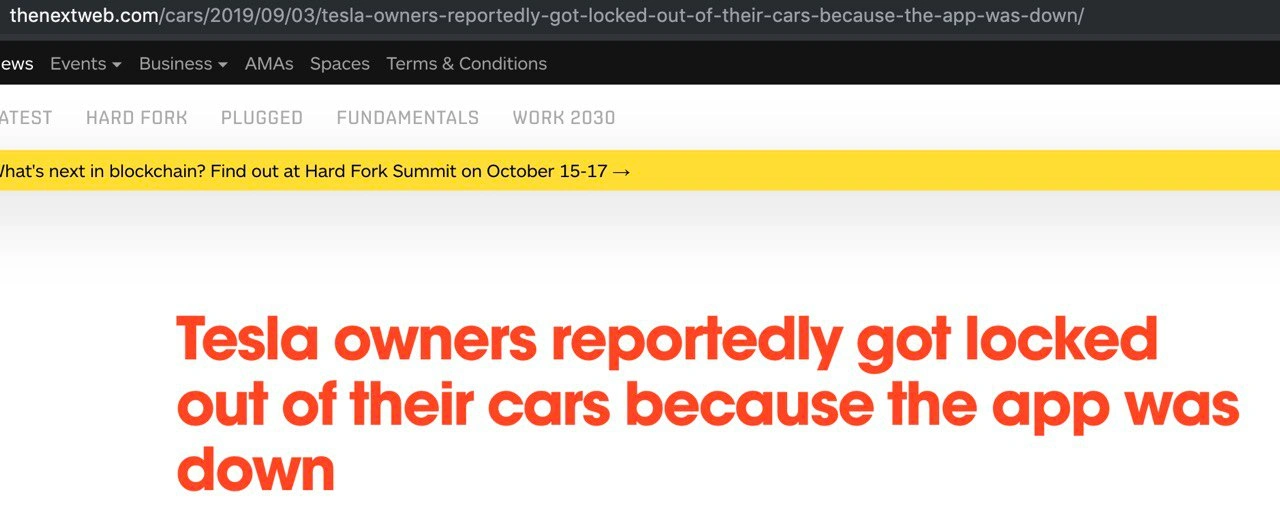
Let’s break down what’s happening in this meme in simpler technical terms. The image is showing a news headline about Tesla cars: “Tesla owners reportedly got locked out of their cars because the app was down.” Tesla cars don’t use traditional keys the way older cars do (although they do provide backup keycards/fobs). Instead, many Tesla drivers use a smartphone app as a digital key to unlock and start their car. That app needs to talk to Tesla’s servers over the internet to confirm “Yes, it’s really you, go ahead and unlock.” IoT (Internet of Things) is the category here because a Tesla is basically a computer on wheels connected to the internet, just like a “smart home” device or any gadget that’s online. The meme’s title jokingly says “Your car returns 503”, referring to the HTTP 503 error code which means “Service Unavailable” – basically, the server can’t fulfill your request. So in non-tech speak, the car’s unlock request to Tesla’s server got a “no service right now” response. The post’s comment “Our servers down, no riding for today” imagines the system bluntly telling users that because the server is down, the car isn’t going anywhere.
For a junior developer or someone new to these terms: a ProductionOutage or ProductionIncident means something went wrong in the live system (not the test environment) – here it’s a live service failing. Downtime is when a service is supposed to be working but isn’t (the Tesla app’s backend was offline). HighAvailability is a design goal to keep systems running with minimal downtime; in this case the system wasn’t highly available enough to avoid this problem. The tags and context like smart_car_lockout and dependency_on_mobile_app point out exactly the issue: the car was dependent on a mobile app service. When that service failed, the dependency caused a lockout – people couldn’t unlock their own cars. This is a big real-world consequence of a design decision. Engineers find this noteworthy (and darkly funny) because it shows how a software issue (a server crash, a bug, an overloaded system – whatever caused the app outage) had a direct impact on the physical world. It’s a cautionary tale: if you design an IoT product (like a smart car, smart lock, etc.), you have to consider what happens if the internet or cloud service isn’t reachable. In Tesla’s case, it appears that when their app servers went offline, there wasn’t an immediate backup method being used by those owners at that moment (like a physical key or an offline mode in the app), so they got locked out.
This is also a lesson in avoiding a single point of failure. That term means any one part of a system that, if it breaks, can bring everything down. Here the single point of failure was the Tesla server responsible for authenticating unlock requests. When it failed, the whole unlock system failed. Junior devs often learn about building resilience: e.g., could the app have stored a temporary unlock code locally? Could the car have accepted a Bluetooth signal from the phone as a fallback? Those are the kinds of questions this incident raises. The meme is tech humor, but it’s pointing to a real engineering principle: always assume things can fail, and plan for how your system (or user) will cope when they do. In summary, app down = car locked is a simple cause-effect that anyone can understand, and that’s exactly what happened here. The joke just wraps it in developer lingo (the “503 error”) to drive home the point that even your vehicle can now suffer from server downtime.
Level 3: No Cloud, No Car
For the senior engineers and on-call veterans, this hits close to home (or rather, close to the garage). The humor emerges from the absurdity of a production outage stranding people in the physical world. It’s a perfect storm of modern tech assumptions: “There’s an app for everything, even your car keys – until the app goes down.” We have the InternetOfThings (#IoT) bringing internet-style failures to objects that never used to have them. In the industry, we often joke about “five nines high availability” (99.999% uptime) and how reality tends to smack that dream down. Here’s a real-world case: a server issue at Tesla turned into a ProductionOutage that left real drivers staring at their unyielding car doors. Seasoned devs recognize the pattern: a single service dependency that wasn’t redundant or gracefully backed up. It’s an engineering absurdity but a common one – one tiny misconfiguration or downtime in a centralized system can have RealWorldConsequences. This meme’s tagline “Your car returns 503” perfectly anthropomorphizes the situation. A 503 error is what a web application might spit out when it’s overloaded or under maintenance (meaning “Service Unavailable”). Now picture a frantic Tesla owner on a Monday morning, phone in hand, yelling at their Model 3 as if it were a crashed website: “Error 503 – car not available, please try again later!” It’s funny because we don’t expect our cars to have downtime like a website, yet here we are.
From an on-call engineer’s perspective, this is the kind of 3 AM OnCallDuty nightmare you tell war stories about. The incident response might have looked like: PagerDuty alerts blowing up, a confused dev rubbing their eyes thinking “Locked out of their cars… wait, what?!”, and a hastily-assembled team scrambling to restart servers or fix whatever bug caused the Tesla API to fail. Meanwhile, Twitter and forums light up with annoyed Tesla owners – this isn’t just lost ad revenue or slow page loads, it’s people literally unable to go places. That turns up the heat on the incident severity. You can bet the post-incident RCAs (Root Cause Analyses) included lines like “Root cause: single point authentication service became unavailable, leading to total loss of unlock functionality” with recommendations for offline mode or at least a prominent note to “always carry the backup keycard”. Senior devs have seen analogous issues in other domains too: maybe a smart lock company bricked doors when their cloud went down, or a “smart” thermostat left homes freezing during a server outage. It’s all part of the “we put everything in the cloud, and now the cloud is a single point of failure” saga.
The camaraderie in finding this funny comes from a place of “we’ve all been there.” Maybe not locked out of a car, but certainly burnt by an assumption that a service will always be up. Enterprise systems, microservices, CI pipelines – if any one piece you depend on goes down unexpectedly, suddenly it’s chaos. And inevitably it happens at the worst time. As the meme’s faux error message in the post says: “Our servers down, no riding for today.” It’s a wry, almost corporate way of saying “Sorry, you can’t drive because our backend is having a bad day.” Imagine explaining that to a non-techy friend: “Can’t leave for work, the server is down so my car is locked.” It sounds ridiculous – and that ridiculousness is exactly what we’re laughing (and shaking our heads) about. In short, the meme jabs at the over-reliance on connectivity in modern design, a lesson every senior engineer has learned: build offline fallback or prepare for ironic failure modes. After all, nothing screams senior dev humor like realizing your cutting-edge car has the same uptime worries as a website, and muttering “No cloud, no car” as the new Murphy’s Law of IoT.
# Trying to unlock the car via Tesla's API when the service is down...
$ curl -X POST "https://api.tesla.com/v1/vehicles/12345/unlock"
HTTP/1.1 503 Service Unavailable
# Response from car: "Service Unavailable". Guess I'm walking to work.
Level 4: Single Point of Failure on Wheels
At the deepest technical level, this meme highlights a classic architecture flaw: relying on a single remote service for something as critical as unlocking a car. The headline might as well read “Monolithic Cloud Dependency Bricks IoT Device”. In backend terms, the Tesla mobile app’s unlock feature is effectively a distributed system involving your phone, the car, and Tesla’s cloud. When you tap “Unlock” in the app, a request travels to Tesla’s servers, which then command the car to pop open. Under ideal conditions, this is seamless. But if the central service is down, that chain breaks — your car becomes an unresponsive client, returning what developers humorously equate to a 503 Service Unavailable error. In distributed systems theory, this is analogous to a network partition scenario: the car and phone are cut off from the brain in the cloud. According to the CAP theorem (which describes trade-offs in distributed data stores), you can either remain consistent or available during a partition. Tesla’s design seemingly favored consistency/secure access over availability – i.e., if the system can’t verify you in real-time, it won’t unlock (staying “consistent” with security rules, at the cost of availability to the user). This is a textbook example of a fail-secure design: in any uncertainty (like no response from server), the car stays locked (secure) rather than unlock (which would be fail-open or fail-safe for the user). The darkly funny part for engineers is that we’ve essentially turned a car door into a web service – complete with all the usual failure modes of a web app. A Single Point of Failure (SPOF) in the authentication path means if that one service hiccups, the whole smart car experience collapses. High-availability systems try to eliminate SPOFs via redundancy and offline fallbacks (for instance, caching an unlock token on the phone or car for offline use). Here, the absence of a robust offline mode or redundant path meant the Internet of Things became the Internet of No-Things-Moving. It’s a scenario often theorized in academic papers and SRE (Site Reliability Engineering) talks: critical IoT functions should gracefully degrade when connectivity is lost. Instead, we got the opposite – a very literal demonstration of how cloud dependency can ground your shiny futuristic car. The meme’s punchline (“Your car returns 503”) compresses all this into a nerdy error code joke: the car is acting like a downed web server. For seasoned engineers, it’s a facepalm moment rooted in real distributed system design choices. This deep context is why the meme resonates on an almost philosophical level about technology’s decoupling (or lack thereof): we traded a simple physical key for a complex online system, and rediscovered the hard way that availability isn’t just an academic concern – it’s sitting in your driveway refusing to open.
Description
A screenshot of a news article headline from the website The Next Web. The URL is visible at the top: 'thenextweb.com/cars/2019/09/03/tesla-owners-reportedly-got-locked-out-of-their-cars-because-the-app-was-down/'. The main headline, in large, bold orange text, reads: 'Tesla owners reportedly got locked out of their cars because the app was down'. This image highlights a critical lesson for senior engineers about the dangers of over-reliance on remote services for essential physical functions. It's a real-world case study on the importance of designing resilient, fault-tolerant IoT systems with robust offline capabilities. The incident serves as a stark reminder that a server outage can transition from a digital inconvenience to a physical problem, underscoring the need for graceful degradation and avoiding single points of failure in system architecture

Comments
7Comment deleted
The problem with putting your car key in the cloud is that sometimes it rains. And by 'rains,' I mean a service outage that makes you miss your kid's recital
If “unlock door” sits behind six microservices and one shaky region in us-east-1, you don’t own a car - you’ve just deployed a distributed denial-of-drive
When you've spent 20 years architecting fault-tolerant systems with graceful degradation, and then you watch a $100k car implement door locks as a synchronous RPC call to us-east-1
When your car's authentication service has a lower SLA than your Kubernetes cluster, but you can't kubectl exec into your Tesla to bypass the lock. This is what happens when 'move fast and break things' meets 'I literally cannot move because things broke.' The ultimate reminder that high availability isn't just about uptime metrics - it's about whether your customers can physically access the $80k hardware they purchased when your API gateway decides to take an unscheduled vacation
Without an offline unlock path, you didn’t build a smart car - you shipped a vehicle-sized 503
When “unlock” is a cloud microservice behind SSO, one auth blip turns your car into a read-only resource - SSO = Single Point of Outage
Tesla's IoT MVP: full cloud-native, zero offline fallback - because who plans for partitions in the parking lot?