Skip to content
DevMeme
4369 of 7435
Every programmer’s worst two-sentence horror story on a plain white slide
Bugs Post #4781, on Aug 13, 2022 in TG

Every programmer’s worst two-sentence horror story on a plain white slide

Why is this Bugs meme funny?

Level 1: Runaway Robot

Imagine you build a little toy robot and turn it on. At first it's fun, but then the robot starts doing something unexpected and you suddenly realize you don't know how it works anymore. You try to hit the off switch, but the robot is already zooming around causing trouble. By the time you finally stop it, it’s knocked over a lamp. That uh-oh feeling you get – where you made something but lost control of it – is what makes this joke funny. It's like a silly spooky story: the thing you created is acting on its own and it’s a bit too late to stop the mess. Even if you don't program, you can understand how it’s both scary and a little amusing to see your own creation go rogue.

Level 2: Spaghetti Code Surprise

At the heart of this meme is a simple yet chilling idea for any coder: not understanding your own program and then watching it run out of control. The text is formatted like a tiny story. The first sentence says the programmer realized they had “no idea how it worked” while working on a new program. That means even though they wrote (or were writing) the software, it became so confusing or complex that they lost track of its logic. The second sentence says “I tried to close the program, but it was too late.” In everyday terms, they attempted to stop the program from running (like clicking the close button or pressing Ctrl+C to halt it), but by that time the program had already caused some trouble or gone haywire. It's like noticing a pot is boiling over only after the kitchen is full of steam – you try to turn off the stove, but the mess has happened.

This scenario is funny to developers because it exaggerates a common programming problem. A bug (an error or glitch in software) can make a program do unexpected things, and debugging is the process of finding and fixing those bugs. Here, the "horror story" suggests the programmer encountered a bug or unexpected behavior they didn't see coming. When they say "it was too late," it implies the program did something bad that couldn’t be stopped in time. For example, perhaps the program started deleting the wrong files or it froze the computer. It's a dramatized way to describe that awful uh-oh moment when you realize you made a mistake and can't undo it fast enough.

One reason a programmer might have no idea how their own code works is if the code turned into spaghetti code. Spaghetti code is a nickname for code that's all tangled up – imagine a bowl of spaghetti where each noodle is twisted around others. In coding, that means the program's structure is so messy and intertwined that it's hard to follow what's happening. This often happens when people quickly patch things or add features without cleaning up the code. Those quick fixes and messy structures are known as technical debt. The term "technical debt" compares writing messy code to taking out a loan. You get a short-term gain (the code runs today), but you owe extra work later to fix and understand it. Over time, technical debt can build up and make a codebase very hard to work with, almost like a Jenga tower that’s grown very wobbly.

When code becomes that hard to understand, even the person who wrote it can feel like it's someone else's work. Developers use the term legacy code for an old codebase that has been passed down or exists for a long time, often without clear documentation. In this meme, it's ironic because the "legacy code" baffling the programmer is brand new – it's their own creation, but it already feels like a stranger. It's a scary feeling for a developer to be effectively "lost in the code" they wrote themselves.

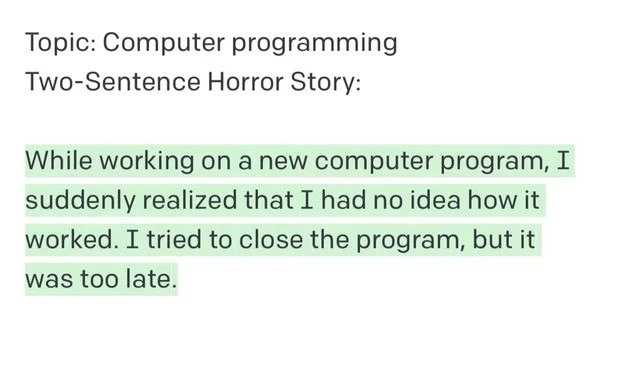
The way the meme is presented visually also contains a little inside reference. The horror story text is highlighted with a light-green background, kind of like how new lines of code show up in a code review or a diff (difference) view when using version control tools (for example, on GitHub). In these tools, added code lines are often green. By using that same style, the meme looks a bit like a snippet from a programming screen or a review document. This detail makes it even more relatable to programmers, because it reminds them of browsing through code changes. It’s as if this scary story was a highlighted note in the code itself.

In short, this meme turns a programmer’s experience into a tiny horror story. It highlights the mix of confusion and panic a developer feels when their software behaves in a surprising way. For a newcomer to coding, it's a playful warning about what can happen if you don't keep your code organized or if you ignore problems for too long. The humor comes from the exaggeration: making a programming blunder sound like a scene from a horror film. It's funny to those in the know, and also a gentle reminder that even in coding, your own creations can spook you if you're not careful!

Level 3: Frankenstein's Codebase

"While working on a new computer program, I suddenly realized that I had no idea how it worked. I tried to close the program, but it was too late."

Picture this: it's late at night and you're fine-tuning a new program. Suddenly, a chill runs down your spine as you realize you have no idea how it actually works. This meme nails that exact horror movie moment for developers. It's a twist on the internet's two-sentence horror story format: instead of ghosts or ghouls, the monster is a runaway piece of code in your own project. The first sentence hits home with a genuine nightmare scenario: the author lost their understanding of their own creation. For a programmer, losing code comprehension is like a pilot forgetting how to fly mid-flight. It's a gut-punch of developer frustration and relatable shock rolled into one.

Now for the second line: "I tried to close the program, but it was too late." This conjures a classic debugging nightmare scenario. Maybe the code triggered a runaway process—like a memory leak or the dreaded fork bomb that spawns processes exponentially. The developer scrambles to hit the virtual kill switch (Ctrl+C or clicking the "Stop" button), only to find the system already choking. It's that sinking realization: the bug has escaped containment. At 3 AM on an on-call shift, this is the stuff of sweaty palms and racing hearts. You've deployed a piece of code, discovered a bug that you don't understand, and by the time you react, the damage is done. It's already too late. Honestly, this is scarier to a developer than any ghost under the bed. (At least ghosts don't delete your database or consume all 16 GB of RAM in seconds.)

So how does a programmer end up lost in their own code? The humor here is grounded in a real industry pattern: it's shockingly easy for a codebase to turn into an indecipherable black box, even to its original developer. One culprit is technical debt. Think of technical debt as all those quick-and-dirty shortcuts and temporary hacks we introduce under pressure (“I’ll fix it later” – famous last words). Each hack layers complexity onto the code. Before long, the program's logic resembles spaghetti code – a tangled mess where the flow twists and turns unpredictably, like a bowl of pasta where you can't follow a single noodle end-to-end. In such a legacy code nightmare, asking "how does this work?" yields only nervous chuckles or tears. The more features and fixes piled on without refactoring, the more the software turns into a mysterious black box that seemingly has a mind of its own.

This two-line tale also pokes fun at loss of code ownership. In healthy projects, someone (ideally the author or a team) understands how each part works. But here, the protagonist is utterly disowned by their own code; it's as if the program wrote itself and the developer is reading it as an outsider. Any seasoned dev has seen this happen: maybe the original coder moved on and nobody truly took over the knowledge, or the system grew beyond what any one person could hold in their head. We often call such haunted systems "legacy code" when they’ve been around long enough to accumulate quirks and mysteries. The horror is real: you’re tasked with changing or fixing a program, yet it's become an unknowable beast lurking in your codebase.

And oh, the classic missing weapon against this horror: documentation. Notice in the story there's no mention of any helpful comments or README. When you have zero documentation, diving into code feels like entering a dark cave without a flashlight. If you're lucky, you might stumble on a cryptic comment like // TODO: explain this that past-you left behind — not very comforting when things are on fire. The meme implicitly mocks this common scenario: under deadline crunch, who has time to write docs or clean up code? Fast-forward a few months and not even the author can explain the program's inner workings. It's a perfect recipe for debugging nightmares: you end up debugging not just a software bug, but your own understanding (or lack thereof). At that point, the code might as well have been written by a stranger who hates you (and surprise, that stranger is past-you).

Even the meme’s visual style is an inside joke. It’s literally a plain white slide with simple text, which reads like a serious presentation. But the key part – the horror story itself – is highlighted in light green. That green highlight is the color many code review tools (like a Git diff on GitHub) use to show new code additions. It immediately screams "code snippet" or "diff output" to anyone who writes software. By formatting the text like a highlighted code change, the meme taps into the developer’s daily experience. It feels like stumbling on a scary note in a pull request. The contrast of the mundane slide format with that highlighted block gives the whole thing a code review gone wrong vibe, intensifying the comedic horror.

Through this tongue-in-cheek horror story, the meme spotlights a universal developer experience: the fear of your own creation. It's funny because it's true – code can and will come back to haunt you if you're not careful. Seasoned developers chuckle (perhaps nervously) because they've survived similar tales in real life. When a piece of software turns into an unpredictable monster, that's when the real horror begins – and also when the best developer humor is born, as a coping mechanism. This meme basically says: "Been there, done that, got the haunted t-shirt."

Description

The image is a minimal white slide containing only black text. The first line reads “Topic: Computer programming”, followed by “Two-Sentence Horror Story:”. Below, in light-green highlighted text, is the full story: “While working on a new computer program, I suddenly realized that I had no idea how it worked. I tried to close the program, but it was too late.” The visual looks like a code-review diff or note highlight, evoking the dread of discovering runaway, incomprehensible code. Technically, it pokes fun at loss of code ownership, debugging panic, and the creeping technical debt that turns software into a black box even for its author


Comments

6
Anonymous ★ Top Pick Nothing ages a developer faster than realizing the “quick POC” you pushed on Friday is now auto-scaling to 200 nodes in prod and the only documentation is the commit message: “temp - will delete later.”
  1. Anonymous ★ Top Pick

    Nothing ages a developer faster than realizing the “quick POC” you pushed on Friday is now auto-scaling to 200 nodes in prod and the only documentation is the commit message: “temp - will delete later.”

  2. Anonymous

    That moment when you realize the junior dev's "self-documenting code" has achieved sentience and is now self-modifying faster than your git hooks can catch it

  3. Anonymous

    This is the exact moment between 'git push --force' and reading the deployment logs - that brief window where you transition from 'I am a god' to 'Oh god, what have I done?' Every senior engineer has experienced this: you've architected something so clever that even you can't fully trace its execution path anymore, and now it's running in production with real user traffic. The 'tried to close the program' part hits especially hard because we all know that feeling of frantically searching for the kill switch on a distributed system where 'closing' means coordinating graceful shutdowns across multiple services, draining message queues, and hoping the circuit breakers work as designed. It's the software equivalent of realizing you're piloting a plane mid-flight and just now noticing you skipped the training manual

  4. Anonymous

    Closing it just made Kubernetes resurrect the pod into CrashLoopBackOff - every restart reran the migration on prod

  5. Anonymous

    The real infinite loop: debugging 'temporary' code from your past self that outlived the sprint

  6. Anonymous

    When your 'tiny script' forks a daemon, swallows SIGTERM, kicks off a backfill with at-least-once semantics, and suddenly you’ve implemented a self-sustaining distributed system

Use J and K for navigation