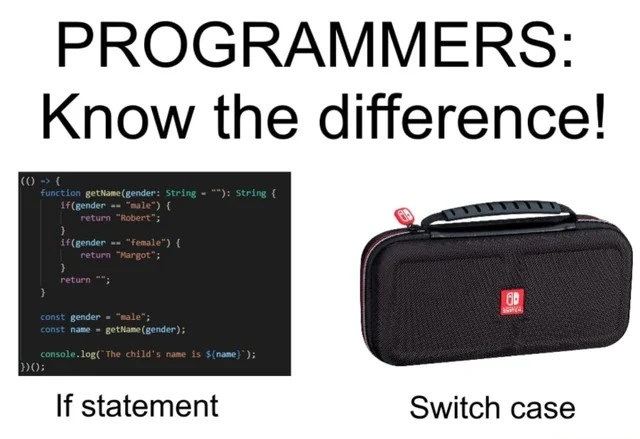
When “switch case” isn’t about control flow, but Nintendo luggage
Why is this Languages meme funny?
Level 1: Not That Case
This meme is playing with words in a fun way. It takes a phrase that programmers use and shows a completely different meaning of those words. Think of it like a simple riddle or a pun. The phrase “switch case” in programming is something that helps a computer make choices (kind of like a traffic light telling cars which way to go: green means go one way, yellow another, red another). But the meme shows a Nintendo Switch case, which is basically a little suitcase to protect a Nintendo Switch game console.
Imagine you hear the words “switch case.” If you’re a gamer, you might picture the black zip-up case that holds a Nintendo Switch. If you’re a coder, you picture a special command in code for making decisions. The joke is that those two things have the same words but totally different meanings. It’s like someone said one thing and your brain thought of something else. For example, if your friend said “I lost my Java script,” a regular person might think they lost a coffee recipe (Java = coffee, script = written text), but a programmer would think of losing a file of code named script.js. Here it’s the opposite: we expected something about code, but got something from the real world instead. The meme says, “PROGRAMMERS: Know the difference!” as a silly way to point out how funny it would be if you mixed them up. Of course, no one really would, and that obviousness is what makes it funny!
In the simplest terms, this meme is a wordplay joke. It’s funny because it shows how a single phrase can mean one thing to programmers and something else to everyone else. It reminds us of when a word has two meanings, like “orange” (a fruit or a color) or “spring” (a season or a coil). If someone used one meaning and you thought of the other, you might get momentarily confused — and that mix-up can be amusing. Here, the phrase “switch case” made us think of serious coding stuff, but then bam! The picture is a gaming gadget case. 😂 The surprise makes us laugh. So the big idea is: in programming, a “switch case” helps the computer choose what to do; in normal life, a “Switch case” keeps your game console safe. Don’t mix them up, unless you want a good giggle!
Level 2: If vs Switch
For a newer programmer (or someone learning the ropes of a language like JavaScript or TypeScript), the terms “if statement” and “switch case” might sound similar, but they refer to two related yet distinct tools for making decisions in code. Let’s break it down in straightforward terms:
If statement: This is a fundamental building block of programming. An
ifstatement checks a condition – for example, “Isgenderequal to 'male'?” – and if the answer is true, it executes a certain piece of code. You can chain multiple conditions usingelse ifand provide a fallback withelse. In the left side of the meme’s code snippet, they used twoifchecks: one for"male", one for"female", and then returned a default ("") if neither condition was met. That’s essentially a series of if/else-if conditions (even though in the snippet eachifstands alone, the logic is equivalent to an if/else chain because eachreturnexits the function). In short, an if statement is like a fork in the road: if the condition is true, go one way; if not, you might go another way or just continue.Switch-case statement: A
switchstatement is another way to handle multiple possible values of a single variable. It’s almost like a menu of actions for each value. You writeswitch(expression)and then a set ofcase value:labels underneath. For eachcasethat matches the expression’s value, the program executes the code under that label. You usually include adefaultcase as well, which is what to do if none of the specified values match. So for the same logic as the snippet, a switch-case version checks thegendervariable and has one case for"male", one for"female", and a default for anything else. The key difference is syntax and clarity. A switch-case can be cleaner and more readable when you have a lot of specific values to compare. Instead of writing manyelse ifstatements, you list out the cases. One important quirk: in many languages like C, Java, and JavaScript, you need to add abreakat the end of each case block to prevent fall-through (that is, to stop execution from continuing into the next case unintentionally). Forgetting thosebreakstatements is a common newbie mistake – one of those little LanguageQuirks you learn by debugging odd behavior when multiple cases run in a row! (In our TypeScript example, usingreturninside each case would also effectively prevent fall-through by exiting the function.)
Now, what’s happening in this meme? The left side is labeled “If statement” and shows exactly that in code form: a function choosing a child’s name based on an input using if. The right side is labeled “Switch case” but shows a very literal switch case: a protective case for the Nintendo Switch console. The joke is a classic bit of programming wordplay. In coding, “switch case” is a phrase meaning a switch statement with its case sections – a concept in CS fundamentals for controlling program flow. But outside of coding, the words “switch” and “case” together could describe an object: a case (container) for a Nintendo Switch (the popular gaming device). The meme is telling us to “Know the difference!” as if someone might actually mix them up. It’s poking fun at the terminology of programming languages that overlaps with normal English.
This resonates with developers because we often use words in coding that have everyday meanings. For example, “array” is a common term in coding (an ordered list of items), but in plain English, array just means an impressive display or range of things. Similarly, “bug” in tech means an error in the code, but ordinarily it’s an insect. Here, “switch” (in code) is a keyword to start a multi-branch conditional, and “case” refers to each branch. But put together “switch case” outside the context of code, and it sounds like you’re talking about a case for a Switch console. 😄 The meme is a lighthearted reminder that context matters: in one context, “switch case” is about code syntax; in another, it’s about a gadget accessory.
For someone early in their coding journey, this meme is also a playful prompt to remember what a switch-case statement actually is. It highlights by contrast: an if statement is one way to handle decisions, whereas a switch statement is another way (usually when there are many possible values to check). And importantly, neither has anything to do with carrying your gaming console! The humor boosts understanding: you’ll definitely “know the difference” after seeing this, because the wrong interpretation is so laughably off-base. It’s a little bit of CodingHumor that doubles as a mnemonic. Next time you hear about a switch-case in a programming discussion, you’ll think of code, not zippers and game cartridges, and maybe crack a smile remembering this meme.
Level 3: Switching Contexts
At first glance, this meme hits experienced developers with a one-two punch of conditional logic humor and plain old wordplay. On the left, we see a TypeScript snippet using a series of if statements to choose a name based on a gender value. On the right, instead of a code snippet with a switch statement, we get a Nintendo Switch carrying case – literally a zip-up Switch case. The caption “PROGRAMMERS: Know the difference!” sets a tongue-in-cheek tone. It’s as if someone fears a coder might hilariously confuse a fundamental code construct with a piece of gaming luggage. This absurd contrast is exactly why it’s funny: it juxtaposes a control flow concept with a console case, exploiting the fact that the phrase “switch case” means something completely different in programming versus everyday life.
From a seasoned developer’s perspective, the meme also riffs on the classic debate of using an if-else chain versus a switch-case statement in code. In many languages (including TypeScript shown here), if statements and switch statements both handle conditional logic, but in different ways. An if checks a boolean condition and can be chained (if/else if/else) to handle multiple possibilities. A switch statement directly jumps to the matching case for a given value. Under the hood, compilers/interpreters might even optimize a switch with a jump table or binary search, making it potentially more efficient than a long cascade of if...else if checks. In our snippet, for example, a seasoned coder might refactor multiple if conditions on the same variable into a cleaner switch. In fact, the left code could be rewritten as:
// Using a switch-case instead of multiple ifs:
function getNameSwitch(gender: string = ""): string {
switch (gender) {
case "male":
return "Robert";
case "female":
return "Margot";
default:
return "";
}
}
However, the meme deliberately avoids showing a code-based switch – because that would spoil the joke. Instead, it gives us the other kind of switch case (the one with zippers and a Nintendo logo) to drive home the pun. Seasoned devs recognize instantly that no amount of case clauses in code will help protect your Nintendo Switch from scratches. 😅 The humor comes from that mental gear-shift: “Oh, not that kind of switch case!” It’s a playful reminder that our programming jargon can sound like everyday phrases. In tech circles, this joke also nods to LanguageQuirks and the ability of language keywords to confuse or amuse. We talk about “cases” in a code context (meaning distinct scenarios or branches in a switch statement), but here we’re confronted with a literal carrying case for a gadget named “Switch.” It’s a perfect syntax pun: same words, wildly different meaning.
There’s a bit of geeky self-awareness too. The meme’s format – “Know the difference!” – parodies the way experienced programmers sometimes correct newbies on terminology. It exaggerates that pedantry to comic effect. No real programmer would truly mix up an if statement with a Switch console case, but framing it as if it’s a crucial distinction is what makes it DeveloperHumor. It also subtly highlights how terms in programming (switch, case, if) can be everyday English words. Context is everything. An old-timer dev might chuckle remembering their early days learning about switch statements and perhaps initially being confused by the word “case” (why call it a case? Is there a box involved? 😜). The meme taps into that shared experience and HumorInTech: even simple CS fundamentals like branching statements can be fodder for jokes when you take words literally. In summary, for the experienced eyes, this meme cleverly merges ConditionalLogic with console carry-cases, reminding us that in programming, as in life, it’s good to clarify which case you mean – lest you end up trying to pack your code into a travel bag!
Description
The meme is laid out in two columns beneath the bold heading “PROGRAMMERS: Know the difference!”. On the left, a dark-themed code editor window shows a TypeScript/JavaScript snippet: “function getName(gender: String = ""): String { if(gender == "male") { return "Robert"; } if(gender == "female") { return "Margot"; } return ""; } const gender = "male"; const name = getName(gender); console.log(`The child's name is ${name}`); }();”. A caption under the snippet reads “If statement”. On the right, a product photo of a black, zip-up Nintendo Switch carrying case with the red Switch logo is captioned “Switch case”. The joke relies on the homonym between the programming keyword pair “switch/case” and a literal Switch console case, reminding seasoned devs of the difference between an if-chain and a switch statement while poking fun at language terminology
Comments
6Comment deleted
One protects a $300 console; the other protects us from the post-mortem when marketing adds a new enum value and every user suddenly gets named “default.”
The real difference is one requires a break statement to avoid falling through, and the other requires a break statement to avoid your kids falling through your home office door during a production incident
This meme perfectly captures the eternal debate: when you're refactoring that gnarly if-else chain into a switch statement, but your team lead keeps asking why there's a Nintendo accessory in the code review. Classic case of premature optimization - both the code and the carrying solution
In prod I only trust the switch case with a zipper; the other kind becomes a disguised GOTO the moment someone forgets break, and suddenly every enum maps to default: incident
Real seniors don’t argue if vs switch - they use a lookup map: O(1), no fall-through, and no carrying handle required
This if-else genders by name like a 90s DB schema; switch cases handle enums without the binary assumptions - or Joy-Con drift