Father’s brutal code review: Boromir would have documented Hello World
Why is this Documentation meme funny?
Level 1: High Expectations
Imagine a proud little kid who just cleaned his room for the first time. He runs to his dad saying, “Look, I cleaned my room all by myself!” He’s beaming, expecting a big hug or a “Good job!” But instead, the dad crosses his arms and replies, “Well, your older brother would have sorted all the toys into labeled boxes and written a list of where everything goes.” Ouch! 😮 It’s the same kind of joke as the meme. The kid did something small but exciting (cleaning the room, like writing a simple program), and the dad responds with an even higher expectation (having everything perfectly organized and documented). It’s funny in a silly way because the dad’s standard is so over-the-top for a first try. The poor kid just wanted some praise, but the dad expected a perfectly catalogued closet! In real life, we laugh at this because we know the dad is being ridiculous – he should just be happy the room is clean at all. The meme uses that idea: a newbie is happy their tiny code works, and the mentor figure jokes that it’s not good enough without a write-up. It’s poking fun at how sometimes parents or teachers (or bosses) compare us to somebody else who always does it better. The humor comes from the exaggeration of the dad’s high expectations, which makes the situation so absurd that it becomes cartoonish and funny.
Level 2: Hello World Best Practices
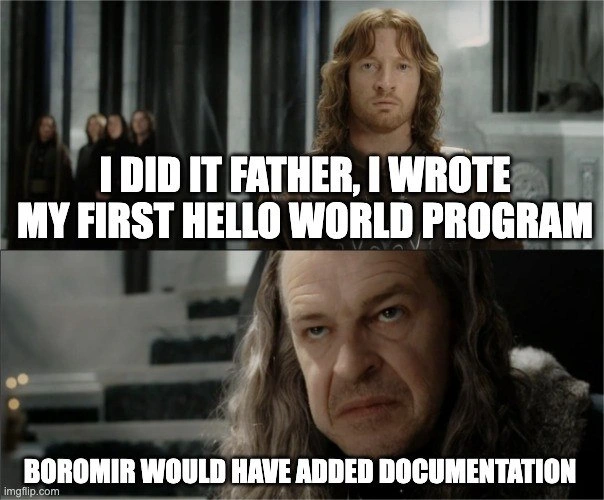
In this meme’s scene, a young developer (like the character Faramir) excitedly tells his mentor or boss (Denethor, his father in LOTR), “I did it, Father, I wrote my first Hello World program!” He’s just proud that he got something working in code. In programmer terms, a Hello World program is the very first, very simple program people write when learning a new programming language – its only job is to print out “Hello, World!” on the screen. It’s practically tradition in coding. Usually, writing a Hello World is part of the learningToCode journey where the goal is to confirm “Hey, my code runs and displays output.” It’s a minimal accomplishment, but for a newbie it’s a big milestone: the computer obeyed their instruction! In the meme, the son is at that stage – thrilled to show Dad his tiny success.
However, the father’s response in the second panel is a total downer: “Boromir would have added documentation.” In the movie this scene is emotional (Denethor always compares Faramir poorly to his older brother Boromir), and here it’s turned into a tech joke. The father is basically acting like a strict code reviewer or a senior developer. Code review is when another developer (often a senior or a teammate) looks over your code and gives feedback before it’s accepted. And boy, is this feedback harsh! He’s saying that simply printing “Hello World” isn’t enough – the son should have also written documentation for it, just like the exemplary older brother would have. Documentation, in a coding context, means any text that explains what the code does or how to use it. It can be comments in the code itself, or external docs like a README file or user guide. It’s a key part of CodeQuality because well-documented code is easier for others (or your future self) to understand and maintain.
Let’s break down the joke. It’s funny because writing documentation for a HelloWorld program is like writing a full instruction manual for a one-line joke. Hello World programs are so simple and universally understood by developers that they almost never come with comments or docs – their purpose is obvious. That’s why the father’s demand feels over-the-top. He’s holding the son to an unrealistically high standard, the kind usually reserved for much larger projects. For a junior developer, just getting the code to run is the big achievement. But the senior developer (the father) cares about process and best practices: they want everything done “properly” even if it’s small. This meme highlights a common Junior vs Senior scenario: the junior says “It works!” and the senior replies “But is it well-documented? Is it formatted correctly? Did you follow all the guidelines?” It can feel nitpicky to the junior, but it’s how seniors try to instill good habits. In real life, a mentor might gently remind a newbie to add a comment at the top of their code explaining the purpose. In the meme, it’s exaggerated as a scolding.
To visualize what the father expects, imagine the son’s HelloWorld code with proper documentation. For example, if it were a Python script, the senior might insist on a module docstring at the top:
"""
HelloWorld.py - A simple program that prints "Hello, World!" to the console.
This script is an introduction to Python and is used to verify that the environment is set up.
"""
# Print a greeting to the user
print("Hello, World!")
In the above code, the part in triple quotes is documentation. It explains what the program is and maybe why it exists. The commented line before the print statement is another tiny bit of documentation describing that line. For a trivial program like this, these comments are arguably unnecessary – any programmer can see that print("Hello, World!") prints a message. But that’s exactly the source of humor: the father character would insist on those comments anyway! If this were Java or C, he’d expect a similar comment block or Javadoc style header. Picture Boromir (the hero older brother) coding: Boromir would not only write the code to print “Hello, World!”, he’d also write a paragraph explaining the code’s purpose, usage instructions, maybe even list the date and author at the top. The dad’s line essentially means “A real developer like Boromir follows all the best practices, whereas you just did the bare minimum.” Ouch!
This is a form of DocumentationHumor because it’s poking fun at how documentation is often treated. Many of us have been in the son’s shoes: excited about making something work, then being told we should’ve commented our code or written a better description. It often happens in school projects or the first time you contribute at work – you submit your code and a reviewer asks, “Can you add some documentation on what this does?” The meme exaggerates it to a ridiculous scenario (demanding docs for HelloWorld) to make us laugh. But if you’ve ever had a pull request where the reviewer wanted more comments, it strikes a chord.
Let’s also touch on the LOTR reference: Denethor, Faramir, and Boromir are characters from The Lord of the Rings. Denethor (the father) was always hard on Faramir (the younger son), thinking Boromir (the older son) was better at everything. In the film scene, Denethor basically says, “I wish Boromir were here instead of you” – pretty brutal parenting. The meme leverages that famous moment to represent a boss or mentor who’s impossible to please. If we translate it to a workplace scenario, Boromir is like the star senior developer who can do no wrong, and Faramir is the new hire trying his best. The father comparing them is like a boss saying, “Why can’t you code and document like Our Best Employee does?” It’s an exaggerated version of real comments juniors sometimes hear, which might sound like: “Good start, but next time remember to add comments like [Senior’s name] always does.” So the meme mixes this pop-culture scene with a coding humor twist, making it very relatable in developer communities. You have the dramatic setting of a medieval throne room (courtesy of the denethor_scene), but the dialogue is about a tiny coding exercise and a harsh code review style remark. That contrast is what makes it so comical.
In summary, the father’s statement “Boromir would have added documentation” highlights the importance placed on documentation in coding practice, albeit in a sarcastic way. It teaches (through humor) that writing code isn’t the only part of a developer’s job – explaining the code is also valued. For a junior dev, this meme is a lighthearted lesson: no matter how small your program is, someone more experienced might poke at the quality aspects you overlooked. And for seniors, it’s a chuckle at our own tendency to sometimes go overboard with code quality rules. After all, expecting a beginner to perfectly document a “Hello World” is as paradoxical as Denethor expecting Faramir to live up to the legendary Boromir in one try. It’s both funny and a little relatable – we’ve all either given or received feedback phrased less dramatically but with the same energy. So, the next time you finish a small script, you might jokingly ask yourself: “What would Boromir do?” (And the meme’s answer: he’d write the docs!).
Level 3: One Does Not Simply Skip Docs
At first glance, this meme mashes up Lord of the Rings drama with developer culture to deliver pointed DocumentationHumor. In the top panel, the proud son (Faramir) announces he wrote his first “Hello World” program – the classic trivial program that just prints HelloWorld to the screen. In the bottom panel, his severe father (Denethor) scowls and retorts, “Boromir would have added documentation.” This is an epic code review burn wrapped in a fantasy reference. It’s making seasoned devs smirk because it captures a JuniorVsSenior dynamic perfectly: a junior dev celebrates a tiny victory, and a senior dev (or overzealous code reviewer) immediately nitpicks about documentation. The humor lies in the absurdly high code quality standards being applied to the most basic program imaginable. It’s as if the father is the self-appointed Steward of Code Quality, demanding that even a one-line script adhere to enterprise-level guidelines.
Why is this funny to people in tech? Because we’ve all seen a harsh code review where a reviewer (like Denethor on his throne) finds something to criticize no matter how trivial the change. Hello World is typically the simplest code in any language – it’s practically a rite of passage in the LearningToCodeJourney and no one writes documentation for it. Yet here, the father implies that not writing docs is a grave omission. This exaggeration hits on a real tension in software teams: seniors insist on best practices (comments, docs, tests, the works) while excited newcomers are just happy the code runs. The meme uses the Denethor-Faramir denethor_scene (where Denethor famously compares his sons and finds Faramir lacking) to parody a code review scenario. The father’s line “Boromir would have added documentation” translates to “a better developer would have followed proper process.” It’s both a snarky jab and an inside joke about strict coding standards. Experienced devs chuckle because they recognize that pedantic reviewer who treats minor omissions as if the world is ending.
This scenario reflects real CodeQuality discussions. In many professional environments, there’s an unwritten rule: “It’s not done until it’s documented.” Seasoned engineers often stress that code should be self-explanatory and have supporting docs or comments. From their perspective, even a simple script benefits from context: Why does it exist? How do you run it? Imagine a senior developer channeling Denethor’s attitude in a GitHub pull request:
- Junior PR title: “Add HelloWorld script.”
- Senior comment: “Where’s the README update? Boromir would have documented this.”
It’s amusing because we know HelloWorld is as straightforward as it gets – any developer reading it can instantly tell what it does. Insisting on documentation for it is overkill, akin to requiring a full user manual for a light switch. But that’s the joke: some teams (or grumpy tech leads) act ultra-strict about process. They treat a tiny beginner script with the same rigor as a mission-critical module. The father’s disappointment encapsulates that extremism. It resonates especially with developers who’ve been on either side of such interactions: the enthusiastic newbie who can’t wait to show something that works, and the jaded veteran who’s seen undocumented code become a nightmare later on. The father’s character is essentially saying, “Working code isn’t enough; you should aspire to the Boromir-level of thoroughness.” (Boromir here represents the model developer who never forgets to write docs, much like an “ideal older sibling” in a dev team who sets a high bar.)
From an industry point of view, this highlights the perennial struggle with docs. Documentation is often the neglected child of software development – everyone knows it’s important, but it’s tedious, and newcomers especially tend to skip it. Seasoned devs who have had to maintain someone else’s code later are keenly aware of the pain of missing docs. Hence, a senior might drill the mantra early: even if it’s just a “Hello World”, practice writing a comment or two. This meme cranks that scenario up to comedic levels by implying a legendary warrior-coder (Boromir) would dutifully comment even the obvious, making the poor junior feel inadequate. In practice, being asked to document a HelloWorld program is a hyperbole – a funny one, because it’s a bit like being asked to provide architectural diagrams for a paper airplane. But it stems from a kernel of truth in developer culture: best practices can sometimes feel onerous or excessive, especially to juniors, yet seniors champion them for long-term good.
To really appreciate the joke, it helps to remember Boromir’s own famous meme line from LOTR: “One does not simply walk into Mordor.” Here it’s as if Denethor is implying “One does not simply write code without docs.” It’s a nerdy cross-reference that deepens the humor for those who know the source. The lord_of_the_rings_meme fusion works great because both realms (Middle-earth and coding) have their serious lore and strict gatekeepers. Denethor’s stern expression in the image matches a nitpicking tech lead’s face perfectly. He’s essentially gatekeeping code quality: no documentation, no glory. This is a classic piece of DeveloperHumor exaggeration – turning an ordinary code review comment into a dramatic cinematic moment. For developers, the meme is funny because it’s too real: we laugh, then we nervously recall that senior colleague who commented on our first commit “Please add comments and documentation.” The meme’s punchline reminds us of an almost universal experience in programming teams, where excitement meets reality: It works, but now make it presentable.
To sum it up, the meme humorously contrasts a junior developer’s perspective with a senior developer’s expectations using LOTR characters as stand-ins. It’s poking fun at how documentation and code quality feedback can deflate a newbie’s triumph. We’re laughing both at Denethor’s over-the-top harshness and at ourselves – because deep down, we know Boromir’s thorough approach is good practice, even if it feels like slaying a dragon with paperwork for a mere “Hello World.” The next time you celebrate a tiny coding win, beware the Denethor in your office who might say, “Sure it works… but where are the docs?” It’s this shared understanding of developer ups and downs that makes the meme instantly relatable and hilarious among coders.
Description
Two-panel meme using the Denethor and Faramir throne-room scene from Lord of the Rings. Panel 1 shows the son character addressing his father; bold white caption reads “I DID IT FATHER, I WROTE MY FIRST HELLO WORLD PROGRAM.” Panel 2 zooms in on the disappointed father, captioned “BOROMIR WOULD HAVE ADDED DOCUMENTATION.” The joke contrasts a junior developer’s excitement over a minimal “Hello World” with a senior-like demand for proper documentation, poking fun at code quality standards and the perennial struggle to write docs. Visually, the meme employs block-letter Impact font, white text with black outline, over a dimly lit medieval hall - typical meme styling - making it accessible as both humor and commentary on developer culture
Comments
6Comment deleted
Denethor’s PR review: “Boromir would’ve shipped an ADR, OpenAPI spec, and a deprecation roadmap for Middle-earth v1 before daring to print ‘Hello, world’ - requesting changes.”
Twenty years later, you're still maintaining that Hello World because someone built the entire company's authentication system on top of it
The irony here cuts deep: we've all been that eager junior who thought shipping 'Hello World' was an achievement, only to become the Boromir who reviews PRs at 2 AM muttering 'where are the goddamn docstrings?' The real tragedy isn't that Boromir died at Amon Hen - it's that he never got to see his team adopt automated documentation linting in their CI/CD pipeline
A 'Hello World' without docs turns O(1) code into O(n) Slack messages
Denethor's wisdom: even hello world needs docs, or it's just the first line of undocumented legacy your successor curses at 3 AM
Hello, World PR: LGTM once you add the README, an ADR on why it’s “World” not “Universe,” SLOs for “Hello,” and a runbook for when it returns 500 at 3AM