Skip to content
DevMeme
4519 of 7435
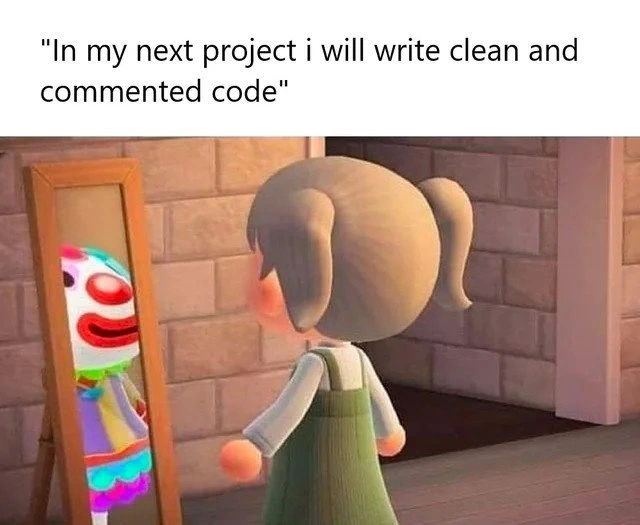
When developers promise clean commented code but the mirror shows a clown
CodeQuality Post #4959, on Oct 28, 2022 in TG

When developers promise clean commented code but the mirror shows a clown

Why is this CodeQuality meme funny?

Level 1: Only Fooling Myself

Imagine you have a big box of toys and your room is totally messy. You tell your parents, "Next time I play, I promise I'll put every toy back and keep my room super clean!" You really mean it when you say it. But then the next day comes, you play with your toys, and...oops! The room is a disaster again. When you look in the mirror, instead of seeing a responsible, tidy kid, you see a silly clown face laughing because it knows you didn’t keep your promise.

This meme is just like that, but for people who write computer code. The person is saying they'll be neat and organized in the future, but deep down they know they're kind of joking with themselves. The clown in the mirror is a funny way of showing that the person realizes they're being a bit silly – like telling a white lie to themselves. It's poking fun at that feeling when you say you'll do better next time, but you kinda know you probably won't. We laugh at the picture because we’ve all been that person, promising to be better and then ending up in the same messy situation, thinking, "Ha, I fooled myself again!"

Level 2: The Next Project Trap

For newer developers, let's break down what's going on. The meme shows a programmer character saying "in my next project I will write clean and commented code." This is basically them promising to do a better job in the future: writing code that is neat, well-organized (clean code), and clearly explained with code comments. Code comments are those bits of text in code (often after // or #) that developers include to describe what the code is doing or why. Clean code and good commenting are part of software best practices you hear about in school or read in guides: things like using clear variable names, breaking your program into small functions, and writing docs so others (and you in the future) can understand the code easily. And yes, these practices are super important for CodeMaintainability – meaning, how easy it is to maintain and update the code later.

Now, why is this developer talking about "my next project"? Often, when you're working on a project under pressure, you might cut some corners. Maybe you leave out comments because you're in a hurry, or you write some messy code just to make something work before a deadline. Afterwards, when the rush is over, you look at the messy result and feel a bit guilty. You might think, "Ugh, this code turned into a mess. But you know what, next project will be different. I'll do everything right from the start next time." It's like a promise to yourself that the next time around you'll follow all the CleanCodePrinciples you've learned. This pattern of thinking "next time I'll get it perfect" is what we mean by The Next Project Trap. It's a trap because it's easy to always push the good habits off to some future project instead of doing them now.

The bottom part of the meme — the mirror showing a clown face — is telling us that this promise is a bit of a joke. The character looks in the mirror expecting to see a serious, determined developer ready to write perfect code, but instead sees a ridiculous clown. Why a clown? In internet and meme culture, calling someone a "clown" or showing them as a clown is a humorous way to say they're fooling themselves or doing something silly. It's self-deprecating here: the developer is basically admitting that believing they'll suddenly become this ultra-disciplined coder just because it's a new project is kind of naïve. In other words, the mirror is saying, "Who are you kidding? You're not really going to do that, you're just clowning around."

This speaks to developer humor and a common experience in coding. Beginners might not have felt it yet, but after a couple of projects, you start noticing how easy it is to intend to write perfect code and how hard it is to actually do it when you're under real-world constraints. For instance, maybe in your first big coding assignment or internship, you promised yourself to write thorough documentation for every function. But then crunch time came, and you left a lot of functions undocumented or with just a quick one-line comment that wasn't very helpful. Later, when trying to fix a bug or add a feature, you struggled to remember what your own code does. That's when you think, "Next time, I'll comment everything properly." The meme captures that exact moment of realization and the somewhat comedic lack of confidence that we'll follow through.

Let's define a couple of terms here in simpler words:

  • Clean code: Code that is easy to read and understand. Imagine a clean room where everything is organized — clean code is like that, but for programs. It uses clear names (e.g., a variable called total_price instead of tp), it has a simple structure (not a 500-line long function doing ten different things), and generally, someone else can read it and quickly grasp what's happening. Clean code often doesn't even need a ton of comments because the code itself is written so clearly. But having comments for complex parts or overall module behavior is definitely part of keeping it understandable. Clean code is a goal taught in many coding courses and books (like the famous "Clean Code" by Robert C. Martin).

  • Commented code: This just means code that has comments explaining or annotating it. In many languages, you write // or /* ... */ for comments (or # in scripts). These comments are ignored by the computer, they're just notes for humans. Example:

    # Calculate the area of a circle given the radius
    area = 3.14 * radius * radius
    

    The sentence starting with # is a comment explaining what the next line of code is doing. Commented code is helpful when the why or how of the code isn't obvious just from reading it. It’s part of writing maintainable code because when you or someone else returns to this code later, the comments act like little guideposts or documentation. However, comments only help if they're written well (accurate, clear, and kept up-to-date if the code changes). If you skip writing them entirely, future maintainers might be left scratching their heads.

  • Technical debt: This is a figurative way to describe what happens when you take shortcuts in coding. Think of it like borrowing money: if you write quick-and-dirty code today (take a shortcut), you "borrow time" — you saved time now, but you incur a debt that you'll have to pay back later by fixing or refactoring that code. Just like financial debt, technical debt can accumulate "interest" – the longer you wait to clean up the messy code, the more it might cost you (in time, bugs, crashes, etc.) down the road. In a newbie's terms: if you don't write clean code now, you'll have a bigger headache fixing it later. The meme hints at this: our developer probably has some ugly code in the current project, feels that debt, and promises to do better next time instead of fixing it now. But pushing it to the future is like pushing debt to the future – it often makes things harder.

Now, why do developers end up writing clown-ish code even when they know they should do better? A lot of it comes down to time and pressure. In a perfect world, you'd carefully plan out the architecture, comment every function, and refactor code whenever you spot a flaw. But in reality, developers often have deadlines (say, an app release or a client demo), and bosses or clients care more about "Does it work?" than "Is it nicely written under the hood?". If you're rushing to add a feature before Friday, you might say, "I'll just squeeze this logic here; it's not the cleanest thing but I'll comment it later or tidy it up after the demo." That "later" is the dangerous part – because once the feature is out and the demo is done, new tasks come in and that promised cleanup might never happen. This is super common in teams: everyone intends to circle back for polish, but there's always another ticket or bug or feature taking priority. Over a whole project, these little messy bits accumulate into a big ball of mud (another term for a messy codebase).

Junior devs often feel bad when they realize their code turned messy. But seeing a meme like this shows it's a universal experience. It's almost a rite of passage to look at your own old code and cringe. In fact, many programmers have a personal rule: "If you don’t feel at least a bit embarrassed by code you wrote 6 months ago, you’re not learning or improving." So feeling that "Oh man, I was such a clown to think this would stay clean!" means you're growing your awareness. The meme's joke is essentially a gentle, humorous nudge: we all wear the clown wig sometimes when it comes to our code.

Also, the image choice is interesting. It's using an Animal Crossing style character (a cute, simple video game character) looking into a mirror. This adds a lighthearted, almost childlike tone — as if the dev is innocently hoping, and the clown is a cartoony reminder not to be too confident. The brick wall and wooden mirror give a cozy vibe, which contrasts comically with the clown reflection's bright face. This contrast emphasizes the surprise: you're in a normal scenario, then bam! clown reality check. The phrase in the image is all lowercase ("in my next project i will write clean and commented code"), which might be just a stylistic choice, but it subtly suggests an informal, offhand promise — not a strongly committed one. Kind of like how we casually say, "Yeah, next time I'll definitely do that..." without truly convincing anyone, even ourselves.

In summary, Level 2 takeaways:

  • Developers strive for high code quality (clean, well-documented code), especially when they've suffered from messy code before.
  • It’s easy to promise to do better later, but much harder to actually change habits when new pressures arise.
  • The clown is a funny way to show the developer is basically fooling themselves with that promise. It's self-mockery common in CodingHumor and DeveloperHumor circles, where we poke fun at our own bad habits.
  • The term technical debt is central to this scenario: it's what accumulates when we don’t write the clean, commented code we plan to. And paying off that debt is never as fun as accumulating it 😉.
  • The meme is basically a mirror (literally) for developers: if you’ve ever thought “next time I’ll do it right” and then didn’t, you see yourself in that clown reflection.

Level 3: Clean Code Delusions

Every seasoned developer has, at some point, sworn to do better next time: "In my next project I will write clean code with plenty of comments." It's a familiar mantra in software teams after slogging through a messy codebase. The humor in this meme hits hard because it lampoons that bold promise versus the clownish reality. The top text is literally a developer's vow for great CodeQuality and CodeMaintainability on the next go-around. But in the mirror, instead of a disciplined coder, stands a clown with rainbow hair and a goofy grin. 😅 This clown is essentially the developer's reflection, calling them out. Why? Because experienced devs know that this virtuous promise often turns into TechnicalDebt and spaghetti code once real-world pressures kick in. The clown staring back is saying, "Sure, buddy, keep telling yourself that."

Let's unpack the elements here. The developer avatar (in a cute Animal Crossing-style) represents any coder with good intentions. She confidently declares the intention to follow CleanCodePrinciples—meaning well-structured functions, clear naming, proper documentation, and no hacky shortcuts. In theory, this would result in maintainable software that any team member can pick up easily. The clown in the mirror, though, symbolizes the truth of what often happens: as soon as deadlines loom, features creep, or that Friday 5 PM deployment goes sideways, our lofty plans for pristine architecture and thorough CodeComments slip away. We've all been there: one minute you're preaching "no global variables, comprehensive docstrings, unit tests for every function", and the next you're copy-pasting Stack Overflow code into production at 2 AM. The clown is basically saying, "Look at yourself. You are the one writing that janky code and leaving // TODO: fix this later all over the place."

This resonates with developers because it's a shared inside joke about technical debt and self-delusion. Technical debt is the concept (coined by Ward Cunningham back in 1992) that when you write quick-and-dirty code or skip best practices, you're borrowing time that you'll have to pay back with interest later when the codebase becomes harder to maintain. In this meme, the "next project" promise is like refinancing that debt – pretending you'll magically repay it by writing flawless code in some future endeavor. The industry reality is that the next project often inherits the same rushed approach and compromises, thus racking up new debt. It's a cycle: developers start fresh with a greenfield project and high ideals, but soon the pressure to deliver features forces cut corners. They might skip writing documentation, ignore proper error handling, or cram multiple responsibilities into one function, just to get things working. Each shortcut is a code smell (a sign of poor CodeMaintainability), but hey, it works... for now. The plan is always to come back and clean it up later. But later never quite arrives — or if it does, it's in the form of a big refactor when things are on fire. 🔥

The meme nails this irony by literally reflecting the developer's future self as a clown. It's essentially saying, "Who are you kidding?" The clown is a classic symbol in memes for someone being foolish or naive — here the developer themselves for believing the "next time" fairy tale. The combination of the earnest statement and the clown mirror makes the humor pop: it's both self-deprecating and painfully relatable. Seasoned engineers chuckle (or groan) because they've lived through countless codebases that started with "Let's do this right" and ended up as an unmanageable circus of quick fixes. The circus metaphor is apt: once the code gets out of control, debugging and adding features becomes a chaotic juggling act, often involving some clownery to patch things up. We joke that some legacy systems are a "clown fiesta" or a circus tent of horrors, maintained only by miracle and duct tape.

Organizational dynamics fuel this too. Business stakeholders reward delivering features fast; rarely do project timelines account for writing documentation or refactoring for clarity. Thus, developers face a tough trade-off: ship it now or spend time cleaning it and risk delays. Under pressure, good habits can slip. It's not that developers want to write bad code; it's that real-life constraints push them into it. Over time, a kind of dark humor develops around this phenomenon. We laugh at memes like this because it's a coping mechanism — better to call yourself a clown playfully than to cry over the 10,000-line monolith script you promised to neatly refactor months ago. The meme's popularity in DeveloperHumor circles shows how universal this experience is: making grand promises about code quality and then breaking them is practically a rite of passage in this field.

In sum, the top half of the meme is every developer's idealism speaking. The bottom half is reality laughing back. "Clean code? Commented code? Sure, maybe in a parallel universe," the clown smirks. It's a gentle roast of our coding mistakes: we often become the clown by writing exactly the kind of messy code we vowed to avoid. This mix of aspiration and self-aware failure is funny because it's true. After all, if you've ever opened a source file six months later and wondered "who wrote this garbage?", only to git blame and discover it was you – congrats, you've seen the clown in the mirror. 🤡

// Idealism on day 1:
function calculateResults(data) {
    // This function will be well-documented and clear
    // ... plan to implement properly ...
}

// Reality by day 30 (rushed and uncommented):
function calculateResults(d) {
    processData(d); doImportantThings(d); return "42"; // TODO: refine logic later
}

Above: At the start, you sketch out a clean plan with intentions to document everything. But by the end, you have a clownish function: doing too much, poorly named variables (d?), cryptic one-liner logic, and a // TODO comment quietly admitting defeat. The code works, but it's a maintainability nightmare for anyone who touches it next (including future you). The clown reflection in the meme is essentially future-you going, "Hah, nice try thinking this would be clean!"

So, why do experienced devs smirk at this image? Because it's a mirror we’ve all looked into. The gap between promise and implementation is a running joke in software development. We know what Clean Code looks like – maybe we've even read Uncle Bob’s Clean Code book and can recite the rules – but keeping a real-world codebase pristine is comically difficult. Something always gives: time, discipline, or clarity, and suddenly the code is wearing a big red clown nose. Once you’ve been through a few projects, you recognize this pattern and can laugh at your past optimism. The meme cleverly distills that rueful laugh: the dev's next project pledge is practically the setup to a punchline, and the clown is the punchline personified. In other words, the code may start as a noble knight, but it often ends up a jester.

Description

The meme has two parts. Top white section contains the text: "In my next project i will write clean and commented code" (all lower-case exactly as shown). Below, a 3-D cartoon character with grey pigtails, rendered in the style of the Animal Crossing video game, stands in front of a full-length wooden mirror. Instead of her own reflection, the mirror shows a brightly colored circus-clown face with rainbow hair and exaggerated red lips, implying the person is fooling only themselves. Technically, the joke highlights the perennial gap between developers’ aspirational plans for clean, well-documented code and the messy reality that turns into unmaintainable “clown” code once deadlines and shortcuts creep in - touching on code quality, maintainability, and technical debt themes familiar to seasoned engineers
Comments

6
Anonymous ★ Top Pick Kickoff me: “This repo will be pristine, fully documented.” Git-blame mirror six weeks later: a 300-line function named handleEverything() with the sole comment // here be dragons - deadline won
  1. Anonymous ★ Top Pick

    Kickoff me: “This repo will be pristine, fully documented.” Git-blame mirror six weeks later: a 300-line function named handleEverything() with the sole comment // here be dragons - deadline won

  2. Anonymous

    The same developer who swore they'd write clean code is now defending their 500-line function in code review because "it's more performant to avoid the overhead of function calls."

  3. Anonymous

    Every senior engineer knows this mirror doesn't lie - we've all stood before it after our tenth 'greenfield project' that somehow accumulated the same technical debt as the legacy system we swore we'd never recreate. The real wisdom isn't in promising clean code next time; it's in accepting that 'clean' is a spectrum, and sometimes shipping with TODO comments and a mental note to refactor is more honest than six months of architectural bikeshedding. The clown isn't the developer who writes messy code under pressure - it's the one who genuinely believes their next sprint will be different without changing the underlying constraints

  4. Anonymous

    “Next project I’ll write clean, commented code” - then the launch date moves left, microservices congeal into a distributed monolith, and the only comment we ship is “TODO: here be dragons.”

  5. Anonymous

    After sprint planning, my mirror renders: class CleanCode implements ShipByFriday { void writeComments() { TODO(); } }

  6. Anonymous

    Mirror, mirror on the wall, whose codebase has the highest WTF/minute of them all?

Use J and K for navigation