Skip to content
DevMeme
664 of 7435
Learning C++: A Divine Comedy of Errors
Languages Post #752, on Oct 27, 2019 in TG

Learning C++: A Divine Comedy of Errors

Why is this Languages meme funny?

Level 1: Sorting Legos, Not Fighting Dragons

Imagine everyone thinks you’re doing something super amazing and adventurous, like fighting dragons or inventing rocket ships, but actually you’re busy with very simple, tiny tasks. That’s the joke here. People around you believe you’re some kind of high-tech hero or doing nothing at all, but really you’re just working on small details. It’s like if all your friends think you build giant Lego castles all day, and your mom thinks you’re a wizard with an old computer, and the movies show you as a secret spy hacker – but in reality you’re just sitting on the floor sorting Lego pieces by color. In the end, programming isn’t always as exciting or magical as everyone expects. It’s mostly careful, patient work on little things that eventually add up to something cool. The meme is funny because it shows that, even though everyone has wild ideas about what you do, a lot of times you’re really just fixing one little brick at a time.

Level 2: Hoodies & Login Buttons

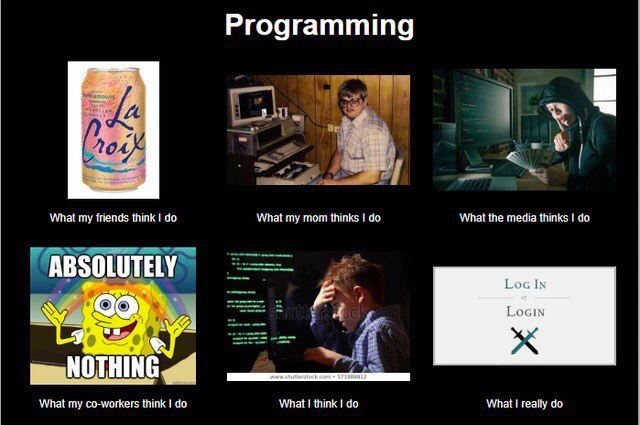
Let’s break down each panel of this Programming stereotype meme and decode the humor. The format is the classic six-panel “What people think I do / What I really do” layout, which is popular for poking fun at many professions. Here it’s applied to a programmer’s life, and each image caption is highlighting a different perspective or misconception about what developers spend their time on.

  • “What my friends think I do” (LaCroix can): The top-left panel shows a can of LaCroix, a trendy sparkling water. This is a nod to the tech hipster vibe. Friends might imagine that programming is super chill or stylish – like you’re hanging out in a cool startup office, sipping fancy flavored water and brainstorming the next big app. In reality, your friends probably don’t see you coding; they just know tech companies have quirky snacks and drinks. So they jokingly think your job is basically enjoying sparkling_water and being on social media, rather than actual hard work. It’s a playful jab at how outsiders see the tech lifestyle as cushy and trendy.

  • “What my mom thinks I do” (80s computer in basement): The top-middle panel is an old-school computer setup with a geeky kid in a basement (very retro_80s_pc_setup vibes). This represents how your mother (or older relatives) picture your job. They might not really understand modern software development, so they recall you as a kid playing with computers or imagine something out of the 1980s when programmers were these basement-dwelling nerds. Mom might think you’re still that tinkerer who fixes the family PC. The image has a beige CRT monitor and a clunky keyboard – it screams “classic nerd in the basement.” It’s lovingly making fun of the generation gap: Mom’s reference point for “programming” is outdated, so her mental image is you surrounded by old hardware and maybe writing simple programs or hacking away like in the movie WarGames.

  • “What the media thinks I do” (hooded hacker celebrating): The top-right panel shows the stereotypical hoodie hacker in a dark room with green code on the screen, possibly pumping a fist in triumph. This is how movies, TV shows, and news media often portray programmers or anyone in tech: as mysterious hackers who wear hooded sweatshirts and perform miraculous hacks in seconds. Think of scenes from Mr. Robot, The Matrix, or basically any Hollywood movie about hacking – there’s always a dim room, multiple monitors with streaming code, and someone furiously typing. The caption highlights that the media doesn’t distinguish regular software developers from hackers. In reality, most of us are building websites or business software, not stealing government secrets, but media depictions make it look like we’re all cyber ninjas. This hoodie_hacker_cliche is a huge contrast to our everyday coding tasks.

  • “What my co-workers think I do” (SpongeBob “ABSOLUTELY NOTHING”): The bottom-left panel features SpongeBob SquarePants proudly exclaiming “ABSOLUTELY NOTHING.” This panel suggests that co-workers (especially those not in the engineering team, like maybe managers or colleagues from other departments) joke that the developer isn’t doing anything at all. Why would they think that? Often, programming work is not visually exciting – it can look like you’re just staring at the screen, browsing the web, or taking a long time on a single task. To someone unfamiliar with coding, it might appear unproductive, so there’s a running joke that developers just slack off or procrastinate. The SpongeBob image is a popular meme used to humorously indicate doing nothing. So this panel is basically saying, “My co-workers think I sit at my desk all day accomplishing nothing tangible.” It’s an exaggeration of the misunderstanding between developers and non-developers in a workplace.

  • “What I think I do” (focused developer at monitor): The bottom-middle panel shows a programmer deep in thought, hand on head, staring at code on a screen. This is the programmer’s self-image. When you’re coding, you feel like you’re engaged in serious, brainy work. You think you’re solving complex problems, writing clever code, and building important systems. The caption “What I think I do” means in our own minds, we perceive our work as intense and significant – we might even feel like the hero of a tech story, diligently crafting solutions. The code on the screen in that image (green text on black) reinforces the feeling of doing real programming (maybe some low-level or C code). It captures that concentration and determination you experience when you’ve been debugging for hours. In short, we think we’re handling big challenges and doing something impactful (and we are, but maybe not as epic as we imagine).

  • “What I really do” (Login form with “Log In / Login”): The bottom-right panel is the big reveal – the reality of daily programming. It shows a very simple user interface: basically just the words “Log In” and “Login” and a pair of crossed swords icon. This is highlighting that the actual work we end up doing can be surprisingly trivial or nitpicky. In this case, it implies the programmer’s real day was spent wrestling with a login screen. The “Log In” vs “Login” text indicates an internal debate over a tiny detail: whether the button text should have a space or not. The crossed swords emoji (⚔️) symbolizes a battle. In other words, the development team probably got into a heated argument over this minor wording. This kind of scenario is extremely common and is often referred to as “bikeshedding.”

Now, bikeshedding is a term that comes from a humorous metaphor (also known as Parkinson’s Law of Triviality). It means giving disproportionate time and energy to unimportant details while avoiding the harder, more important work. Why “bike shed”? The classic story goes that a committee spent so long debating the color of a bike shed (a relatively minor thing) instead of focusing on a much bigger issue (like building a nuclear reactor), because everyone can voice an opinion on the simple stuff. In programming, bikeshedding might look like debating variable names, arguing over indent style, or, as shown here, agonizing over UI copy like “Log In” vs “Login.” It’s funny because it’s true — teams sometimes get stuck on these tiny decisions.

So “What I really do” being that login button means: rather than doing the sensational or glamorous work people think I do, I actually spent my day fixing a tiny UI detail or tweaking text on a form. It might seem like absolutely nothing to an outsider, but for the project it was a task that needed doing (like making the site more user-friendly or consistent). The humor is that after all those grand perceptions, the reality is a bit anticlimactic: a developer painstakingly working on a humble login page. Every developer can relate to this realWorldVsIdeal contrast — we’ve all had days where the only visible change after hours of work is a single word or a one-line code fix. And that’s why this meme is so relatable in developer culture: it captures our life in a nutshell, from the misunderstood outsider views to the mundane truth of the job.

Level 3: Hipsters, Hackers & Bikesheds

This meme nails the misaligned expectations around a programmer’s life, using the classic “What people think I do / What I really do” format. Each panel is a tongue-in-cheek look at a different programmer stereotype. To a seasoned developer, it’s hilariously on-point because we’ve lived every one of these perceptions.

  • Friends’ view (LaCroix can): Your buddies see the trendy tech lifestyle – the stereotype that programmers sip sparkling water like La Croix in a cool office and browse hip new frameworks. It implies they think you’re basically a tech hipster indulging in startup perks rather than doing “real” work. They imagine the developer day as lounging with fancy drinks and ping-pong tables.

  • Mom’s view (80s basement PC): Mom’s mental image is frozen in the retro 80s PC era – she recalls you as that kid hunched over a beige CRT monitor in the basement. In her mind, “programming” means tinkering with dusty hardware or writing BASIC on an old IBM clone. It’s a nostalgic, somewhat outdated stereotype: the whiz kid in a wood-paneled room with floppy disks, because that’s what computers looked like to many parents.

  • Media’s view (hoodie hacker): Ah yes, the Hollywood hoodie_hacker_cliche. The media thinks we’re all hooded figures in dark rooms, furiously typing green text to break into mainframes by night. This panel shows the triumphant Mr. Robot-style hacker, fists clenched in victory. It’s the cinematic image of programming: dramatic cyber break-ins, “Access Granted!” popping up on neon screens. In reality, most of us are debugging web apps in well-lit offices, not doing cyber espionage at 3 AM – but try telling the movies that!

  • Co-workers’ view (SpongeBob “Absolutely Nothing”): Here our co-workers (likely non-engineers or even fellow devs teasing) think we do “Absolutely Nothing.” The meme uses the famous SpongeBob scene where he proclaims he’s done nothing at all. This reflects the office joke that when a feature is delayed or you’re staring at the screen thoughtfully, it must mean you’re slacking off. Fellow team members might only notice your work when something breaks, so day-to-day coding magic can look invisible – as if you did nothing. It’s an exaggeration of the frustration when others underestimate how complex and time-consuming programming tasks are.

  • What I think I do (focused coder): Now the self-perspective: I think I’m an intense problem-solver. That image of a developer leaning into the monitor glow, hand on forehead, scrolling through code, is exactly how we feel tackling tough bugs. We believe we’re diligently engineering sophisticated solutions, crafting efficient algorithms, maybe even envisioning ourselves as keyboard warriors refactoring a codebase for elegance. In our heads, we’re doing deep work and conquering challenging architectural puzzles. It’s serious brainwork – or so it seems at 2 PM with caffeine in our veins.

  • What I really do (Login form bikeshedding): And finally, the punchline: what I actually do all day. The meme reveals the mundane truth with a barebones “Log In / Login” UI mock-up and crossed swords. In practice, a lot of programming time goes into seemingly trivial tasks like arguing over a tiny piece of text on a login button. It’s a hysterically accurate depiction of bikeshedding: pouring excessive effort into trivial decisions. Here, the team likely spent hours debating whether the button should say "Log In" (two words) or "Login" (one word). Those crossed swords signify a tongue-in-cheek “holy war” over this minute detail. It’s the great Login Button Battle that every dev team knows too well, where an insignificant UI copy change turns into a grand debate in meetings or pull request comments.

In other words, while outsiders imagine grand coding feats, our real triumphs (and tribulations) often involve stuff as unglamorous as pixel-perfect alignment or one-word text changes. There’s an old joke: “The two hardest problems in computer science are cache invalidation, naming things, and off-by-one errors.” Here we’re literally struggling with naming — deciding the exact wording of a button is oddly difficult and can consume an absurd amount of time. This is textbook DeveloperExperience_DX humor: the contrast between grand ideals and the real-world developer experience. Every engineer who’s sat through a meeting about button text or bike-shed color is both laughing and crying at this panel.

To drive it home, here’s what that final “What I really do” might look like in code form – the culmination of a day’s work as a diff:

- <button type="submit">Login</button>
+ <button type="submit">Log In</button>

Yep, sometimes that’s the output of an entire afternoon: adding a space in a string. 😅 The humor stings because it’s true. After all the grand perceptions, the actual day in a programmer’s life might boil down to a tiny change like this. The meme brilliantly captures this irony, and that’s why every developer smirks in recognition. We’ve all been there: what we really do often feels like “absolutely nothing” or the most trivial fix, even though it’s important in context. It’s the ultimate RealWorldVsIdeal gag, and a reminder not to believe all the hype about what programming looks like from the outside.

Description

A four-panel meme depicting a conversation with God about learning C++. In the first panel, a person asks, 'How much time would it take me to learn C++?'. In the second panel, God replies, '15 years'. The person expresses surprise in the third panel, 'So long??'. In the final panel, God clarifies, 'I was talking about the basics'. The humor lies in the gross exaggeration, which experienced C++ developers find relatable due to the language's vast and complex feature set, including manual memory management, templates, and a notoriously difficult learning curve. It's a jab at how mastering C++ can feel like a lifelong endeavor

Comments

7
Anonymous ★ Top Pick C++ is the only language where you can spend a decade writing it and still discover new ways to shoot yourself in the foot. It's not a language; it's a lifelong commitment to debugging
  1. Anonymous ★ Top Pick

    C++ is the only language where you can spend a decade writing it and still discover new ways to shoot yourself in the foot. It's not a language; it's a lifelong commitment to debugging

  2. Anonymous

    Twenty years of "senior engineering" and the hardest part is still deciding if the auth microservice should say “Log in,” “Login,” or just redirect to SSO - so yes, media, fear my hoodie

  3. Anonymous

    After 20 years in tech, I've architected distributed systems, led migrations to microservices, and optimized databases handling billions of requests - but somehow I still spend half my day debugging why OAuth tokens expire 3 seconds too early in production but never in staging

  4. Anonymous

    After 15 years in the industry, I've learned that 'What I really do' is the most accurate panel - because no matter how sophisticated your distributed systems architecture or how elegant your microservices orchestration, someone will inevitably ask you to 'just make the login button bigger' at 4:45 PM on a Friday. The real senior engineer move? Knowing that login form represents three days of OAuth2 implementation, CSRF token handling, rate limiting, and arguing with product about whether we really need that third-party SSO integration

  5. Anonymous

    Fifteen years in and the hardest part of “hacking” is choosing between “Log in” and “Login” while coaxing three IdPs’ redirect URIs to behave in Safari

  6. Anonymous

    Mom envisions Anonymous ops; I'm just pwning my own SAML IdP misconfig at 3 AM

  7. Anonymous

    The hardest part of our auth stack isn’t SAML or SameSite - it’s when marketing changes “Log In” to “Login” and every client, cookie, and CSRF check treats it like a breaking change

Use J and K for navigation