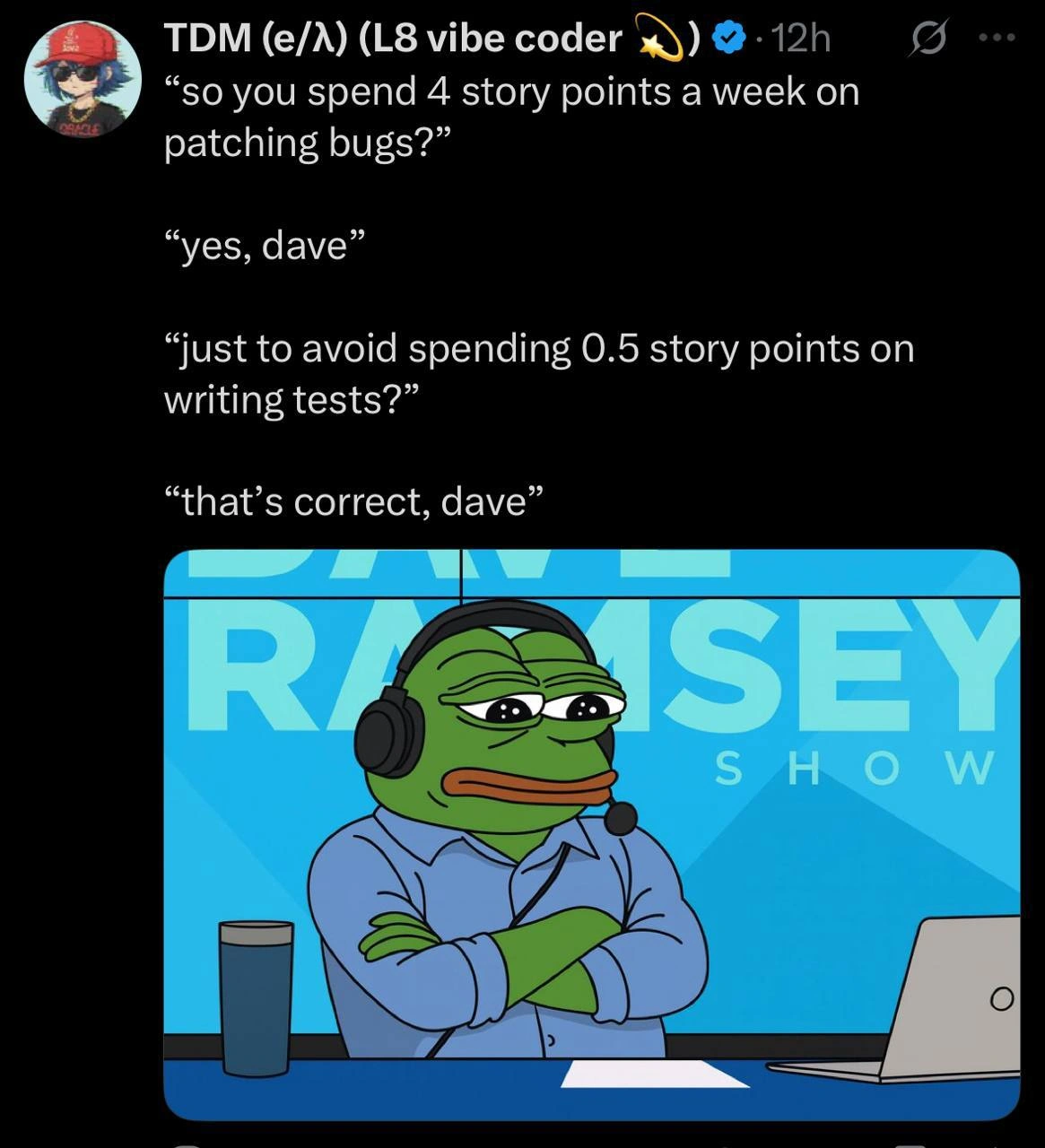
The I Don't Need Tests Starter Pack
Why is this Testing meme funny?
Level 1: The Closet Monster
Imagine you have a really messy room. You’ve been shoving toys, clothes, and junk into your closet for months, telling yourself, “I’ll clean it later.” But “later” never comes, and that closet just gets more overstuffed and messy. After half a year, you’re a little scared to even open it! It’s as if the pile of neglected chores in there has grown into a monster – a Closet Monster that might jump out at you. 😨 Now, picture it’s Halloween, and someone says they’re going to dress up as that exact monster. Kinda funny and spooky, right?
That’s exactly what this developer meme is joking about, but with computer code. The “closet” is like a programmer’s to-do list (backlog), and the messy pile is a long-ignored coding task (we call that technical debt in programmer language). The person hasn’t “cleaned up” their code for six months, so the task has become a big scary deal. Saying “I’ll be that forgotten task for Halloween” means the task has become as frightening as a Halloween ghost or goblin. 😂 It’s funny because we all know procrastinating – whether it’s not cleaning your room or not fixing something important – can make a small thing turn into a big, intimidating problem. This meme makes us laugh and remember: it’s better not to let our chores (or our coding tasks) turn into monsters!
Level 2: Backlog Boogeyman
Let’s break this down in simpler terms. This meme is a joke about technical debt and how teams handle it in an Agile workflow. First, what is technical debt? It’s a programming term that compares writing quick, messy code to taking on debt. For example, if a developer rushes a feature and leaves the code a bit sloppy (promising to fix it later), that’s like borrowing time — you “owe” cleanup work. Just like real debt, if you don’t pay it off, interest accumulates. In code, “interest” shows up as growing problems: the code might get harder to change, more bugs might appear, and future development around that area slows down.
Now, what about a backlog? In Agile project management (used by many software teams), a backlog is essentially a to-do list of all pending work items. These items are often called tickets or user stories. They can include new features, bug fixes, or chores like refactoring old code. Teams regularly do backlog grooming (or refinement sessions) to review and prioritize these tickets, deciding what to tackle in upcoming sprints (development cycles, usually 1-2 weeks long). In theory, important things should not languish too long in the backlog without being addressed. But in practice, certain tasks keep getting pushed down the list. Especially TechnicalDebt tasks – because they don’t deliver a shiny new feature that managers can demo, they’re easy to postpone.
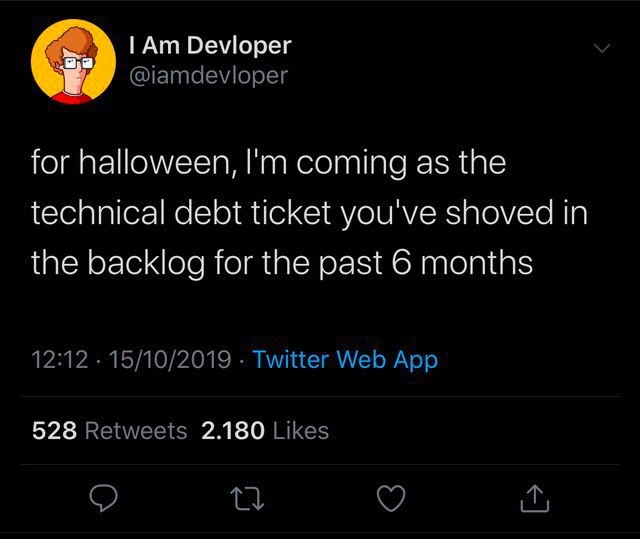
The meme specifically mentions “that technical debt ticket you’ve shoved in the backlog for the past 6 months.” This paints a vivid picture: there’s a known issue or improvement that the team logged half a year ago. Maybe it’s a note like “Refactor the authentication module” or “Upgrade the old database driver.” Every sprint planning, the team sees this ticket and says, “Not this time; we have more urgent stuff.” So it just sits there, for six long months, untouched. We call such items ignored_tickets or backlog rot. Over time, the ticket almost becomes invisible – nobody talks about it anymore, but everyone knows it’s lurking. It’s the boogeyman of the backlog, something vaguely scary that nobody wants to deal with today.
Enter the Halloween joke: The author of the tweet (@iamdevloper, a popular parody developer account on Twitter) quips that for Halloween, they’ll dress up as this very neglected ticket. Why? Because it’s the scariest thing they can think of in a software team’s world! 🎃 It’s a bit of AgileHumor and DeveloperHumor. Instead of a ghost costume, the developer will figuratively wear the identity of that ancient JIRA ticket that haunts the project. To a developer, seeing someone dressed as your six-month-old unresolved task is both hilarious and horrifying. It’s like your procrastination coming back to bite you.
The image described is a screenshot of that tweet in dark mode (white text on black background). It’s pretty minimalistic – just the joke text and some Twitter details (like the time, date, and how many retweets/likes it got). The avatar of the account is a cartoon of a developer, which many in the dev community recognize (the account is known for tech jokes). The high retweet and like counts (hundreds and thousands) show that many other developers found this super relatable. In meetings, developers might even joke, “This bug is turning into a Halloween monster.” Here, the tweet takes that feeling and makes it literal: the backlog item becomes a costume because it’s that scary.
To put it plainly: the meme is saying “Remember that code fix we keep delaying? It’s spooky how long it’s been, and it’s going to come back and haunt us.” Teams often experience this when a neglected issue suddenly causes a major outage or huge headache down the road. That’s the “haunting.” The interest on the technical debt “loan” has come due in the form of stress and emergency work. For junior developers or those new to Agile, it’s a funny introduction to the concept that ignoring problems doesn’t make them go away. In fact, it often makes them worse. The tweet’s humor works because it takes a dry concept (code maintenance) and personifies it as a Halloween creature. Even if you’re new to the idea of technical debt, you can imagine an overdue task looming like a ghost – it’s a simple metaphor.
So, in summary at this level: The tweet jokes that a programmer’s Halloween costume idea is to be the scary technical debt ticket that’s been sitting in their backlog forever. It’s poking fun at how software teams procrastinate on certain tasks. This is classic DeveloperHumor – turning an uncomfortable truth (neglected work) into a laugh. It teaches that in Agile projects, if you keep ignoring something, it might become a big, spooky problem later. And indeed, just thinking about finally tackling that 6-month-old, crusty code fix can send shivers down a developer’s spine!
Level 3: Ghosts of Sprints Past
This meme conjures up a scenario all too familiar to seasoned developers: the technical debt ticket that’s been sitting in your Agile backlog for ages, now resurfacing as a Halloween horror. It’s funny because it’s painfully true. In software, TechnicalDebt refers to those quick-and-dirty code fixes or postponed refactors that your team promises to clean up later. Pushing off this work is like borrowing time – your codebase incurs “interest.” Over six months, that neglected fix has likely tangled itself deeper into the code. New features might have been built on top of it, and now untangling that mess is scarier (and costlier) than it was back when the ticket was first logged. Ward Cunningham (the programmer who coined the term technical debt in the 90s) warned that delayed clean-ups accumulate complexity just like unpaid financial debt racks up interest. Half a year down the line, that innocent refactor has grown into a poltergeist in your codebase, haunting your every deploy. 👻
In an ideal world, Agile teams do regular backlog grooming (also called backlog refinement) to prioritize work and tackle important fixes. But let’s be real: when sprint planning comes around, there’s always a shiny new feature or a pressing bug stealing the spotlight. The technical debt ticket keeps getting deprioritized – pushed to “next sprint” over and over until “next sprint” becomes never. It festers in the backlog, silently rotting. The joke here is that this forgotten task has been festering for so long it’s practically grown a life of its own. By Halloween, it’s ready to jump out and yell “BOO!” during stand-up. It’s AgileHumor built on the RelatableDeveloperExperience that so many of us share: we’ve all seen JIRA or Trello boards with a ghostly column of ignored tasks lurking at the bottom.
The Twitter screenshot format adds to the humor with its deadpan, one-liner delivery. The account @iamdevloper (known for sharp developer jokes) quips: “for halloween, I’m coming as the technical debt ticket you’ve shoved in the backlog for the past 6 months.” It’s a minimalist tweet – just white text on a black background – yet it encapsulates a whole story of project neglect and looming dread. The engagement metrics (528 retweets, 2,180 likes) prove how many developers nodded knowingly (and maybe shuddered) at this. The combination of TechDebt and an Agile backlog in one sentence is essentially a perfect horror tale for senior engineers. Why? Because we’ve lived it. We know that feeling when an old undone ticket suddenly becomes urgent, and you can practically hear it cackling, “Remember me?”
This meme brilliantly satirizes the gap between software best practices and reality. Sure, everyone on the team acknowledges that refactoring crufty code is important — in theory. In practice, business pressures and deadlines create an incentive to keep shoving that ticket aside. Every sprint review, someone might ask, “What about that refactor task?” and the response is a collective sigh: “We’ll get to it after the release… promise.” Months and a dozen releases later, the ticket still haunts the backlog, like an unwelcome ghost at the feast. TechnicalDebt items often lack visible user-facing impact, so product owners and managers tend to underrate them until things catch fire. The meme’s humor comes from exaggerating this dynamic: the scariest costume a developer can imagine is not a vampire or zombie, but the ignored_tickets in their backlog finally coming for revenge. It’s a tongue-in-cheek critique of how teams procrastinate on maintenance. After all, nothing is more frightening to a battle-worn coder than the words, “legacy refactor, 6 months overdue.” 🎃
Why is this so relatable? It shines a light on an industry-wide anti-pattern: treating the backlog as a graveyard for “when we have time” tasks. Over time, those tasks turn into skeletons in the closet. The meme is basically one big inside joke: Tech leads talk about paying down debt, but we end up creating our own haunted house of old code. The tweet format delivers this truth bomb in a casual, shareable way. It’s short, sarcastic, and spot-on. Experienced devs chuckle (or groan) because they remember that one fateful night when a long-ignored piece of code blew up in production, forcing an exorcism of technical debt at 3 AM. The Agile ideals say “responding to change over following a plan,” but ironically the change (i.e., fixing the debt) never made it into the plan! So here we are with a backlog phantom. At the senior level, we appreciate the dark humor: we created this monster ourselves by constantly deferring the work – and now it wants vengeance.
To sum up the advanced perspective: this meme wraps a software engineering lesson (don’t ignore your technical debt) in a clever Halloween metaphor. It pokes fun at our habit of sweeping problems under the rug (or into the backlog) and the inevitable fact that those problems will come back to haunt us. It’s the development horror story we laugh at nervously because we know how true it is.
Description
A two-panel meme in the 'Panik Kalm Panik' format, featuring a serene, bald character on the left and a panicked, sweating version on the right. The top panel, associated with the 'Kalm' character, has the text: 'I don't have to write tests because I have no bugs'. The bottom panel, associated with the 'Panik' character, shows the text: 'I don't have to write tests because I have no bugs'. The punchline is the stark contrast in the character's demeanor while the text remains the same. In the first instance, it's a statement of arrogant confidence. In the second, it becomes a desperate, frantic justification while dealing with the fallout of that arrogance. This perfectly captures the Dunning-Kruger effect often seen in less experienced developers who underestimate the complexity of software and the inevitability of bugs, only to be humbled when their code breaks in production

Comments
7Comment deleted
The confidence of a developer who doesn't write tests is directly proportional to the blast radius of their next commit
At least this costume ships on schedule - unlike the refactor it represents, which has slipped four sprints and is now accruing more interest than your AWS bill
That technical debt ticket has been in the backlog so long it's now a breaking change to remove it because three other systems have built workarounds assuming it will never be fixed
The scariest part isn't the costume itself - it's realizing that ticket now has 47 merge conflicts, depends on a deprecated library, and the original author left the company 4 months ago. But hey, at least it's still marked as 'P2 - Should Have' in your backlog, right next to that Kubernetes migration you've been 'planning' since 2021
Tech debt is the only backlog item with compound interest; postpone it until Q4 and it matures into a rewrite plus a weekend migration
Backlogs: where tech debt tickets ferment like fine wine, emerging vintage enough to tank your next quarterly audit
Tech debt compounds faster than cloud costs - after two quarters, that 'two-hour refactor' becomes a multi-quarter migration