Skip to content
DevMeme
665 of 7435
The Eternal Progress Bar
BuildSystems CICD Post #753, on Oct 27, 2019 in TG

The Eternal Progress Bar

Why is this BuildSystems CICD meme funny?

Level 1: The Embarrassing Friend

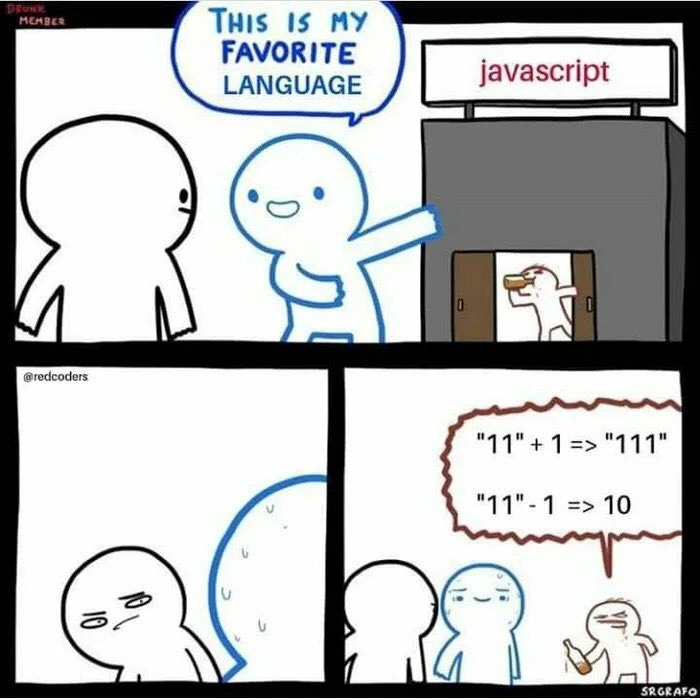
Imagine you’re bragging to your buddies about how awesome your friend is at math. You’re super proud, saying “My friend is the best at this!” But then someone asks your friend a simple math question like, “What’s 11 plus 1?” and your friend loudly replies, “111!” Everyone looks confused. Then they ask, “Okay... what about 11 minus 1?” and your friend says, “10.” Now you’re standing there sweating. 🙈 Your amazing friend just gave some really odd answers, and you feel a bit embarrassed for hyping them up.

That’s exactly what’s happening in this joke. The programmer was proudly saying JavaScript is their favorite (like their super smart friend), but JavaScript sometimes does funny things with numbers and words. It put the “11” and “1” together like text to make “111”, or took away 1 and somehow got 10. It’s silly and unexpected, just like a friend doing something goofy at the worst time. The humor comes from that turn of events: being proud one moment, then surprised and embarrassed the next when the favorite language acts so strangely. It’s a fun way to remember that computers can take things very literally and sometimes do things that make us go, “Wait... what just happened?!”

Level 2: Type Coercion 101

JavaScript is a dynamically typed language, which means variables can hold different types (like numbers or strings) at different times, and the language often converts types automatically. This automatic conversion is called type coercion (or implicit type casting). In simpler terms, JavaScript sometimes changes a value’s type behind the scenes to try to make an expression work. This can lead to funny surprises when you don’t expect it. The meme gives a perfect example of this quirk:

console.log("11" + 1); // "111"
console.log("11" - 1); // 10

Here’s what’s happening in each case:

  • "11" + 1 => "111": One of the values is a string ("11"), and we’re using the plus sign. In JavaScript, the + operator will concatenate (join) strings if either side is a string. So the number 1 gets converted into the string "1". Then "11" + "1" becomes "111" – just like gluing two pieces of text together. Think of it as "11" + "1" = "11" plus "1" stuck on the end. The result is a longer string, not a mathematical sum.

  • "11" - 1 => 10: Now we use the minus sign. JavaScript doesn’t have a meaning for “string minus number,” so it tries to treat both values as numbers. The string "11" gets converted into the numeric value 11. Then it performs 11 - 1, which equals 10. The result is the number 10. In this case, JavaScript’s coercion turns the string into a number because subtraction only makes sense with numbers.

So why does this matter? If you’re new to JavaScript, you might expect "11" + 1 to give you 12 (like a math addition) but instead you get "111" because of the string concatenation. It’s a big “surprise!” the first time it happens. This is an example of loose typing humor – JavaScript being a little too helpful and doing things you didn’t explicitly ask for. Implicit type casting means the language didn’t throw an error; it just guessed what you wanted. Sometimes that guess is handy, and other times, like here, it produces a wacky result.

For a junior developer or someone learning, the lesson is: always be aware of your data types in JavaScript. If you really want to add numbers, make sure they’re numbers (you can use Number("11") or parseInt to convert the string "11" to the number 11). If you actually wanted to join strings, then the + doing that is fine. This meme is a lighthearted way of saying “JavaScript might do string concatenation or numeric conversion when you least expect it!” It’s relatable humor for anyone who’s scratched their head at an output like this. The blue character sweating in the second panel represents that uh-oh moment when a dev realizes their beloved language might embarrass them with a crazy result in front of others. And the little gremlin with the beer bottle labeled “javascript” is basically JavaScript’s wild side popping up—kind of like a friend who blurts out something silly after one too many drinks at a party. In real coding, understanding these quirks helps you avoid confusion and bugs. It’s all part of learning the JavaScript ropes: knowing when the language is going to automatically coerce types (and being ready for the outcome).

Level 3: When Types Get Tipsy

In this meme, JavaScript’s most notorious language quirk takes center stage: its loose typing and implicit type coercion. A developer triumphantly proclaims “This is my favorite language” while pointing at a JavaScript booth – only to have JavaScript’s drunk little gremlin (the embodiment of type coercion) stumble out and blurt a nonsensical result. The punchline showcases a classic JS_WTF_moment:

  • "11" + 1 produces "111" (string concatenation)
  • "11" - 1 produces 10 (numeric subtraction)

Why is this funny to experienced devs? Because we’ve all been there – proudly defending JavaScript, then cringing as its dynamic typing gotcha shows up like an embarrassing friend at a party. JavaScript is a loosely typed language, meaning it often converts types on the fly. The + operator in JavaScript is double-faced: if either operand is a string, it coerces the other to a string and concatenates them. So "11" + 1 becomes "11" + "1" under the hood, yielding the string "111". But the - operator has no meaning for strings, so JavaScript implicitly casts "11" to the number 11 and subtracts, giving the numeric result 10. The two operations look similar but behave very differently – a perfect illustration of drunken type coercion staggering into the conversation.

Seasoned engineers smirk at this because it encapsulates the love-hate relationship with JavaScript. It’s a TechHumor staple: we admire JavaScript’s flexibility and power on the frontend, but we swap war stories of bizarre bugs caused by these conversions. This DeveloperHumor highlights how a seemingly simple addition can turn into a string concatenation surprise or a numeric conversion edge case, depending on the context. The meme’s sweaty blue figure knows what’s coming – that pang of favorite_language_embarrassment when someone brings up JavaScript’s “quirky” math in a convo. It’s a gentle roast of JavaScript’s design: created in 10 days, trying to be helpful by guessing types, yet sometimes acting like a drunken overenthusiastic intern who takes things too literally (or not literally enough!).

For veteran devs, the scenario is painfully relatable and hilariously predictable. We’ve learned (often the hard way) that in JavaScript 42 might secretly be "42" if it comes from user input, and adding it to another number could glue strings together instead of adding values. This meme distills that headache into one cheeky visual. It’s simultaneously an affectionate ribbing and a cautionary tale: Yes, JavaScript is powerful and beloved — until its “drunken” type system crashes the party with a puzzling output. Knowing laughter ensues because every experienced JS programmer has been that blue guy at some point, enthusiastically praising the language while mentally praying no one asks about == vs === or the infamous "11" + 1 trick.

Description

A popular meme format showing a skeleton sitting calmly on a park bench at the bottom of the ocean. Fish and other marine life swim around in the murky blue-green water. Above the image is the white text 'Waiting for the progress bar to finish'. The meme humorously exaggerates the experience of waiting for a slow process to complete. For developers, this is a deeply relatable scenario, representing the seemingly endless time spent watching progress bars for tasks like compiling a large codebase, running an exhaustive test suite, deploying to a staging environment, or downloading large dependencies. It’s a visual metaphor for the moments of forced idleness that break a developer's focus and productivity

Comments

7
Anonymous ★ Top Pick I have three progress bars I watch. One for my code compiling, one for my tests running, and one for my youth fading away
  1. Anonymous ★ Top Pick

    I have three progress bars I watch. One for my code compiling, one for my tests running, and one for my youth fading away

  2. Anonymous

    JavaScript is the only shop where '+' turns into join-strings karaoke while '-' insists everyone does math sober

  3. Anonymous

    After 20 years in the industry, I've learned that JavaScript's type coercion isn't a bug, it's a feature request from chaos itself - the only language where '[] + [] = ""' but '[] + {} = "[object Object]"' and we just accept it because the alternative is rewriting everything in TypeScript and pretending we've solved the problem

  4. Anonymous

    JavaScript developers explaining why it's their favorite language is like describing Stockholm syndrome with extra steps and a package.json. Sure, '11' + 1 gives you '111' while '11' - 1 gives you 10, but after 15 years of wrestling with implicit type coercion, you learn to appreciate the... character-building experience. At least TypeScript lets us pretend we have type safety until the transpiler reminds us we're still just writing JavaScript with training wheels

  5. Anonymous

    JavaScript: where AddExpression follows ToPrimitive('default') and concatenates if a string shows up, but SubtractionExpression goes straight to ToNumber - every code review becomes an anthropology lecture on 1995 web compatibility

  6. Anonymous

    JavaScript's + operator: because nothing says 'elegant' like turning arithmetic into a string remix, while - clings to numeric sanity

  7. Anonymous

    Only in JavaScript does '+' convene a TC39 workshop (ToPrimitive → ToString) while '-' files the RCA with ToNumber - ship '===' and forbid implicit coercion unless your KPIs should be strings

Use J and K for navigation