Skip to content
DevMeme
4436 of 7435
From Lua Tables To Haskell Typeclasses: The Spectrum Of Type Safety
Languages Post #4862, on Sep 14, 2022 in TG

From Lua Tables To Haskell Typeclasses: The Spectrum Of Type Safety

Why is this Languages meme funny?

Level 1: Silly vs Strict

Imagine four friends each trying to solve the same simple task, but each friend has a different style of following rules:

  • The first friend is super laid-back. He says, “Eh, I’ll just use this one box for everything.” He throws all kinds of items into one big box without labeling anything. This is funny because he’s so relaxed about it — he doesn’t worry at all if things might get mixed up. (This is like Lua treating everything the same, using one container for any kind of thing.)

  • The second friend is like a quick improviser. When something doesn’t fit quite right, he goes, “Don’t worry, I’ll just reshape it a bit so it fits!” For example, if he has a square peg and a round hole, he’ll whittle the peg or stretch the hole until somehow the peg goes through. He even says, “If you don’t like how I’m doing it, my cousin over here has a measuring tape and can help organize it better.” This is amusing because he’s so eager to make things work that he’ll change the pieces on the fly. (This friend is acting like JavaScript, which automatically converts things to make them fit, and the cousin with the measuring tape is like TypeScript adding some order.)

  • The third friend is old-fashioned but careful. He insists on using the traditional instructions from an old guide, but he’s added a few safety checks of his own. Imagine he’s following an old family recipe (that’s a bit risky), but he’s wearing modern oven mitts and using a timer so nothing burns. He speaks very formally: “One must adhere to the original, but I have taken the liberty to include precautions.” It’s a bit funny because he’s trying to be both loyal to the old ways and safe with new tricks — sometimes he ends up juggling a lot of rules! (This is like C++ trying to stick with C’s way of doing things but adding extra safety rules so you don’t get hurt as easily.)

  • The fourth friend is a total perfectionist and kind of a brainiac. Before doing anything, she pulls out a full blueprint and a textbook. Every single step is planned to the max. She says, “We have a very strict plan and advanced math to back it up, so nothing can go wrong.” Even if she wants to do something simple like pour a glass of water, she has a specific measured container and a formula for it! It sounds over the top, and it is — but you have to admit, her results are super reliable. It’s funny in contrast to the first friend because she’s so strict about rules that it makes everyone else look like they’re winging it. (This is like Haskell, which uses a very strict system — almost like a lot of math and rules — to guarantee everything is correct, even turning actions into special labeled actions so they’re done properly.)

In the end, all four friends can get the task done, but their attitudes make you chuckle. The carefree friend might get things done quickly but might also make a mess because he didn’t organize (like dynamic languages where mistakes show up only later). The improviser friend can handle unexpected situations by bending the rules, which is impressive but sometimes a bit odd (like JavaScript doing funny conversions). The old-fashioned careful friend follows rules but has to deal with a mix of old and new – he’s safer than the first two but sometimes a little complicated (like C++ mixing old C ways with new safety features). And the perfectionist friend takes a lot of time to plan with strict rules, almost to a nitpicky level, but in the end, her result is extremely solid (like Haskell catching almost every error in the planning stage so the final program runs without a hitch).

It’s funny and relatable because we often meet people like this or even act like them in different situations. Some of us wing it, some of us plan everything. In programming, languages are designed with these styles: some let you wing it (very few rules), and some make you plan a lot (lots of rules). The meme makes us laugh by showing these languages as if they’re people with those personalities talking about their approach to safety. It’s like hearing four chefs boast about their cooking style: one says “I throw all ingredients in one pot, no recipe needed!”, another says “I substitute ingredients on the fly, trust me it’ll taste good (and if not, my sous-chef will fix it)”, the third says “I follow grandma’s recipe to the letter but I use a food thermometer to be safe,” and the last says “I have a chemistry-degree-level recipe and measure every gram precisely for perfect results.” They all make soup in the end, but in such different ways that it makes you smile. The core humor is in these contrasting safety styles – from silly loose rules to strict formal rules – and realizing that, just like the friends, each programming language has its own quirky way of keeping things under control (or sometimes letting chaos happen!).

Level 2: Tables, Conversions & Classes

Let’s step back and explain the key concepts and terms in this meme for someone with a bit less experience. The joke revolves around how different programming languages handle types (the kind of data like numbers, text strings, etc.) and type safety (making sure you don’t mix up incompatible types in your code). Each panel personifies a language and its attitude toward types. Here’s what you need to know:

  • Lua – “Everything is a table”: In the first panel, Lua suggests “Why not make everything a table.” Lua is a lightweight, dynamically-typed scripting language (often used in game scripting and configuration). A dynamic type system means you don’t specify types for your variables; the language figures it out at runtime. Lua is famous (and sometimes notorious) for using a single data structure called a table as its catch-all container. A table in Lua is a flexible structure that can work like an array, dictionary (hash map), or even an object with methods. For example, you can do:

    local person = {}          -- create a new table
    person.name = "Alice"      -- add a key-value pair (like a dictionary)
    person[1] = "Programmer"   -- use it like an array (numerical index)
    

    Here, person is just a table, but we’re using it to store a name (like an object property) and also treating it like a list for a job title. Lua won’t complain about types – you can put strings, numbers, other tables, whatever you want inside a table. Type safety in Lua is very relaxed: if you try to access something that isn’t there, you get nil (Lua’s “nothing” value), but Lua won’t stop you from trying. The meme jokingly presents Lua as extremely laid-back about types, basically saying “Don't worry about rigid types, just use tables for everything!” This reflects the real Lua philosophy: keep the language simple and let the programmer manage how data is structured. It’s powerful but puts the responsibility on the developer to avoid errors like typos in keys or wrong assumptions about what’s in the table (since the language won’t check those for you).

  • JavaScript – Implicit conversions (and TypeScript): The second panel’s text about mismatched types and implicit conversions refers to JavaScript. JavaScript is also dynamically typed, meaning variables can hold any type of data at any time, and the language doesn’t enforce types at compile time (in fact, classic JavaScript is interpreted or JIT-compiled on the fly in the browser, not ahead-of-time compiled with type checks). What’s special about JavaScript is that it does a lot of implicit type coercion. Implicit conversion (or coercion) means if an operation involves two mismatched types, JavaScript will automatically try to convert one type to another to make the operation make sense. For example:

    console.log("5" - 3);    // Prints 2   ("5" is treated as number 5 here)
    console.log("5" + 3);    // Prints "53" ("3" is converted to "3", string concatenation)
    

    In the first case, JavaScript saw a string "5" and a number 3 with a - (minus) and decided, “Hmm, subtraction is a numeric operation, I’ll treat the string "5" as the number 5.” In the second case, the + operator can mean string concatenation if any operand is a string, so it turned the number 3 into "3" and glued the strings together. These are examples of JavaScript’s implicit conversions. Sometimes the rules can get really quirky (like an empty array [] converting to "" or 0 depending on context). This flexibility is a double-edged sword: it allows you to, say, easily add numbers and strings without explicit parsing, but it can also produce confusing results if you weren’t expecting a conversion to happen. That’s why the meme shows JS as saying “don’t worry” about mismatched types — because JS will try to handle it for you behind the scenes. Now, the mention of “my younger brother TypeScript” is about TypeScript, which is a language developed by Microsoft that builds on JavaScript by adding static typing. Static typing means you (or a type inference system) declare what type each variable is supposed to be, and the compiler will catch if you use them incorrectly before running the program. TypeScript looks a lot like JavaScript (in fact, every valid JavaScript program can be a TypeScript program), but you can add annotations like:

    let count: number = 5;
    // count = "five";  // TypeScript would error here: "five" is not a number
    

    With TypeScript, the second line would be underlined as an error in your editor because you declared count should be a number, and assigning a string "five" is not allowed. Under the hood, TypeScript will compile (or transpile) back to plain JavaScript (because browsers run JS, not TS), but it catches a lot of mistakes in the code beforehand. The meme jokingly calls TypeScript JS’s younger brother who might “please you” if you’re not a fan of JavaScript’s anything-goes approach. In simpler terms: JavaScript is very forgiving and will try to make sense of any operation (which can lead to wacky outcomes), whereas TypeScript is like a stricter sibling that says “hold on, let’s make sure the types line up correctly before we do anything.” This has become a common upgrade path: many developers start with easygoing JavaScript and later adopt TypeScript for larger projects to get the benefits of type safety (fewer bugs due to type errors).

  • C++ – C’s safer successor: The third panel references C++ and its relationship to C. C++ is a statically-typed, compiled language known for high performance and complexity. The text in the meme essentially says: “We prefer to stay compatible with C, but we felt it was necessary to add more safety than plain C offers.” To unpack this: C (the predecessor) is a powerful low-level language, but it’s weak on type safety. In C, you can do things like convert a pointer of one type to another arbitrarily, or treat a chunk of memory as different data types without much restriction (this is why C is fast and flexible but also why it’s easy to have bugs like crashes and memory corruption). C++ was created to improve C by adding features like classes (hence the name C++ “C plus plus”) which let you bundle data and functions together and enforce invariants, as well as stronger type checking in some areas. For example, C++ requires proper type casts for many conversions that C would do implicitly or not check. If you have an int and you try to assign it to a pointer type in C++ without a cast, the compiler will yell at you, whereas C might let you do it (with just a warning). C++ introduced references which are like safer pointers that must refer to a valid object (they can’t be null or dangling once set correctly), as well as function overloading (where the compiler chooses the right function version based on argument types – something that needs strong type checking to work). The meme’s formal tone (“whilst... we view it necessary...”) playfully mimics how C++ often is described as a very rational, engineered language. Key term: backward compatibility with C – C++ retained a lot of C’s characteristics so you can reuse C code. But it did bolt on more type safety: think of C++ as C with seatbelts and airbags added. You can still drive recklessly (there are ways to circumvent the safety) but there are more guardrails if you choose to use them. For a junior developer, an example difference is: in C, if you have a function that expects a struct X* (pointer to a structure) and you accidentally pass a struct Y*, the code might compile or give a mild warning and then misbehave at runtime. In C++, that’s a straight-up compile error – you can’t pass a Y* to a function expecting X* unless there’s an inheritance relationship or an explicit cast, and those casts are very visibly marked in code. So, C++ says “we add extra security.” This refers to things like:

    • Stronger type checking: The compiler is stricter about type mismatches.
    • Encapsulation and classes: You can hide data inside classes and only allow certain operations, preventing some invalid states.
    • Standard Library containers: Instead of raw arrays (which don’t know their own length), C++ offers std::vector that knows its type and size, preventing you from accidentally iterating out of bounds easily.
    • Const correctness: You can mark data as const (unmodifiable) and the compiler will enforce that, which is a form of safety to avoid unintended changes.

    However, the backward compatibility means C++ also inherits C’s rough edges. For instance, it’s still possible to cast a pointer to any other type with a bit of work, and manual memory management (using new/delete or malloc/free) is still present, which can cause issues if not done carefully. The meme encapsulates this by having C++ speak very primly about security while implicitly acknowledging it still cares about C. If you imagine the languages as people: C is like a seasoned craftsman who doesn’t believe in safety goggles (“I’ve done this for years, trust me”), and C++ is the apprentice who wears a suit and has a first-aid kit, but still works in the same workshop so to speak. The bottom line: C++ brings static typing and more safety checks (at compile time) compared to C, reducing some classes of errors.

  • Haskell – advanced type system & typeclasses: The last panel is about Haskell, a purely functional programming language with a very strong static type system. The meme text mentions typeclasses and the idea that even actions are types, highlighting Haskell’s unique approach. Let’s clarify those:

    • Strict, static type system: Haskell requires everything to have a type and does not allow type errors. But you often don’t have to write the types explicitly because Haskell has a powerful type inference engine (it figures out the types for you in many cases). Still, behind the scenes every value and function in Haskell has a precisely determined type, and if you try to use something in a way that doesn’t match its type, the program simply won’t compile. For example, if you have a function that adds two numbers, you cannot accidentally pass a text string to it – the compiler will stop you.
    • Multiple math-inspired typeclasses: A typeclass in Haskell is a bit like an interface or a set of capabilities that a type can have. For instance, there’s a typeclass Eq for “equality-comparable” things: if a type is an instance of Eq, it means you can compare two values of that type for equality (using ==). There’s a typeclass Num for numeric things, meaning if a type is an instance of Num, you can do arithmetic like +, - on it. These are “math-inspired” because they formalize properties like equality, ordering, addition, etc., in a way similar to algebra. Some typeclasses (like Functor, Monad, Monoid) come directly from abstract math (category theory or algebraic structures). They often sound intimidating, but they provide a lot of expressiveness. For example, the Monad typeclass in Haskell (often joked about) is a framework that, among other uses, handles sequencing of computations (particularly those with context like "this might fail" or "this involves I/O"). When the meme says “even actions are types,” it’s referring to Haskell’s way of treating side effects (like input/output, changing a variable, etc.) as values with their own types. In Haskell, doing I/O returns a value of type IO something. For example, reading a line from the console might have type IO String (meaning “an I/O action that will yield a String”). You can’t mix that with a regular String without explicitly staying in the IO context. This is very different from most languages where, say, calling print() doesn’t have a type; it just happens. In Haskell, it has a type (IO () for a print action that yields nothing useful). The benefit is that the language can enforce purity: functions without IO in their type cannot perform I/O – so you know a pure function’s result only depends on its inputs. This is part of what they mean by maximal safety: the type system is preventing you from, say, accidentally doing I/O or changing state in the middle of a pure computation. It’s like very strictly separating the “safe, transparent” parts of code from the “dangerous, side-effect” parts.

    In simpler terms, Haskell is depicted as a bit of a type safety fanatic. It has a reputation for being one of the most type-safe languages available; it will catch many kinds of errors at compile time that other languages might only catch when you run the program (or not catch at all!). For example, trying to add a number and a string in Haskell isn’t just a bad idea – it’s literally impossible unless you explicitly convert one to the other, because the compiler will reject it. Compare that to JS (which will try to make it work) or even C++ (which will error but you might force-cast types unsafely if you really want). Haskell basically says, “If it doesn’t make sense type-wise, I won’t run it. Period.” The “math inspired typeclasses” line is poking fun at how Haskell often introduces concepts that are straight out of a math textbook, which can be daunting. But those concepts give Haskell code very robust guarantees. When you write Haskell, you often spend a lot of time thinking about types and making the compiler happy – and once it compiles, it’s common that the code works on the first try (which sounds like magic, but it’s because so many potential mistakes were eliminated by the compiler). The meme portrays Haskell as a confident businessperson bragging about these high-level features — it’s both celebrating and poking a bit of fun at Haskell’s academic, “strict” nature.

To sum it up at this level: the meme is comparing dynamic typing (Lua, JavaScript) with static typing (C++, Haskell) and even within static typing, comparing a less strict, backward-compatible approach (C++) with a very strict, theoretically pure approach (Haskell). Type safety refers to how well the language prevents type errors (like adding incompatible types, calling something that doesn’t exist on an object, etc.). Lua and JavaScript are on one end (very flexible, but you rely on careful testing to catch mistakes), and Haskell is on the far opposite end (very rigid, but the language itself prevents a huge class of mistakes). C++ sits somewhere in the middle — more checks than Lua/JS, but not as ironclad as Haskell, due to practical considerations. The meme uses personification and humor to make this comparison: each panel’s quote is basically the language bragging or commenting about its philosophy:

  • Lua’s quote = “I don’t worry about types, I just use my one trusty structure (table) for everything.”
  • JavaScript’s quote = “I’ll adjust types on the fly so you don’t have to; but if you need more order, my sibling TypeScript can help.”
  • C++’s quote = “We respect the old ways of C but have introduced some rules and safety features on top of it.”
  • Haskell’s quote = “We take types super seriously — our type system is complex but gives you maximum safety, even modeling side effects as types, inspired by mathematical concepts.”

Understanding these helps a newer developer see the contrast and why it’s amusing. It’s basically an inside joke about how different languages treat the notion of a “type” — from almost not treating it at all (just a table, just convert things at runtime) to treating it with high ceremony (strict compile-time checking and fancy type abstractions). The humor comes from how extreme each position sounds when voiced as a person. In everyday coding, these differences mean:

  • In Lua/JS you might accidentally use a value the wrong way and only find out during execution (maybe your program crashes or malfunctions).
  • In C++, the compiler will catch some of those mistakes, but you can still override it if you’re not careful (and then you might face similar crashes at runtime).
  • In Haskell, the compiler is almost overprotective – it refuses to let a lot of things even run unless you prove to it (via correct types) that they make sense.

Each approach has fans and detractors, which is why developers find this meme both funny and relatable: it neatly sums up the pros, cons, and attitudes of these language communities in one-liners.

Level 3: Type Safety Showdown

For experienced developers, this meme hits home by personifying four programming languages, each with a distinct attitude toward type safety. It’s essentially a programming_language_personification of the classic dynamic vs static typing debate, sprinkled with real-world trade-offs and a dash of seasoned dev humor. Let’s break down why this combination is so laugh-inducing (and true):

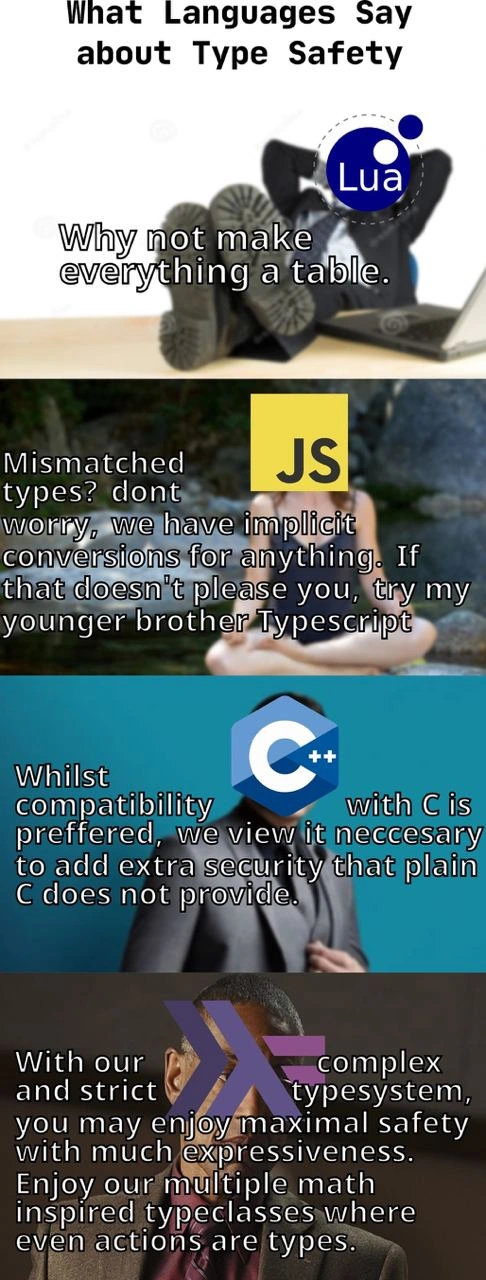
  • Lua – The “Anything Goes” Pragmatist: The first panel shows someone casually leaning back with the Lua logo, saying “Why not make everything a table.” This perfectly caricatures Lua’s approach. Lua is known for its simplicity and flexibility: it basically has one complex data structure, the table, which acts as an array, dictionary, object, and more. In Lua, almost all structured data is just a table (even modules and objects are tables under the hood). This design makes the language super easy to embed and extend, but it also means there’s no static type checking – the language won’t stop you from treating any value as any type. Seasoned devs chuckle here because we’ve all seen (or written) Lua scripts where a variable that was a table suddenly becomes a number or string, and nothing complains until something really unexpected happens at runtime. The meme captures that “meh, it’ll be fine” attitude: Lua is that chill friend who says “I use one tool for every job.” It’s both a strength and a weakness – great for quick scripting and game configs (where Lua is popular), but if you misuse a table key or value type, you won’t find out until much later. The humor is in how blasé the Lua persona is about something (type discipline) that more cautious languages fuss over. To a veteran developer, this recalls countless debugging sessions where a Lua table had the wrong value type and caused a runtime error deep in the code. It’s a gentle ribbing: “Ha! Lua just makes everything a table, no worries about types at all.” A classic dynamic typing anti-pattern packaged as a carefree philosophy.

  • JavaScript – The Implicit Magician (with TypeScript as the Sober Sibling): The second panel turns the spotlight on JavaScript, depicted as a meditating guru by a stream. The text reads: “Mismatched types? don’t worry, we have implicit conversions for anything. If that doesn’t please you, try my younger brother TypeScript.” This is a tongue-in-cheek summary of JavaScript’s infamous type coercion behavior and the emergence of TypeScript to mitigate it. Experienced devs often swap war stories of JavaScript’s wackier conversions – like how "5" + 3 ends up "53" (string concatenation) but "5" - 3 becomes 2 (numeric subtraction after converting "5" to 5). JavaScript will happily convert strings to numbers, numbers to strings, null to falsey, [] (empty array) to "" (empty string) or 0 depending on context, and so on, in order to make an operation work. This is what the meme calls implicit conversions for anything. It’s as if JavaScript is this zen master saying “relax, I’ll make it work somehow”, even if the method is a bit mystical. Seasoned devs find this hilarious (or painful) because these implicit rules often lead to bizarre bugs. For instance, the infamous NaN (Not-a-Number) can suddenly appear if you do weird math on non-numeric strings, or the classic gotcha that [] == 0 is true in JavaScript, but [] == [] is false (since each [] is a different object). The meme’s meditating JS figure embodies that “everything is one, I will convert and unify types” vibe. Now, the kicker: “If that doesn’t please you, try my younger brother TypeScript.” This line is pure insider humor. TypeScript is a language that adds optional static typing on top of JavaScript – essentially created because many developers were not pleased by JavaScript’s loosey-goosey type system. TypeScript is like the more responsible sibling who says, “Alright, let’s put some safety rails on this.” In the meme’s context, JavaScript acknowledging TypeScript is comedic because it’s like a hippie guru admitting, “My ways might be too chill; maybe you should visit the dojo next door for some stricter training.” Experienced developers know that dynamic typing in JS can lead to runtime errors or weird behavior, and TypeScript has become incredibly popular in the last decade exactly to prevent those “undefined is not a function” moments by catching type mistakes at compile time. So the meme is essentially nodding at that industry trend: JavaScript’s implicit conversions have caused enough pain points that a whole “younger brother” language (TypeScript, backed by Microsoft) gained prominence to bring type safety to the JavaScript ecosystem. It’s funny because it anthropomorphizes JS as being proud of converting anything (“I can turn water into wine… or a string into a number!”) while also slightly defensive – “hey if you don’t like my magic, go talk to TypeScript over there.” Devs who’ve transitioned from JavaScript to TypeScript or have to mix both will smirk at this interplay. We’ve all experienced that moment of relief using TypeSafety (pun intended) in TypeScript after wrestling with a mysterious JavaScript bug. The meme captures that relief by literally presenting TypeScript as the solution to displease with JS’s antics.

  • C++ – The C with Safety, Suit-and-Tie Guy: The third panel shows a sharply dressed individual adjusting a suit with the C++ logo, accompanied by a formal-sounding quote: “Whilst compatibility with C is preferred, we view it necessary to add extra security that plain C does not provide.” This is a brilliant parody of C++’s ethos and tone. C++, historically speaking, was built as an extension of C (one of the earliest high-level languages, which is very powerful but also notoriously easy to shoot yourself in the foot with). The phrase “compatibility with C is preferred” nods to the fact that C++ designers (and community) value the ability to use existing C code and libraries – it’s a language that extends C rather than completely breaks from it. Any senior developer familiar with C/C++ will recall that one can compile most C code as C++ with little or no changes. But C++ also “viewed it necessary” to improve upon C to provide more safety and abstraction. The meme’s formal phrasing humorously mimics how a C++ committee member or textbook might sound – very proper, almost stodgy, about adding features like classes, stricter type checking, and so forth. The content of the quote highlights type safety improvements: “extra security that plain C does not provide.” In practice, this refers to numerous C++ enhancements: stronger type checking (no implicit int to pointer conversions, for example, which old C would sometimes allow), references (which must refer to a valid object, as opposed to raw pointers that can be null or dangling), encapsulation via classes (so you can bundle data with functions and enforce invariants), RAII for resource safety (to automatically manage memory and avoid many manual memory management errors common in C), and things like const-correctness (ability to mark data as immutable, adding safety). But because C++ values backward compatibility, it still carries some of C’s unsafe baggage: you can still do pointer arithmetic, cast types explicitly to bypass the type system (reinterpret_cast can be as unsafe as a C cast), and include raw arrays. The humorous part for a veteran is that C++ often feels like a split personality: one side in a fancy suit designing high-level abstractions (templates, smart pointers, type-safe enums), and another side that’s a grizzled C hacker under the hood. The meme text, with its slightly pedantic tone (“whilst… is preferred,” “we view it necessary…”), jokes about how C++ folks often rationalize the complexity of C++ by saying, “well, we had to keep it compatible with C, but trust us, it’s safer now.” Many of us have heard (or made) arguments in defense of C++ like: “Yes, it’s complicated, but it needs to be because of legacy C code.” This panel is funny because it’s true – C++ did add a lot of safety nets, but in doing so it became a very elaborate language. Yet, at heart it hasn’t completely escaped the wild west of C. A senior dev might chuckle recalling how a stray printf with the wrong format specifier (a very C-style bug) can still crash a C++ program, or how including a C library can bring in risks that C++ on its own might prevent. It’s that trade-off of legacy compatibility vs. modern safety captured in one prim and proper sentence. Essentially, the C++ persona in this meme is saying, “We respect our elders (C) but we wear a suit of armor on top of their old leather jacket.” This resonates with anyone who has dealt with C++’s mix of low-level and high-level features – it’s simultaneously empowering and frustrating, which is exactly why this polite self-assured quote is so humorous.

  • Haskell – The Type Safety Purist (Math Genius in a Power Suit): The final panel shows a confident businessperson with the Haskell logo (a purple lambda) and declares: “With our complex and strict type system, you may enjoy maximal safety with much expressiveness. Enjoy our multiple math inspired typeclasses where even actions are types.” This is a playful caricature of the Haskell community’s pride in their language’s rigorous approach to types and purity. For seasoned devs, especially those into functional programming, Haskell is often seen as the pinnacle of type safety in mainstream programming. It has a reputation: if a Haskell program compiles, it’s very likely to be correct. The meme text reads like a high-brow sales pitch, which is funny because Haskell devotees do sometimes sound like they’re selling a luxury car or high-end philosophy course: “strict type system,” “maximal safety,” “much expressiveness,” “math-inspired typeclasses” – these phrases could come straight out of a Haskell intro talk or blog that extols its academic strengths. Let’s unpack the humor and the truth here. Haskell’s type system is quite complex (at least compared to many languages). It’s strongly statically typed with features like algebraic data types, type inference, higher-kinded types, and of course typeclasses which allow a form of ad-hoc polymorphism (think of them as interfaces on steroids, letting you define generic operations like “equality” or “serialization” that any data type can implement, but with compile-time resolution). When the meme says “multiple math inspired typeclasses,” it’s referencing that many of Haskell’s abstractions (Monoid, Functor, Applicative, Monad, etc.) come from mathematics (category theory and abstract algebra). This is a well-known aspect that seasoned devs either love or find intimidating (or both!). It’s the source of countless inside jokes — e.g., “A monad is just a monoid in the category of endofunctors, what’s the problem?” (a tongue-in-cheek way Haskell gurus tease newcomers). The meme distills that vibe: Haskell proudly flaunts its mathematically grounded type system as a feature. The line “even actions are types” is a clear nod to how Haskell handles side effects. In languages like C++ or JS, performing I/O or changing a global variable is just something you do – there’s no special type difference. But in Haskell, doing an I/O action (like reading a file or printing to console) yields a value of type IO Something. You can’t, for instance, mix an IO String (an action producing a string) with a plain String without explicitly handling the IO type via monadic bindings (>>= or do notation). To an experienced dev, this is one of Haskell’s hallmark safety features: it forces you to be explicit about side effects, making pure and impure code distinct by type. So the meme essentially has Haskell bragging, “Our type system is so strict and advanced that everything, even side-effectful operations, are captured in the type domain. Nothing escapes the type safety net!” The humor comes from the contrast with Lua and JavaScript. It’s like Haskell is the uptight but brilliant specialist who triple-checks everything with mathematics, whereas Lua and JS were the laid-back generalists who say “we’ll figure it out as we go.” Seasoned developers who have dabbled across these languages recognize the kernel of truth: writing Haskell can feel like solving a puzzle where the compiler is a relentless coach (“Handle that case! Specify that type or I won’t compile!”), but once it runs, it’s rock solid. Meanwhile, writing JavaScript is like improvising a tune – quick to get results, but you might hit a wrong note (runtime error) during the performance. We find it funny because the Haskell persona in the meme is almost smug about its “maximal safety,” and indeed Haskell fans often joke (semi-seriously) that other languages let too many errors slip by. It plays into the stereotype of Haskell being a bit “academic” or “elitist” about types (with phrases like “math inspired typeclasses” – which, let’s admit, sounds both impressive and comically grandiose in a meme context). If you’ve ever seen debates on static vs dynamic or simple vs fancy type systems, Haskell advocates often tout these exact points, which makes the panel instantly relatable and chuckle-worthy for industry folks. It’s the ultimate type safety meme punchline: the language that takes types so seriously that monads and monoids enter the chat.

  • The Spectrum & Shared Pain: Underneath the humor, there’s a shared experience for polyglot programmers (those who work with multiple languages). Moving from Lua/JavaScript to C++ or Haskell (or vice versa) can be a jarring experience. Each panel of the meme exaggerates the internal monologue of a language, but developers recall real moments that match these attitudes. For example, a Python or JS developer trying Haskell for the first time might feel exactly like the meme suggests – overwhelmed by the strictness and all the “mathy” jargon. Conversely, a C++ or Java developer diving into Lua or JS might be horrified (or liberated!) by how those languages let you do anything without a peep. There’s comedy in that contrast. It’s funny because it’s true: these philosophies lead to very different programming experiences. The meme captures the “spectrum of type safety” in a quick, highly visual way that senior devs immediately get. We see Lua’s free spirit, JavaScript’s “chill but weird” flexibility, C++’s serious attempt at discipline while carrying some historical baggage, and Haskell’s uncompromising type rigor. Each approach has caused us both joy and pain:

    • Joy when the flexibility lets us quickly solve a problem (like banging out a quick Lua script or a JS hack and it works without ceremony).
    • Pain when that same flexibility causes an obscure bug (like a silent type coercion in JS leading to NaN and breaking a calculation).
    • Joy when the strict typing catches an error at compile time (like Haskell refusing to compile until you handled a null case with Maybe).
    • Pain (or at least effort) in wrestling with the compiler or verbose type annotations to get the code to compile in a language like C++ or Haskell.

    The meme is essentially winking at this trade-off: “We’ve all been there – every language promises it has the best way of handling types.” The truth is each has advantages and trade-offs, and that’s the underlying joke: the Lua dev, the JS dev, the C++ dev, and the Haskell dev might each brag about their approach at a conference (perhaps with exactly the tones shown in the panels), and each would both be right and a little myopic at the same time. It’s the classic inside joke among seasoned developers: no matter the language, there’s always something funny or frustrating about how it handles (or doesn’t handle) types. And we laugh because we have battle scars from all of them – whether it’s a JavaScript production bug due to a bad this binding or a Haskell compile-a-thon where you spend an hour appeasing the type checker. This meme takes those war stories and condenses them into four caricatures, which is why it elicits knowing nods and laughs from the experienced crowd.

In the end, “What Languages Say about Type Safety” is both a celebration and a satire of our multi-language world. It reminds experienced devs of the persistent type safety debates and the almost human-like personalities we attribute to our favorite (or least favorite) languages. It’s funny because we recognize a bit of ourselves and our past projects in each panel. Who hasn’t been as relaxed as the Lua guy when prototyping, or as zen (and occasionally crazy) as the JS guru when coaxing a web app to work, or as pedantic as the C++ gentleman insisting on std:: everything, or as idealistic as the Haskell proponent preaching the gospel of monads? The meme nails these archetypes, making us laugh at the absurdity and genius in each approach. It’s a type_safety_meme that speaks to the heart of CS_fundamentals and real-world language design compromises, all in one quick visual. For a seasoned developer, it’s hard not to smile and think, “Yep, I’ve met all these ‘people’ (languages) before,” and that shared understanding is exactly what makes it so amusing.

Level 4: Type Theory Temple

At the highest level of abstraction, this meme touches on programming language theory and the philosophy of type systems. In theoretical terms, each panel represents a different point in the static vs dynamic typing spectrum, with hints of advanced concepts like type inference, type safety proofs, and even category theory lurking in the background:

  • Formal Type Safety vs. Flexibility: In programming language theory, a language is statically typed if type checking is done at compile time (before the program runs), and dynamically typed if types are checked at runtime. A statically typed language (like C++ or Haskell) attempts to prove the absence of certain type errors before execution – essentially a mild form of formal verification. For example, a Haskell compiler uses the Hindley–Milner type inference algorithm to ensure a program respects all type rules, serving as a sort of theorem prover where a well-typed program is a proof that type errors won’t occur. Dynamically typed languages (like Lua or JavaScript), on the other hand, perform type checks on the fly as the program runs (if at all), favoring flexibility and rapid development at the cost of catching type mismatches only when they actually happen. This fundamental divide is often framed in academic terms as manifest typing (static) vs latent typing (dynamic). The meme humorously personifies this divide: from Lua’s free-for-all typing (latent, with minimal upfront guarantees) to Haskell’s compile-time strictness (manifest, with strong guarantees). It’s essentially poking fun at how each language answers the theoretical question, “When and how should we ensure values are of the right type?”.

  • Mathematical Underpinnings (Haskell’s Secret Sauce): The Haskell panel proudly touts “complex and strict type system” and “multiple math-inspired typeclasses where even actions are types.” This isn’t just boastful jargon – it points to real theoretical concepts. Haskell’s type system is rooted in lambda calculus and advanced type theory. Its designers drew from academic research to provide maximal safety with much expressiveness. For instance, Haskell’s typeclasses (like Num, Functor, or the infamous Monad) are inspired by algebraic structures in mathematics and category theory. A Monad in Haskell isn’t just a buzzword – it’s a concept from category theory that provides a formal way to chain computations, especially those involving side effects, in a pure functional manner. The meme’s phrase “even actions are types” alludes to Haskell’s approach of modeling side effects as values in the type system. When you perform I/O in Haskell, you’re not executing an action directly; instead, you’re creating an IO action value (of type IO<?>) which the runtime will perform. This is a manifestation of the Curry-Howard correspondence, where types can be seen as logical propositions and programs as proofs: Haskell treats doing something (like printing to the screen) as a value with a specific type (IO () for an action that returns nothing), thereby keeping the pure functional core of the language intact. All these theoretical underpinnings mean Haskell can guarantee, for example, that a function declared pure cannot have hidden side effects – a property proven through its type system. The meme humorously exaggerates this as Haskell bragging about “maximal safety,” which in truth refers to how Haskell’s strong static typing (along with features like parametric polymorphism and type inference) catch many errors at compile time. There’s an oft-repeated adage among Haskell enthusiasts: “If it compiles, it usually works.” This reflects the fact that the compiler’s rigorous checks (grounded in type theory) eliminate a whole class of bugs before the program ever runs. To seasoned FP developers, the mention of “math-inspired typeclasses” screams category theory inside! – an ultimate level of type safety kung-fu that borders on academic research. It’s the language equivalent of having a PhD in type systems, which is why this panel resonates as both impressive and humorously over-the-top.

  • Bridging Two Worlds – Backwards Compatibility vs. Type Safety: The C++ panel’s statement hints at the delicate balance between legacy compatibility and evolving type-safety practices. “Compatibility with C is preferred” highlights a historical design choice: C++ started as “C with Classes,” meant to extend C (a largely typeless, non-object-oriented language when it comes to high-level constructs) with more structure and safety. The phrase “extra security that plain C does not provide” speaks to theoretical improvements in type safety and program correctness. In theory, C++ enforces stricter type checks than C. For instance, C++ requires proper declarations and type-safe linkages (no implicit function declarations returning int as in very old C), and it introduces stronger type conversions (static_cast, dynamic_cast, etc.) instead of C’s blunt (Type) casts. C++’s type system is nominally stricter: you can’t accidentally use an int where a std::string is expected without an explicit conversion, whereas in C, you might just treat raw memory bytes in any way you want. However, from a PL theory perspective, C++ did not take type safety to the max — it made a trade-off. To remain compatible with C’s low-level operations, C++ allows potentially unsafe practices (raw pointer arithmetic, explicit casting to circumvent the type system, manual memory management). So while C++ has a richer type system (with classes, templates, references that must refer to valid objects, etc.), it’s still not memory-safe and relies on the programmer’s discipline for ultimate safety. The meme captures this compromise as a posh-sounding C++ saying in essence: “We prefer C’s way, but we’ve added seatbelts.” From a theoretical angle, C++ templates are another fascinating aspect: they implement parametric polymorphism (like generics) and are evaluated at compile-time, making the C++ compiler a sort of execution engine for templates. In fact, it’s a quirky theoretical fact that the C++ template system is Turing-complete, meaning the compiler’s type-checking phase can theoretically perform any computation given the right template metaprogramming. This is a far cry from Lua’s and JavaScript’s simple “do it at runtime” ethos, and it shows how C++ straddles the line between pragmatism and type theory: it respects the theory enough to add safety and abstraction (you can model concepts like RAII for resource safety or use std::variant for tagged unions ensuring type-safe unions), but it’s pragmatic enough to let you drop down to unchecked C-style operations when needed.

  • Dynamic Typing and Implicit Conversion (Chaos by Design): Now consider Lua and JavaScript from a theoretical lens. These languages embody a dynamically typed philosophy where type-checking is part of the program’s runtime behavior. In theoretical discussions, you might hear that dynamic languages have latent types or no static type inference at all – the program’s correctness is established only by running it and seeing if type errors occur (or writing tests to exercise those code paths). Lua is extreme in its simplicity: it provides a single universal data structure (table) and a small set of basic types like number, string, boolean, etc. Everything more complex is built using tables (which can act like arrays, dictionaries, objects), leading to the meme’s quip “Why not make everything a table.” In theoretical terms, Lua has a structural, duck-typed approach: if you treat a table as an object with certain fields, it’ll work as long as at runtime those fields exist – there’s no static checking of an object’s “shape.” This is an incredibly flexible but un-sound type system, meaning there’s no compile-time guarantee to prevent you from calling a non-existent method on a table – you’ll just get a runtime error (or nil) if you guessed wrong. JavaScript similarly is dynamically typed, but with an extra twist: implicit type coercion. The meme’s JavaScript guru character saying “Mismatched types? don’t worry, we have implicit conversions for anything” is referencing JavaScript’s defined rules for converting between types on the fly. In theoretical terms, JavaScript’s type system is sometimes described as weakly typed (because it readily converts types instead of halting with an error) as opposed to strongly typed (which would require an explicit conversion or just error out). The ECMAScript language specification defines exactly how values should be coerced: numbers to strings, strings to numbers, booleans to numbers, objects to primitives, etc., through algorithms like ToNumber, ToString, etc. This was by design, aimed at beginner-friendliness and forgiving behavior (e.g., "5" * 3 would try to interpret the "5" as a number 5, yielding 15, so that simple arithmetic might “just work” even if someone left a value as a string). However, from a type theory perspective, this leads to a lack of type soundness. You can have expressions that are allowed by the language but don’t really make logical sense, relying on implicit rules to produce a result. For example, the expression {} + [] in JavaScript yields 0 (an almost nonsensical outcome derived from internal rules), whereas a language like Haskell would reject adding a list to a list (or any mismatched types) outright at compile time. Academically, one could say JavaScript’s ethos is “if it can be coerced, allow it”, aligning with a philosophy of maximizing convenience, whereas Haskell’s ethos is “if it’s not provably correct, reject it”, aligning with maximizing safety. Meanwhile, the meme also nods to TypeScript (“If that doesn’t please you, try my younger brother TypeScript”): TypeScript is essentially an application of a concept known in PL theory as gradual typing. It adds an optional static type layer on top of JavaScript – allowing developers to opt into manifest, compile-time typing discipline. The existence of TypeScript is itself a recognition of the theoretical trade-offs: by giving up some of JavaScript’s dynamic freedom (TypeScript needs you to annotate or let it infer types, and it will flag type mismatches before running the code), you regain some soundness (catching mistakes early, enforcing contracts). However, even TypeScript is not fully sound (it deliberately allows some unsafe escapes and structural typing that can be bypassed), because it has to interoperate with pure JavaScript and maintain the flexibility that JavaScript developers expect. In formal terms, TypeScript’s type system aims to be a superset that’s as sound as possible without making typical JavaScript coding patterns impossible — a very delicate theoretical and practical balance.

In summary, on this lofty theoretical level the meme is a light-hearted dig at the spectrum of type system design: from the laissez-faire dynamism of Lua and JavaScript (guided by practicality and “make it work” philosophy), through the hybrid world of C++ (attempting to reconcile legacy compatibility with modern type theory), all the way to the lofty peaks of Haskell’s strong, math-rich type system (guided by academic research and the pursuit of provable program correctness). Each approach has roots in deep concepts: whether it’s the formal proof-like guarantees of static typing or the flexible dynamic typing that corresponds to treating programs as “scripts” that evolve at runtime. The humor is that we’ve personified these heavy concepts as if each language is smugly preaching its type philosophy — a little inside joke for language theory buffs who know just how profound (and occasionally absurd) these differences can be. It’s like a mini tour of the Type Theory Temple, with each language guiding you through its chosen doctrine of types.

Description

Vertical four-panel meme titled "What Languages Say about Type Safety." Panel 1 shows a relaxed person leaning back with feet on a desk; the Lua logo is overlaid and text reads, "Why not make everything a table." Panel 2 has a meditating figure by a stream with the JavaScript logo and the caption, "Mismatched types? dont worry, we have implicit conversions for anything. If that doesn't please you, try my younger brother Typescript." Panel 3 depicts a sharply dressed individual adjusting a suit; the C++ logo sits above the line, "Whilst compatibility with C is preferred, we view it neccesary to add extra security that plain C does not provide." Panel 4 features a confident businessperson; a purple lambda (Haskell) logo accompanies, "With our complex and strict typesystem, you may enjoy maximal safety with much expressiveness. Enjoy our multiple math inspired typeclasses where even actions are types." The meme humorously contrasts dynamic versus static typing philosophies, implicit coercion, backward-compatibility trade-offs, and advanced type theory - all familiar pain points for seasoned language polyglots
Comments

13
Anonymous ★ Top Pick If your architecture review sounds like this meme, congratulations - you’ve accidentally built a microservice zoo where each service demands its own definition of "int" and Lua’s already suggested storing the whole thing in one giant, totally-type-safe™ table
  1. Anonymous ★ Top Pick

    If your architecture review sounds like this meme, congratulations - you’ve accidentally built a microservice zoo where each service demands its own definition of "int" and Lua’s already suggested storing the whole thing in one giant, totally-type-safe™ table

  2. Anonymous

    The real type safety was the runtime errors we discovered in production along the way - because no matter how sophisticated your type system, someone will always find a way to pass null where it shouldn't go, and Haskell developers will still spend 3 hours explaining why IO Monad makes perfect sense once you understand category theory

  3. Anonymous

    This perfectly captures the type safety spectrum: Lua's 'everything is a table' philosophy (until you need actual structure), JavaScript's infamous '[] + {} !== {} + []' shenanigans that spawned TypeScript as damage control, C++'s attempt to add guardrails to C without breaking 40 years of legacy code, and Haskell's 'if the compiler accepts it, it probably works' approach where you spend more time satisfying the type checker than solving the actual problem. The real irony? Each language's defenders will claim their approach is the only sane one, while the rest of us are just trying to ship features before the heat death of the universe

  4. Anonymous

    Type safety roadmap: Lua says everything is a table, JS says everything becomes a string eventually, C++ says everything is compatible with 1972, and Haskell says everything is a proof; ship when QED

  5. Anonymous

    Lua's 'everything's a table' meets JS's runtime roulette, C's pointer freedom, and TS's type Tetris - pick your poison for prod incidents

  6. Anonymous

    At scale, “type safety” usually means JS will coerce it, C++ will template it, Haskell will prove it, and your API will stringify it

  7. Deleted Account 3y

    Typeclasses are just better interfaces

    1. Deleted Account 3y

      Yes

  8. Deleted Account 3y

    > Haskell > complex typesystem Lmao

  9. @viktorrozenko 3y

    Yeah, Haskell type system is boss

    1. Deleted Account 3y

      idris

      1. @viktorrozenko 3y

        What's Idris?

  10. @dinoretro 3y

    Rust: I'm totally typesafe but you need to add some ancient hieroglyphs

Use J and K for navigation