Skip to content
DevMeme
4437 of 7435
From polite nit-picks to instant consensus: junior vs senior code review
CodeReviews Post #4863, on Sep 14, 2022 in TG

From polite nit-picks to instant consensus: junior vs senior code review

Why is this CodeReviews meme funny?

Imagine two people baking cookies. One is a kid who’s just learning, and the other is a grandparent who’s been baking for 30 years.

First, the kid pulls a tray of cookies out of the oven. He’s really proud and thinks they’re almost perfect (maybe just a tiny bit more chocolate chips next time). He asks his friend to taste one, hoping his friend will love it or maybe suggest a small improvement. But the friend spits the cookie out and yells, “Blegh! This cookie tastes awful!” The kid feels terrible. He thought he did a good job, and hearing “your cookie is awful” hurts his feelings. He might even cry or get angry, saying “No, I bet it’s not that bad!” They end up arguing because the kid wasn’t expecting such a harsh reaction, and the friend maybe doesn’t know how to give nice feedback. It’s a messy situation, and nobody agrees on what to do next (except maybe not eat those cookies).

Now picture the experienced grandparent with another baker friend. They try a new cookie recipe together. After one bite, the grandparent wrinkles their nose and simply asks, “Burnt?” and the friend immediately nods and says, “Yep, burnt.” They both know right away that this batch of cookies didn’t turn out well. Maybe they left them in the oven too long or added too much salt by accident. Either way, they agree in just two words that the cookies are no good. But here’s the important part: neither of them gets upset about it. They don’t feel personally hurt or start arguing. In fact, they might share a little laugh, toss the bad cookies in the bin, and say, “Let’s try that again and do it differently.” Because they’ve been baking for so long, they trust each other’s judgment completely. If one says the cookies are bad, the other one isn’t offended — they both just want to make the recipe better.

This meme is funny for the same reason this cookie story is a bit funny. In the first scenario with the kid, there’s a lot of emotion and confusion. The kid expected a gold star but got a rough shock instead. In the second scenario with the experienced bakers, it’s super short and clear – almost like they can read each other’s minds – and no one’s feelings are hurt even though the verdict was negative. It highlights how people who are new at something and people who are experts handle criticism differently. Beginners often need feedback to be gentle (and even then it might sting), while experts just cut to the chase because they’ve heard it all before. In simple terms: when you’re new, you might need a bit of sugarcoating on advice to swallow it, but when you’re experienced, you’d rather people not waste time and just tell you if something’s bad. The meme shows these two extremes in a silly, exaggerated way, which is what makes it fun and relatable.

Level 2: Code Review Culture Shock

Let’s break down what’s happening in this meme in simpler terms. First, a code review is a common practice where developers check each other’s code changes before those changes are merged into the main project. For example, if you write a new feature or bug fix, you typically open a pull request (PR) on a platform like GitHub or GitLab. Your teammates will then review the code in that PR, leaving comments, suggestions, or approval. The goal is to catch issues, improve code quality, and share knowledge. It’s like having a second pair of eyes (or several) go over your work to spot mistakes you might have missed and to ensure the code meets the team’s standards.

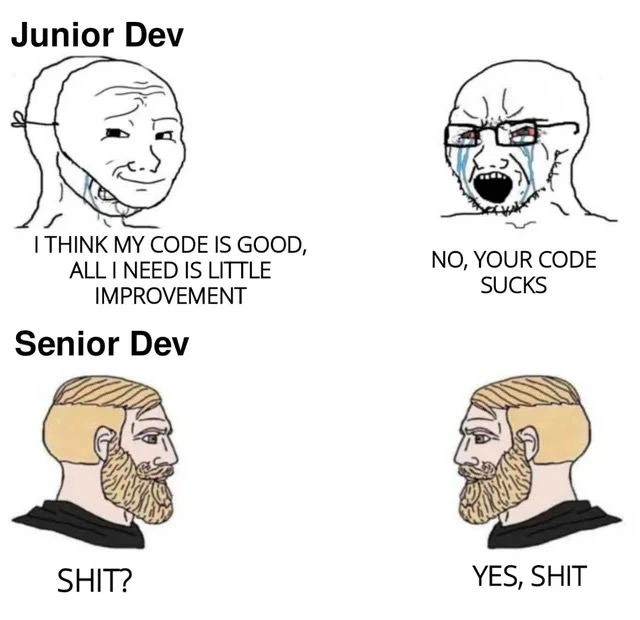
Now, the experience of a code review can be very different for a junior developer versus a senior developer. A junior dev is someone who is relatively new to the field or has less experience working on big, complex systems. When you’re new, getting feedback on your code can feel intense. You might be proud of what you wrote and think, “Hey, this is pretty good for the most part, maybe just polish a tiny bit.” That’s exactly what the top-left character (the Wojak with the hopeful expression) is saying: “I THINK MY CODE IS GOOD, ALL I NEED IS LITTLE IMPROVEMENT.” This reflects the junior’s expectation that any critique will be minor tweaks. Often juniors haven’t yet seen all the edge cases or potential pitfalls, so they might not realize bigger issues are lurking. They also might be a bit protective of their code – it’s hard not to take critique personally when you’re just starting out.

The other character in the top panel (Wojak with the angry, crying face) responds, “NO, YOUR CODE SUCKS.” This is a very blunt and non-constructive piece of feedback – basically an outright “this is bad” with no sugarcoating. In a real code review, a colleague ideally wouldn’t phrase things this harshly (good reviewers give specific reasons and suggestions). But the meme is exaggerating to make a point: from the junior’s perspective, even slightly harsh feedback can feel as extreme as “your work is awful.” The phrase “your code sucks” here stands in for all the pain and shock a newbie might experience when a reviewer points out a lot of problems. It’s a memetic way to depict the worst-case code review for a junior: they expected maybe a pat on the back and a couple nit-picks, but instead they got a bucket of cold water dumped on their pride. This is a huge culture shock for someone new to professional coding environments. It highlights one of the CodeReviewPainPoints – how to handle criticism and not take it as a personal attack.

Now look at the bottom panel, labeled “Senior Dev.” Both of the figures here are the Chad meme character (distinguished by the chiseled jawline, confident posture, and blond beard). Chad is often used in memes to represent someone who is ultra-competent, confident, and unfazed. So two Chads facing each other implies two experienced, self-assured individuals. One says just “SHIT?” and the other replies “YES, SHIT.” They’re talking about the code using only the single word “shit” – essentially one asks “Is this code garbage/bad?” and the other says “Yep, totally bad.” It’s a one-word consensus. That might look bizarre or overly rude, but in the context of two senior devs who trust each other, it can be a kind of humorous shorthand. Senior developers have usually seen a lot of bad code in their career (including code they themselves wrote years ago!), so they’re not overly dramatic about it. If something is poorly written or not up to standards, they’ll acknowledge it plainly. They’ve also learned not to tie their personal worth to any single piece of code – code can be good, bad, or ugly, and calling code “shit” doesn’t mean you are shit. This separation of self from code is part of developing a thick skin as an engineer. It lets senior folks exchange frank, succinct feedback without anyone getting upset. In fact, many senior engineers appreciate direct feedback because it saves time. Rather than dancing around the issue with a paragraph of polite commentary, a quick “this part is a mess, let’s rework it” gets everyone on the same page faster. The meme’s bottom dialogue is an extreme caricature of that brevity. It’s funny because it reduces an entire code review discussion (“What do you think of this code?” “I think it’s pretty bad, we shouldn’t approve it as is.” “Agreed, it’s quite bad.”) into two words: “Shit?” “Shit.”

In real-world teams, code review comments ideally strike a balance – clear and honest, but also respectful and specific. For example, instead of saying “Your code sucks,” a reviewer might say, “This function is really hard to follow and will be difficult to maintain. Could you refactor it using smaller helper functions? Also, watch out for the null pointer case.” That’s constructive. Early-career developers sometimes do encounter gruff feedback, but most workplaces encourage a culture of being respectful (especially to help juniors learn). However, among seniors who know each other well, a bit of blunt humor is not uncommon. They might chuckle and say “yeah this part is crap” in conversation, even if in the code review tool they’d write a more helpful comment. The meme plays on that behind-the-scenes candor. It’s an inside joke on RelatableDeveloperExperience: as you gain experience, you start to find blunt assessments oddly refreshing, and you realize that when a teammate says something you wrote is “shit”, it’s not the end of the world — it’s often true (we’ve all written some real stinkers), and now you’ll go fix it. In other words, junior vs senior developers have a totally different emotional response and communication style during reviews. The junior phase involves a lot of learning to accept criticism and analyzing every comment in detail, whereas the senior phase often involves quick pattern recognition (“we’ve seen this kind of bad code before”) and shorthand speech. The meme humorously compresses that whole journey into two panels of text. It’s funny and a bit absurd, but it resonates because it caricatures a real progression many devs experience in their career.

Level 3: Blunt Force Code Review

From an experienced developer’s perspective, this meme nails a classic CodeReview culture clash. It humorously contrasts the verbose, ego-sensitive feedback often seen with Juniors against the terse, no-nonsense shorthand that Senior developers use once they’ve been battle-hardened by enough deployments and midnight bug hunts. The top half (“Junior Dev”) features the shaky Wojak characters delivering a drawn-out, emotionally fraught code review exchange. The junior author timidly says “I think my code is good, all I need is a little improvement,” seeking validation or at least gentle guidance. The reviewer’s response — “No, your code sucks” — comes off as an overly harsh slap-down. This is the polite nit-picks phase gone horribly wrong: instead of constructive criticism, the junior gets blunt rejection. It’s an exaggerated take on CodeReviewPainPoints that many of us recognize. Early in our careers, getting feedback on our code can feel like a personal attack. A line like “your code sucks” can sting because, to a newbie, their code quality is tangled up with their self-esteem. The meme captures that shared pain: every developer remembers the first time a reviewer basically said “nope, this won’t fly” and how our younger self either got defensive or wanted to crawl under a rock.

Now compare that to the bottom half (“Senior Dev”), with the iconic side-profile Chad characters. Here we have two confident, stoic figures who waste no words. One simply asks “SHIT?” and the other immediately confirms “YES, SHIT.” It’s jarring how blunt and minimal this dialogue is — and that’s exactly why it’s funny. These Chads represent senior engineers who have worked together long enough to develop a kind of telepathy (or at least a very blunt dialect). They’ve done hundreds of code reviews over the years, seen every flavor of spaghetti code and WTFs per minute, and they no longer bother with the formalities or sugarcoating. If code is bad, they’ll call it bad with a single syllable. And crucially, no one’s feelings get hurt. There’s a mutual understanding that calling the code “shit” is not an insult to the person who wrote it, but just an efficient, almost affectionate, way of saying “let’s not ship this; it needs work.” In senior engineer land, calling a piece of code “complete garbage” can oddly be a sign of respect — it means the reviewer trusts that the author’s ego can handle the truth and they can get straight to fixing things. It’s like a shared dark humor: “Haha, this module is a hot mess, right?”“Oh absolutely, total dumpster fire. Let’s rewrite it.” Both laugh, roll up their sleeves, and improve the code without any HR interventions.

The humor in this contrast comes from how relatable it is across the developer experience spectrum. We’ve all seen the transformation: in the beginning, code reviews feel like a meticulous grammar class with a lot of red ink and fragile emotions. Every comment is carefully phrased (“nit: maybe consider renaming this variable, just a suggestion 😊”) and every criticism might come with a compliment sandwich to not demoralize the junior dev. But by the time you’re a senior, code reviews often turn into short, brutally honest exchanges like a pair of grumpy mechanics grunting at a broken engine. The meme’s chad_vs_wojak_format perfectly exaggerates this: Wojak (with tears and shaky lines) embodies the anxious, argumentative junior phase where a review might devolve into a defensive back-and-forth, whereas Chad (strong jaw, confident) embodies the seasoned pros who communicate at a glance. One might say the seniors have developed thick skin and a sense of efficiency – why write ten comments politely dancing around the issue when a single “This is crap, redo it” conveys the message and everyone understands it? It’s blunt code feedback distilled to its purest form.

There’s also an industry in-joke here about how much context senior devs share. Seasoned teammates often have a long history of shared codebase pain. They’ve been in the trenches together, perhaps stayed up at 3 AM refactoring some awful legacy module. That kind of camaraderie builds trust – and a certain cynical frankness. They know that a bad commit can set the on-call pager off at midnight, so they’d rather be candid now than sorry later. In a way, the seniors in the meme demonstrate what in agile parlance might be called “fail fast” feedback: identify the failure (bad code) instantly and move on. As a senior, you learn it’s better to hurt the code’s feelings by calling it out than to let that code hurt you in production. 🤷‍♂️ When someone says “Shit?” and you nod “Yes, shit,” it’s almost therapeutic – you’ve instantly achieved consensus that there’s a problem, and now you can join forces to fix it. No ego, no lengthy debate, just instant consensus on quality (or lack thereof). It’s a brutally efficient feedback loop that takes years of trust and experience to cultivate.

In summary, the meme exaggerates two ends of the spectrum in code review culture for comedic effect. On one end, inexperienced devs either tip-toe around feedback or react defensively (lots of talking, little agreement). On the other end, veteran devs cut straight to the chase with almost comical brevity (almost no talking, instant agreement). It’s funny because it’s true to life – once you’ve been on both sides, you recognize the evolution from “please be gentle, I tried really hard” to “give it to me straight, I can take it.” The DeveloperHumor here is that we’re laughing both at our younger selves (oh, the drama over a code review comment!) and admiring the unvarnished efficiency some teams achieve after years of shared pain and working together. It’s a reminder that behind the gruff one-word confirmation “shit,” there’s actually a lot of hard-earned understanding.

Level 4: Single-Roundtrip Consensus

At the most theoretical level, the Senior Dev exchange in this meme resembles an ultra-efficient distributed consensus protocol between two highly-synchronized nodes. One senior proposes a single-bit of information — essentially “Is this code garbage?” — and the other node immediately acknowledges with a matching verdict. In distributed systems theory, reaching agreement usually demands multiple phases of communication (think of the multi-round handshakes in Paxos or Raft). Here, by contrast, these two veteran engineers achieve consensus in just one request-response round trip. It’s as if they’ve implemented a custom one-phase commit: the first Chad offers a value (“SHIT?”) and the second Chad responds in kind (“YES, SHIT”) without any further negotiation. The decision about code quality is final after only two messages – a constant-time consensus!

This nearly frictionless agreement is possible because both “nodes” share the same protocol and context for evaluating code. They have a pre-established schema of what constitutes terrible code, so no lengthy data exchange is needed to explain why the code is bad. It’s analogous to two servers that already know the format of a message and trust each other, allowing them to converge on a state with minimal bandwidth. The seniors’ blunt code review dialog is effectively a high-bandwidth signal condensed into a single word. In networking terms, it’s like sending a single UDP packet with the payload “💩?” and immediately getting “💩!” back – an instant acknowledgement of the code’s state. The latency between code submission and shared understanding is hilariously low.

Meanwhile, the Junior Dev panel is more like a failed consensus attempt with lots of packet loss and retries. The junior author starts with a different initial value (“I THINK MY CODE IS GOOD, ALL I NEED IS LITTLE IMPROVEMENT”), while the reviewer’s response (“NO, YOUR CODE SUCKS”) is a conflicting proposal. They haven’t agreed on the value of the code; there’s no quorum or common ground yet. In a distributed systems analogy, it’s like two servers exchanging gibberish because they haven’t agreed on a protocol – one speaks in hopeful euphemisms, the other in brutal truth, and the messages collide. Achieving consistency (i.e., a shared view of the code’s quality) would require multiple rounds of clarification, maybe involvement of a leader node (like a more experienced dev or team lead) to mediate. The humor here is that the seniors short-circuit all that verbosity and negotiation. They act like a tightly coupled cluster that reached agreement on “this code is trash” with virtually zero overhead, whereas the juniors are stuck in a noisy, emotionally-charged consensus protocol that’s going nowhere fast. In essence, the meme encodes a distributed consensus joke: the seasoned engineers have optimized their “algorithm” for code review feedback to be as terse and fault-tolerant as possible (neither will be offended by the harsh truth), while juniors are bogged down by high latency, dropped messages (hurt feelings), and mismatched expectations.

Description

Four-panel Wojak/Chad meme. Top header reads "Junior Dev" above two shaky line-art Wojak heads (faces pixelated). Left Wojak caption: "I THINK MY CODE IS GOOD, ALL I NEED IS LITTLE IMPROVEMENT." Right Wojak reply: "NO, YOUR CODE SUCKS." Bottom header reads "Senior Dev" above two stoic, side-profile Chad drawings with blond hair and beards facing each other. Left Chad asks "SHIT?" and right Chad answers "YES, SHIT." The joke contrasts a drawn-out, ego-laden junior code review with the terse, mutually understood bluntness of seasoned engineers, highlighting how experience compresses feedback cycles (and diplomacy) down to a single-word consensus

Comments

6
Anonymous ★ Top Pick Two seniors achieving one-word agreement - finally, a consensus algorithm that converges under full Byzantine snark
  1. Anonymous ★ Top Pick

    Two seniors achieving one-word agreement - finally, a consensus algorithm that converges under full Byzantine snark

  2. Anonymous

    The real senior developer moment isn't when you stop writing bad code - it's when you develop the existential awareness that all code is technical debt in disguise, and the only difference between junior and senior is how quickly you can smell your own garbage before it hits production

  3. Anonymous

    The real senior move isn't writing perfect code - it's having the battle scars to instantly recognize when you've architected yourself into a corner at 2 AM, shipped it anyway because deadlines, and can now calmly acknowledge 'yes, this is indeed shit' without your ego shattering. Junior devs defend their code like it's their firstborn; seniors know every codebase is just technical debt with a launch date

  4. Anonymous

    Senior review rubric at scale: 1) Is it bad? 2) Will the blast radius stay behind a feature flag until Q3? If yes, LGTM

  5. Anonymous

    Juniors see 'minor tweaks'; seniors see 'excavation site for buried tech debt'

  6. Anonymous

    Seniority is when your PR comments collapse from bikeshedding to one question: can we hide this behind a feature flag until the strangler fig refactor lands?

Use J and K for navigation